Manufacturing welders form the backbone of industrial production across the Western United States, particularly in sectors like oil and gas, aggregate processing, and recycling operations. These skilled professionals combine technical expertise with precision craftsmanship to create everything from structural steel components to custom fabrication projects. Understanding the role, requirements, and safety considerations for manufacturing welders is essential for businesses seeking to maintain competitive operations and deliver high-quality results.
The Critical Role of Manufacturing Welders in Industrial Operations
Manufacturing welders represent far more than workers who join metal together. They serve as problem solvers, quality controllers, and safety advocates within production environments. In commercial and industrial settings, these professionals must interpret engineering drawings, select appropriate welding processes, and execute complex joins that meet stringent industry specifications.
Key responsibilities include:
- Reading and interpreting blueprints, technical drawings, and welding symbols
- Selecting proper welding techniques based on material composition and project requirements
- Operating various welding equipment including MIG, TIG, stick, and flux-core systems
- Conducting visual inspections and quality checks on completed welds
- Maintaining equipment and ensuring proper function of welding machinery
The demand for skilled manufacturing welders continues to grow as industries expand throughout Colorado and neighboring states. Manufacturing and machining operations require welders who can adapt to different materials, positions, and specifications while maintaining consistent quality standards.
Essential Certifications and Training Requirements
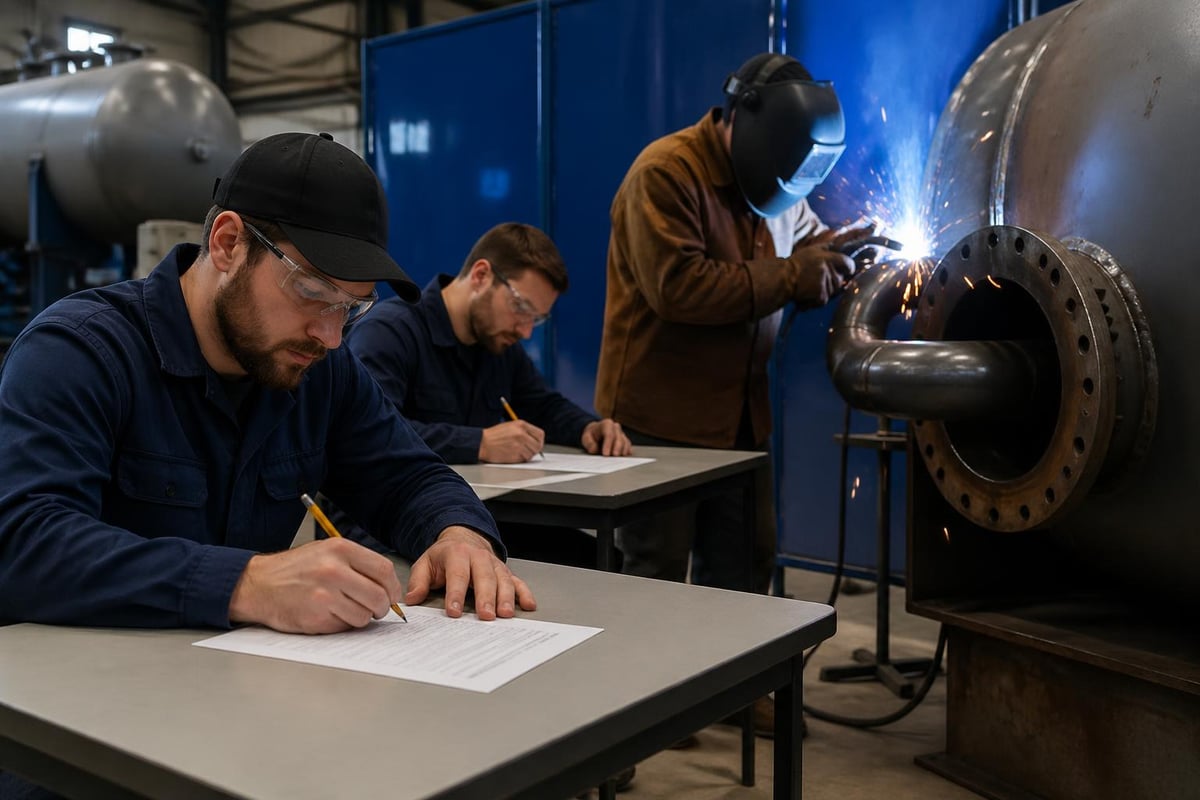
Professional manufacturing welders must acquire specific certifications to work on commercial and industrial projects. The American Welding Society (AWS) provides standardized certification programs that validate a welder's competency in specific processes and positions. Businesses investing in welding and fabrication services should verify that their welders hold current certifications appropriate for the work being performed.
| Certification Type | Application | Renewal Period |
|---|---|---|
| AWS D1.1 Structural | Building construction, bridges, structural steel | 6 months |
| ASME Section IX | Pressure vessels, boilers, piping systems | Varies by employer |
| AWS D1.6 Stainless Steel | Food processing equipment, pharmaceutical facilities | 6 months |
| API 1104 Pipeline | Oil and gas pipelines, transmission systems | Annual |
Ongoing training ensures manufacturing welders stay current with evolving technologies and safety protocols. Many fabrication welding shops invest in continuous education programs that cover new welding processes, metallurgy updates, and advanced inspection techniques.
Safety Standards and Workplace Hazard Management
Safety remains the paramount concern in any welding operation. Manufacturing welders face multiple hazards daily, including extreme heat, toxic fumes, electrical shock, and ultraviolet radiation exposure. Understanding and implementing proper safety measures for welders protects both personnel and business operations from costly accidents and regulatory violations.
Personal Protective Equipment Requirements
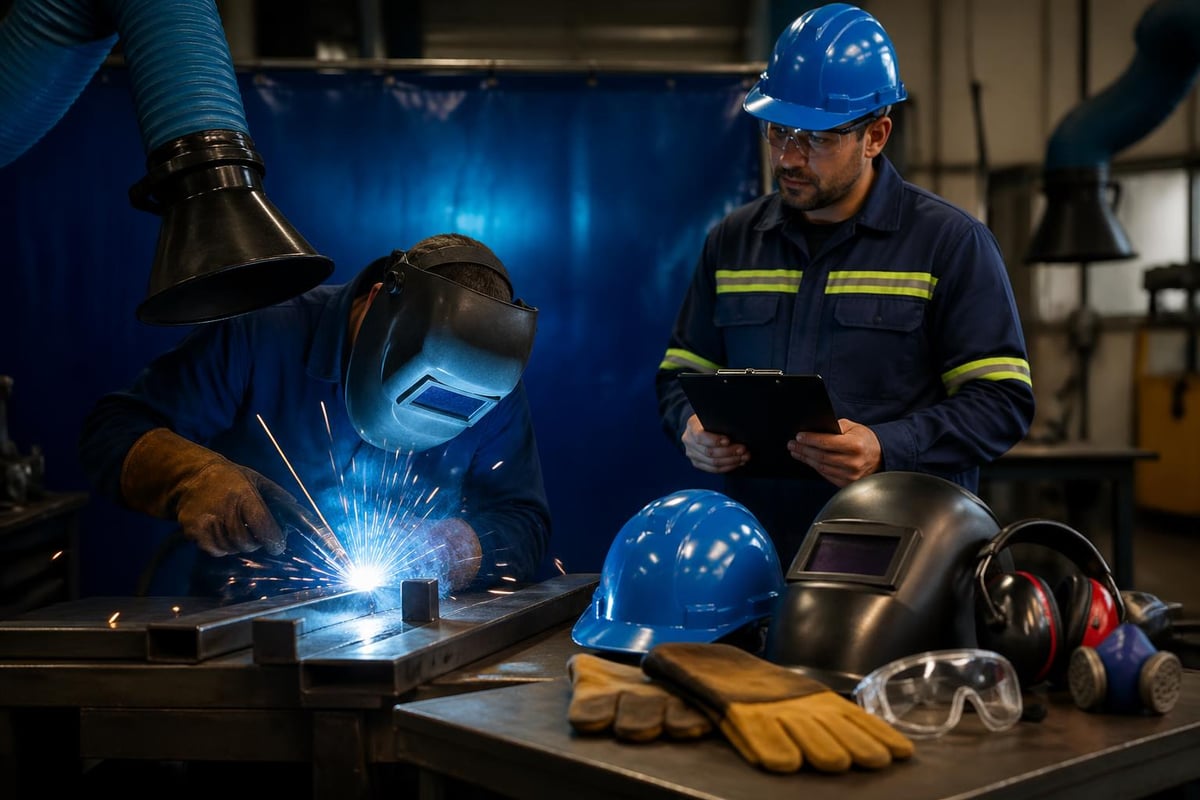
Proper PPE forms the first line of defense against welding hazards. Manufacturing welders must wear appropriate equipment for each specific task and environment.
Essential PPE includes:
- Auto-darkening welding helmets with appropriate shade ratings (typically shade 10-13)
- Flame-resistant clothing made from leather or treated cotton
- Welding gloves with adequate insulation and dexterity
- Steel-toed boots with metatarsal guards
- Respiratory protection when working with materials producing toxic fumes
The Occupational Safety and Health Administration establishes clear guidelines for welding operations. Businesses should familiarize themselves with strategies to avoid welding hazards and implement comprehensive safety programs that exceed minimum compliance requirements.
Ventilation and Fume Control Systems
Welding fumes contain potentially harmful metal oxides and gases that pose serious health risks. Manufacturing welders working in enclosed spaces or on materials like galvanized steel, stainless steel, or painted metals face heightened exposure risks. Proper ventilation systems remove these contaminants before they accumulate to dangerous levels.
Modern industrial manufacturing facilities implement multiple ventilation strategies including local exhaust systems, downdraft tables, and general area ventilation. Mobile fume extractors provide flexibility for field work and temporary setups where permanent systems aren't practical.
Welding Process Selection and Technical Expertise
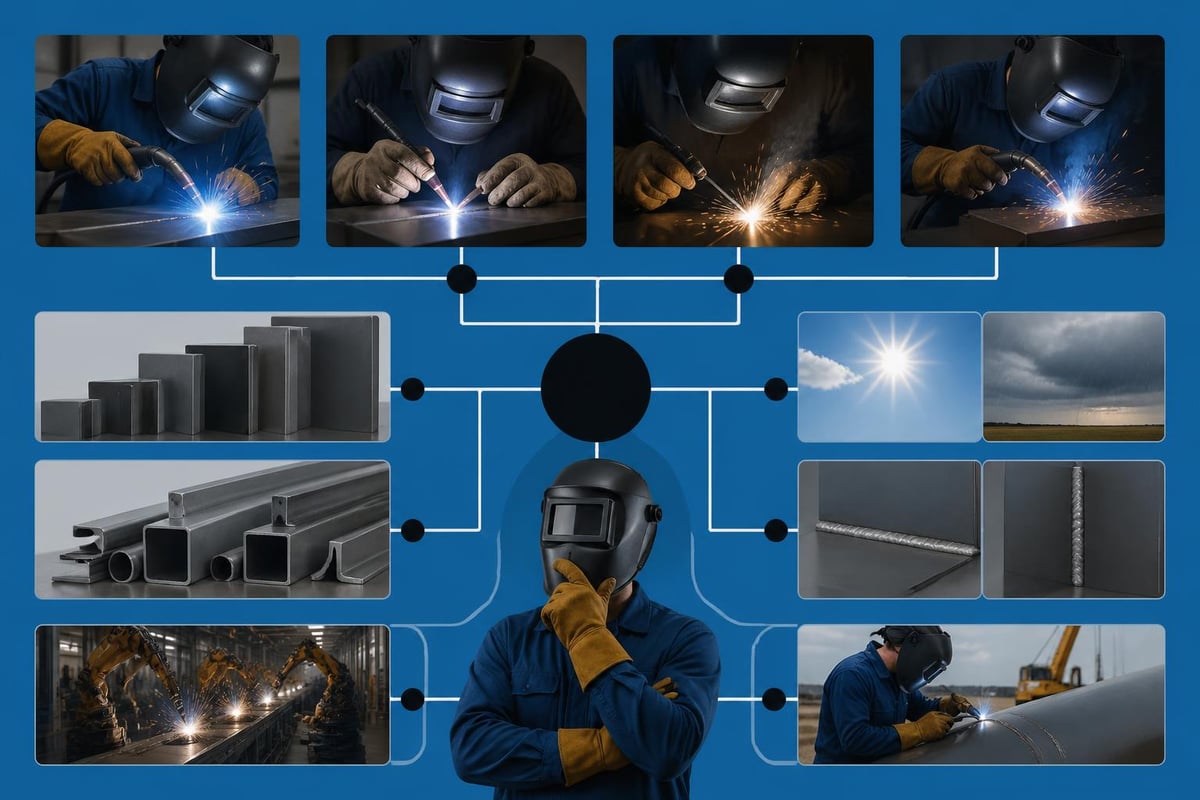
Manufacturing welders must master multiple welding processes to handle diverse project requirements. Each process offers distinct advantages depending on material type, thickness, position, and environmental conditions. The ability to select and execute the optimal process separates competent welders from truly exceptional craftspeople.
Common Welding Processes in Manufacturing
| Process | Best Applications | Advantages | Limitations |
|---|---|---|---|
| MIG (GMAW) | High-volume production, sheet metal | Fast, easy to learn, versatile | Requires shielding gas, limited outdoor use |
| TIG (GTAW) | Precision work, thin materials, stainless steel | Excellent quality, clean welds | Slower, requires high skill level |
| Stick (SMAW) | Field repairs, thick materials, outdoor work | Portable, works in wind, no shielding gas needed | Slower, produces slag |
| Flux-Core (FCAW) | Structural steel, heavy fabrication | High deposition rates, deep penetration | Produces more spatter, requires cleanup |
Understanding welding process standards helps manufacturing welders maintain consistency and quality across projects. These international frameworks provide guidelines for optimizing productivity while ensuring safety and structural integrity.
Material Considerations and Metallurgy Knowledge
Different metals require specific approaches to achieve strong, defect-free welds. Manufacturing welders working on custom metal fabrication projects must understand how various materials respond to heat input, filler metal selection, and post-weld treatment.
Common materials and considerations:
- Carbon steel: Most forgiving material, accepts various processes, requires minimal preheat below 1/2 inch thickness
- Stainless steel: Requires lower heat input, benefits from back purging, specific filler metal selection critical
- Aluminum: Demands cleanliness, requires AC current for TIG, susceptible to porosity and cracking
- Cast iron: Needs careful preheat and controlled cooling, special nickel-based filler metals often required
Experienced manufacturing welders develop intuitive understanding of how materials behave under different welding conditions. This expertise proves invaluable when troubleshooting weld defects or adapting procedures for unique applications.
Quality Control and Inspection Procedures
Manufacturing welders share responsibility for quality assurance throughout the fabrication process. While dedicated inspectors may perform final verification, welders conduct continuous self-inspection to identify and correct issues before they become costly problems. Welding businesses that emphasize quality control during production achieve better outcomes than those relying solely on final inspection.
Visual Inspection Techniques
Visual examination remains the most fundamental and frequently used inspection method. Manufacturing welders trained in proper visual inspection can identify most common weld defects including porosity, undercut, overlap, incomplete penetration, and excessive reinforcement.
Inspection checklist for manufacturing welders:
- Before welding: Verify joint preparation, fit-up, cleanliness, and preheat requirements
- During welding: Monitor bead appearance, listen for process irregularities, maintain proper technique
- Between passes: Remove slag completely, inspect for cracks or defects, ensure proper interpass temperature
- After completion: Verify weld size, check for surface defects, confirm dimensional requirements
Advanced inspection methods including ultrasonic testing, radiographic examination, and magnetic particle inspection require specialized training. However, manufacturing welders should understand when these methods apply and what defects they detect.
Field Welding Versus Shop Environment Considerations
Manufacturing welders often work in both controlled shop environments and challenging field conditions. Each setting presents unique demands that require different skills, equipment, and approaches. Success in both environments demonstrates versatility and adaptability that manufacturing projects frequently require.
Shop Welding Advantages and Practices
Controlled shop environments offer manufacturing welders optimal conditions for producing high-quality work. Temperature control, overhead cranes for positioning, adequate lighting, and proximity to support equipment create ideal circumstances for precision fabrication.
Shop welders typically achieve higher productivity through specialized workstation setups, readily available consumables, and access to advanced equipment. Metal fabrication manufacturing facilities invest in automation, positioners, and jigs that enhance both quality and efficiency for repetitive operations.
Field Welding Challenges and Solutions
Field conditions test a manufacturing welder's problem-solving abilities and technical skills. Wind, rain, temperature extremes, awkward positions, and limited access complicate even straightforward welding tasks. Successful field welders prepare thoroughly and adapt techniques to overcome environmental challenges.
Field welding best practices:
- Select processes suitable for outdoor conditions (stick or flux-core rather than MIG)
- Establish proper grounding and ensure electrical safety in varied locations
- Use windbreaks and shelters to protect the weld pool from atmospheric contamination
- Maintain preheat temperature in cold weather through insulation and additional heat sources
- Plan material staging and equipment access before beginning work
The ability to deliver consistent quality regardless of location distinguishes exceptional manufacturing welders from average performers. Businesses operating across the Western United States particularly value welders comfortable working in remote locations with minimal support.
Career Development and Advancement Opportunities
Manufacturing welders who continuously develop their skills find numerous advancement opportunities within industrial sectors. Career progression extends beyond simply improving welding technique to encompass leadership, specialized certifications, and broader fabrication knowledge.
Skill Specialization Paths
Experienced manufacturing welders often pursue specialization in high-demand areas that command premium compensation. Pipe welding, underwater welding, aerospace welding, and pressure vessel fabrication represent specialized fields requiring additional training and certification.
Some welders transition into inspection and quality control roles, becoming Certified Welding Inspectors (CWI) through the American Welding Society. Others develop expertise in welding engineering, procedure development, or training roles that leverage their practical experience.
Integration with Related Trades
Modern manufacturing increasingly values cross-trained professionals who understand multiple aspects of fabrication. Manufacturing welders who develop competency in machining, fitting, rigging, or hydraulics become more valuable to employers and expand their career options.
Machining and fabrication operations particularly benefit from employees who can seamlessly transition between processes. Understanding how welding integrates with cutting, forming, and machining operations enables better project planning and problem solving.
Technology Integration and Industry 4.0 Impact
Manufacturing welders today work alongside advancing technologies that enhance productivity and quality. Robotic welding systems, augmented reality guidance, and digital documentation systems transform traditional fabrication environments. Rather than replacing skilled welders, these technologies augment human capabilities and create new opportunities for tech-savvy professionals.
Collaborative Robotics and Human-Machine Interaction
Welding robots excel at repetitive tasks in controlled environments, but manufacturing welders remain essential for complex geometries, field work, and adaptive problem-solving. Research into improving welding robotization through operator skill identification demonstrates how human expertise and machine precision can combine for optimal results.
Progressive manufacturing welders embrace technology as a tool that enhances their capabilities rather than viewing it as a threat. Understanding robot programming, fixture design, and automated system troubleshooting creates competitive advantages in modern fabrication environments.
Workforce Development and Training Programs
The welding industry faces ongoing workforce challenges as experienced manufacturing welders retire and demand for skilled workers continues growing. Businesses throughout Colorado and the Western United States compete for qualified welders, making effective recruitment and training programs essential for operational success.
Apprenticeship and On-the-Job Training
Structured apprenticeship programs combine classroom instruction with supervised hands-on experience, producing well-rounded manufacturing welders who understand both theory and practice. These programs typically span two to four years, progressively building competency across multiple processes and applications.
Effective training program components:
- Foundational metallurgy and welding theory instruction
- Supervised practice in multiple welding processes
- Blueprint reading and technical documentation interpretation
- Safety training and hazard recognition
- Quality control and inspection procedures
- Real-world project experience under journeyman supervision
Businesses investing in comprehensive training programs develop loyal, skilled workforces while addressing chronic labor shortages. The initial investment in education pays dividends through improved quality, reduced rework, and enhanced safety performance.
Regulatory Compliance and Industry Standards
Manufacturing welders work within a complex regulatory environment that balances safety, quality, and productivity requirements. Understanding applicable codes, standards, and regulations ensures compliance while protecting workers and end-users of fabricated products.
Critical Standards and Codes
Different industries and applications require adherence to specific welding standards. Manufacturing welders must identify which codes apply to their work and understand the requirements those standards impose.
| Standard | Application Area | Key Requirements |
|---|---|---|
| AWS D1.1 | Structural steel welding | Prequalified joint details, welder qualification, inspection criteria |
| ASME Section IX | Pressure equipment | Procedure qualification records, performance qualification tests |
| API 1104 | Pipeline construction | Specific testing requirements, acceptance criteria for defects |
| AWS D1.6 | Stainless steel structures | Procedures for maintaining corrosion resistance |
Maintaining compliance requires documentation, testing, and ongoing verification. Industrial and manufacturing operations typically maintain detailed records of welder qualifications, procedure specifications, and inspection results to demonstrate regulatory adherence.
Best Practices for Safety Compliance
Beyond meeting minimum regulatory requirements, leading fabrication operations implement best practices for welding safety that create cultures of continuous improvement. Regular safety meetings, hazard assessments, and incident investigation processes identify risks before accidents occur.
Manufacturing welders play active roles in safety programs through participation in committees, reporting near-misses, and suggesting improvements based on frontline experience. This collaborative approach produces safer workplaces and demonstrates commitment to worker wellbeing.
Economic Impact and Industry Outlook
The manufacturing welding profession continues evolving in response to economic conditions, technological advances, and changing industry demands. Understanding these trends helps both businesses and individual welders prepare for future opportunities and challenges.
Market Demand Across Industry Sectors
Manufacturing welders find employment across diverse sectors throughout the Western United States. Oil and gas operations, mining equipment fabrication, agricultural machinery manufacturing, and renewable energy infrastructure all require skilled welding professionals.
The aggregate and recycling industries particularly depend on custom welding and fabrication services to maintain and upgrade processing equipment. These sectors experience steady demand for welders capable of working with abrasion-resistant materials and heavy structural components.
High-growth sectors for manufacturing welders:
- Renewable energy infrastructure (wind turbines, solar mounting systems)
- Water treatment and environmental systems
- Food processing and agricultural equipment
- Mining and aggregate processing machinery
- Industrial maintenance and repair services
Geographic location significantly influences demand patterns and compensation levels. Manufacturing welders in remote areas or regions with concentrated industrial activity often command premium wages due to limited labor availability and challenging working conditions.
Manufacturing welders remain indispensable to industrial operations across the Western United States, delivering the specialized skills and expertise that modern fabrication demands. Whether you need precision shop work or field repairs in challenging locations, LTJ Industrial Services provides certified manufacturing welders, comprehensive machining capabilities, and custom fabrication solutions tailored to your commercial or industrial requirements. Our team serves the oil and gas, recycling, and aggregate sectors throughout Colorado and neighboring states with the quality and reliability your operations deserve.