
Global manufacturing is entering a new era, marked by rapid advancements in technology and significant investments across key sectors. From semiconductors to electric vehicles, the pace of transformation is accelerating, creating unprecedented opportunities and challenges.
This article highlights the top 8 most innovative manufacturing projects poised to reshape entire industries by 2026. These manufacturing projects incorporate breakthrough technologies, span diverse sectors, and promise a profound impact on sustainability, automation, and economic growth.
Discover how these developments in semiconductors, EVs, batteries, data centers, solar, and more are set to influence industry professionals, investors, and policymakers. Stay informed to capture emerging opportunities as these projects redefine the global manufacturing landscape.
The 2026 Manufacturing Landscape: Trends and Drivers
The global surge in manufacturing projects is transforming the industrial landscape at an unprecedented pace. In 2026, several key trends are shaping which innovations will lead and how companies invest for the future. Understanding these drivers is essential for anyone involved in manufacturing projects, from C-suite leaders to policymakers and investors.
Technology and Digitalization
The expansion of Industry 4.0 is revolutionizing how manufacturing projects operate. Facilities now integrate AI, IoT, and automation to boost productivity and streamline processes. Smart manufacturing relies on collaborative robots, advanced analytics, and real-time data to optimize every aspect of production.
Investments in US manufacturing have exceeded $86 billion since the Inflation Reduction Act, signaling digitalization as a competitive necessity. According to Industry 4.0 market growth statistics, IoT and AI are rapidly transforming manufacturing projects worldwide.
Companies adopting digital solutions gain a vital edge, ensuring efficiency and resilience as technology continues to evolve.
Sustainability and Clean Energy
Sustainability is now a central pillar of manufacturing projects. Companies are pivoting toward renewable energy, low-carbon processes, and green investments in battery, solar, and EV facilities. Major solar and battery gigafactories in North America symbolize this shift.
In Q1 2023 alone, $33 billion was invested in US automotive and EV projects, reflecting both regulatory and market-driven forces. Manufacturing projects that prioritize sustainability not only meet compliance but also attract eco-conscious customers.
These efforts help reduce emissions, lower operating costs, and position companies as leaders in the clean energy transition.
Supply Chain Resilience and Localization
Building resilient and localized supply chains is a top priority for manufacturing projects in 2026. Onshoring and reshoring of critical manufacturing, such as semiconductors and batteries, address global disruptions and geopolitical challenges.
Recent examples include new semiconductor fabs in Utah and New York, designed to ensure steady supply and support national interests. Localizing supply chains reduces risk and enables faster response to market changes.
Manufacturing projects that invest in regional networks can better withstand shocks and contribute to local economic growth.
Workforce and Investment Trends
The success of manufacturing projects depends on skilled labor and robust investment. As advanced technology becomes standard, the need for workforce development intensifies. Public and private sectors are making large-scale investments in training and infrastructure.
For instance, Texas Instruments’ Utah fab marks the state’s largest-ever economic investment. More than 220 online properties now serve over 50 million professionals in the space, highlighting the sector’s growth.
Talent and capital together drive innovation, making workforce strategy a core element of manufacturing projects today.
Top 8 Innovative Manufacturing Projects to Watch in 2026
The year 2026 will mark a turning point for manufacturing projects worldwide, with the most ambitious initiatives reshaping the landscape across multiple sectors. From semiconductors to EVs, batteries, and solar, these projects are more than just infrastructure—they represent the future of industrial growth, sustainability, and regional economic development.
For industry professionals seeking expert perspectives and guidance on upcoming manufacturing projects, the commercial fabrication project guide offers valuable insights into trends and best practices.
1. Texas Instruments $11B Semiconductor Fab, Utah
Texas Instruments is setting a new benchmark for manufacturing projects with its $11 billion semiconductor fab in Utah. This state-of-the-art facility represents the largest economic investment in Utah’s history and is designed to produce 300mm wafers using advanced automation.
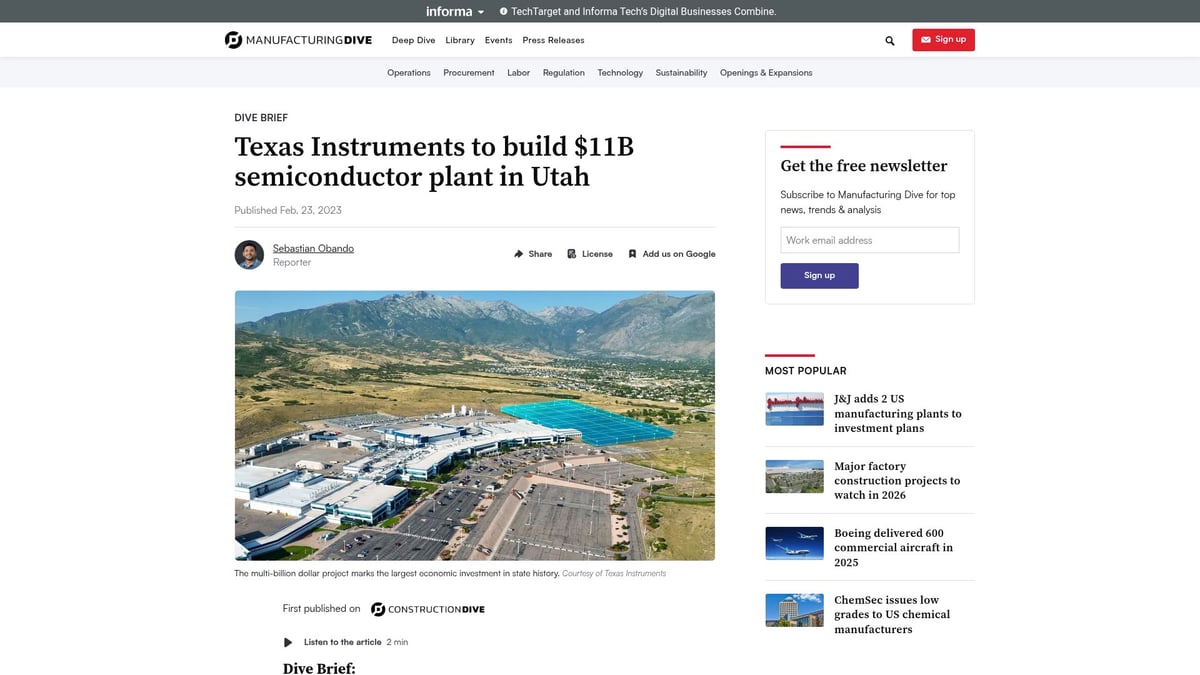
Key features include seamless integration with existing operations, cutting-edge efficiency, and a focus on sustainability. The fab will support US chip independence, create high-skilled jobs, and stimulate the local economy.
| Pros | Cons |
|---|---|
| State-of-the-art automation | High capital expenditure |
| Boosts supply chain resilience | Long build timeline |
| Supports US chip independence |
A unique aspect is the project’s response to global chip shortages that have impacted industries post-pandemic. For tech manufacturers, defense contractors, and automotive leaders, this fab is a game-changer within the manufacturing projects landscape.
2. Northvolt $5B Battery Gigafactory, Quebec
Northvolt’s first North American gigafactory in Quebec is a milestone for battery manufacturing projects. With a $5 billion investment, this facility will produce lithium-ion battery cells for EVs and energy storage, supporting the rapid growth of North America’s EV supply chain.
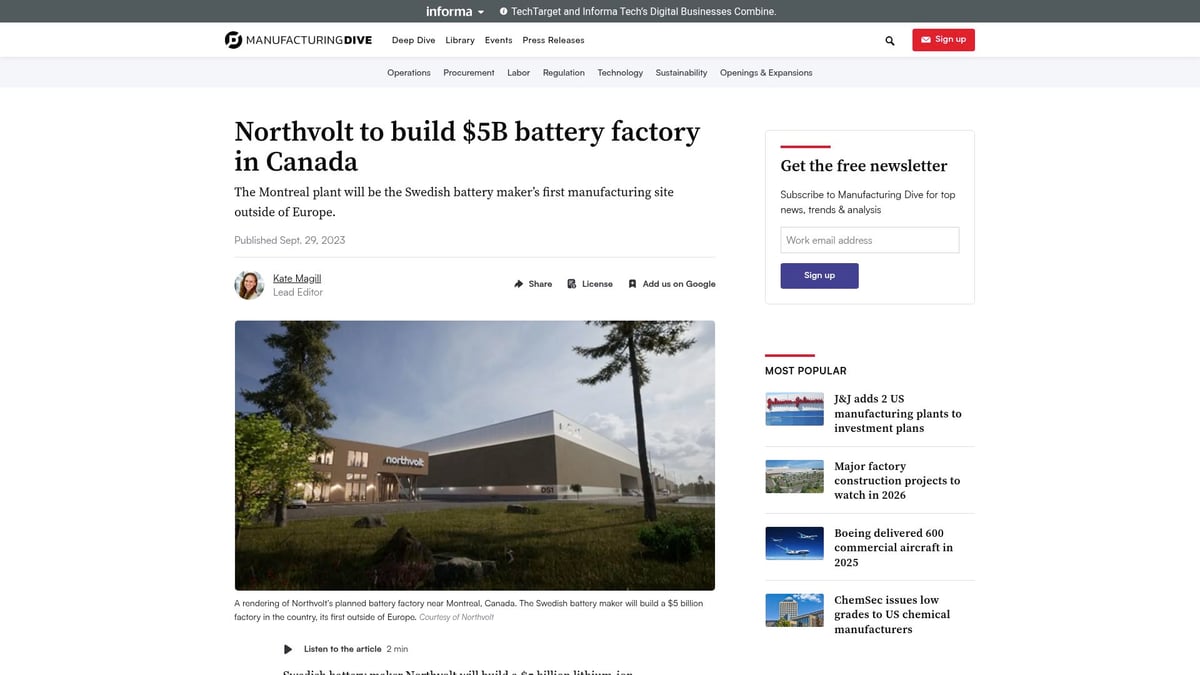
The plant is powered by renewable energy and emphasizes recycling, making it one of the greenest manufacturing projects in the sector. Automotive OEMs and renewable energy developers will benefit from a lower carbon footprint and a reliable regional battery supply.
- Supports green manufacturing and clean energy goals
- Reduces reliance on imports
- High initial costs and evolving battery technologies present challenges
This project is a major step in localizing the EV ecosystem, setting standards for sustainable manufacturing projects.
3. GlobalFoundries $10B Semiconductor Expansion, New York
GlobalFoundries is expanding its New York campus with a $10 billion investment, making it one of the most significant semiconductor manufacturing projects in the US. The expansion will add 633,000 square feet and advanced utility infrastructure focused on silicon-on-insulator chips.
Key benefits include supporting critical sectors like defense, automotive, and data centers. The project leverages government incentives and focuses on advanced node technologies, enhancing the US’s competitive edge in manufacturing projects.
| Feature | Impact |
|---|---|
| Advanced nodes | Supports cutting-edge applications |
| High-tech jobs | Workforce development in high-skill areas |
| Incentives | Government-backed supply chain security |
While the long ROI period and global competition are considerations, this expansion directly addresses supply chain and national security priorities for the manufacturing sector.
4. LG Energy Solution $5.5B Battery Complex, Arizona
LG Energy Solution’s $5.5 billion battery complex in Arizona is the company’s largest US investment to date and a key player among manufacturing projects focused on the EV market. This site will produce both battery cells and modules, supporting the scaling of US EV production.
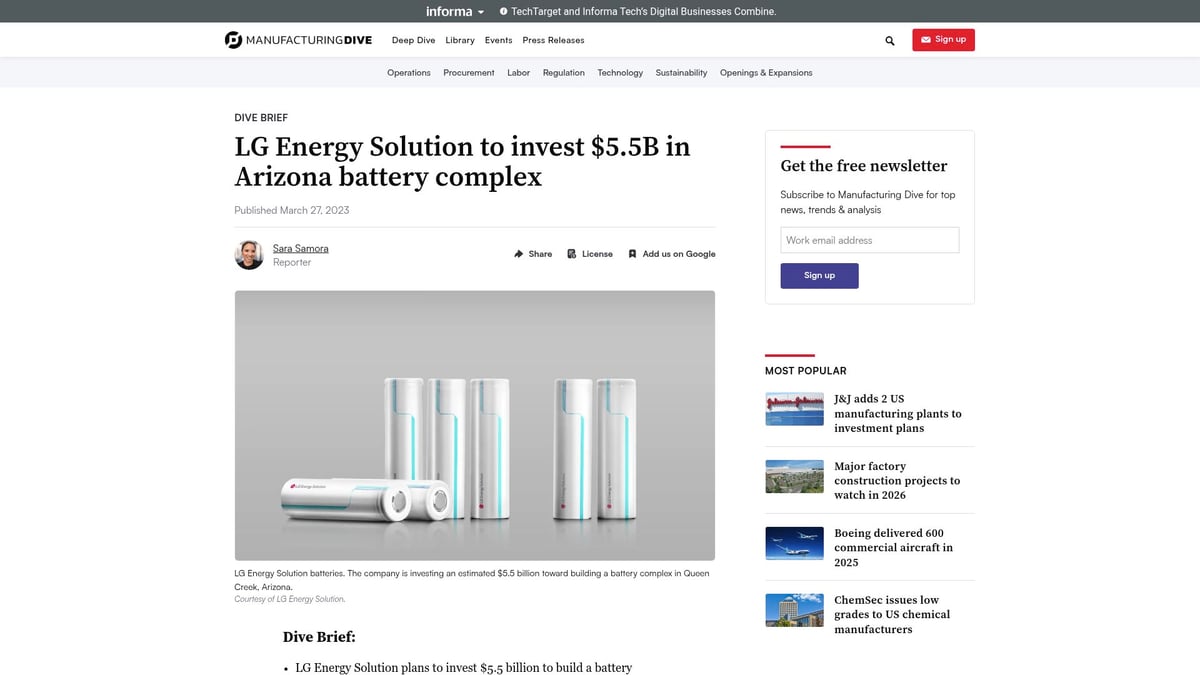
The facility’s advanced manufacturing processes and proximity to major automakers make it strategically vital. The project is also LG’s second site in Arizona, reinforcing the state’s manufacturing ecosystem.
- Pros: Local supply, advanced automation, job creation
- Cons: Market volatility, rapidly changing technology
This complex exemplifies how manufacturing projects can drive regional growth and bolster the US’s position in the global EV race.
5. Meta Platforms Data Center Campus, North Carolina
Meta’s 900,000-square-foot data center campus in North Carolina is a leading example of how manufacturing projects are evolving to support the digital economy. This facility will power Facebook’s global services with high-efficiency cooling and renewable energy sourcing.
What sets this project apart is its modular design and sustainability focus, helping meet the explosive demand for data and AI infrastructure. The data center will also stimulate the regional tech ecosystem and create numerous tech-focused jobs.
| Pros | Cons |
|---|---|
| Energy efficiency | High energy demands |
| Scalability for future growth | Rapid risk of obsolescence |
Meta’s project is a testament to the vital role of manufacturing projects in supporting next-generation cloud computing and AI.
6. Hanwha Q Cells $2.5B Solar Manufacturing Plant, Georgia
Hanwha Q Cells is building the largest solar manufacturing plant in US history with a $2.5 billion investment in Georgia. This vertically integrated facility will handle everything from polysilicon to finished panels, making it a cornerstone of clean energy manufacturing projects.
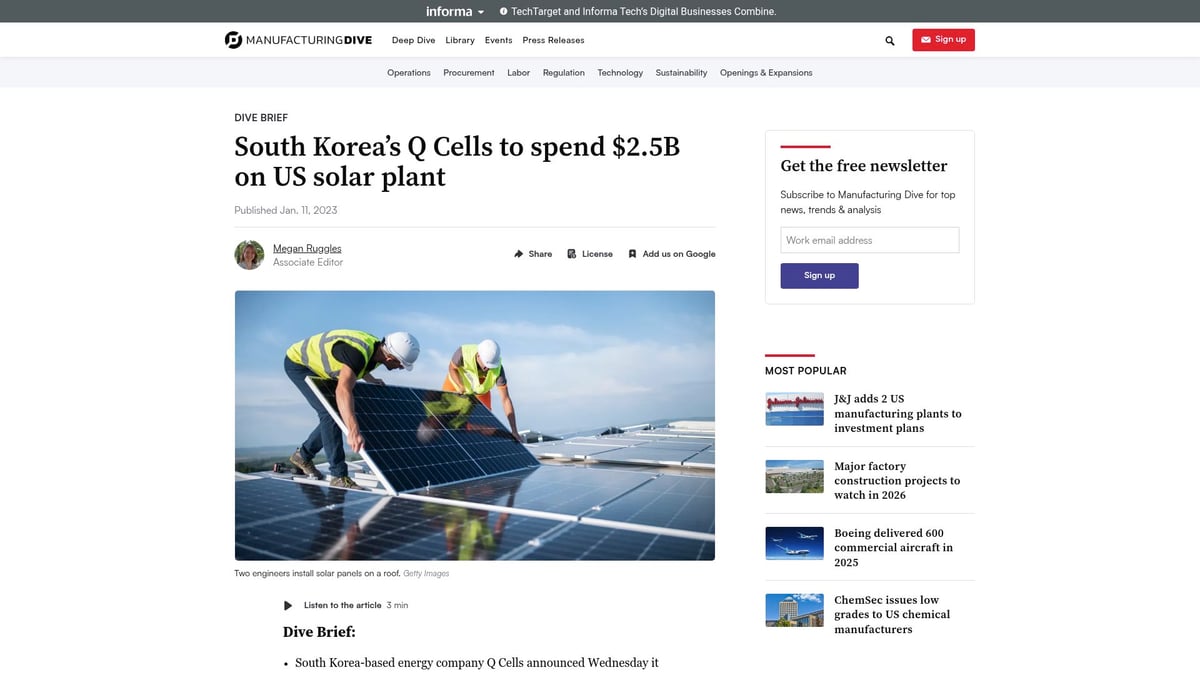
The project reduces reliance on imports and supports federal clean energy objectives. Utilities and commercial solar developers will benefit from a fully US-based supply chain and substantial job creation.
- End-to-end US solar manufacturing
- Supports market expansion and sustainability
- Faces competition from lower-cost imports and evolving solar technology
Hanwha Q Cells’ initiative represents a new era for solar manufacturing projects in the US.
7. Rivian $5B EV and Battery Assembly Plant, Georgia
Rivian’s $5 billion EV and battery assembly plant in Georgia will be one of the most expansive manufacturing projects in the automotive sector. Spanning 19.8 million square feet, the campus will deliver 50 GWh of battery capacity and up to 400,000 EVs annually.
This project will have a transformative impact on US EV manufacturing, supporting consumers, fleet operators, and commercial buyers. It’s also the largest economic development project in Georgia’s history.
| Attribute | Details |
|---|---|
| Integrated production | High output and efficiency |
| Local economic impact | Major job creation |
| Supply chain | Complex but robust |
Intense competition and supply chain complexity are challenges, but Rivian’s investment accelerates US EV adoption and manufacturing projects at scale.
8. Ford $3.5B LFP Battery Plant, Michigan
Ford’s new $3.5 billion LFP battery plant in Michigan focuses on producing cost-effective, durable batteries for mass-market EVs and commercial vehicles. In partnership with CATL, Ford is diversifying battery supply and making affordable EVs more accessible.
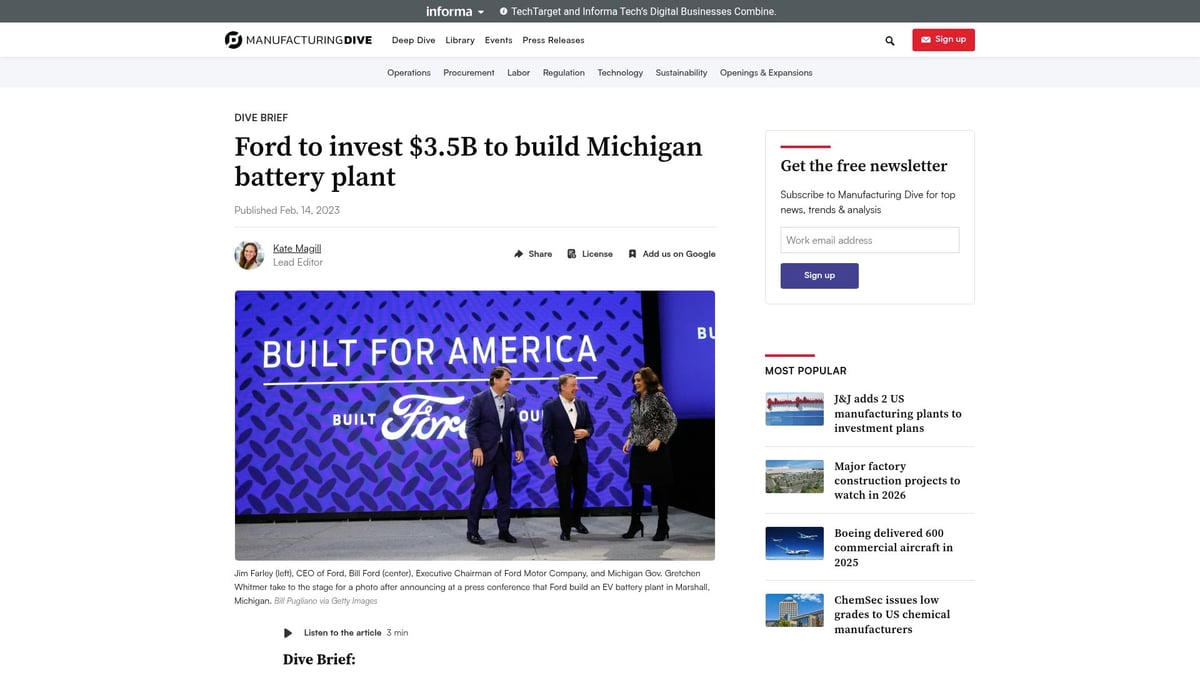
The plant’s unique emphasis on lithium iron phosphate chemistry enhances safety and reduces costs, providing a competitive edge among manufacturing projects aimed at broad market adoption.
- Pros: Lower battery costs, improved safety, supports affordable EVs
- Cons: Technology licensing complexities, uncertain market uptake
Ford’s initiative is a pivotal step toward making EVs mainstream, highlighting the evolving priorities of modern manufacturing projects.
Cross-Sector Impacts and Future Outlook
The wave of innovative manufacturing projects launching in 2026 is set to transform industries far beyond their immediate sectors. These developments are driving regional growth, sustainability leadership, and long-term supply chain resilience. The impacts ripple across communities, economies, and global competition, making it essential for stakeholders to track these shifts closely.
Economic and Workforce Development
Manufacturing projects are fueling significant job creation and skill development in regions like Utah, Georgia, and Michigan. As new facilities open, local economies benefit from both direct employment and secondary business growth. Recent investments have already led to over 50,000 new jobs across the United States, with demand for engineers, technicians, and tradespeople rising.
States are investing in workforce training programs, often partnering with technical schools and universities. These initiatives ensure that communities have the skilled talent needed for advanced manufacturing projects. For professionals and local leaders, understanding these shifts is key to leveraging new opportunities.
Sustainability and Environmental Innovation
Sustainability is at the heart of many manufacturing projects, with companies focusing on renewable energy, recycling, and emissions reduction. Northvolt’s battery facility in Quebec and Q Cells’ solar plant in Georgia exemplify how clean energy manufacturing can dramatically reduce carbon footprints.
The economic impact of clean energy manufacturing is substantial, with billions invested and thousands of jobs created. According to Clean energy manufacturing’s economic impact, these projects are not only environmentally responsible but also pivotal drivers of regional prosperity. For industry professionals, sustainability is now a core metric for project value.
Supply Chain Security and Resilience
Recent disruptions have highlighted the importance of resilient supply chains. Manufacturing projects focused on semiconductors and batteries are bringing critical production back to North America, reducing reliance on overseas suppliers and mitigating risk.
Onshoring efforts supported by government incentives are strengthening regional economies and ensuring that vital components remain accessible. By localizing production, companies can better manage logistics and respond quickly to changing market demands. Supply chain resilience is now a strategic priority for all manufacturing projects.
Technology Transfer and Global Competition
The race for innovation is intensifying, with North America emerging as a global hub for advanced manufacturing. Collaboration between firms, such as Ford’s partnership with CATL and LG’s alliances, accelerates technology transfer and adoption across sectors.
Growing R&D investments are fueling breakthroughs in automation, materials, and digitalization. These efforts give manufacturing projects a competitive edge while positioning the region as a leader in global markets. Staying ahead in this landscape requires constant adaptation and openness to new partnerships.
What to Watch: Key Trends Shaping Manufacturing Projects in 2026
The next wave of manufacturing projects is being shaped by rapid advances in technology, new energy paradigms, evolving policy incentives, and increasing collaboration. Understanding these trends is essential for industry leaders, investors, and policymakers looking to stay ahead. Let us explore the four key forces that will define manufacturing projects in 2026.
Advanced Automation and AI
Automation and AI are transforming manufacturing projects, driving productivity and precision. Robotics, machine learning, and digital twins enable real-time monitoring and predictive maintenance. Collaborative robots (cobots) are working alongside humans, streamlining complex assembly lines.
According to recent studies, AI adoption in manufacturing is rising each year, with more facilities integrating smart sensors and autonomous systems. Research on the Unified Smart Factory Model demonstrates how Industry 4.0 principles can align with sustainability goals, offering a blueprint for next-generation facilities.
These innovations help manufacturers reduce downtime, improve quality, and make data-driven decisions for long-term competitiveness.
Energy Transition and Electrification
A powerful shift toward electrification is fueling investments in battery, EV, and solar manufacturing projects. Facilities are being designed to support renewable energy, from massive battery gigafactories to vertically integrated solar panel plants.
In 2023 alone, US automotive and EV manufacturing projects attracted $33 billion in new investment. This focus on clean energy not only reduces carbon emissions but also positions North America as a leader in sustainable industrial production.
For companies, embracing electrification means access to new markets and compliance with tightening environmental regulations.
Regionalization and Policy Incentives
Manufacturing projects are increasingly influenced by regionalization and robust policy support. US and Canadian government incentives, such as the Inflation Reduction Act and clean energy credits, are attracting record investments in domestic production.
Post-IRA, over $86 billion has flowed into new US manufacturing projects. Regionalization also helps companies localize supply chains, reduce risk, and support local economies.
Strategic site selection and alignment with policy incentives are now critical factors in project planning and execution.
Collaboration and Ecosystem Building
Manufacturing projects thrive in collaborative ecosystems. Public-private partnerships, joint ventures, and supplier alliances accelerate the adoption of advanced technologies and reduce time to market.
Examples include cross-industry battery joint ventures and integrated supply networks. These collaborations foster innovation, allow for shared risk, and build resilient value chains.
Companies that prioritize ecosystem building are better positioned to adapt, scale, and lead in a rapidly evolving manufacturing landscape.
As you look ahead to the groundbreaking manufacturing projects shaping 2026, it’s clear that innovation and quality craftsmanship are driving the industry forward. If you’re inspired by these advancements and considering your own large-scale manufacturing or fabrication initiatives, we’re here to help. At LTJ Industrial Services, we bring hands-on expertise in welding, machining, and custom metal solutions—ensuring your projects are built to the highest standards. Ready to take your ideas from concept to reality with a partner who understands your industry’s needs? Request a Quote and let’s move your vision forward together.