
Manufacturing sales represents a complex ecosystem where technical expertise, relationship building, and market knowledge converge to drive business success. Unlike traditional retail or service sales, selling in the manufacturing sector requires deep understanding of client operations, custom specifications, and long-term partnership potential. For companies serving the commercial and industrial sectors, particularly in welding, fabrication, and machining, the sales approach must balance technical consultation with strategic account management.
The landscape of manufacturing sales continues to evolve with economic shifts and industry trends. Recent data from the U.S. Census Bureau demonstrates how manufacturing and trade inventories directly correlate with sales performance, providing valuable insights into market conditions. Understanding these dynamics helps fabrication shops and machining businesses position their services effectively within competitive markets.
Understanding the Manufacturing Sales Cycle
The manufacturing sales process differs significantly from standard commercial transactions. Sales cycles often extend weeks or months, involving multiple decision-makers, technical specifications, and budget approvals.
Technical consultation forms the foundation of successful manufacturing sales. When industrial fabrication service providers engage potential clients, they must demonstrate not only capability but also understanding of the client’s operational challenges. This consultative approach transforms the sales conversation from price negotiation to value creation.
Key Components of Effective Sales Approaches
Manufacturing sales professionals must master several core competencies to succeed in industrial markets:
- Technical knowledge of fabrication, welding, and machining processes
- Industry expertise in sectors like oil and gas, recycling, and aggregate
- Problem-solving abilities to address custom manufacturing challenges
- Relationship management for long-term account development
- Project estimation skills for accurate quoting and scheduling

The sales cycle typically begins with inquiry or referral, progresses through technical assessment, moves to proposal development, and culminates in project execution. Each stage requires different skill sets and approaches. For companies offering custom welding services, the ability to translate client needs into technical specifications becomes paramount.
Building Trust Through Technical Competence
Manufacturing clients purchase based on capability and reliability rather than price alone. A welding and fabrication shop that demonstrates comprehensive understanding of metallurgy, structural requirements, and industry standards will outperform competitors focused solely on low-cost offerings.
| Trust Factor | Impact on Sales | Implementation Strategy |
|---|---|---|
| Technical expertise | High | Regular training, certifications |
| Past project success | Very High | Portfolio development, references |
| Quality consistency | High | Quality management systems |
| Delivery reliability | Very High | Project management protocols |
| Communication clarity | Medium-High | Regular client updates, transparency |
Market Trends Influencing Manufacturing Sales
The manufacturing sector experiences continuous evolution driven by economic conditions, technological advancement, and industry-specific demands. Statistics Canada’s manufacturing data reveals sector-specific performance patterns that inform sales strategies.
Recent analysis shows manufacturing sales fluctuations tied directly to commodity prices, particularly in petroleum-based industries. For service providers supporting oil and gas operations, understanding these market dynamics enables proactive sales planning and capacity management.
Regional considerations significantly impact manufacturing sales approaches. Companies serving the Western United States must account for regional industry concentrations, transportation logistics, and sector-specific requirements. Colorado industrial markets, for example, demonstrate unique characteristics shaped by mining, energy, and agricultural sectors.
Adapting to Seasonal and Economic Variations
Manufacturing sales often follow seasonal patterns and economic cycles. Aggregate and construction-related fabrication typically peaks during warmer months, while maintenance and repair services for industrial manufacturing facilities maintain steadier demand throughout the year.
Sales professionals must develop strategies for managing these variations:
- Diversify client base across multiple industries to balance seasonal fluctuations
- Develop maintenance contracts for predictable revenue streams
- Build project pipeline during slow periods for future execution
- Adjust capacity planning to match anticipated demand cycles
- Maintain financial reserves to bridge lower-revenue periods
Economic indicators provide valuable guidance for sales forecasting. Trading Economics data on manufacturing sales demonstrates month-over-month trends that help businesses anticipate market conditions and adjust sales strategies accordingly.
Relationship Management in Industrial Sales
Manufacturing sales success depends heavily on relationship quality and longevity. Unlike transactional sales, industrial partnerships often span years or decades, with repeat business forming the revenue foundation.
Developing Strategic Accounts
Strategic account management transforms one-time clients into long-term partners. This approach requires:
- Regular communication beyond active projects
- Proactive problem-solving before issues escalate
- Continuous value addition through technical consultation
- Flexible service delivery matching client operational needs
- Transparent pricing building trust and predictability

For custom fabrication services providers, strategic accounts often generate referrals to sister facilities or industry contacts, multiplying the value of relationship investment.
The Role of Field Service in Sales Development
Field service capabilities directly enhance manufacturing sales effectiveness. Companies offering on-site welding, machining, and repair services solve client problems that competitors cannot address, creating competitive differentiation and sales opportunities.
Emergency response capabilities particularly strengthen client relationships. When production equipment fails, manufacturers need immediate support. Service providers who respond quickly and effectively create loyalty that extends beyond individual incidents.
Technical Capabilities as Sales Differentiators
Manufacturing sales conversations often center on technical capabilities and specialized equipment. The ability to handle complex projects separates market leaders from commodity providers.
| Service Category | Technical Differentiator | Sales Advantage |
|---|---|---|
| Welding | Multi-process certification | Broader project acceptance |
| Machining | CNC precision equipment | Complex part production |
| Fabrication | Heavy-duty equipment capacity | Large-scale project capability |
| Hydraulics | Complete rebuild expertise | Comprehensive service offering |
| Water Jetting | High-pressure cutting systems | Unique problem-solving ability |
CNC machining job shop capabilities enable manufacturers to serve clients requiring precision components for heavy industry applications. This technical capability opens sales opportunities that general fabrication shops cannot pursue.
Quality Systems and Certifications
Quality management systems and industry certifications provide tangible proof of capability. Manufacturing clients increasingly require documented quality processes and certified welders for critical applications.
Certifications serve multiple sales functions:
- Qualify providers for specific project types
- Reduce client risk perception
- Support premium pricing strategies
- Differentiate from uncertified competitors
- Enable participation in government and regulated industry projects
Pricing Strategies for Manufacturing Services
Manufacturing sales pricing requires balancing competitiveness with profitability. Unlike product sales with established price points, custom fabrication and machining services demand project-specific estimation.
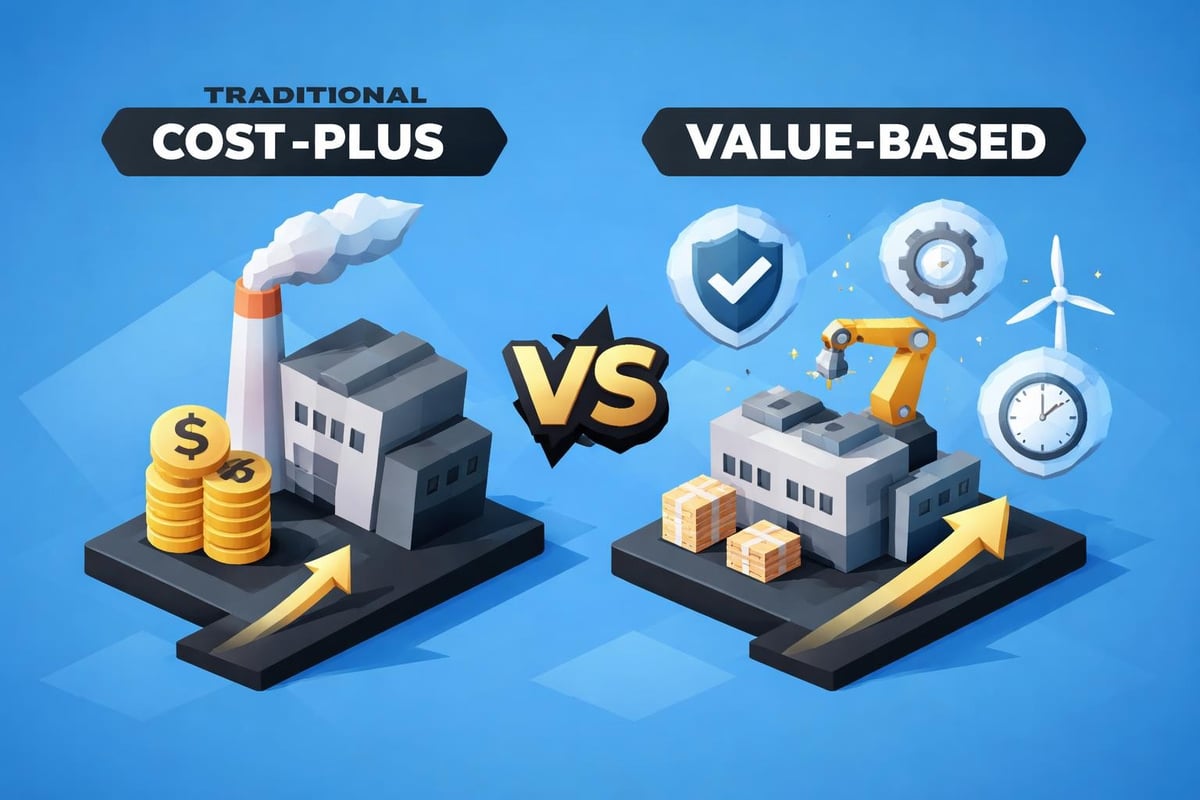
Value-Based Pricing Approaches
Value-based pricing focuses on client outcomes rather than input costs. When metal fabrication and welding services prevent extended downtime or enable production increases, the value delivered far exceeds material and labor costs.
Successful value pricing requires:
- Understanding client economics to quantify service impact
- Documenting cost savings from quality and reliability
- Demonstrating speed advantages reducing downtime
- Highlighting risk mitigation through proper execution
- Communicating total cost of ownership versus initial price
Competitive Bidding Considerations
Many manufacturing sales opportunities involve competitive bidding. Success requires strategic approach development that balances win probability with project profitability.
Effective bid strategies include:
- Selective pursuit of well-matched opportunities
- Relationship leverage with existing clients
- Differentiation emphasis beyond price competition
- Risk assessment before committing resources
- Alternative solution proposals adding value
For manufacturing projects requiring specialized capabilities, technical differentiation often outweighs price considerations in client decision-making.
Digital Presence and Modern Manufacturing Sales
Manufacturing sales increasingly begins online as procurement professionals research potential suppliers before making contact. Digital presence directly impacts sales pipeline development.
Website Optimization for Industrial Buyers
Manufacturing service websites must address buyer research needs with technical depth and credibility markers. Procurement professionals seek evidence of capability, experience, and reliability before initiating contact.
Effective websites feature:
- Detailed service descriptions with technical specifications
- Project portfolio demonstrating relevant experience
- Equipment lists showing capability breadth
- Certification documentation validating quality systems
- Industry focus areas confirming sector expertise
- Contact accessibility for inquiry generation
The industrial services company website becomes a 24/7 sales tool, qualifying leads and building credibility before human interaction begins.
Content Marketing for Technical Audiences
Technical content establishes expertise and supports search visibility for manufacturing sales-related searches. Educational content addressing client challenges positions service providers as knowledgeable partners rather than transaction vendors.
Content types supporting manufacturing sales include:
| Content Type | Purpose | Sales Impact |
|---|---|---|
| Technical guides | Educate buyers | Authority building |
| Case studies | Demonstrate capability | Proof of performance |
| Process explanations | Clarify service delivery | Reduce buyer uncertainty |
| Industry insights | Show market knowledge | Thought leadership |
| FAQ resources | Answer common questions | Pre-qualify leads |
Sales Team Development and Training
Manufacturing sales requires specialized knowledge that standard sales training programs rarely address. Developing effective sales capabilities demands industry-specific skill building.
Essential Skills for Industrial Sales Teams
Sales professionals serving manufacturing markets need both traditional sales skills and technical competency. The combination enables credible client conversations and effective solution development.
Core competency areas include:
- Understanding metallurgy and material properties
- Comprehending manufacturing processes and equipment
- Reading technical drawings and specifications
- Estimating project scope and resource requirements
- Managing complex, multi-stakeholder sales cycles
- Communicating technical concepts to varied audiences
For companies serving specialized sectors, additional industry knowledge becomes necessary. Oil and gas service providers, for example, must understand upstream, midstream, and downstream operational differences.
Balancing Field Experience with Sales Acumen
Many successful manufacturing sales professionals begin in technical roles before transitioning to client-facing positions. This background provides credibility and practical knowledge that purely sales-trained professionals struggle to develop.
Skilled welders who develop business development capabilities bring unique advantages to manufacturing sales conversations. They speak the client’s technical language and can assess project feasibility during initial discussions.
Client Acquisition Versus Retention Balance
Manufacturing sales strategies must balance new client acquisition with existing account development. While new business drives growth, account retention provides stability and profitability.
Retention advantages include:
- Lower acquisition costs compared to new clients
- Established trust reducing sales cycle length
- Better understanding of client needs and preferences
- Higher profit margins from efficiency and relationship value
- Referral generation to similar organizations
Account retention strategies focus on consistent delivery, proactive communication, and continuous value demonstration. Regular check-ins, even without active projects, maintain relationships and surface future opportunities.
Measuring Manufacturing Sales Performance
Effective sales management requires metrics tracking both activity and results. Manufacturing sales metrics differ from retail or service industry standards due to longer cycles and project-based revenue.
| Metric | Purpose | Target Setting Approach |
|---|---|---|
| Quote conversion rate | Efficiency measurement | Historical baseline + improvement |
| Average project value | Revenue sizing | Market analysis + capability match |
| Sales cycle length | Process optimization | Industry benchmarking |
| Client lifetime value | Relationship ROI | Multi-year revenue tracking |
| Referral rate | Satisfaction indicator | Percentage of revenue from referrals |
Statistics on manufacturing sales trends provide context for setting realistic performance targets aligned with broader market conditions.
Geographic Expansion Strategies
Manufacturing service providers often begin with local or regional focus before expanding geographically. Growth requires strategic planning to maintain service quality while reaching new markets.
Service Area Determination
Defining optimal service areas balances market opportunity with operational capability. For field service providers, travel time and mobilization costs directly impact profitability and competitiveness.
Expansion considerations include:
- Client concentration in target regions
- Competitive landscape and market saturation
- Travel logistics from existing facilities
- Regional industry characteristics and growth patterns
- Equipment mobilization requirements and costs
Companies serving the Western United States face unique geographic challenges given the region’s size and dispersed industrial centers. Strategic positioning and efficient logistics become critical success factors.
Partnership and Alliance Development
Strategic partnerships extend market reach without proportional cost increases. Alliances with complementary service providers enable broader capability offerings and geographic coverage.
Partnership models include:
- Reciprocal referral agreements with non-competing service providers
- Subcontracting relationships for capacity overflow
- Joint venture arrangements for large projects
- Equipment sharing agreements reducing capital requirements
- Technical collaboration combining specialized expertise
Industry-Specific Sales Approaches
Manufacturing sales strategies should adapt to target industry characteristics. Oil and gas clients have different procurement processes, timelines, and priorities than aggregate or recycling operations.
Oil and Gas Sector Sales
Energy sector manufacturing sales involve stringent safety requirements, vendor qualification processes, and often complex approval hierarchies. Sales cycles extend longer, but project values and relationship duration typically exceed other sectors.
Success factors include:
- Safety program documentation and performance records
- Insurance coverage meeting industry requirements
- Vendor qualification completion and maintenance
- Emergency response capabilities for critical equipment failures
- Geographic proximity to operating areas
Recycling and Aggregate Industries
These sectors emphasize equipment durability, rapid turnaround, and cost efficiency. Operations run continuous schedules where downtime directly impacts revenue, creating urgency around maintenance and repair services.
Metal fabrication industries supporting recycling operations must understand material handling challenges, wear patterns, and replacement cycles to provide proactive service recommendations.
Sales Pipeline Management
Systematic pipeline management ensures consistent revenue flow despite manufacturing sales volatility. Tracking opportunities through defined stages enables forecasting and resource planning.
Pipeline Stage Definitions
Clear stage definitions create consistency in opportunity assessment and forecasting accuracy. Each stage should have entry criteria, expected duration, and defined next actions.
Typical manufacturing sales stages:
- Lead identification – Initial awareness of potential opportunity
- Qualification – Verification of fit, budget, and timeline
- Needs assessment – Detailed requirement gathering
- Proposal development – Solution design and pricing
- Negotiation – Terms, pricing, and contract finalization
- Contract execution – Agreement signing and project initiation
Advanced pipeline management tracks probability by stage, enabling weighted revenue forecasting that accounts for uncertainty in opportunity conversion.
CRM Systems for Manufacturing
Customer relationship management systems designed for manufacturing sales differ from general business CRM platforms. Industry-specific features support technical quoting, project tracking, and equipment history.
Essential CRM capabilities include:
| Feature | Benefit | Manufacturing Application |
|---|---|---|
| Technical specifications storage | Detailed requirement tracking | Custom fabrication projects |
| Quote version management | Proposal evolution tracking | Iterative design processes |
| Equipment history logging | Maintenance tracking | Preventive service scheduling |
| Document management | Drawing and spec organization | Reference material accessibility |
| Multi-contact account structure | Complex organization navigation | Large industrial facilities |
Continuous Improvement in Sales Performance
Manufacturing sales effectiveness improves through systematic analysis and refinement. Regular review of wins, losses, and process efficiency identifies improvement opportunities.
Win-Loss Analysis
Understanding why opportunities convert or fail provides actionable insights for strategy refinement. Structured debriefs following major pursuits capture learning while details remain fresh.
Key analysis questions include:
- What factors most influenced the client decision?
- How did our technical approach compare to competitors?
- Was our pricing strategy appropriate for the opportunity?
- Did our sales process meet client expectations?
- What could we have done differently to improve outcomes?
Patterns emerging from win-loss analysis inform training priorities, capability development needs, and strategic positioning adjustments.
Sales Process Optimization
Manufacturing sales processes should evolve based on performance data and market feedback. Regular process review identifies bottlenecks, unnecessary steps, and improvement opportunities.
Process optimization focuses on:
- Reducing quote turnaround time without sacrificing accuracy
- Improving qualification criteria to focus on winnable opportunities
- Streamlining proposal development through templates and systems
- Enhancing client communication frequency and quality
- Shortening decision cycles through effective stakeholder engagement
Recent manufacturing industry reports demonstrate how operational efficiency directly correlates with sales performance in competitive markets.
Manufacturing sales success requires technical expertise, relationship management, and strategic market positioning working in concert. The complexity of industrial sales demands specialized approaches that balance consultative selling with operational excellence. Whether serving oil and gas operations, aggregate facilities, or recycling centers throughout the Western United States, manufacturing service providers must continuously refine their sales capabilities to remain competitive. LTJ Industrial Services combines decades of welding, fabrication, and machining expertise with customer-focused sales and service delivery, helping industrial clients throughout Colorado and beyond achieve their operational goals through reliable, high-quality technical solutions.