
ASME certified welding represents the gold standard for quality assurance in pressure vessel and piping fabrication across industrial sectors. For manufacturers in the oil and gas, aggregate, and recycling industries, understanding ASME certification requirements isn't just about regulatory compliance-it's about ensuring structural integrity, worker safety, and operational reliability. The American Society of Mechanical Engineers (ASME) Boiler and Pressure Vessel Code (BPVC) Section IX establishes comprehensive guidelines that govern how welding procedures are developed, tested, and qualified, creating a framework that protects both fabricators and end users throughout the Western United States and beyond.
Understanding ASME Certified Welding Requirements
The foundation of asme certified welding rests on the ASME BPVC Section IX, which outlines specific requirements for qualifying welding procedures and welders. This code applies to the welding, brazing, and fusion processes used in constructing pressure-containing equipment.
Unlike general welding certifications, ASME qualification focuses specifically on procedures and performance rather than just welder skill. The code requires both Welding Procedure Specifications (WPS) and Procedure Qualification Records (PQR) to document that welding processes will produce sound, defect-free joints under specified conditions.
Key Components of ASME Section IX
ASME Section IX divides its requirements into distinct categories that work together to ensure weld quality:
- Procedure Qualification: Establishes and documents that welds produced by a specific procedure can meet prescribed standards
- Performance Qualification: Demonstrates that welders and welding operators possess the skill necessary to execute qualified procedures
- Essential Variables: Defines parameters that, when changed, require requalification
- Supplementary Essential Variables: Identifies additional variables that affect toughness properties
- Nonessential Variables: Lists changes that don't require requalification but must be documented
The systematic approach ensures that every variable affecting weld quality is controlled and verified. ASME’s certification process integrates these requirements into a comprehensive quality management system that extends beyond individual welds to entire fabrication operations.
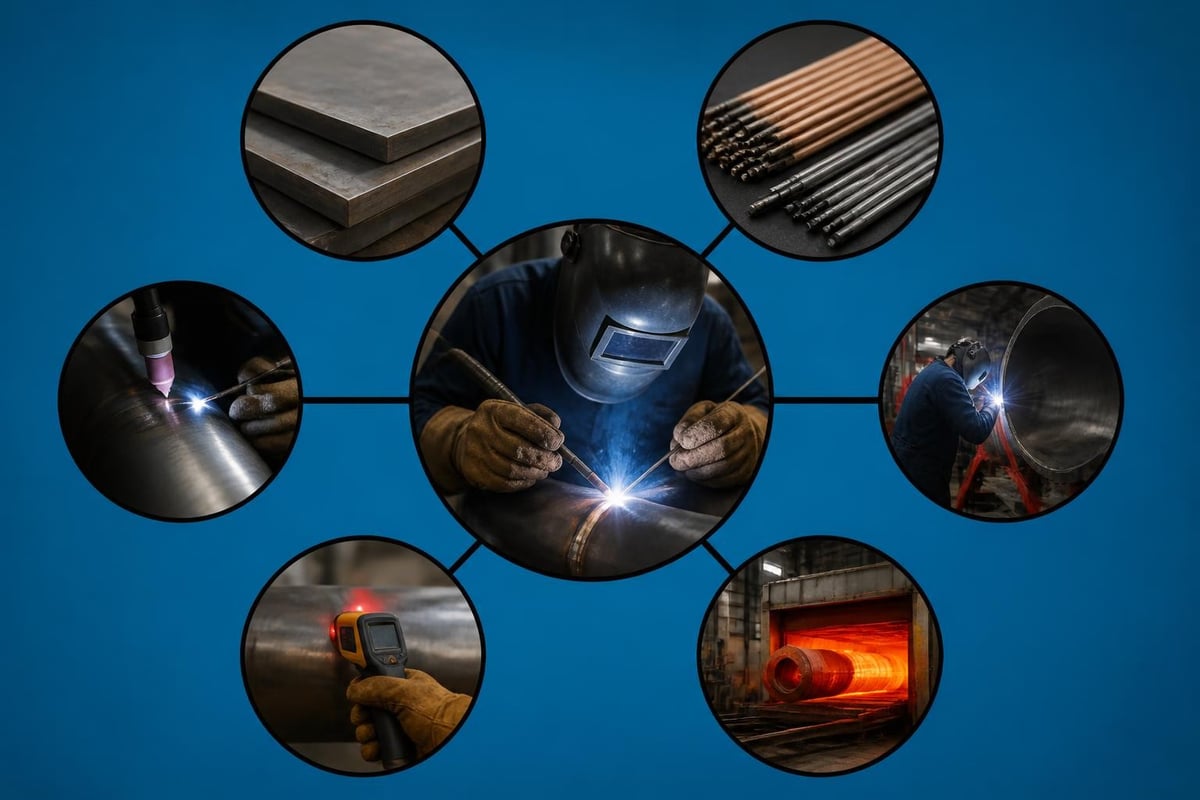
Developing Welding Procedure Specifications
Creating a compliant WPS requires detailed documentation of every aspect of the welding process. For industrial fabricators serving sectors like oil and gas or aggregate processing, the WPS serves as the blueprint that ensures consistency across multiple welders and projects.
A comprehensive WPS must specify the following elements in accordance with ASME BPVC standards:
| WPS Component | Required Information | Purpose |
|---|---|---|
| Base Metal | P-Number, Group Number, Thickness | Defines material compatibility |
| Filler Metal | F-Number, A-Number, Size | Specifies consumable properties |
| Position | 1G, 2G, 3G, 4G, etc. | Documents qualified positions |
| Preheat/Interpass | Temperature ranges | Controls cooling rates |
| PWHT | Time, temperature, methods | Ensures mechanical properties |
| Electrical Characteristics | Current, voltage, polarity | Defines arc parameters |
The WPS must be supported by a PQR that provides objective evidence the procedure produces acceptable results. This record documents actual welding parameters used during qualification testing, mechanical test results, and visual examination findings.
Qualifying Your Welding Procedures
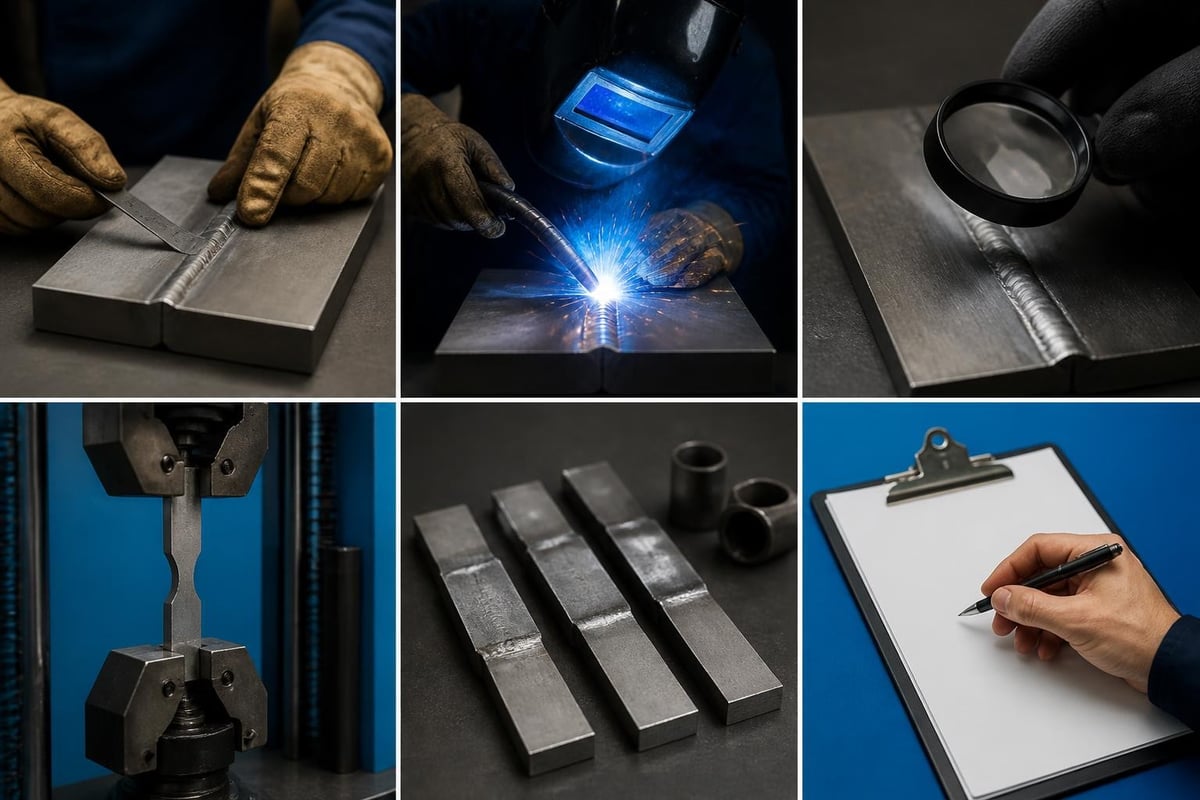
Procedure qualification testing involves creating test coupons using the proposed WPS parameters, then subjecting those coupons to destructive testing. The specific tests required depend on the application, but typically include:
- Visual examination for surface defects and weld profile
- Tensile testing to verify strength meets or exceeds base metal
- Bend tests (root, face, or side) to assess ductility and soundness
- Impact testing when toughness is specified
- Macro-examination to evaluate fusion and identify discontinuities
Successful completion of all required tests demonstrates that the welding procedure produces welds with acceptable mechanical properties and metallurgical characteristics. For companies providing oil and gas welding services, maintaining current PQRs across various material combinations and thicknesses ensures readiness for diverse project requirements.
Welder and Welding Operator Qualification
While the WPS defines the process, welder performance qualification verifies that individual welders can execute that process competently. ASME Section IX establishes specific performance test requirements based on the welding processes and positions to be used in production.
Welder qualification tests must be performed using a qualified WPS, and the test conditions must encompass all essential variables for the production work. The qualification limits determine what production work the welder is authorized to perform.
Performance Qualification Variables
ASME IX qualification ranges define specific limits based on test coupon parameters:
- Thickness qualification: Pipe and plate thickness ranges based on test coupon thickness
- Diameter limitation: Pipe diameter ranges for pipe welders
- Position qualification: Specific positions or all-position qualification based on test position
- Process qualification: Each welding process requires separate qualification
- Filler metal: F-number groupings determine qualified filler metals
Test coupons undergo visual examination and either radiographic examination or bend testing depending on material type and thickness. All tests must meet acceptance criteria defined in Section IX before the welder receives qualification.
Maintaining Qualification Records
ASME requires employers to maintain records of welder qualifications and ensure continuity of qualification through regular production welding or periodic retesting. Welders who haven't welded with a process for six months or more must be requalified.
Documentation must include:
- Welder identification number
- Welding processes qualified
- Base material types and thickness ranges
- Positions qualified
- Test results and examination records
- Dates of initial qualification and any renewals
For fabricators managing both field welding and shop welding operations, comprehensive qualification tracking systems ensure the right welders are assigned to appropriate tasks while maintaining full compliance.
ASME Certification vs. Code Qualification
Understanding the distinction between ASME certification and code qualification prevents common misunderstandings in industrial fabrication. Many professionals ask what ASME certification means in practical terms, particularly regarding facility capabilities versus individual qualifications.
ASME Code Qualification refers to qualifying welding procedures (PQR/WPS) and welders according to Section IX requirements. Any fabricator can qualify procedures and welders by following the code-no formal ASME approval is required for this activity.
ASME Certification, by contrast, involves third-party audit and authorization of manufacturing facilities to apply ASME code stamps (U-stamp, S-stamp, etc.) to pressure vessels, boilers, and piping systems. This certification requires:
- Quality control manual approved by an Authorized Inspector
- Qualified procedures and welders per Section IX
- Material control and traceability systems
- Nondestructive examination capabilities
- Regular audits by Authorized Inspection Agencies
The National Board of Boiler and Pressure Vessel Inspectors oversees the network of Authorized Inspectors who verify compliance with ASME requirements during fabrication and periodically audit certificate holders.
Industry-Specific Code Applications
Different industrial sectors apply ASME certified welding requirements through various code sections and complementary standards. Understanding these distinctions helps fabricators serve diverse markets effectively.
| Industry | Primary Code | Welding Requirements | Additional Standards |
|---|---|---|---|
| Pressure Vessels | Section VIII | Section IX qualification | State regulations, NB-23 |
| Power Boilers | Section I | Section IX qualification | State/jurisdictional codes |
| Piping Systems | B31.1, B31.3 | Section IX qualification | ASME B31 series variations |
| Oil & Gas Pipelines | B31.4, B31.8 | Section IX or API 1104 | DOT regulations, API standards |
Companies providing comprehensive welding, fabrication, and machining services must maintain qualifications across multiple code applications to serve commercial and industrial manufacturing sectors effectively. The comparison between ASME B31 and international standards illustrates how requirements vary across jurisdictions.
Integration with Other Welding Standards
ASME certified welding standards frequently intersect with other industry codes and certification programs. Understanding these relationships ensures complete compliance across complex projects involving multiple specifications.
AWS and ASME Coordination
The American Welding Society (AWS) provides complementary standards and certification programs that work alongside ASME requirements. AWS BPVC Section IX endorsements enable Certified Welding Inspectors to demonstrate specialized knowledge of ASME code application.
The AWS Certified Welder Program offers standardized testing that some fabricators use in addition to employer-specific ASME qualifications. While AWS certifications demonstrate welder competency, they don't replace code-required performance qualifications for ASME work.
Key coordination points between AWS and ASME include:
- D1.1 Structural Welding Code: Often specified alongside ASME for structural components
- Filler Metal Specifications: AWS A5.X series referenced in ASME WPS documents
- Inspector Qualifications: CWI credentials valuable for ASME quality control personnel
- Pre-qualified WPS: AWS D1.1 pre-qualified procedures vs. ASME qualification testing
For projects involving structural steel fabrication combined with pressure-containing components, understanding which standard governs each weld joint prevents costly errors and rework.
API Standards in Energy Sector Applications
Pipeline and petroleum industry projects frequently reference both ASME and API standards. API 1104 provides welding requirements specifically developed for pipeline construction, offering alternatives to ASME Section IX for certain applications.
Fabricators serving oil and gas clients should understand the differences between AWS D1.1 and API 1104 and how these relate to asme certified welding requirements. The selection depends on project specifications, jurisdictional requirements, and equipment design codes.
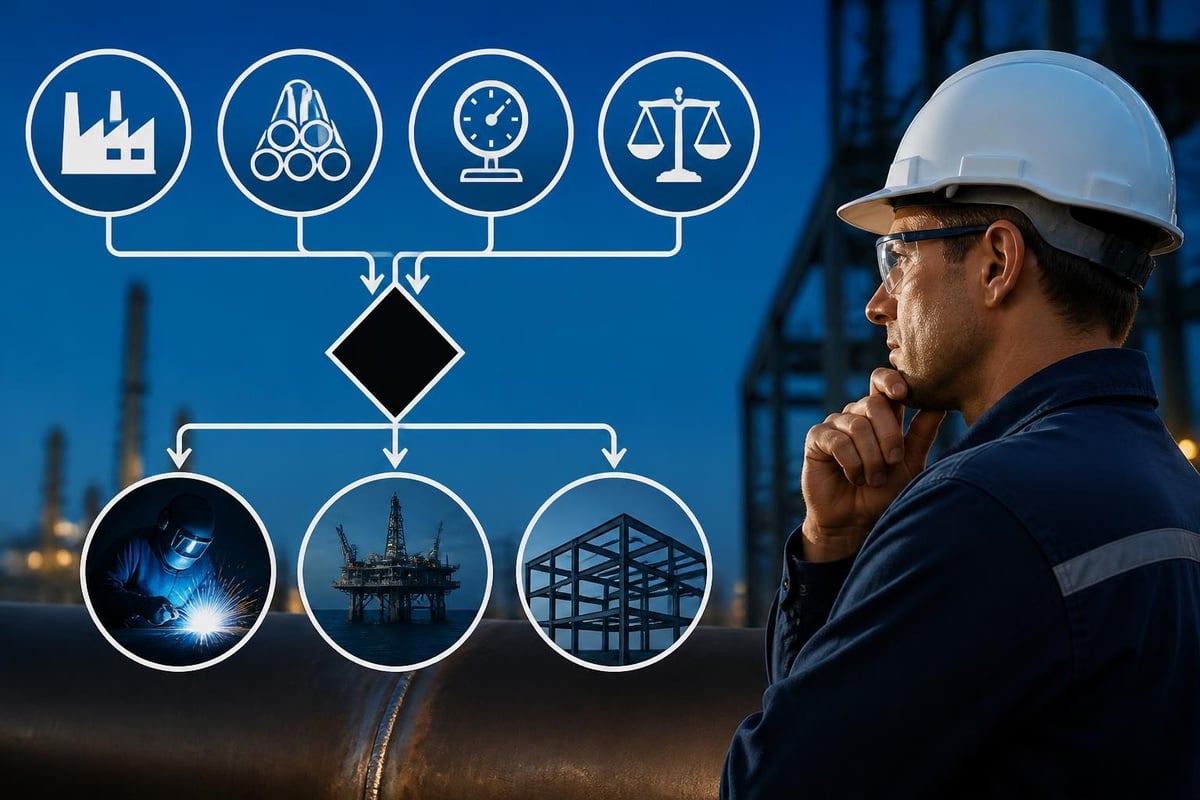
Material-Specific Considerations
ASME certified welding requirements vary significantly based on base material properties. Section IX organizes base metals into P-Numbers that group materials with similar welding characteristics, but fabricators must understand specific considerations for common industrial materials.
Carbon and Low-Alloy Steels
P-Number 1 materials (carbon steels) represent the most common base metals in pressure vessel and piping fabrication. While generally considered weldable, proper procedure development must address:
- Preheat requirements based on carbon equivalent and thickness
- Hydrogen control to prevent cold cracking in restrained joints
- Post-weld heat treatment when specified for stress relief or property enhancement
- Impact testing for low-temperature service applications
Qualification thickness ranges allow a single PQR to qualify a WPS for various thickness combinations. Understanding these ranges optimizes qualification testing investments while maintaining code compliance.
Stainless Steel and Corrosion-Resistant Alloys
P-Number 8 (austenitic stainless steels) and other corrosion-resistant alloys require specialized welding procedures addressing:
- Carbide precipitation prevention through controlled heat input
- Ferrite content verification in austenitic welds for crack resistance
- Dissimilar metal welding between carbon steel and stainless steel
- Sensitization control to maintain corrosion resistance
Filler metal selection becomes critical for maintaining mechanical properties and corrosion resistance. The A-Number system classifies filler metals based on weld metal chemistry, with specific requirements for matching or overmatching base metal properties.
High-Strength and Specialty Materials
Advanced materials used in demanding applications require enhanced qualification procedures:
- Duplex stainless steels: Phase balance verification through metallography
- High-strength low-alloy steels: Controlled heat input to prevent property degradation
- Nickel alloys: Specialized cleaning and contamination prevention
- Clad or overlay materials: Multiple-layer procedure qualification
For companies handling diverse manufacturing projects across recycling, aggregate, and energy sectors, maintaining qualified procedures for specialty materials expands service capabilities and competitive advantages.
Quality Control and Inspection Requirements
ASME certified welding demands rigorous quality control throughout fabrication. The code establishes minimum inspection requirements, but many specifications impose additional examination or testing based on service conditions.
Visual Examination Standards
All welds must receive visual examination per Section IX acceptance criteria. Qualified inspectors evaluate:
- Weld profile: Reinforcement height, width, and uniformity
- Surface condition: Cracks, porosity, undercut, and overlap
- Dimensional accuracy: Size, alignment, and fit-up compliance
Visual examination serves as the primary quality control method, with additional NDE required based on code section, material type, and service requirements. Establishing clear visual acceptance criteria in WPS documents prevents interpretation disputes during production.
Nondestructive Examination Methods
Section IX permits various NDE methods for welder qualification testing and production examination:
| NDE Method | Application | Advantages | Limitations |
|---|---|---|---|
| Radiography | Volumetric inspection | Permanent record, high sensitivity | Radiation safety, access requirements |
| Ultrasonic | Volumetric inspection | No radiation, portable | Operator skill-dependent, calibration critical |
| Magnetic Particle | Surface/near-surface | Rapid, economical | Ferromagnetic materials only |
| Liquid Penetrant | Surface discontinuities | Works on all materials | Surface-breaking defects only |
Production NDE requirements depend on the applicable construction code section. Section I (Power Boilers) and Section VIII (Pressure Vessels) specify mandatory examination percentages and acceptance standards that exceed Section IX qualification testing.
Documentation and Traceability
Complete documentation forms the backbone of ASME quality assurance. Required records include:
- Material test reports certifying base metal properties
- Filler metal certifications matching WPS specifications
- WPS and supporting PQR documents
- Welder qualification records and continuity documentation
- NDE procedures, calibration records, and examination reports
- Heat treatment charts demonstrating time-temperature compliance
- Final data reports compiled by Authorized Inspectors
Electronic quality management systems streamline documentation while ensuring traceability from raw materials through final inspection. For fabricators managing custom fabrication projects, robust documentation systems demonstrate quality commitment while facilitating client audits and jurisdictional reviews.
Training and Workforce Development
Maintaining a qualified welding workforce requires ongoing investment in training, testing, and skills development. ASME certified welding standards evolve periodically through code revisions and interpretations, necessitating continuous education for welders, inspectors, and engineering personnel.
Welder Training Programs
Effective welder development combines classroom instruction with hands-on practice in processes and positions relevant to production work. Training should address:
- Code familiarity: Understanding WPS interpretation and essential variable restrictions
- Process-specific skills: SMAW, GTAW, FCAW, SAW techniques and applications
- Position proficiency: Flat, horizontal, vertical, and overhead welding practice
- Quality awareness: Recognizing and preventing common discontinuities
Many fabricators establish apprenticeship programs that blend formal education with supervised production experience, developing welders who understand both technical requirements and practical efficiency.
Inspector and Engineer Qualification
Quality control personnel require specialized knowledge beyond welding skills. AWS Certified Welding Inspector (CWI) credentials provide comprehensive training in code requirements, but ASME-specific knowledge requires additional focus.
Engineering staff responsible for WPS development and PQR review should maintain current knowledge of:
- Section IX requirements and code interpretations
- Material properties and metallurgical considerations
- Design code requirements from applicable ASME sections
- Fabrication feasibility and cost optimization
Regular code training sessions keep personnel updated on revisions and industry best practices. Companies investing in workforce development establish competitive advantages through superior quality and reduced rejection rates.
Cost Implications and ROI
Understanding the financial aspects of asme certified welding helps fabricators make informed decisions about qualification investments and pricing strategies. While initial qualification costs can be significant, the long-term value justifies the investment for companies serving regulated industries.
Direct Qualification Costs
Qualifying welding procedures and welders involves measurable expenses:
- Test coupon materials: Base metal, filler metals, and backing materials
- Labor costs: Welding time, fit-up, and preparation
- Testing fees: Destructive testing, NDE, and laboratory services
- Documentation: Engineering time for WPS development and PQR compilation
A single procedure qualification might cost $2,000 to $5,000 depending on material costs and testing requirements. Welder performance qualifications typically range from $300 to $800 per test, varying with position complexity and examination methods.
Strategic procedure development minimizes qualification costs by selecting essential variable ranges that maximize production applicability. One well-planned PQR can support multiple WPS documents covering different thickness ranges, positions, and filler metal sizes.
Competitive Advantages and Market Access
ASME certified welding capabilities open market segments unavailable to non-qualified fabricators:
- Pressure vessel fabrication: Projects requiring U-stamp or U2-stamp certification
- Power generation: Boiler and heat exchanger manufacturing
- Petrochemical processing: Equipment for refineries and chemical plants
- Pharmaceutical and food processing: Sanitary systems requiring code compliance
The premium pricing justified by ASME qualifications typically exceeds qualification costs within several projects. Clients value the reduced liability and inspection confidence that code compliance provides.
For companies providing custom metal fabrication across diverse industries, ASME capabilities differentiate services while justifying premium rates that reflect enhanced quality assurance and regulatory compliance.
Regional Considerations for Western Markets
Industrial fabricators operating throughout the Western United States encounter varying jurisdictional requirements and market conditions that influence ASME certified welding applications. Understanding regional factors helps optimize service delivery across Colorado, Wyoming, Utah, and surrounding states.
Jurisdictional Variations
While ASME codes provide national standards, state and local authorities implement varying adoption schedules and supplementary requirements:
- Boiler and pressure vessel registration: State-specific requirements for inspection and installation
- Code edition adoption: Jurisdictions may lag behind current ASME editions
- Inspector authorization: Varying requirements for Authorized Inspector qualifications
- Local amendments: Additional requirements beyond base ASME code
Fabricators must verify current jurisdictional requirements before starting projects, particularly for pressure vessels requiring state registration. The National Board Information System provides jurisdiction-specific adoption information for ASME codes.
Industry-Specific Applications
Western regional industries create unique demands for ASME certified welding:
Oil and Gas: Wellhead equipment, processing facilities, and pipeline interconnections require Section VIII vessels and B31.3 piping fabrication. Understanding oil and gas welding requirements ensures proper procedure qualification for sour service, low-temperature applications, and high-pressure systems.
Aggregate and Mining: Processing equipment including crushers, screens, and material handling systems combines structural fabrication with pressure-containing components like hydraulic systems and compressed air equipment.
Recycling Industry: Shredders, balers, and sorting equipment require robust fabrication with pressure components for hydraulic power systems. The combination of high-cycle fatigue loading and pressure requirements demands careful procedure development.
Field Service Considerations
Remote project locations throughout the Western United States create logistical challenges for maintaining ASME quality assurance. Field welding requires:
- Portable qualification testing: Mobile NDE equipment and temporary test facilities
- Weather protection: Environmental controls preventing contamination and ensuring proper preheat
- Equipment accessibility: Welding power sources suitable for remote locations
- Communication systems: Coordinating with Authorized Inspectors and quality personnel
Companies offering both shop and field capabilities provide clients with flexible solutions that maintain code compliance regardless of project location. The differences between field and shop welding influence procedure development and qualification strategies.
Advanced Applications and Emerging Technologies
ASME certified welding continues evolving as new welding processes, materials, and automation technologies emerge. Staying current with these developments positions fabricators for future market opportunities while maintaining code compliance.
Automated and Robotic Welding
Section IX addresses welding operators (those operating machine or automatic welding equipment) separately from manual welders. Automated systems offer advantages including:
- Consistency: Reduced variability in welding parameters
- Efficiency: Higher deposition rates and reduced labor costs
- Documentation: Automatic parameter recording for quality records
- Complex geometries: Programmed sequences for intricate joint configurations
Qualification requirements for automated welding include demonstrating that the welding operator can properly set up, operate, and monitor the equipment. The equipment itself must be included in the essential variables documented in the WPS.
Advanced Materials and Processes
Emerging materials and joining technologies require updated qualification approaches:
- Laser-hybrid welding: Combining laser and arc processes for high-speed fabrication
- Friction stir welding: Solid-state joining for aluminum and specialty alloys
- Narrow-gap techniques: Deep joint welding with reduced filler metal consumption
- Advanced high-strength steels: Ultra-high-strength materials requiring specialized procedures
While Section IX provides principles applicable to new processes, fabricators must carefully document essential variables and validate mechanical properties through comprehensive testing. Early adoption of advanced technologies creates competitive differentiation in specialized markets.
Digital Quality Management
Modern fabrication increasingly relies on digital systems integrating procedure management, welder qualification tracking, and production documentation:
- Electronic WPS databases: Centralized access to current procedures
- Automated parameter monitoring: Real-time welding data collection and verification
- Digital inspection records: Tablet-based examination reporting
- Blockchain traceability: Immutable quality record chains
These systems enhance compliance while improving efficiency through reduced paperwork and faster information access. Integration with existing ERP and project management platforms creates seamless workflow from estimation through final documentation delivery.
ASME certified welding represents a comprehensive framework ensuring safety, reliability, and quality in pressure vessel and critical piping fabrication. Understanding the nuances of Section IX requirements, maintaining qualified procedures and welders, and implementing robust quality systems position fabricators for success in regulated industrial markets. Whether your project involves pressure vessels, process piping, or specialty fabrication requiring code compliance, LTJ Industrial Services provides the certified capabilities and technical expertise to deliver quality results. Our team maintains current ASME qualifications across multiple processes and materials, supported by comprehensive quality systems that ensure your projects meet or exceed applicable code requirements throughout Colorado and the Western United States.