
Manufacturers and fabrication professionals in the commercial and industrial sectors face a critical decision on every project: where should the welding take place? The choice between field welding vs shop welding impacts project timelines, quality control, costs, and ultimately the integrity of the finished product. Understanding the fundamental differences between these two approaches helps businesses optimize their fabrication strategies, whether they're working on aggregate processing equipment, oil and gas infrastructure, or heavy industrial machinery across the Western United States.
Fundamental Differences Between Shop and Field Welding Environments
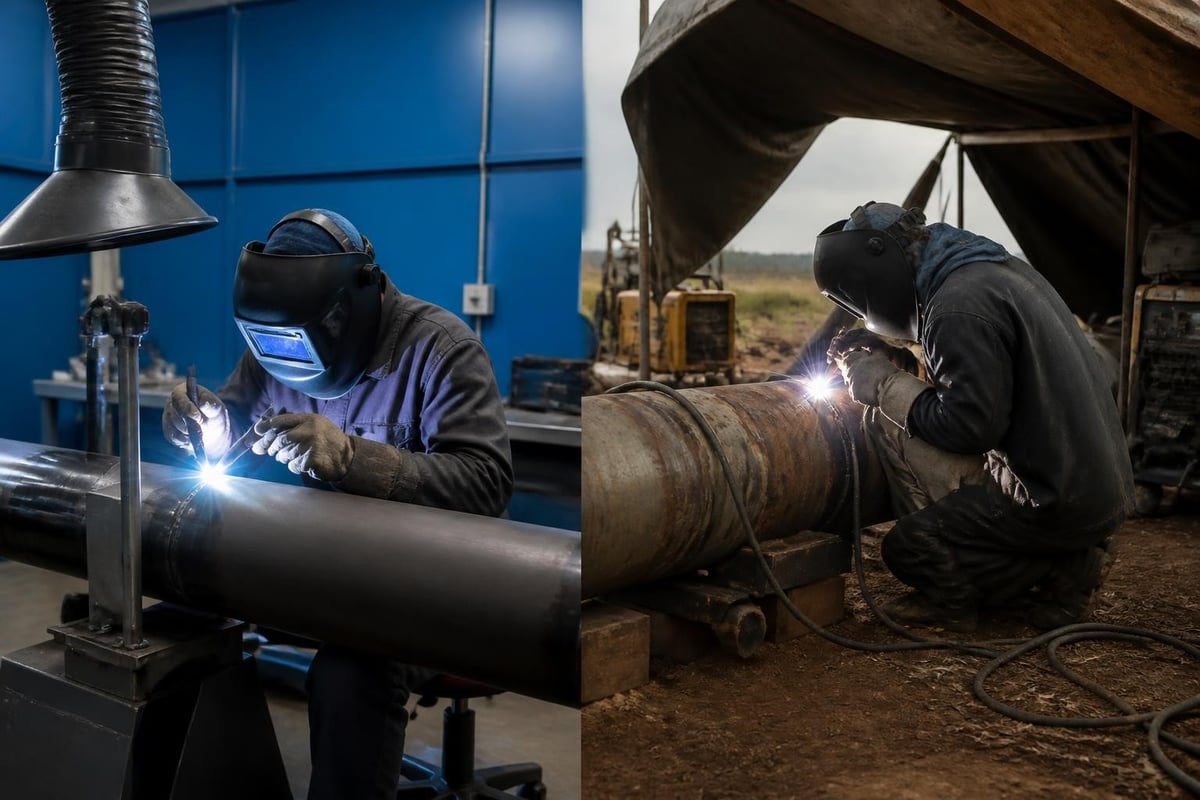
Shop welding occurs in a controlled indoor facility where fabricators have access to fixed equipment, consistent power supplies, and protection from environmental variables. This controlled setting allows welders to position materials optimally, maintain precise joint preparation, and execute welds with maximum repeatability.
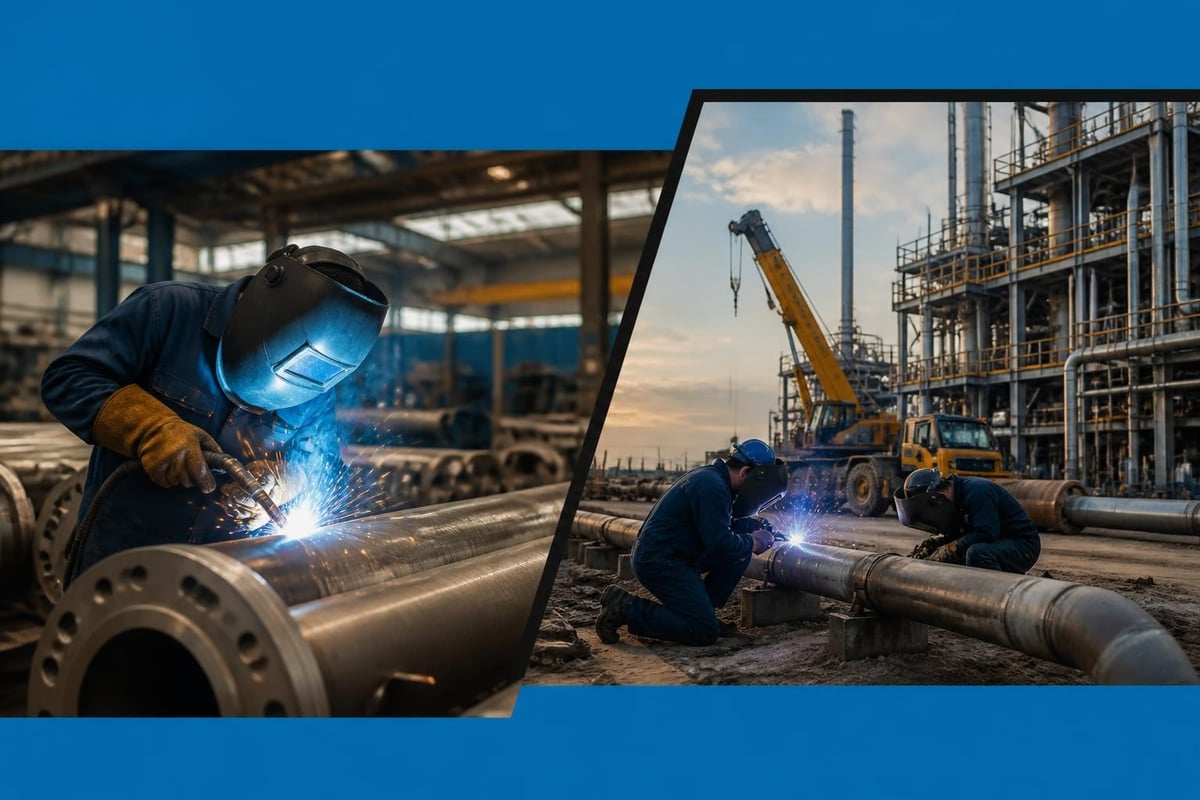
Field welding, by contrast, takes place at the installation site where structures are being erected or repaired. These welding field operations must adapt to variable conditions including weather exposure, limited equipment access, and challenging work positions.
Key environmental distinctions include:
- Temperature and humidity control (shop) versus exposure to elements (field)
- Stable power sources versus portable generators
- Fixed welding stations versus mobile equipment setups
- Overhead crane access versus manual material handling
- Climate-controlled storage versus outdoor material exposure
The AWS D1.1/D1.1M Structural Welding Code establishes different requirements and considerations for shop versus field welding, recognizing these environmental distinctions affect quality outcomes.
Material Positioning and Joint Access
Shop fabrication allows welders to rotate assemblies, position joints for downhand (flat) welding, and use positioning equipment to maintain optimal angles. Field welders frequently work in overhead, vertical, or other challenging positions dictated by the installed structure.
This positioning advantage in shop environments directly translates to higher deposition rates, better fusion characteristics, and reduced defect potential. Field operations require welders qualified in all positions, adding complexity to the welder qualification process outlined in ASME Section IX standards.
| Aspect | Shop Welding | Field Welding |
|---|---|---|
| Positioning Control | Full rotation and manipulation | Fixed by installation geometry |
| Preferred Positions | 80-90% flat/horizontal | 40-60% overhead/vertical |
| Positioning Equipment | Positioners, manipulators, turntables | Scaffolding, lifts, ladders |
| Joint Access | Optimized during fit-up | Constrained by structure |
Quality Control and Inspection Considerations
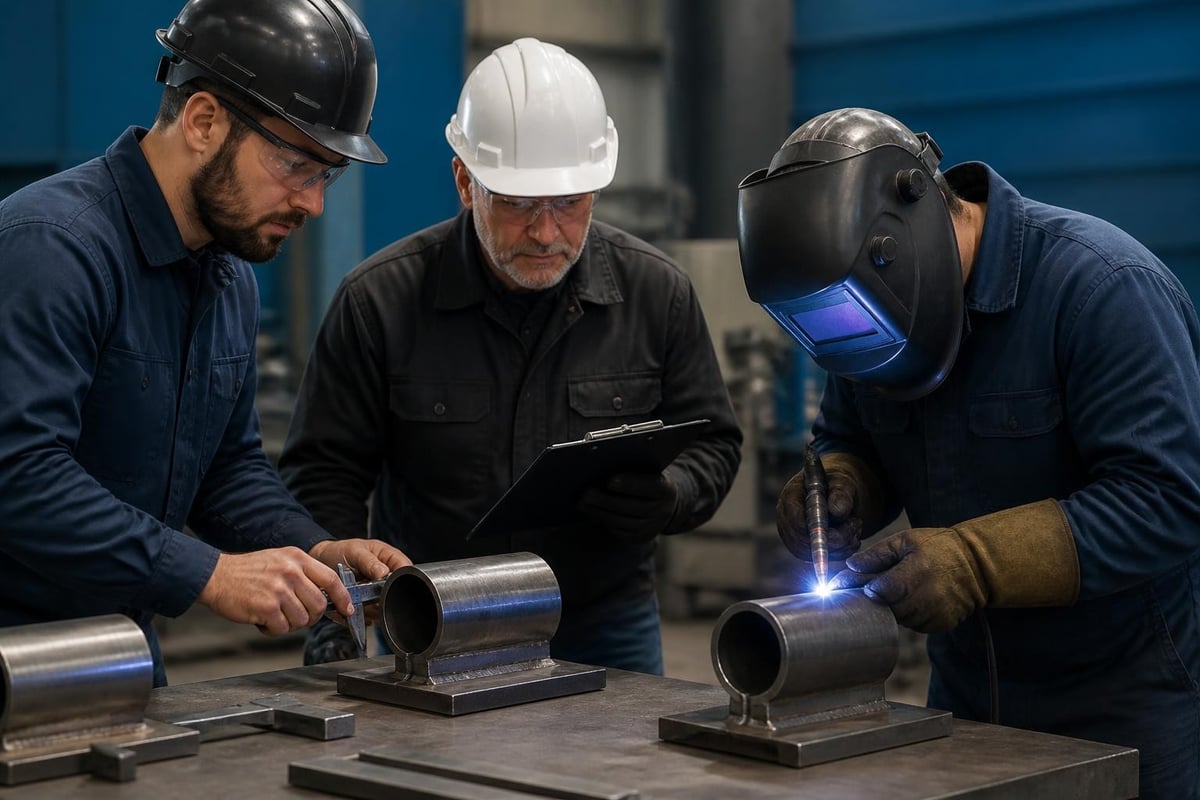
When evaluating field welding vs shop welding from a quality perspective, the controlled shop environment provides significant advantages for maintaining consistent weld quality. Shop operations support systematic quality programs with dedicated inspection stations, controlled lighting, and immediate access to nondestructive examination (NDE) equipment.
Field quality control faces inherent challenges. Inspectors must work around construction schedules, accommodate weather delays, and conduct examinations in difficult positions. The FHWA Bridge Welding Reference Manual extensively addresses these practical quality differences, particularly for structural applications.
Inspection Access and Documentation
Shop fabrication enables comprehensive inspection protocols with permanent records created in optimal conditions. Digital radiography, ultrasonic examination, and magnetic particle testing can be performed with calibrated equipment in controlled settings.
Shop inspection advantages:
- Dedicated NDE stations with permanent equipment
- Controlled access for radiographic exposure
- Systematic test piece programs
- Real-time quality feedback during production
- Complete documentation before shipping
Field inspection must adapt to site constraints, often requiring portable NDE equipment with reduced sensitivity compared to shop systems. Weather conditions can prevent certain examination methods, and documentation may be delayed by site access limitations.
Cost Factors in the Field Welding vs Shop Welding Decision
The economic analysis of field welding vs shop welding extends beyond simple labor rate comparisons. Transportation costs, productivity rates, rework expenses, and project schedule impacts all influence the total cost equation.
Shop welding typically achieves higher productivity measured in pounds of weld metal deposited per welder-hour. Controlled conditions, optimized joint positions, and continuous workflow support efficient production. However, completed shop assemblies require transportation to the site, potentially adding significant logistics costs for large structures or remote locations.
Field welding eliminates transportation of completed assemblies but typically operates at 40-60% of shop productivity rates. Weather delays, position welding requirements, and site logistics reduce efficiency. For industrial and manufacturing applications across the Western United States, distance to fabrication facilities often makes this decision critical.
Labor Rate and Skill Level Variations
| Cost Element | Shop Environment | Field Environment |
|---|---|---|
| Base Labor Rate | Standard regional rate | Premium rate (15-30% higher) |
| Productivity | 100% baseline | 40-60% of shop rate |
| Consumable Usage | Optimized, minimal waste | Higher consumption, weather waste |
| Equipment Costs | Amortized over volume | Mobilization and rental costs |
| Per Diem/Travel | None | Significant for remote sites |
| Weather Downtime | None | 10-20% schedule risk |
Specialized field welders command premium rates reflecting their position welding qualifications and ability to work in challenging conditions. Projects in Colorado's oil and gas fields or remote aggregate operations must factor these premiums into budget planning when choosing between shop and field approaches.
Welding Procedure Specifications and Qualification Requirements
Both shop and field welding require qualified Welding Procedure Specifications (WPS) supported by Procedure Qualification Records (PQR). However, the practical application of these procedures differs significantly between environments.
Shop procedures can specify optimal parameters, controlled preheat and interpass temperatures, and protected post-weld cooling. Field procedures must accommodate variable ambient conditions, wind protection requirements, and practical heat input limitations with portable equipment.
The AWS Committee on Standard Welding Procedure Specifications provides prequalified procedures, but these still require adjustment for field versus shop application. For projects requiring fabrication services, understanding these procedure differences ensures appropriate planning.
Environmental Protection and Shielding Gas Management
Shop welding maintains consistent shielding gas coverage with minimal atmospheric disturbance. Field operations must contend with wind, requiring protective enclosures or adjusting flow rates that can affect weld quality and increase consumable costs.
Field environmental controls include:
- Wind screens and welding tents for gas shielded processes
- Flux-cored wires designed for outdoor use
- Increased preheat requirements in cold weather
- Humidity and rain protection systems
- Portable heating/cooling for extreme temperatures
These additional requirements add complexity and cost to field operations while shop environments maintain optimal welding atmospheres year-round.
Code Compliance and Regulatory Considerations
When comparing field welding vs shop welding under structural codes, both environments must meet identical final weld quality standards. However, the path to achieving compliance differs substantially based on location.
The Michigan DOT Field Manual for Structural Welding illustrates how regulatory agencies often impose stricter oversight on field operations, recognizing the increased quality risks. Enhanced inspection frequencies, mandatory witnessing of critical welds, and additional testing requirements commonly apply to field work.
Shop fabrication occurs under established quality programs often supported by AWS certification (D1.1 Certified Fabricator) or similar credentials. These programs demonstrate systematic quality control, reducing the need for continuous inspector presence during production.
Documentation and Traceability Systems
Shop environments support comprehensive weld tracking from procedure qualification through final inspection. Bar-coded travelers, digital tracking systems, and centralized record keeping ensure complete documentation.
Field operations require more robust systems to maintain documentation integrity across multiple work zones, weather interruptions, and shift changes. For custom fabrication projects, this documentation burden influences the decision between shop and field welding strategies.
Project-Specific Selection Criteria
The optimal choice between field welding vs shop welding depends on multiple project-specific factors beyond simple cost analysis. Size limitations, transportation constraints, existing structure modifications, and schedule pressures all influence this decision.
When shop welding is preferred:
- Components fit within shop capacity and crane limits
- Transportation to site is practical and economical
- Maximum quality control is critical
- Complex joint geometry benefits from positioning equipment
- Production quantity justifies fixture and tooling investment
- Weather-sensitive materials or processes are required
When field welding is necessary:
- Structures exceed transportation size/weight limits
- Site access prevents delivery of large assemblies
- Modifications to existing installed equipment
- Remote locations make transportation prohibitively expensive
- Installation tolerances require site fit-up
- Project schedule cannot accommodate shop fabrication and delivery
For heavy equipment repair and maintenance across industrial facilities, field welding becomes the only practical option regardless of cost considerations.
Quality Assurance Program Differences
Shop fabrication quality programs operate within established facilities under consistent management oversight. Written procedures, calibrated equipment, and trained personnel create repeatable quality outcomes. Third-party certification programs validate these systems, providing customer confidence before purchase orders are issued.
Field quality assurance requires adaptive programs that maintain standards despite variable conditions. Daily toolbox talks address site-specific hazards, weather monitoring determines work windows, and flexible inspection scheduling accommodates construction sequences.
| QA Element | Shop Implementation | Field Implementation |
|---|---|---|
| Procedure Control | Centralized, version controlled | Site distribution, change management |
| Equipment Calibration | Scheduled laboratory calibration | Portable equipment field checks |
| Welder Continuity | Consistent crew assignments | Variable crew composition |
| Inspection Points | Fixed stations, 100% access | Staged inspections, access limitations |
| Environmental Monitoring | Controlled, minimal variation | Continuous weather/temperature tracking |
For companies specializing in both approaches, such as those offering comprehensive welding and machining services, maintaining parallel quality systems ensures consistent outcomes regardless of work location.
Equipment and Consumable Management
Shop welding operations maintain extensive equipment inventories including multiple welding machines, wire feeders, positioning equipment, and specialized tooling. This capital investment spreads across high production volumes, reducing per-unit equipment costs.
Field operations require portable equipment packages that can be mobilized to various sites. Generators, wire feeders capable of feeding extended distances, and equipment designed for outdoor exposure all carry premium costs compared to shop-based systems.
Consumable Storage and Handling
Electrode and flux storage presents minimal challenges in climate-controlled shops with dedicated holding ovens and moisture-controlled storage rooms. Field sites require portable ovens, weather-protected storage containers, and strict protocols to prevent moisture contamination of low-hydrogen electrodes.
Wire and flux-cored electrode packaging degrades faster in field environments, increasing waste and potentially affecting weld quality if exposure limits are exceeded. These practical considerations add to the total cost differential when evaluating field welding vs shop welding approaches.
Workforce Qualification and Training Requirements
Welder qualification requirements theoretically remain identical whether testing occurs in a shop or field setting. However, field welders must demonstrate proficiency in all positions, as position welding predominates in installed work.
Shop welders may qualify primarily for flat and horizontal positions if production work allows component positioning. This reduces qualification costs and training time. However, maintaining a versatile workforce capable of both environments provides maximum flexibility for businesses serving diverse markets.
Field welder premium qualifications:
- All-position certification requirements
- Environmental awareness and safety training
- Confined space and height work certifications
- Portable equipment operation and troubleshooting
- Site-specific safety protocol familiarity
For industrial fabrication operations supporting multiple sectors including oil and gas, recycling, and aggregate processing, cross-training welders for both shop and field deployment maximizes workforce utilization.
Schedule and Project Timeline Impacts
Shop fabrication follows predictable production schedules minimally affected by external factors. Weather independence, shift flexibility, and controlled processes support accurate timeline forecasting. However, shop work requires lead time for engineering, material procurement, fabrication, and transportation before site installation can begin.
Field welding aligns directly with construction schedules, eliminating separate fabrication and delivery windows. This concurrent approach can compress overall project timelines despite lower productivity rates. Weather delays and site logistics interruptions introduce schedule uncertainty that must be managed through contingency planning.
Projects requiring rapid response to equipment failures or emergency repairs naturally favor field approaches. Companies providing heavy-duty welding services maintain field response capabilities specifically for these time-critical situations where shop fabrication delays would be unacceptable.
Material Handling and Logistics Considerations
Shop environments utilize overhead cranes, forklifts, and material handling systems optimized for fabrication workflow. Heavy components move efficiently between workstations, supporting high productivity and reducing manual handling injuries.
Field sites present significant material handling challenges. Mobile cranes, rough-terrain forklifts, and manual rigging move materials across uneven terrain in variable weather. These logistics constraints affect productivity, safety, and cost.
For large structural projects, the decision between shop assembly and field erection often centers on transportation limits. Bridge components, pressure vessels, and modular processing equipment may require field welding simply because assembled shop fabrications exceed highway weight and dimension restrictions.
Specialized Applications and Industry-Specific Considerations
Certain industries and applications inherently favor one approach. Pipeline construction requires extensive field welding due to the linear nature of installation. Pipeline welding contractors maintain specialized field crews qualified under API 1104 standards specifically for this work.
Conversely, pressure vessel fabrication under ASME Section VIII almost exclusively occurs in certified shop facilities where controlled conditions and comprehensive NDE support code compliance. The complexity of radiographic examination and post-weld heat treatment makes field fabrication impractical for most vessel applications.
Manufacturing equipment and custom skid fabrication for oil and gas applications typically combines both approaches. Complex assemblies fabricate in the shop, while final tie-ins and site-specific connections complete in the field during installation.
Risk Management and Warranty Considerations
Warranty terms and risk allocation differ significantly between shop and field welding contracts. Shop-fabricated products typically carry comprehensive warranties covering materials, workmanship, and performance. Controlled fabrication conditions and complete pre-shipment testing support these warranty commitments.
Field welding warranties must account for variables beyond the contractor's control, including existing structure conditions, weather impacts, and owner-furnished materials. Scope definition becomes critical to clearly delineate responsibility boundaries.
Insurance and liability considerations also vary. Shop operations occur in controlled facilities with established safety programs and lower incident rates. Field operations face higher exposure to accidents, environmental incidents, and third-party liability, reflected in insurance costs that affect project pricing.
For businesses throughout Colorado and the Western United States requiring both shop fabrication and field services, working with providers experienced in managing risks across both environments ensures appropriate project protection regardless of execution approach.
Selecting between field welding vs shop welding requires careful analysis of project-specific requirements, quality expectations, cost constraints, and schedule demands. Both approaches deliver quality results when executed by qualified personnel following appropriate procedures and quality controls. Whether your project requires controlled shop fabrication, responsive field welding, or an integrated approach combining both strategies, LTJ Industrial Services provides comprehensive capabilities across Western United States industrial sectors. Contact our team to discuss how our expertise in metal fabrication, machining, and welding can support your next project with solutions tailored to your specific operational requirements.