
Manufacturing operations across industries rely on precision metal machining services to transform raw materials into functional components. Whether supporting oil and gas infrastructure, aggregate processing equipment, or recycling machinery, the quality and accuracy of machined parts directly impact operational efficiency and equipment longevity. Modern metal machining encompasses diverse processes, from traditional manual operations to advanced CNC-controlled systems, each offering unique capabilities for specific applications.
Understanding Metal Machining Capabilities
Metal machining services represent a collection of subtractive manufacturing processes that remove material from metal workpieces to achieve precise dimensions and surface finishes. These capabilities extend far beyond simple cutting operations, incorporating sophisticated techniques that address complex geometric requirements and tight tolerance specifications.
Core Machining Processes
The foundation of metal machining services includes several primary operations:
- Turning: Rotating workpieces against stationary cutting tools to create cylindrical features, tapers, and contours
- Milling: Using rotating multi-point cutters to remove material and create flat surfaces, slots, pockets, and complex 3D geometries
- Drilling: Producing round holes with specific diameters and depths in various materials
- Grinding: Achieving superior surface finishes and ultra-tight tolerances through abrasive processes
- Boring: Enlarging existing holes to precise diameters with exceptional accuracy
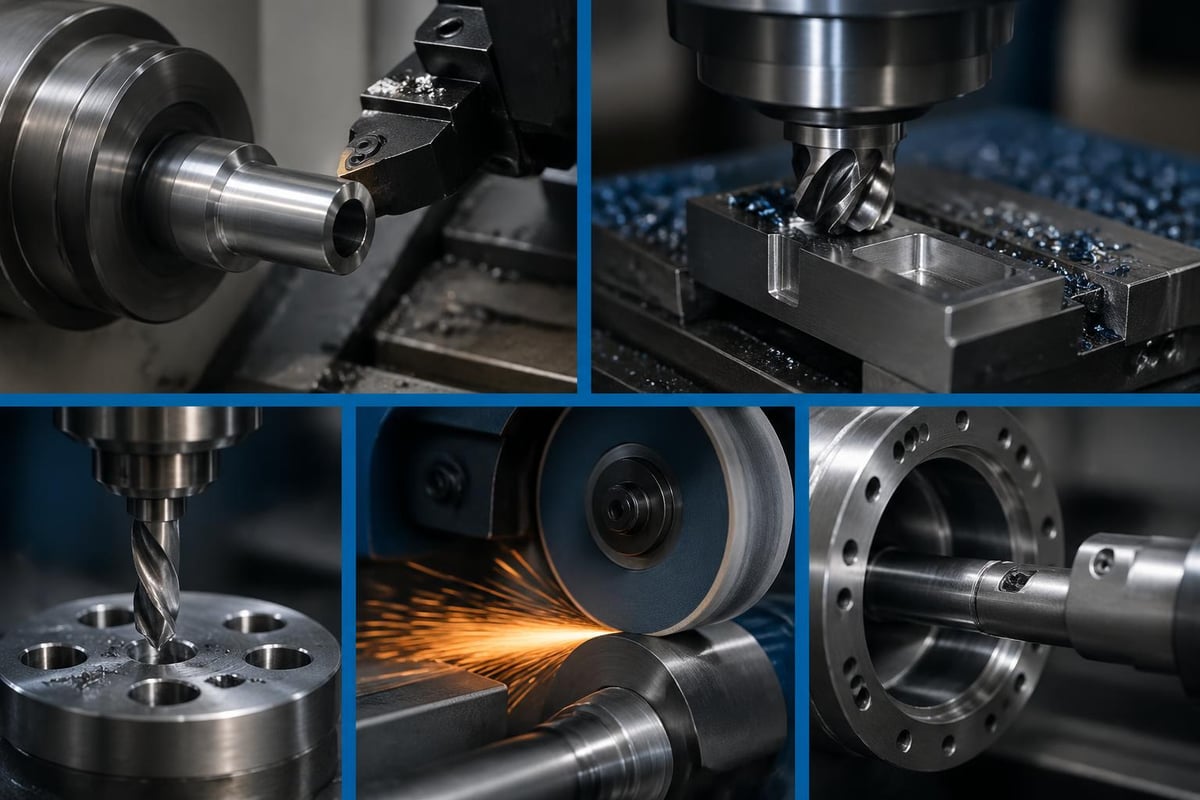
Advanced facilities integrate manufacturing and machining operations to provide comprehensive solutions. The selection of appropriate processes depends on material properties, geometric complexity, production volume, and required tolerances.
Materials and Applications
Metal machining services accommodate an extensive range of materials, each presenting unique challenges and opportunities. Carbon steels, stainless steels, aluminum alloys, copper, brass, titanium, and exotic alloys all require specific tooling, cutting parameters, and expertise.
Industrial applications span multiple sectors:
- Oil and Gas: Valve components, pump parts, drilling equipment, and pipeline fittings
- Aggregate Processing: Crusher components, conveyor parts, and screening equipment
- Recycling Operations: Shredder components, sorting machinery parts, and processing equipment
- Manufacturing: Custom fixtures, tooling, production components, and replacement parts
The metalcasting industry continues advancing machining processes, addressing challenges in component quality and production efficiency.
Precision and Quality Control Standards
Achieving consistent quality in metal machining services requires rigorous quality control protocols and measurement capabilities. Modern facilities employ advanced metrology equipment alongside traditional inspection methods to verify dimensional accuracy, surface finish, and geometric tolerances.
Tolerance Specifications
| Tolerance Class | Typical Range | Applications |
|---|---|---|
| Standard | ±0.005" to ±0.010" | General manufacturing components |
| Precision | ±0.001" to ±0.005" | Bearing surfaces, mating parts |
| Ultra-precision | ±0.0001" to ±0.001" | Critical aerospace, medical components |
Tolerance requirements directly influence process selection, tooling choices, and production costs. Projects requiring tighter tolerances demand specialized equipment, skilled machinists, and extended production times.
Surface Finish Requirements
Surface finish impacts both functional performance and aesthetic appearance. Roughness average (Ra) measurements quantify surface texture, with lower values indicating smoother finishes. Typical applications include:
- Ra 250-500 microinches: General machined surfaces, non-critical applications
- Ra 63-125 microinches: Bearing surfaces, sliding components, hydraulic components
- Ra 16-32 microinches: Precision sealing surfaces, critical mating parts
- Ra 2-8 microinches: Mirror finishes, medical implants, optical components
Research on abrasive machining and finishing techniques demonstrates how advanced processes improve surface quality for specialized applications.
CNC Technology in Modern Machining
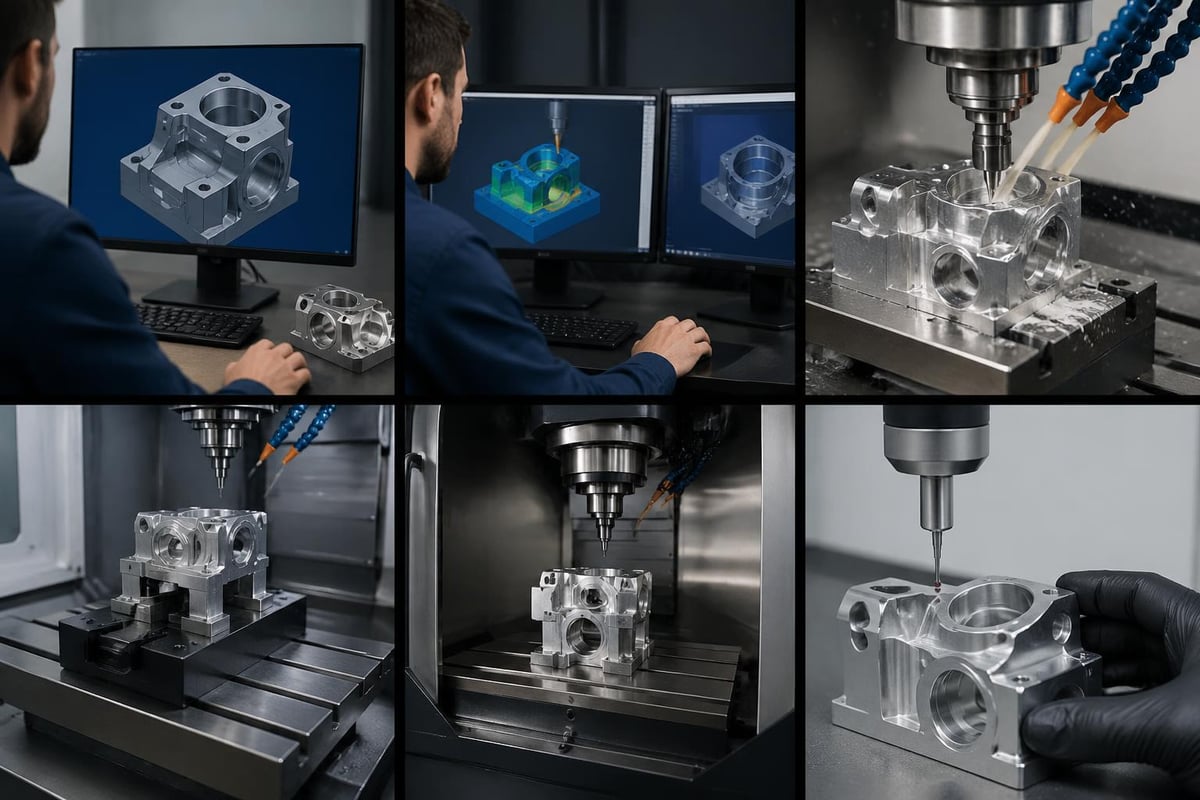
Computer Numerical Control (CNC) technology revolutionized metal machining services by enabling automated, repeatable, and highly precise operations. CNC systems translate digital designs into machine movements, producing complex geometries that would be difficult or impossible through manual machining.
Advantages of CNC Machining
Consistency and repeatability stand out as primary CNC benefits. Once programmed, CNC machines reproduce identical parts with minimal variation, essential for production runs requiring interchangeable components. This consistency extends across multiple production batches, even when separated by months or years.
Complex geometry capabilities expand design possibilities. Multi-axis CNC machines simultaneously control movement along multiple planes, creating intricate contours, undercuts, and compound angles. Five-axis machining centers access workpiece surfaces from various orientations without repositioning, reducing setup time and maintaining dimensional relationships.
Reduced human error improves quality outcomes. Automated tool changes, precisely controlled feed rates, and programmed cutting depths eliminate variables introduced through manual operation. Operators focus on setup, monitoring, and quality verification rather than continuous manual control.
Recent advances in modelling of metal machining processes help facilities optimize CNC programming for improved efficiency and part quality.
Programming and Setup Considerations
CNC programming requires expertise in CAD/CAM software, G-code generation, and machine-specific capabilities. Skilled programmers develop toolpaths that balance production speed with tool life, surface finish, and dimensional accuracy.
Setup time significantly impacts project economics, particularly for short production runs. Fixtures, work holding devices, and tooling selection all influence total production costs. Experienced industrial manufacturing company facilities minimize setup requirements through standardized work holding systems and efficient programming practices.
Custom Machining for Specialized Applications
Standard production processes address common requirements, but many industrial applications demand customized approaches. Custom metal machining services adapt capabilities to unique project specifications, material constraints, and operational environments.
Project Assessment and Planning
Successful custom machining begins with comprehensive project assessment. Engineers evaluate drawings, specifications, material requirements, and end-use conditions to develop optimal manufacturing strategies. Critical considerations include:
- Material selection based on strength, corrosion resistance, and temperature requirements
- Process selection balancing cost, timeline, and quality objectives
- Tooling requirements for specific geometries and materials
- Inspection protocols ensuring compliance with specifications
Custom metal fabrication often integrates machining operations with welding, forming, and assembly processes to deliver complete solutions.
Prototype Development and Production Runs
Custom machining supports both prototype development and production manufacturing. Prototype projects validate designs, test fit and function, and identify potential manufacturing challenges before committing to full production.
| Phase | Characteristics | Typical Applications |
|---|---|---|
| Prototype | Single or limited quantities, design flexibility | New product development, concept validation |
| Low-volume Production | 10-100 pieces, process refinement | Specialized equipment, replacement parts |
| Production Runs | 100+ pieces, optimized processes | OEM components, recurring maintenance parts |
Numerical simulations using advanced computational methods help predict machining outcomes and optimize parameters before physical production begins.
Field and Shop Machining Services
Metal machining services extend beyond traditional shop environments to include field machining capabilities. This versatility proves essential for large equipment maintenance, emergency repairs, and installations where transporting components to a shop facility is impractical or impossible.
Shop-Based Operations
Shop machining provides controlled environments with full access to specialized equipment, tooling, and measurement capabilities. Advantages include:
- Climate-controlled conditions minimizing thermal expansion effects
- Complete equipment availability supporting diverse operations
- Efficient material handling and workpiece positioning
- Comprehensive quality control and inspection resources
Manufacturing projects benefit from shop capabilities when component size, complexity, and quality requirements align with facility resources.
Field Machining Advantages
Field machining delivers precision operations directly at customer sites, eliminating transportation costs and downtime associated with component removal. Portable machining equipment handles:
- On-site shaft repair: Restoring bearing journals, sealing surfaces, and keyways
- Flange facing: Preparing mating surfaces for gaskets and seals
- Bolt hole drilling: Creating new mounting points in installed equipment
- Line boring: Aligning bearing housings and structural components
Field capabilities particularly benefit facilities in Colorado's industrial sectors, where equipment size and location make shop transport impractical.
Integration with Fabrication and Welding
Complete metal machining services often integrate with fabrication and welding operations, creating comprehensive manufacturing solutions. This integration streamlines production, maintains quality control, and simplifies project management through single-source responsibility.
Combined Process Benefits
Reduced handling and transportation minimize risks of damage and dimensional changes between operations. Components move seamlessly from fabrication through machining to final assembly without external transfers.
Maintained dimensional relationships ensure critical features align correctly. When metal fabrication and welding precede machining operations, integrated facilities maintain datums and reference surfaces throughout production.
Streamlined quality control provides consistent inspection standards across all manufacturing processes. Single-source accountability eliminates finger-pointing between separate vendors when issues arise.
Typical Integrated Projects
Manufacturing projects frequently combine multiple processes:
- Welded structural frames requiring machined mounting surfaces and precision alignment features
- Fabricated tanks or vessels needing machined flange faces and nozzle connections
- Custom equipment assemblies integrating welded components with machined precision parts
- Repair projects requiring both welding restoration and subsequent machining to final dimensions
Material Considerations and Tool Selection
Different materials respond uniquely to machining processes, requiring specific cutting tools, parameters, and expertise. Understanding material properties guides process planning and ensures optimal results.
Common Materials and Machining Characteristics
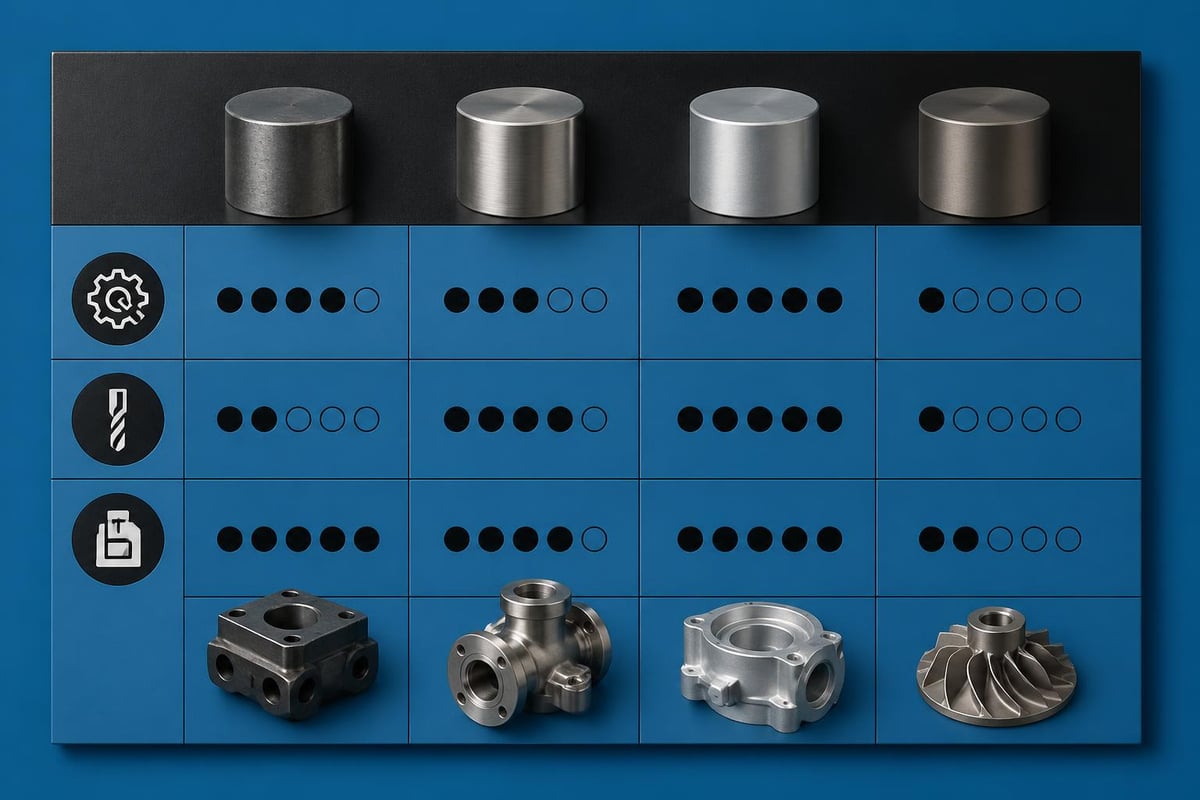
Carbon and alloy steels represent the most common machined materials, offering good machinability with appropriate tool selection. Standard cutting speeds and feeds produce quality results with reasonable tool life.
Stainless steels present increased work hardening tendencies and higher cutting forces. Positive rake angles, sharp cutting edges, and proper coolant application prevent excessive work hardening and tool wear.
Aluminum alloys machine readily at high speeds with excellent surface finish potential. However, material buildup on cutting edges requires attention to tool geometry and cutting parameters.
Exotic alloys including titanium, Inconel, and other high-temperature materials demand specialized tooling, reduced cutting speeds, and careful heat management to prevent work hardening and excessive tool wear.
Predictive models discussed in recent metal machining research help optimize parameters for challenging materials.
Tool Selection Impact
| Tool Material | Applications | Advantages | Limitations |
|---|---|---|---|
| High-Speed Steel (HSS) | General machining, manual operations | Cost-effective, tough | Limited speed capability |
| Carbide | Production machining, CNC operations | High speed, long life | More brittle, higher cost |
| Ceramic | High-speed finishing, hard materials | Extreme hardness, heat resistance | Brittle, limited toughness |
| CBN/Diamond | Hardened materials, finishing | Superior hardness, finish quality | Very expensive, specific applications |
Tool selection balances performance requirements with economic considerations, particularly for production runs where tool costs significantly impact per-piece pricing.
Quality Assurance and Inspection Methods
Metal machining services maintain quality through systematic inspection protocols using precision measurement equipment. Verification begins with first-article inspection and continues through production with appropriate sampling intervals.
Measurement Equipment and Techniques
Modern metrology supports various inspection approaches:
- Calipers and micrometers: Basic dimensional verification for features within typical tolerance ranges
- Height gauges and indicators: Surface flatness, parallelism, and perpendicularity measurements
- Coordinate measuring machines (CMM): Complex 3D geometry verification with high precision
- Optical comparators: Profile verification and small feature measurement
- Surface roughness testers: Quantitative finish measurement for critical surfaces
Inspection frequency depends on process stability, production volume, and critical feature importance. High-volume production typically employs statistical process control (SPC) methods, monitoring key dimensions to detect process trends before producing non-conforming parts.
Documentation and Traceability
Complete documentation provides quality evidence and supports traceability requirements common in regulated industries. Standard deliverables include:
- Material certifications verifying chemical composition and mechanical properties
- Inspection reports documenting measured dimensions versus specifications
- Process certifications for special processes like heat treatment
- Photographic documentation of completed components
Industrial and manufacturing projects requiring strict traceability benefit from comprehensive documentation protocols throughout production.
Maintenance and Repair Applications
Beyond new component production, metal machining services provide critical support for equipment maintenance and repair operations. Machining capabilities restore worn surfaces, adapt equipment for new applications, and extend service life for expensive capital assets.
Common Repair Scenarios
Shaft restoration addresses wear on bearing journals, sealing surfaces, and keyways. Chrome plating or thermal spray coating builds up worn diameters, followed by precision machining to restore original specifications.
Bearing housing repair corrects wear, corrosion, or damage in bearing bores. Machining oversized, installing wear sleeves, or line boring multiple housings simultaneously restores alignment and proper bearing fit.
Flange reconditioning restores sealing surfaces damaged by corrosion, scratching, or warpage. Precision flange facing ensures flat, parallel surfaces for reliable gasket sealing.
Thread repair addresses damaged internal or external threads through machining oversize and installing thread inserts, or recutting threads to the next standard size.
Emergency Response Capabilities
Equipment failures rarely occur during convenient timeframes. Facilities offering comprehensive metal machining services provide emergency response capabilities, including:
- 24/7 availability for critical breakdowns
- Expedited production schedules minimizing downtime
- Field machining capabilities bringing precision operations to the equipment location
- Extensive material inventory supporting rapid project initiation
Cost Factors and Project Economics
Understanding factors influencing metal machining services costs helps customers make informed decisions balancing quality, timeline, and budget considerations. Multiple variables impact final project pricing beyond simple per-hour machine rates.
Primary Cost Components
Setup and programming represent significant portions of total project costs, particularly for complex geometries or short production runs. Initial setup includes fixturing, tool selection, program development, and first-article verification. These costs amortize across production quantity, making longer runs more economical per piece.
Material costs vary dramatically based on alloy selection, availability, and required stock sizes. Exotic materials command premium pricing, while common grades like A36 steel offer economical options for non-critical applications.
Machining time depends on material removal rates, required surface finish, tolerance specifications, and geometric complexity. Tighter tolerances and finer finishes require slower cutting speeds and additional finishing passes.
Secondary operations including heat treatment, plating, or coating add costs but may prove necessary for application requirements. Integrated facilities streamline these operations, reducing handling and coordination expenses.
Value Engineering Opportunities
Collaboration between customers and machining service providers identifies cost reduction opportunities without compromising essential requirements:
- Material substitution using more machinable alloys with equivalent performance
- Design modifications eliminating difficult-to-machine features or relaxing non-critical tolerances
- Process optimization selecting efficient machining approaches for specific geometries
- Batch sizing balancing inventory costs against per-piece production economies
Technology Trends Shaping Metal Machining
Metal machining services continue evolving through technological advancement, process innovation, and changing customer requirements. Understanding emerging trends helps businesses anticipate future capabilities and competitive advantages.
Automation and Industry 4.0 Integration
Modern machining facilities increasingly incorporate automated material handling, robotic loading/unloading, and integrated quality inspection systems. These automation advances reduce labor costs, improve consistency, and enable lights-out manufacturing for appropriate applications.
Industry 4.0 concepts integrate sensors, data analytics, and connectivity throughout machining operations. Real-time monitoring tracks tool wear, predicts maintenance requirements, and optimizes cutting parameters based on actual performance data rather than theoretical calculations.
Advanced Materials and Processes
Additive manufacturing (3D printing) complements traditional subtractive machining by producing near-net shapes requiring minimal finish machining. Hybrid approaches combine additive material deposition with precision machining, creating complex geometries economically.
New cutting tool materials and coatings extend tool life and enable higher cutting speeds in difficult materials. Multi-layer coatings, advanced geometries, and material-specific designs optimize performance for particular applications.
Sustainability Considerations
Environmental awareness drives efficiency improvements in metal machining services. Minimum quantity lubrication (MQL) systems reduce coolant consumption while maintaining cutting performance. Advanced filtration extends coolant life and enables recycling. Efficient chip management converts waste into recyclable scrap rather than contaminated disposal requirements.
Energy-efficient machine tools, optimized programming reducing cycle times, and strategic facility design all contribute to reduced environmental impact while improving operational economics.
Successful industrial operations depend on reliable metal machining services that deliver precision components meeting exact specifications and timeline requirements. Whether supporting new equipment manufacturing, maintenance operations, or emergency repairs, the combination of advanced equipment, skilled personnel, and comprehensive capabilities ensures project success. LTJ Industrial Services provides complete machining, welding, and fabrication solutions throughout the Western United States, supporting oil and gas, aggregate, recycling, and manufacturing industries with both shop and field capabilities that keep operations running efficiently.