
The industrial manufacturing landscape has transformed dramatically in recent years, with digital channels becoming the preferred method for procurement professionals to source fabrication services. When an industrial fabrication shop requesting quote online becomes the standard practice rather than the exception, both buyers and suppliers benefit from faster turnaround times, improved accuracy, and better documentation. Understanding how to optimize this process delivers competitive advantages across the commercial and industrial manufacturing sectors, from aggregate operations to oil and gas facilities throughout the Western United States.
The Shift Toward Digital Quoting in Industrial Fabrication
Traditional procurement methods involving phone calls, faxes, and email chains have given way to sophisticated online quote request systems. Recent research from Kula Partners’ Industrial Buyer Pulse indicates that self-serve quoting adoption has accelerated significantly, with buyers expecting immediate responses and transparent pricing structures.
This digital transformation affects how companies approach welding, machining, and fabrication services. Buyers no longer tolerate week-long quote cycles when competitors deliver preliminary estimates within 24 hours. The pressure intensifies particularly in industries like recycling, where equipment downtime translates directly to lost revenue.
Key Drivers Behind Online RFQ Adoption
Several factors have accelerated the adoption of online quote request systems:
- Speed requirements: Production schedules demand rapid vendor selection and project initiation
- Documentation standards: Quality management systems require detailed audit trails
- Remote operations: Distributed teams need centralized procurement platforms
- Cost transparency: Stakeholders expect itemized quotes with clear specifications
- Vendor comparison: Buyers evaluate multiple fabrication shops simultaneously
The ability to submit detailed specifications through metal fabrication services portals has become a baseline expectation rather than a premium feature.
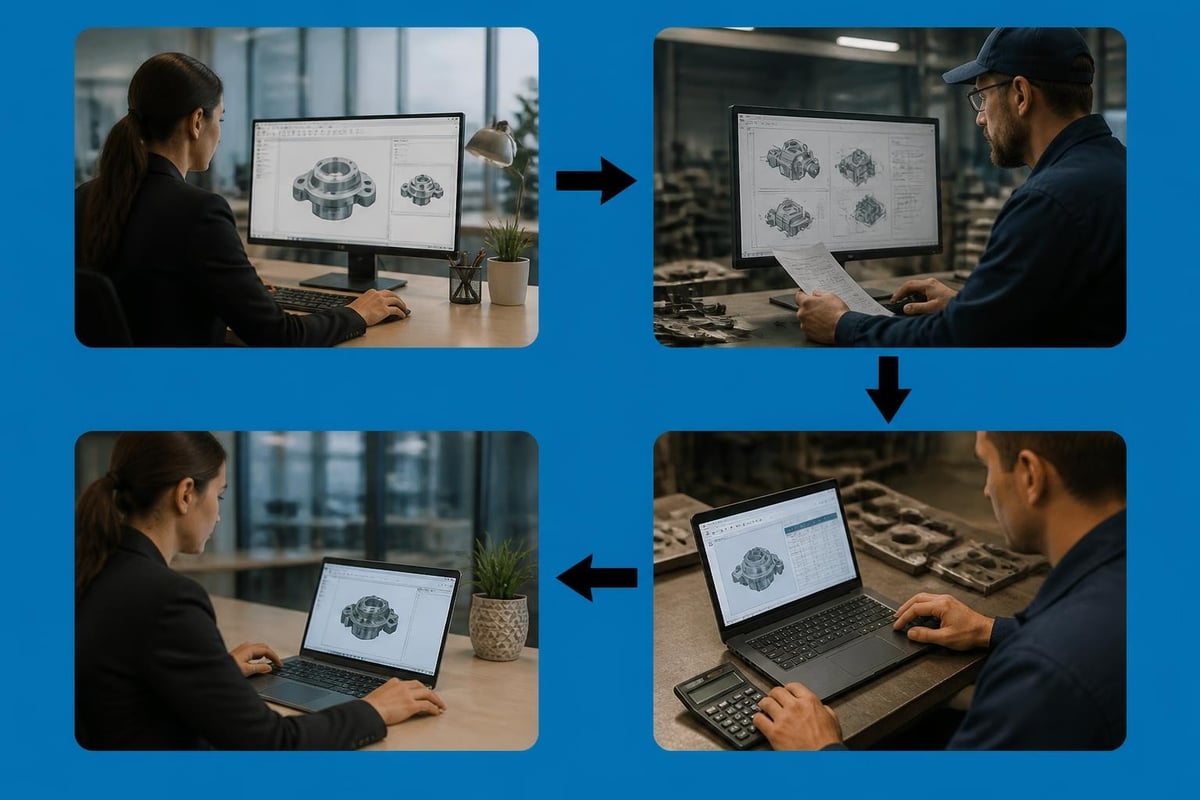
Essential Components of Effective Online RFQ Submissions
When an industrial fabrication shop requesting quote online receives your inquiry, the completeness and clarity of your submission directly impacts response quality and turnaround time. Incomplete requests generate unnecessary back-and-forth communication, delaying projects and increasing administrative costs.
Technical Specifications and Documentation
Comprehensive technical documentation forms the foundation of accurate quoting. Your submission should include:
- Detailed drawings: CAD files, PDFs with dimensions, tolerances, and material callouts
- Material specifications: Grade, certification requirements, acceptable substitutes
- Quantity requirements: Per-piece pricing, volume discounts, minimum order quantities
- Quality standards: Industry codes, testing requirements, inspection criteria
- Delivery expectations: Lead time constraints, shipping methods, packaging needs
Federal procurement guidelines outlined in Acquisition.gov’s RFP development chapter provide excellent frameworks that commercial buyers can adapt for their own quote requests, ensuring clarity and completeness.
| Documentation Type | Purpose | Impact on Quote Accuracy |
|---|---|---|
| CAD Models (.STEP, .IGES) | Dimensional verification | High – enables automated analysis |
| Material Certificates | Traceability compliance | Medium – affects sourcing costs |
| Weld Procedures | Quality assurance | High – determines labor rates |
| Inspection Plans | Testing requirements | Medium – influences overhead |
| Shipping Instructions | Logistics planning | Low – affects delivery only |
Quality Management and Certification Requirements
Quality expectations significantly influence pricing and capabilities. When requesting quotes from fabrication shops, specify relevant certifications and standards upfront. The ASME Quality Program for Suppliers provides comprehensive guidance on documentation that buyers should request or accept during the evaluation process.
For pressure vessel work or ASME code welding services for pressure piping, certification requirements must be explicit in your RFQ. Similarly, pipeline work demands specific qualifications such as certified API 1104 pipeline welding contractors credentials that directly affect vendor selection and pricing.
Safety Compliance and Regulatory Considerations
Safety and regulatory compliance add layers of complexity to industrial fabrication quotes. When an industrial fabrication shop requesting quote online evaluates your project, they assess regulatory obligations that affect scheduling, equipment, and labor costs.
OSHA standards for metal fabrication including welding, cutting, and brazing operations impose specific requirements that influence shop capabilities and pricing structures. Projects involving hazardous materials, confined space work, or specialized ventilation systems require premium rates that reflect compliance investments.
Environmental and Site-Specific Factors
Field work introduces variables that shop-based projects avoid:
- Site accessibility: Remote locations increase mobilization costs
- Environmental conditions: Extreme temperatures affect welding procedures
- Permitting requirements: Municipal and environmental permits extend timelines
- Utilities availability: Power, water, and compressed air access affects equipment selection
- Safety protocols: Client-specific safety programs require additional training
Companies providing welding businesses comprehensive services across the Western United States must account for elevation changes, weather patterns, and regional code variations when preparing quotes for field fabrication.

Technology Integration in Modern Quoting Systems
Advanced technology has revolutionized how fabrication shops process and respond to online quote requests. Artificial intelligence and automation tools discussed in IndustryWeek’s coverage of AI in manufacturing enable smaller manufacturers to deploy sophisticated analysis capabilities that were previously available only to large corporations.
Modern quoting platforms integrate:
Automated feasibility analysis that flags design-for-manufacturability issues before human review begins, saving time for both parties. Material cost databases that pull real-time pricing from suppliers, ensuring quotes reflect current market conditions. Capacity planning tools that check shop schedules against delivery requirements, preventing overcommitment. Compliance verification that cross-references project specifications against shop certifications and capabilities.
Data Security and Intellectual Property Protection
When submitting proprietary designs through online portals, intellectual property protection becomes paramount. Reputable fabrication shops implement secure file transfer protocols, non-disclosure agreements, and access controls that safeguard customer information.
Before uploading sensitive technical data, verify that the shop's online system provides:
- Encrypted data transmission (SSL/TLS certificates)
- User authentication and access logging
- Automatic NDA acceptance workflows
- Secure file storage with retention policies
- Export control compliance for ITAR/EAR items
Manufacturing and machining operations handling defense, aerospace, or energy sector work maintain rigorous data security protocols that meet or exceed industry standards.
Optimizing Quote Request Content for Better Responses
The quality of responses when an industrial fabrication shop requesting quote online evaluates your project correlates directly with how well you communicate project requirements. Vague or incomplete requests generate equally vague responses that provide little value for decision-making.
Structuring Your RFQ for Maximum Clarity
Organize quote requests using consistent formatting that fabrication shops can quickly parse and evaluate:
Project Overview Section: Brief description including application, operating environment, and criticality to operations. Context helps shops understand quality priorities and recommend appropriate solutions.
Technical Requirements Section: Detailed specifications organized by component or assembly. Use tables for complex projects with multiple items requiring individual pricing.
Schedule and Logistics Section: Milestone dates, delivery windows, and preferred shipping methods. Specify whether partial shipments are acceptable or if complete orders must ship together.
| RFQ Element | Buyer Benefit | Shop Benefit |
|---|---|---|
| Part numbering system | Easier change tracking | Accurate order processing |
| Revision history | Version control | Avoids obsolete quotes |
| Preferred alternates | Cost flexibility | Material sourcing options |
| Inspection hold points | Quality assurance | Process planning |
| Payment terms | Budget management | Cash flow planning |
Common Pitfalls to Avoid
Even experienced procurement professionals make mistakes that compromise quote quality. Avoid these frequent errors:
Insufficient lead time: Requesting quotes with unrealistic delivery expectations forces shops to either decline or pad pricing for expedite charges. Allow adequate time for material procurement, production scheduling, and quality verification.
Ambiguous specifications: References to "standard tolerances" or "typical finishes" without defining those standards create confusion. One shop's standard may be another's premium service. Define expectations explicitly using industry standards like ASME’s general industry quality program guidelines.
Missing quantity break points: Requesting pricing for a single quantity prevents cost optimization through batch production. Ask for pricing at multiple quantities (1, 5, 25, 100) to identify economies of scale.
Evaluating Responses and Vendor Selection Criteria
When quotes arrive from multiple shops after an industrial fabrication shop requesting quote online process concludes, systematic evaluation prevents costly mistakes. Price represents only one factor in total cost of ownership.
Beyond Price: Total Value Assessment
Comprehensive vendor evaluation considers multiple dimensions:
- Technical capability: Does the shop possess equipment and expertise for your specific requirements?
- Quality credentials: Do certifications align with your industry standards and customer expectations?
- Financial stability: Can the vendor sustain operations through multi-week or multi-month projects?
- Communication responsiveness: How quickly did they respond, and how thoroughly did they address questions?
- References and track record: What do similar customers report about on-time delivery and quality?
Companies serving demanding sectors like industrial and manufacturing operations understand that reliability and consistency often outweigh marginal price differences, particularly for critical path components.

Industry-Specific Quoting Considerations
Different industrial sectors impose unique requirements that affect the quoting process. Understanding these nuances helps buyers communicate effectively and shops price accurately.
Oil and Gas Sector Requirements
Projects in oil and gas demand rigorous material traceability, specialized welding procedures, and often API or ASME certification. When requesting quotes for pipeline work, pressure vessels, or wellhead equipment, specify:
- Material test reports (MTRs) and positive material identification (PMI) requirements
- Welding procedure specifications (WPS) and procedure qualification records (PQR)
- Non-destructive testing (NDT) methods and acceptance criteria
- Code compliance documentation and third-party inspection needs
- Environmental conditions affecting material selection and joining processes
Recycling and Aggregate Industry Needs
Equipment for recycling and aggregate operations faces extreme abrasion, impact loading, and corrosive environments. Quote requests should address:
Wear resistance: Hardplate specifications, overlay welding requirements, and expected service life. Access for maintenance: Removable wear components, standard bolt patterns, and field replaceability. Safety features: Guarding, lockout/tagout provisions, and compliance with industry-specific regulations.
Manufacturing shops experienced in these demanding applications can recommend material upgrades and design modifications that extend equipment life and reduce total ownership costs.
Regional Considerations for Western United States Projects
Geography introduces practical factors that affect quoting and project execution. When an industrial fabrication shop requesting quote online operates across the Western United States, regional variables influence pricing and scheduling.
Elevation and Climate Impacts
High-altitude locations common throughout Colorado and neighboring states affect welding processes, material properties, and equipment performance. Shops must account for:
- Adjusted welding parameters for reduced atmospheric pressure
- Cold weather preheat requirements and interpass temperature controls
- Transportation logistics for mountainous terrain and seasonal road conditions
- Local labor availability and prevailing wage requirements
Companies based in regions like Rifle, CO develop expertise managing these challenges across industries in Colorado and throughout the mountain West.
Multi-State Project Coordination
Projects spanning multiple states require coordination of permits, inspections, and compliance across jurisdictions. Effective online quote requests for multi-location work should specify:
- Primary and satellite work locations with addresses and site contacts
- Jurisdictional requirements for each location (state, county, municipal)
- Mobilization sequence and schedule coordination between sites
- Equipment transportation between locations and associated logistics
- Regional labor agreements or union requirements
Specialized Service Integration
Comprehensive industrial projects often require multiple complementary services beyond basic fabrication. When an industrial fabrication shop requesting quote online can provide integrated capabilities, project coordination improves and schedule risk decreases.
Complementary Capabilities to Consider
Machining services: Precision boring, milling, turning, and drilling that complete fabricated assemblies without transferring between vendors. Hydraulic systems: Design, fabrication, and testing of hydraulics manufacturing components including cylinders, manifolds, and power units. Water jetting: High-pressure cleaning, surface preparation, and cutting services that support fabrication workflows through water jetting company capabilities.
Integrated service providers streamline project management, reduce logistics complexity, and maintain single-point accountability for project success.
| Service Combination | Project Type | Efficiency Gain |
|---|---|---|
| Fabrication + Machining | Structural frames with precision bores | 15-20% schedule reduction |
| Welding + NDT | Pressure vessels and piping | Single-source quality control |
| Fabrication + Hydraulics | Mobile equipment cylinders | Integrated testing and validation |
| Cutting + Forming + Welding | Custom enclosures and guards | Coordinated material flow |
Field Service Capabilities
Shop-based fabrication represents only part of the value chain. Many projects require on-site installation, modification, or repair services. When evaluating quotes, consider whether the shop provides field capabilities including:
- Mobile welding and machining equipment for on-site work
- Certified field technicians with appropriate safety training
- Emergency response capabilities for unplanned outages
- Preventive maintenance programs that extend equipment life
Industrial businesses across sectors from mining to energy increasingly value vendors who can seamlessly transition between shop and field environments, particularly for complex projects requiring both fabrication and installation expertise.
Quality Documentation and Traceability Requirements
Modern manufacturing quality systems demand comprehensive documentation that traces materials, processes, and inspections from raw material to finished product. When an industrial fabrication shop requesting quote online receives requirements for extensive documentation, costs increase accordingly.
Understanding documentation levels helps buyers request appropriate rigor without over-specifying:
Level 1 – Basic compliance: Certificates of conformance, dimensional reports, and visual inspection records suitable for non-critical commercial applications.
Level 2 – Enhanced traceability: Material test reports, weld maps, NDE reports, and calibration records appropriate for industrial equipment and pressure boundary components.
Level 3 – Full traceability: Complete procedure documentation, traveler records, personnel qualifications, and third-party witnessing required for critical service applications and regulated industries.
ISO 9001 purchasing and supplier selection guidance helps buyers determine appropriate quality requirements to communicate in RFQ documentation, balancing cost against risk.
Long-Term Partnership Considerations
While individual quotes focus on specific projects, strategic buyers think beyond transactions toward partnerships. When an industrial fabrication shop requesting quote online demonstrates capabilities, responsiveness, and cultural fit, developing long-term relationships delivers mutual benefits.
Building Strategic Vendor Relationships
Effective partnerships evolve through consistent communication and mutual investment:
Blanket purchase agreements: Negotiated rates for recurring requirements that eliminate repetitive quoting cycles. Consignment inventory: Critical components held on-site or nearby for rapid deployment during emergencies. Process improvement collaboration: Joint initiatives that reduce costs, improve quality, or accelerate delivery. Capacity reservation: Guaranteed production slots during peak demand periods in exchange for volume commitments.
Companies serving US industrial sectors understand that customer success drives long-term growth, making partnership orientation a competitive differentiator.
Effective online quote requesting processes combine comprehensive technical specifications, clear quality expectations, and realistic scheduling requirements to generate accurate responses from qualified fabrication shops. By structuring RFQs systematically and evaluating responses holistically, industrial buyers secure the capabilities, quality, and reliability their operations demand. LTJ Industrial Services brings decades of experience serving the commercial and industrial manufacturing sectors throughout the Western United States, combining shop-based fabrication and machining with field service capabilities to deliver complete solutions for your most demanding projects.