The manufacturing landscape continues to evolve rapidly, and businesses across the Western United States rely on specialized partners to deliver precision work on time and within budget. An industrial fabrication co serves as the backbone for companies in oil & gas, aggregate, and recycling sectors, providing comprehensive welding, machining, and metal fabrication services that keep operations running smoothly. Understanding what sets exceptional fabrication partners apart helps manufacturers make informed decisions when selecting providers for critical projects.
What Defines an Industrial Fabrication Co in 2026
An industrial fabrication co encompasses far more than basic metalworking. These specialized operations combine advanced machining capabilities, certified welding expertise, and comprehensive shop services under one roof.
Core Competencies and Service Offerings
Modern fabrication companies must deliver diverse capabilities to meet industry demands. The most competitive providers offer integrated solutions that eliminate the need for multiple vendors.
Essential service categories include:
- Custom metal fabrication for structural and specialty applications
- Precision machining with CNC and conventional equipment
- Certified welding processes including ASME code work
- Hydraulic system design, repair, and maintenance
- Field services for on-site repairs and installations
- Water jetting for cutting and surface preparation
These capabilities allow an industrial fabrication co to handle projects from initial design through final installation. Companies serving the aggregate industry, for example, frequently require custom conveyor components, structural repairs, and equipment modifications that demand multiple skill sets. Manufacturing and machining services that integrate these disciplines provide significant advantages in project coordination and timeline management.
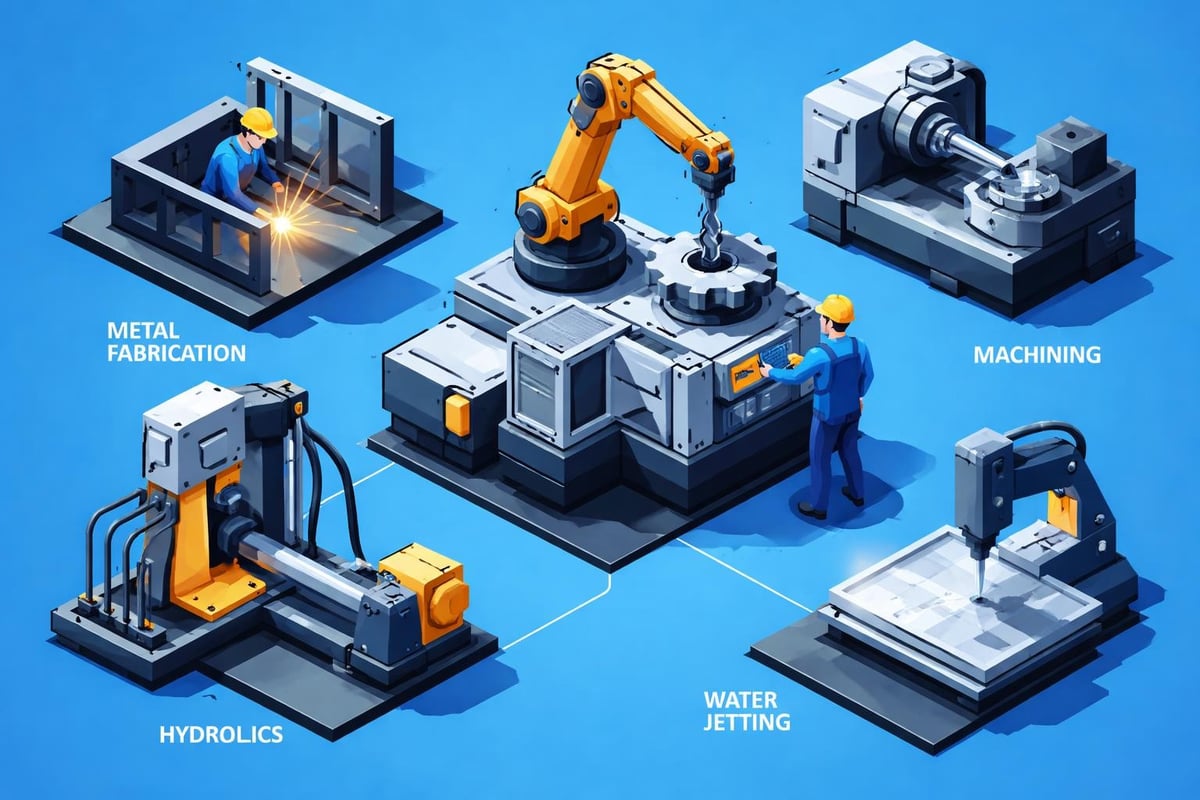
The shift toward integrated service models reflects broader industry trends. According to key trends shaping industrial fabrication, digital transformation and workforce evolution are driving companies to streamline operations and reduce vendor dependencies.
Quality Standards That Separate Leaders from Competitors
Quality control represents the foundation of reliable fabrication work. An industrial fabrication co must implement rigorous standards that ensure consistent results across diverse projects.
Documentation and Certification Requirements
Proper documentation creates accountability and traceability throughout manufacturing processes. Adhering to fabrication standards requires comprehensive record-keeping systems that track materials, procedures, and inspection results.
| Quality Element | Implementation Method | Business Impact |
|---|---|---|
| Material Certification | Mill test reports verification | Ensures specification compliance |
| Welding Procedures | WPS/PQR documentation | Meets code requirements |
| Inspection Records | NDT and visual inspection logs | Provides quality assurance |
| Calibration Tracking | Equipment certification maintenance | Guarantees measurement accuracy |
These systems become particularly critical when fabricating components for pressure vessels or structural applications. ASME code welding services require meticulous documentation that withstands third-party inspection and regulatory review.
Continuous Improvement and Employee Training
The most successful fabrication companies invest heavily in workforce development. Quality control best practices emphasize ongoing training programs that keep welders, machinists, and fabricators current with evolving techniques and standards.
Effective training programs address:
- New welding processes and metallurgy fundamentals
- CNC programming and advanced machining techniques
- Blueprint reading and geometric dimensioning
- Safety protocols and OSHA compliance requirements
- Quality inspection methods and measurement tools
An industrial fabrication co that prioritizes skill development maintains competitive advantages in precision work and problem-solving capabilities. This investment pays dividends when tackling complex projects that require innovative approaches.
Safety Culture and OSHA Compliance
Workplace safety transcends regulatory compliance, representing a fundamental business value that protects employees and reduces operational risks. Manufacturing environments present inherent hazards that demand proactive management.
Equipment Safety and Hazard Mitigation
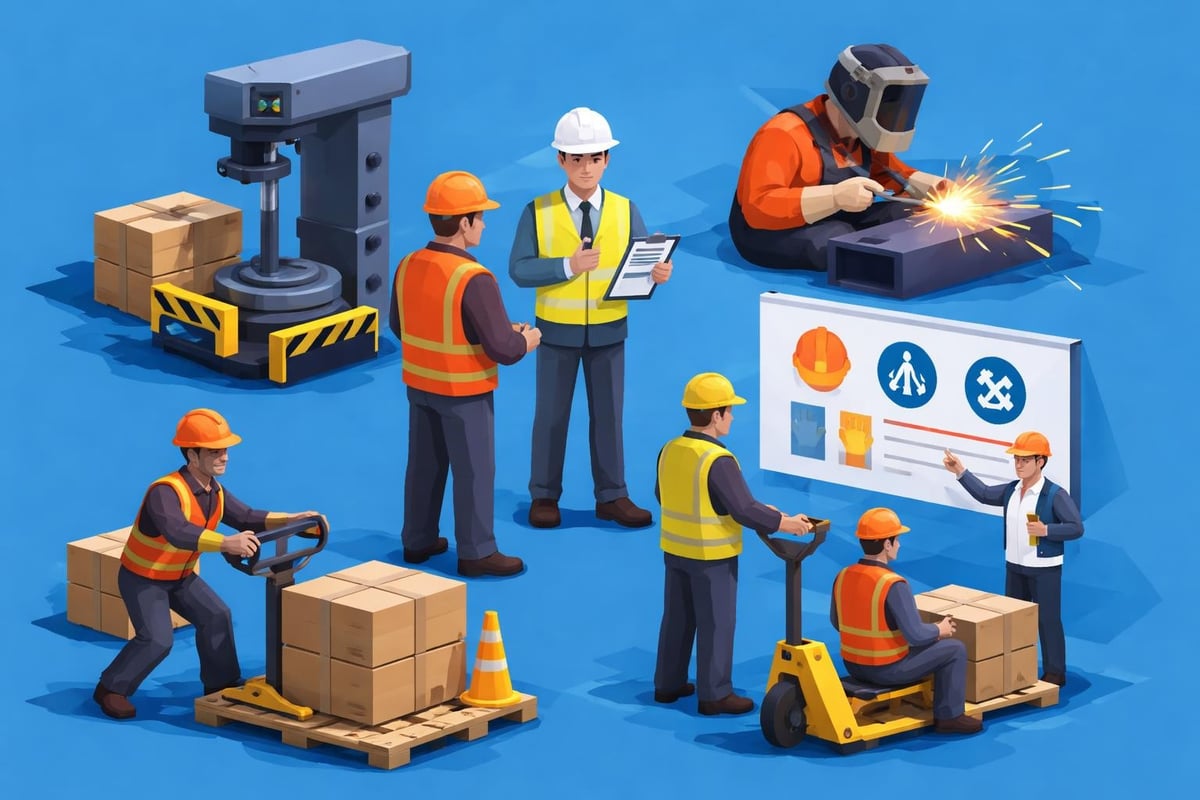
Proper equipment maintenance and safety protocols prevent accidents and equipment damage. OSHA best practices for fabricators provide frameworks for identifying hazards and implementing protective measures.
Machine guarding, proper ventilation systems, and personal protective equipment form the first line of defense against workplace injuries. An industrial fabrication co must establish clear procedures for equipment operation, maintenance lockout/tagout, and hazardous material handling.
Critical safety focus areas include:
- Welding fume extraction and respiratory protection
- Crane and rigging operations for heavy materials
- Confined space entry protocols
- Chemical handling and storage procedures
- Fire prevention and emergency response
Regular safety audits and employee feedback sessions help identify potential hazards before incidents occur. Companies serving industrial sectors understand that safety performance directly impacts project timelines and client relationships.
Industry-Specific Expertise and Market Positioning
Different industrial sectors present unique challenges that require specialized knowledge and experience. An industrial fabrication co serving diverse markets must understand the specific requirements of each industry.
Oil & Gas Sector Requirements
The energy industry demands fabrication partners capable of working with exotic materials, high-pressure applications, and strict regulatory environments. Projects often involve pipeline components, processing equipment, and field installations that require certified welders and documented procedures.
Heavy equipment welding in oil & gas applications frequently involves thick-section materials, preheat requirements, and post-weld heat treatment. Fabricators must maintain certifications and demonstrate proven performance in critical service applications.
Aggregate and Mining Applications
Aggregate operations subject equipment to extreme wear and demanding duty cycles. Conveyor systems, crushing equipment, and screening machinery require robust fabrication work that withstands abrasive materials and continuous operation.
An industrial fabrication co serving this sector develops expertise in wear-resistant materials, structural reinforcement techniques, and rapid repair capabilities that minimize downtime. Field service capabilities become essential for addressing equipment failures at remote sites.
Recycling Industry Demands
Recycling facilities process diverse materials that create unique challenges for equipment design and maintenance. Custom fabrication work must accommodate varying material characteristics while maintaining efficiency and safety standards.
| Industry Sector | Primary Challenges | Required Capabilities |
|---|---|---|
| Oil & Gas | Code compliance, exotic materials | Certified welding, documentation |
| Aggregate | Abrasion resistance, structural integrity | Heavy fabrication, field service |
| Recycling | Material diversity, custom equipment | Adaptive design, quick turnaround |
| Manufacturing | Precision tolerances, production support | Machining accuracy, inventory management |
Understanding these sector-specific requirements allows fabrication companies to develop targeted capabilities and deliver superior results. Industrial and manufacturing projects often cross multiple disciplines, requiring partners who understand the interconnected nature of modern industrial operations.
Strategic Location and Regional Service Advantages
Geographic positioning significantly impacts service delivery, response times, and logistical efficiency. An industrial fabrication co located in the Western United States can serve multiple industrial centers while maintaining accessibility to remote operations.
Western United States Industrial Landscape
The Rocky Mountain region and surrounding areas host significant oil & gas activity, mining operations, and manufacturing facilities. Companies based in strategic locations like Colorado can efficiently serve clients across multiple states while providing rapid response for emergency repairs.
Proximity to major transportation corridors facilitates material sourcing and finished product delivery. An industrial fabrication co with established supplier relationships and logistics capabilities reduces project lead times and controls costs.
Regional advantages include:
- Access to diverse industrial sectors and project types
- Reduced mobilization costs for field service work
- Familiarity with regional environmental and regulatory requirements
- Established relationships with local suppliers and subcontractors

Custom welding services delivered locally provide significant advantages over distant providers, particularly for projects requiring site visits, measurements, or iterative design collaboration.
Digital Transformation and Modern Business Practices
Technology adoption separates progressive fabrication companies from those struggling to compete. An industrial fabrication co that embraces digital tools gains efficiency, accuracy, and competitive positioning advantages.
CAD/CAM Integration and Design Collaboration
Modern fabrication work begins with digital design tools that enable precise specifications and collaborative development. Computer-aided design (CAD) systems allow clients to visualize components before fabrication begins, reducing errors and revision cycles.
CAM (computer-aided manufacturing) integration translates designs directly into machine code for CNC equipment, eliminating manual programming errors and accelerating production. This seamless workflow improves accuracy while reducing lead times.
A case study on digital strategy success demonstrates how fabrication companies generate substantial new business through technology adoption and digital marketing initiatives.
Project Management and Communication Systems
Effective project coordination requires robust communication tools and transparent progress tracking. Cloud-based project management platforms enable real-time updates, document sharing, and milestone tracking that keep stakeholders informed.
Digital tools enhance:
- Material procurement and inventory tracking
- Production scheduling and capacity planning
- Quality documentation and inspection records
- Customer communication and project updates
- Financial tracking and cost analysis
An industrial fabrication co that implements these systems delivers superior customer service while improving internal efficiency. Clients gain visibility into project status without constant phone calls or emails.
Material Selection and Supply Chain Management
Material quality and availability directly impact project success and profitability. Sophisticated fabrication companies develop supplier relationships and inventory strategies that ensure material access while controlling costs.
Strategic Material Sourcing
The global fabricated metal products market continues expanding, with market valuations reaching $1,200 billion driven by infrastructure development and industrial growth. This demand creates supply chain pressures that require proactive management.
An industrial fabrication co must balance material costs against delivery reliability and quality assurance. Relationships with multiple suppliers provide flexibility when facing availability challenges or urgent project requirements.
Material management considerations:
- Mill certification and traceability requirements
- Inventory carrying costs versus just-in-time delivery
- Alternative material specifications and equivalents
- Domestic versus international sourcing decisions
- Specialty alloy availability and lead times
Quality Verification and Testing
Material certification represents only the starting point for quality assurance. Physical testing and verification ensure that materials meet project specifications and performance requirements.
Hardness testing, chemical analysis, and mechanical testing provide data that confirms material properties. An industrial fabrication co with testing capabilities reduces reliance on external laboratories and accelerates project timelines.
Field Service Capabilities and Emergency Response
Shop-based fabrication represents only one dimension of comprehensive service offerings. Field service capabilities extend fabrication expertise directly to client facilities, addressing urgent repairs and on-site installations.
Mobile Welding and Repair Services
Equipment failures rarely occur during convenient business hours or favorable weather conditions. An industrial fabrication co that maintains field service capabilities provides emergency response that minimizes production downtime.
Certified welders equipped with portable welding equipment can address structural repairs, pipeline modifications, and equipment breakdowns at remote locations. This flexibility proves invaluable for operations where transporting equipment to a shop facility creates unacceptable delays.
On-Site Machining and Installation
Large components often cannot be economically transported to fabrication shops. Portable machining equipment enables precision work at customer facilities, including bearing journal repair, flange facing, and valve seat machining.
| Service Type | Application Examples | Primary Benefits |
|---|---|---|
| Mobile Welding | Pipeline repairs, structural modifications | Eliminates transportation, reduces downtime |
| Portable Machining | Bearing surfaces, flange facing | Maintains alignment, controls costs |
| Hydraulic Service | Cylinder repair, system troubleshooting | Rapid response, system optimization |
| Water Jetting | Surface preparation, concrete removal | Versatile application, minimal damage |
These capabilities distinguish full-service providers from limited-scope competitors. Structural steel fabrication projects frequently require both shop work and field installation, making integrated capabilities particularly valuable.
Competitive Pricing and Value Delivery
Cost considerations influence every purchasing decision, but sophisticated buyers recognize that lowest price rarely equals best value. An industrial fabrication co must demonstrate cost-effectiveness through quality work, reliable delivery, and comprehensive service.
Transparent Quoting and Project Estimation
Detailed quotes that break down labor, materials, and overhead costs build customer confidence and enable informed decision-making. Hidden costs and surprise charges damage relationships and create budget challenges.
Experienced estimators analyze drawings, specifications, and project requirements to develop accurate pricing that reflects actual work scope. This precision prevents scope disputes and change order conflicts during project execution.
Value-focused pricing considers:
- Material costs and current market conditions
- Labor hours based on proven production rates
- Equipment utilization and setup requirements
- Quality assurance and inspection costs
- Delivery, installation, and warranty support
Long-Term Partnership Economics
Single-transaction pricing differs significantly from partnership-based relationships. An industrial fabrication co serving repeat customers develops efficiency advantages through familiarity with requirements, streamlined processes, and optimized inventory strategies.
Industry best practices emphasize relationship development and continuous improvement initiatives that benefit both fabricators and clients. Volume commitments, scheduled maintenance agreements, and collaborative planning create mutual value.
Capacity Planning and Production Flexibility
Manufacturing capacity constraints limit growth potential and service reliability. An industrial fabrication co must balance equipment investment against market demand while maintaining flexibility for project variations.
Equipment Investment and Capability Development
Strategic equipment purchases expand service offerings and improve competitive positioning. CNC machining centers, automated welding systems, and specialty tooling require significant capital investment but deliver long-term returns through improved efficiency and quality.
Capacity decisions must consider market trends, customer requirements, and competitive positioning. Overcapacity creates financial burdens, while insufficient capacity forces work refusals and delays.
Capacity optimization strategies:
- Flexible scheduling that accommodates varying project sizes
- Subcontractor relationships for overflow and specialty work
- Multi-shift operations during peak demand periods
- Cross-training employees for multiple equipment types
- Preventive maintenance that maximizes equipment availability
Managing Project Mix and Scheduling
Diverse project portfolios require sophisticated scheduling that balances large contracts against quick-turn repairs. An industrial fabrication co must optimize production flow while meeting committed delivery dates.
Production planning software helps visualize capacity utilization, identify bottlenecks, and allocate resources efficiently. This visibility enables proactive communication with customers when schedule adjustments become necessary.
Environmental Responsibility and Sustainable Practices
Environmental stewardship represents both regulatory compliance and corporate responsibility. Manufacturing operations generate waste streams, emissions, and environmental impacts that require management and mitigation.
Waste Reduction and Recycling Programs
Metal fabrication inherently produces scrap material, cutting fluids, and consumable waste. An industrial fabrication co can implement programs that minimize waste generation while recovering value from unavoidable byproducts.
Scrap metal recycling returns value while reducing landfill disposal. Proper segregation of stainless steel, aluminum, and carbon steel maximizes recovery rates. Cutting fluid recycling systems extend fluid life and reduce hazardous waste volumes.
Sustainable practice areas:
- Energy-efficient equipment and lighting systems
- Waste minimization through optimized cutting patterns
- Water conservation and treatment systems
- Emissions control and air quality management
- Sustainable packaging and shipping practices
Regulatory Compliance and Reporting
Environmental regulations continue evolving, requiring proactive compliance management. Proper permitting, emissions monitoring, and waste disposal documentation prevent violations and demonstrate environmental stewardship.
An industrial fabrication co serving regulated industries must maintain environmental compliance while helping clients meet their sustainability objectives. This alignment creates competitive advantages with environmentally conscious customers.
Technology Adoption and Future-Ready Operations
Emerging technologies promise to reshape manufacturing operations over the coming years. An industrial fabrication co that monitors technological developments and selectively adopts proven innovations maintains competitive relevance.
Automation and Robotics Integration
Automated welding cells, robotic material handling, and lights-out machining enable production efficiency previously unattainable. These technologies require substantial investment but deliver consistency, speed, and quality improvements.
Successful automation implementation balances technology capabilities against practical business requirements. Not every operation benefits from full automation, and hybrid approaches often deliver optimal results.
Advanced Materials and Processes
New alloys, composite materials, and joining technologies expand fabrication possibilities while creating learning requirements. An industrial fabrication co must invest in training and equipment to work with emerging materials.
Additive manufacturing, laser cutting, and friction stir welding represent technologies gaining traction in industrial applications. Early adoption creates competitive advantages, while delayed implementation risks obsolescence.
Successfully navigating modern manufacturing demands requires partnerships with capable, reliable fabrication providers who deliver comprehensive services and proven expertise. Whether your operation needs certified welding, precision machining, or custom fabrication solutions, choosing the right industrial fabrication co impacts project success and long-term operational efficiency. LTJ Industrial Services combines shop and field capabilities with deep experience across oil & gas, aggregate, and recycling sectors throughout the Western United States, delivering the quality and responsiveness your projects demand.