
CNC plasma cutting uses a computer-guided plasma torch to cut electrically conductive metals such as carbon steel, stainless steel and aluminum into repeatable shapes from sheet and plate. It is the fastest and most economical way to produce structural and mid-thickness parts, which is why industrial operations rely on it for brackets, base plates, guards, flanges and replacement components. For operations managers in oil and gas, mining, construction and recycling, the real decision is whether to buy a table, hire a cutting service, or combine cutting with fabrication under one roof.
This article covers how the process works, what to look for in a machine, three CNC plasma tables with their published specs, and how an outsourced service compares.
How CNC Plasma Cutting Works
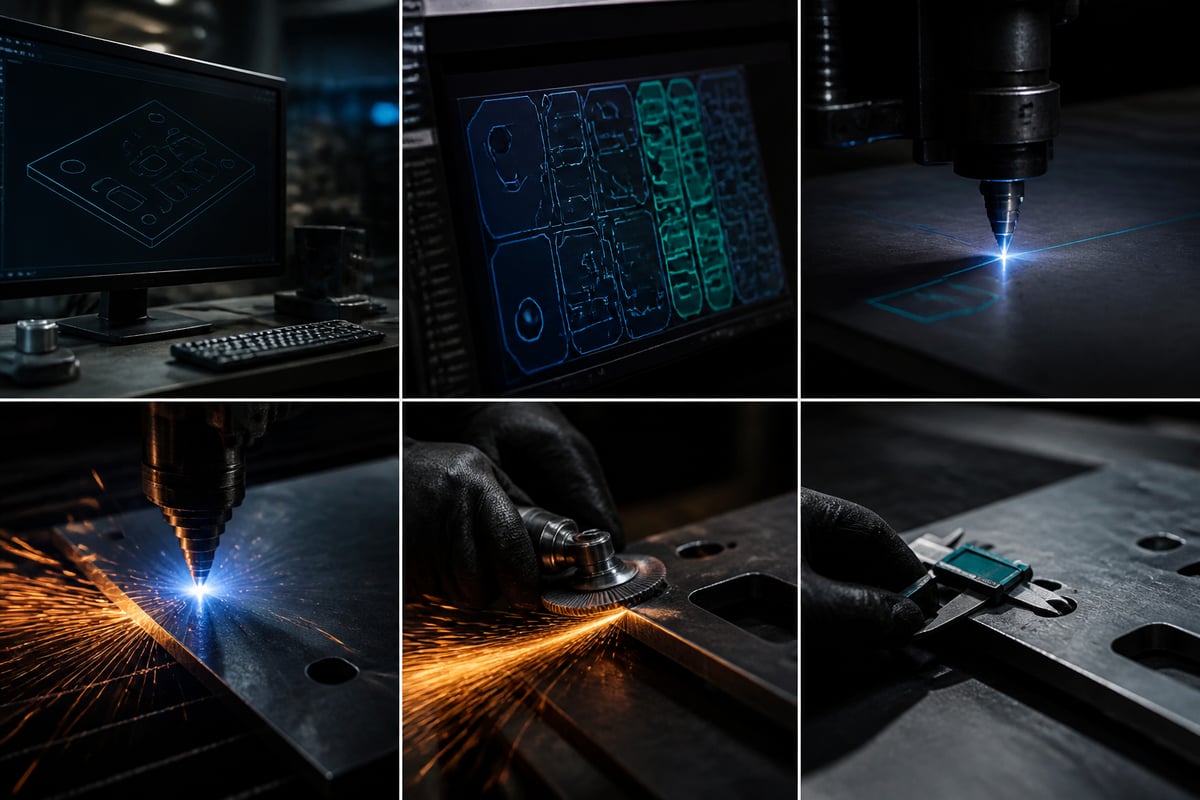
A CNC plasma system ionizes compressed gas into a high-temperature arc that melts the metal and blows it clear of the kerf. A controller moves the torch along a programmed path, usually generated from a CAD drawing and nested in software to reduce scrap.
Four elements decide cut quality:
- Power supply amperage: Higher amperage cuts thicker plate and cuts it faster.
- Torch height control: Automatic height control holds a consistent standoff over warped plate, which keeps bevel and dross down.
- Table and motion system: Rigid gantries and quality drives keep the torch on the programmed path at speed.
- Consumables and gas: Nozzles, electrodes and shield gas wear continuously and affect edge quality.
Plasma leaves a heat-affected zone and a slight edge bevel. For parts that will be welded or bolted in structural service, that is normally acceptable. For tight bores or machined faces, the part is usually cut oversize and finished by machining. LTJ's own guide on custom fabrication and the difference between structural and machining tolerances explains where that line falls.
What to Look for When Choosing a CNC Plasma Cutting Setup
A CNC plasma cutting setup should be judged on the thickness you cut most often, the plate size you handle, and the edge quality your downstream welding or machining requires. Five checks narrow the field quickly:
- Cut thickness: Match rated capacity to your typical plate, with margin. Published maximums are for severance, not clean production cuts.
- Table size: A 4 x 8 ft bed handles standard sheet; structural and heavy plate work often needs 6 x 20 ft or larger.
- Height control and drives: Automatic torch height control matters more than headline speed on field-grade, uneven plate.
- Fume and water management: Downdraft tables or water tables control smoke and dust, which matters in an enclosed shop.
- Consumable cost and support: Torch consumables are a recurring expense, and warranty terms vary by maker.
Operators in the Western US also need to weigh staffing. A table is only productive when someone programs, nests, loads and maintains it. For intermittent demand, a cutting service often costs less than the labor and floor space a machine requires.
1. FORSUN Portable CNC Metal Plasma Cutting Machine with 100A Power Supply (FS1325P)
The FS1325P is a portable CNC plasma table aimed at sheet and plate cutting in small workshops or at on-site locations. FORSUN lists its X/Y travel as 1,300 x 2,500 mm (4 x 8 ft), with larger table options including 1,500 x 3,000 mm (5 x 10 ft).
Key specs:
- X/Y travel: 1,300 x 2,500 mm (4 x 8 ft)
- Plasma power options: 63 A, 100 A, 105 A, 120 A, 160 A or 200 A
- Listed cutting thickness: carbon steel 0 to 50 mm; stainless steel 0 to 20 mm
- Maximum rapid travel speed: 40,000 mm/min
- Two-year warranty
Approximate price: Listed as $1,500 to $6,000 on the FORSUN product page, depending on configuration.
Best use: Sheet and plate cutting where a portable, standard 4 x 8 ft footprint is enough, such as brackets, gussets and repair parts produced in a small shop or at a remote site.
Verdict: A flexible entry-level table with a wide choice of power supplies.
2. FORSUN Portable CNC Plasma Cutter for Precision Metal Cutting (FS1325P)
This listing covers the same FS1325P platform with an emphasis on motion control and cut consistency. FORSUN describes it as having automatic height control and lists cutting speeds above 20 m/min on its product page.
Key specs:
- Automatic torch-height control
- X/Y travel: 1,300 x 2,500 mm (4 x 8 ft)
- Plasma power options: 63 A to 200 A
- Cutting speeds above 20 m/min per the product page
Approximate price: Listed as $1,500 to $6,000 on the FORSUN product page.
Best use: Small shops that cut a range of metals and want automatic height control to keep edge quality steady on plate that is not perfectly flat.
Verdict: Choose this listing when height control and cut consistency are the priority over portability alone.
3. FORSUN Frame-Style CNC Metal Plasma Cutting Machine (FS2060P)
The FS2060P is a larger frame-style table designed for full-size plate and structural work. FORSUN lists 2,000 x 6,000 mm X/Y travel with plasma-power options from 63 A to 200 A.
Key specs:
- X/Y travel: 2,000 x 6,000 mm
- Plasma power options: 63 A to 200 A
- Listed cutting thickness: carbon steel 0 to 50 mm; stainless steel 0 to 20 mm
- Maximum rapid travel speed: 40,000 mm/min
Approximate price: Listed as $1,500 to $6,000 on the FORSUN product page.
Best use: Fabricators that need a large-format bed for long plate, structural members and nested production runs, where a standard 4 x 8 ft table would force repositioning.
Verdict: The right scale for plate and structural work, with the same power range as the portable models.
4. LTJ Industrial Services CNC Plasma Cutting
LTJ Industrial Services offers CNC-controlled plasma cutting of steel and other metals for fast, accurate parts, delivered as a service rather than a machine purchase. The company is based in Rifle, CO and serves industrial customers across the Western US.
Key points:
- CNC-controlled cutting of steel and other metals
- Part of a shop that also handles fabrication, machining, hydraulics and finishing
- Welding services that serve industrial customers across the Western US
- Support in the shop and on-site to minimize downtime
Approximate price: Quoted per project. Contact LTJ for pricing.
Best use: Operations that need cut parts for repairs, replacements or new builds without carrying the cost of a table, operator and consumables, particularly when the parts then need welding or machining.
Verdict: The practical choice when cutting is one step in a larger fabrication job. LTJ's precision CNC plasma cutting overview gives more detail on the process.
5. LTJ Industrial Services Custom Metal Fabrication
LTJ's custom metal fabrication service builds industrial equipment, structural components and specialized projects to customer specifications, in the shop or in the field. Cutting is the first step of that workflow, so this option suits jobs where cut blanks must become finished assemblies.
Key points:
- Built to customer specifications
- In-shop and field work
- Fabrication, machining, hydraulics and finishing handled in one place
- A team with decades of hands-on experience in welding, fabrication, machining and field service
Approximate price: Quoted per project.
Best use: Equipment frames, structural components and repair assemblies for recycling, aggregate and oil and gas operations, where one vendor controlling cutting, welding and finishing reduces handoffs.
Verdict: Best when the deliverable is a finished assembly, not a stack of cut blanks. LTJ's custom metal fabrication guide shows how cutting fits into that sequence.
Side-by-Side Comparison
| Item | Type | Work envelope | Power / thickness | Approx. price (Nov 2026) | Best for |
|---|---|---|---|---|---|
| FORSUN FS1325P (100A) | Portable table | 1,300 x 2,500 mm | 63 to 200 A; steel 0 to 50 mm | Listed $1,500 to $6,000 | Small shops, on-site cutting |
| FORSUN FS1325P (precision) | Portable table | 1,300 x 2,500 mm | 63 to 200 A; speeds above 20 m/min | Listed $1,500 to $6,000 | Auto height control |
| FORSUN FS2060P | Frame-style table | 2,000 x 6,000 mm | 63 to 200 A; steel 0 to 50 mm | Listed $1,500 to $6,000 | Large plate, structural work |
| LTJ CNC Plasma Cutting | Service | Per project | Per project | Quoted | Outsourced cut parts |
| LTJ Custom Fabrication | Service | Shop or field | Per project | Quoted | Finished assemblies |
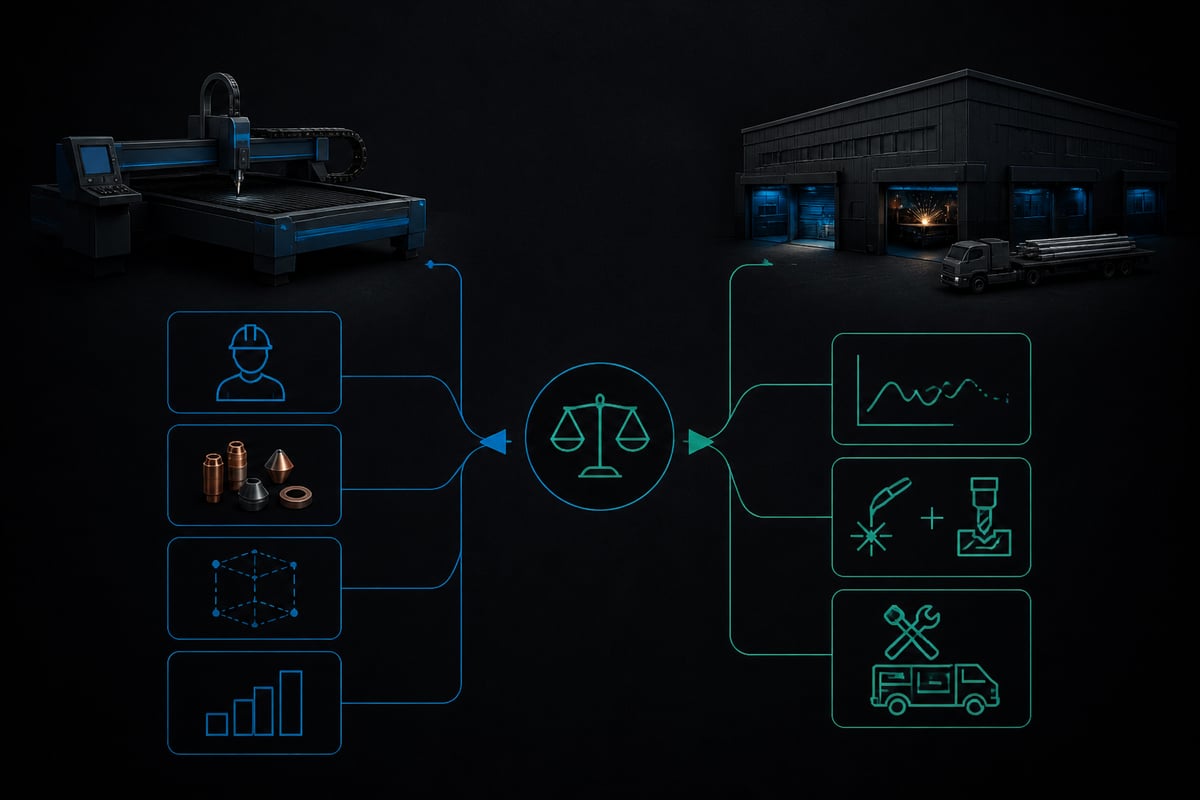
Buying a Table or Outsourcing: A Cost and Risk View
Buying a table makes sense when you cut steady volume of similar parts and have staff to run it. Outsourcing makes sense when demand is uneven, parts need follow-on welding or machining, or downtime from a missed part is expensive.
The purchase price is only the start. Budget for:
- Consumables such as nozzles, electrodes and shields
- Compressed air or gas supply and filtration
- Fume extraction or a water table
- Nesting and CAM software
- Operator training and programming time
- Plate handling and storage space
For a maintenance manager who needs a replacement liner plate or a mounting bracket by Friday, a vendor with a running table, plate in stock and welders on staff often beats a machine that is still waiting on consumables.
Plasma Compared With Waterjet and Laser
Plasma is the right process for most carbon steel plate in the mid to heavy thickness range, while waterjet and laser fill specific gaps. Plasma cuts fastest on conductive metals and costs less per part. Waterjet cuts without heat, handles non-conductive materials and avoids a heat-affected zone, which matters for hardened or heat-sensitive material. Laser gives tighter edges on thin sheet.
Many industrial parts are better cut by waterjet when thickness is large or heat distortion is a concern. LTJ's comparison of waterjet cutting vs plasma cutting covers that decision, and its page on industrial waterjet cutting for thick metal is a useful reference when plasma edge quality is not enough.
Edge Quality, Tolerances and Finishing Plans
Plan the finishing step before you cut. Plasma edges carry a bevel, a heat-affected zone and sometimes dross, and each one affects what happens next.
- Welded joints: Light grinding of the cut edge is usually enough for structural welds.
- Bored or bearing surfaces: Cut undersize in the bore and finish by machining. LTJ's precision CNC machining service handles that stage.
- Wear parts: Hardfacing extends the life of cut plate used in crushers, chutes and screens.
- Coated parts: Surface preparation by blasting prepares the plate for paint or coating.
Specify tolerances on the drawing by feature type, not as one blanket number. Structural features can tolerate looser limits than mating holes or datum faces, and stating that up front avoids paying for precision a part does not need.
Working With a Cutting Vendor: What to Provide
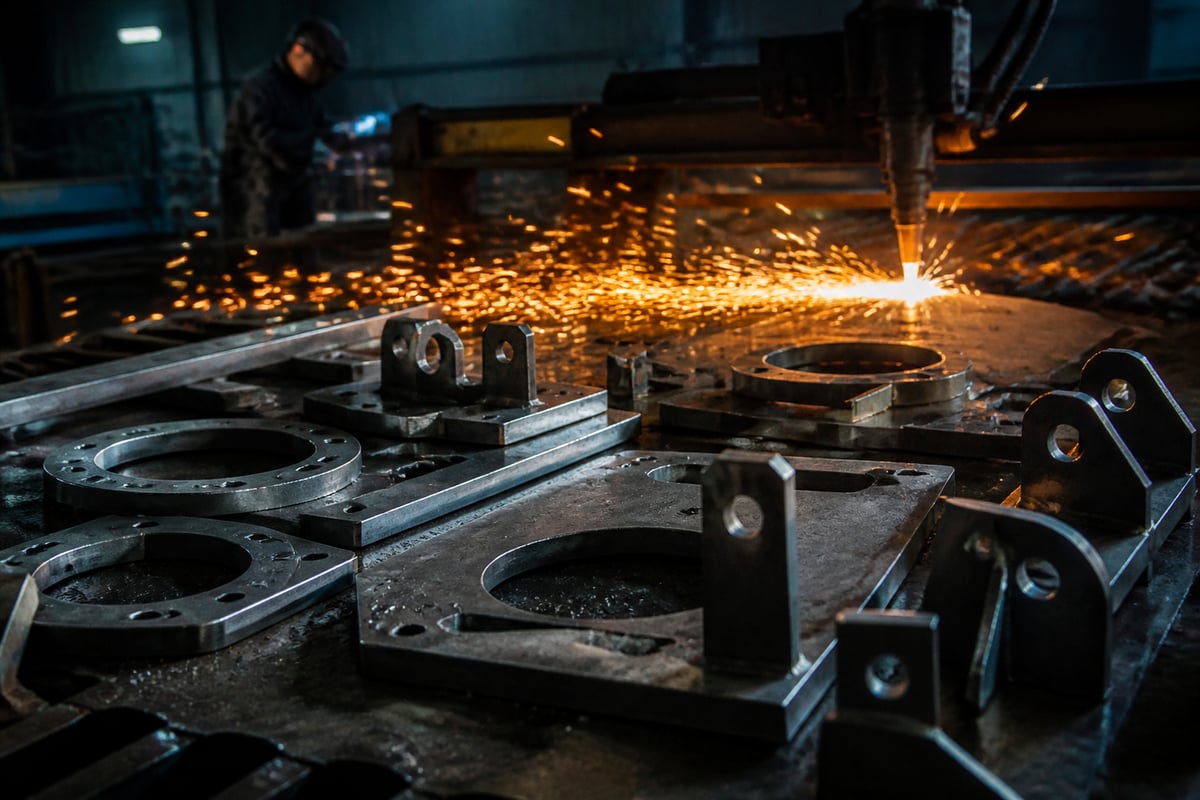
A clean request gets a faster, more accurate quote. Send these items with every inquiry:
- Drawings or DXF files with material, thickness and quantity
- Grade and certification needs, such as mill test reports
- Tolerance notes by feature
- Secondary operations: welding, machining, brake forming, finishing
- Delivery location and any on-site installation requirements
Ask each vendor how they handle code work, what inspection they perform and how they communicate status. A single point of contact reduces the risk of rework when a cut part feeds a pressure or structural assembly. LTJ's welding and cutting page outlines how those services connect.
Gather your drawings, material grades and quantities for the parts you need cut, then send them for review. LTJ Industrial Services can cut, weld, machine and finish those parts in one place, using its CNC plasma cutting service and its custom metal fabrication capability for assemblies. To get a project reviewed and priced, contact LTJ Industrial Services and request a quote.