
A welding spec is the written set of requirements that tells a welder and an inspector exactly how a weld must be made and accepted, covering the governing code, base and filler metals, process, joint design, heat input, preheat, and testing. It protects the owner, the fabricator and the people who will work around the finished equipment. For operations managers in oil and gas, mining, construction and recycling, a clear specification is what separates a repair that passes inspection from one that gets cut out and redone.
What a Welding Spec Actually Contains
A welding spec is a package of documents, not a single page, and each document answers a different question about the weld.
- Governing code or standard: AWS D1.1 for structural steel, ASME Section IX for pressure equipment, API 1104 for pipelines.
- Welding Procedure Specification (WPS): the written instructions for making the weld.
- Procedure Qualification Record (PQR): the test evidence that the WPS produces a sound weld.
- Welder performance qualification: proof that the person holding the torch can follow the procedure.
- Inspection and acceptance criteria: visual, nondestructive and destructive testing requirements.
- Project notes: material certifications, traceability, documentation and hold points.
Think of the code as the rulebook, the WPS as the recipe, and the PQR as the proof the recipe works. If any one of those pieces is missing, the weld has no defensible basis.
Welding Procedure Specification and PQR: How They Differ
A WPS sets the welding variables intended to achieve specified weld quality and mechanical properties, while the PQR records the testing that proves those variables work. TWI describes supporting records such as nondestructive examination and mechanical test results as part of the procedure approval record, which is called a WPAR under BS EN ISO 15614 and a PQR under ASME.
A typical WPS lists essential variables such as base metal group, thickness range, filler classification, shielding gas, preheat and interpass temperature, travel speed, and post-weld heat treatment. Change an essential variable beyond what the code allows and the procedure needs requalification. Nonessential variables can usually be adjusted for convenience without retesting.
Codes also differ in how they treat qualification. According to TWI, ASME IX requires a welding procedure test (PQR), whereas AWS D1.1 permits prequalified procedures when they stay within the specification's applicable limits. That distinction affects schedule. A prequalified joint on structural steel can start sooner, while a pressure-boundary weld on a vessel needs documented testing first. For a deeper walkthrough, LTJ Industrial Services explains the WPS welding procedure specification in detail.

Choosing the Right Code for the Job
The correct code is the one your contract, regulator or insurer names, and the application usually narrows the choice quickly. The table below matches common industrial work to the standards most often specified.
| Application | Typical Code | What It Governs |
|---|---|---|
| Structural steel, frames, platforms | AWS D1.1 | Steel structures, prequalified joints permitted |
| Pressure vessels, boilers, piping | ASME Section IX | Procedure and welder qualification |
| Pipelines, transmission lines | API 1104 | Pipeline welding and acceptance |
| Aluminum structures | AWS D1.2 | Structural aluminum |
| Sheet metal, stainless fabrication | AWS D1.3 / D1.6 | Thin gauge and stainless structures |
Pipeline work shows how tightly regulation and code interlock. Under 49 CFR § 195.228, welds on covered pipelines must be inspected, including visual inspection supplemented by nondestructive testing. Acceptability is determined under API Standard 1104 section 9 or Appendix A, and Appendix A cannot be used to accept cracks. The specification you write has to align with that federal rule, not just a preference.
Writing a Welding Spec for Shop Fabrication
A shop welding spec can be tighter because the environment is controlled. Fixtures, positioners, climate control and calibrated equipment let you specify narrower parameter windows and more repeatable results.
For shop fabrication, a strong specification typically addresses:
- Material and traceability: heat numbers, mill test reports and material grade verification before cutting.
- Joint preparation: bevel angles, root openings, cleaning requirements and fit-up tolerances.
- Process and consumables: GTAW, GMAW, SMAW or FCAW, with filler classification and storage requirements for low-hydrogen electrodes.
- Heat control: preheat, interpass maximums and any post-weld heat treatment.
- Distortion control: sequencing, tack welding practice and fixturing.
- Inspection: percentage of welds receiving visual, magnetic particle, dye penetrant, ultrasonic or radiographic examination.
Shop work also benefits from coordination with machining. When a weldment will be machined after welding, the spec should note stress relief, machining allowance and datum surfaces so tolerances survive the heat of the process. Having fabrication, machining and finishing under one roof, as LTJ Industrial Services does, removes a common handoff problem between vendors.
Writing a Welding Spec for Field Work
Field welding demands a spec that anticipates wind, temperature, access limits and hazardous atmospheres, because none of those can be controlled the way they can in a shop. The difference between field welding and shop welding comes down largely to which variables you can manage and which you must plan around.
Field specifications should address:
- Weather protection: windscreens or shelters for gas-shielded processes, and minimum ambient or base-metal temperatures before welding begins.
- Position and access: vertical, overhead and out-of-position welds need procedures qualified for those positions.
- Power and cabling: OSHA's arc welding and cutting standard requires at least 10 feet from the electrode-holder end of a cable to be free of repairs or splices, except for standard insulated connectors or equally insulated splices. It also requires a ground-return cable with safe current-carrying capacity equal to or greater than the welding unit's specified maximum output.
- Hot work controls: OSHA's oil and gas hot work guidance calls for hot-work permits where hazardous materials cannot be removed or flammable atmospheres could exist, and recommends inspecting welding equipment before use.
- Repair history: for equipment in service, record the original material, prior repairs and any contamination such as oil, hydrocarbons or coatings that must be removed first.
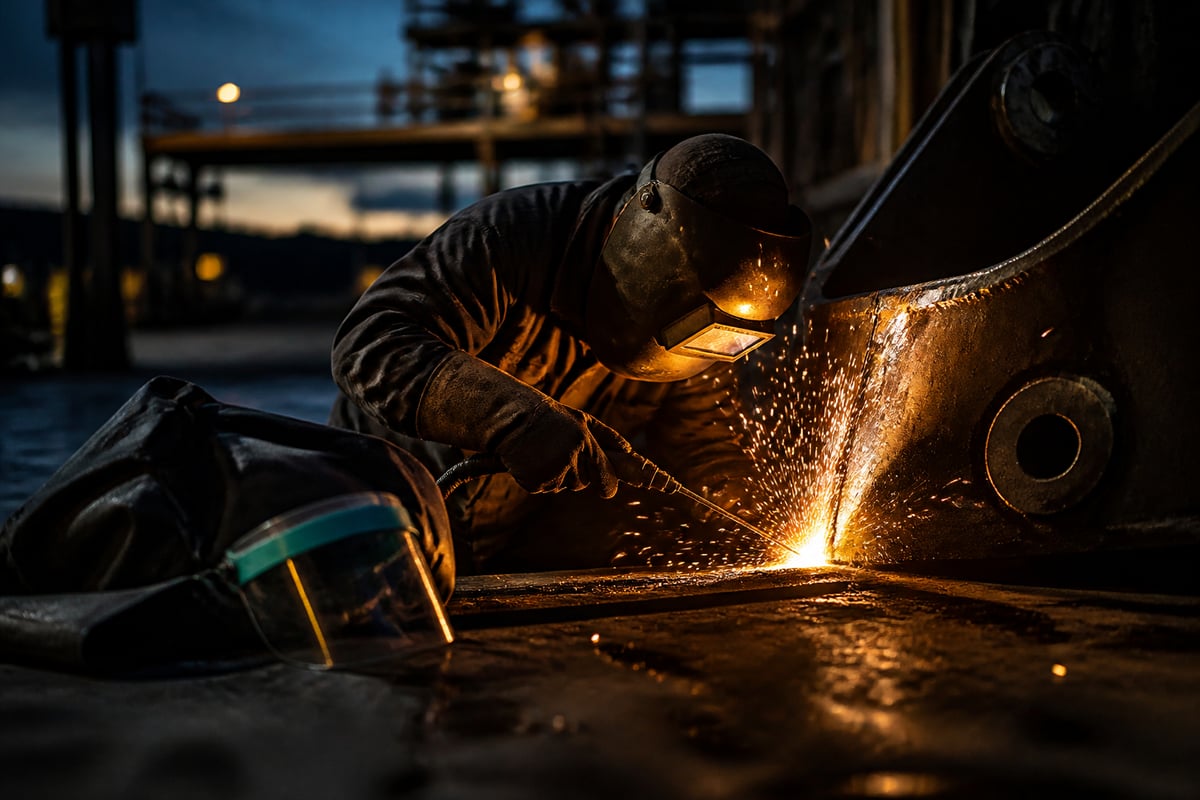
Field repair on worn crusher frames, conveyor structures, loader buckets or wellsite equipment often means welding on aged, work-hardened or unknown steel. The specification should state how the base metal will be identified and what preheat applies if the chemistry is uncertain.
Shop vs. Field: Where the Requirements Diverge
Both environments follow the same codes, yet the practical emphasis differs. This list summarizes where a welding spec typically shifts.
- Shop: tighter fit-up tolerances, positioner access, repeatable parameters, easier NDE scheduling.
- Field: environmental controls, permits, limited access, equipment mobilization, and fewer opportunities to re-inspect after a problem is found.
- Shared: qualified procedures, qualified welders, documented materials and defined acceptance criteria.
One useful habit is to write the field spec as if the inspector will arrive unannounced. That means procedures posted at the work location, welder credentials on hand, and consumables stored per the specification.
Can You Use Another Company's Qualified Procedure?
Sometimes, but not automatically. Procedure qualification generally belongs to the organization that performed and documented the testing, and codes set conditions for adopting someone else's work. TWI addresses this question in its FAQ on whether one company can use welding procedures qualified by another company, with references to AWS D1.1 and qualification requirements.
For an owner, the practical takeaway is to ask a contractor to show its own WPS and PQR set for the materials and joints in your scope, rather than assuming a generic procedure covers your project. A contractor with a mature procedure library can often start sooner because the qualification work is already done. That is one reason it pays to vet a certified welding services provider before bid day instead of after award.
Welder Qualification and Continuity
A procedure is only as reliable as the welder executing it, so every specification should state how welders are qualified and how their qualification stays current. Performance qualification typically ties a welder to a process, position, material group and thickness range. Continuity rules then require that the welder actually use the process within a defined period, or requalify.
Request these items from any contractor before work starts:
- A current welder qualification record for each welder assigned.
- The WPS number each welder will work to, matched to the joint.
- Continuity logs showing the welder has kept the process active.
- Visual and NDE results from any production test coupons.
Owners reviewing credentials can find more on what ASME welding certification means.
Documentation That Makes a Welding Spec Auditable
A weld that cannot be traced to paperwork is a liability, even if it looks good. Build the documentation requirements into the specification itself so they are priced and scheduled from the start.
A practical documentation package includes:
- Approved WPS and supporting PQR for each joint type
- Welder qualification records and continuity
- Material test reports and heat-number traceability
- Consumable certifications and storage records
- NDE reports with technician qualification
- Weld maps or logs identifying each joint, welder and inspection result
- Nonconformance and repair records
For pressure equipment and pipelines, this package may be reviewed by an authorized inspector, an insurer or a regulator years after the work is done. Store it with the asset record, not in a project folder that gets archived and lost.
Common Specification Mistakes That Cause Rework
Most failed inspections trace back to the specification, not the welding. Watch for these recurring problems:
- Vague code references: "weld per AWS" without naming the document and edition leaves room for dispute.
- Mismatched qualifications: a WPS qualified on one thickness range applied to a joint outside it.
- Unspecified acceptance criteria: no stated NDE method or percentage, so scope grows after the fact.
- Ignored service conditions: low temperature, sour service, cyclic loading or abrasion not reflected in material or filler choices.
- No repair procedure: if a weld is rejected, there should already be an approved method for excavating and rewelding it.
A short pre-job review between the owner's engineer or maintenance lead and the contractor's welding supervisor catches most of these. Thirty minutes of alignment before mobilization costs far less than a day of standby while a crew waits for clarification.
Matching the Spec to Your Industry
Different sectors weight different parts of the specification. Oil and gas work leans toward API 1104, hot work permitting and documented NDE. Mining and aggregate operations often need wear-resistant overlay, heavy plate repair and fast field turnaround for loaders, haul bodies and crusher components. Recycling facilities see constant impact and abrasion on shredder and conveyor structures, where repair welds must tolerate fatigue. Construction projects typically follow AWS D1.1 with special inspection requirements set by the engineer of record.
Whichever sector applies, the same principle holds: specify the service conditions first, then select the code, procedure and inspection plan that fit them. Operators seeking a partner for oil and gas welding services or recycling equipment repair welding should expect the contractor to ask about those conditions before quoting.
Working With a Contractor on Your Welding Spec
The smoothest projects treat the specification as a shared document. The owner supplies the code, service conditions and acceptance criteria. The contractor supplies qualified procedures, qualified welders and a documentation plan, and flags any conflicts early.
LTJ Industrial Services supports customers both in the shop and on site, and handles fabrication, machining, hydraulics and finishing in one place. For projects that need certified structural, pressure or custom work, its certified welding service is built around the codes and procedures covered above.
Frequently Asked Questions About a Welding Spec
The schema below summarizes the most common questions owners and maintenance managers ask when they prepare or review a welding specification.
Start by pulling the governing code, drawings and service conditions for your next repair or fabrication job and listing the WPS, welder qualifications and inspection requirements you expect to see. Then hand that list to a contractor who can meet it in the shop or in the field. LTJ Industrial Services brings welding, machining and fabrication capability together for Western US industrial customers, and you can start a conversation about your project by choosing to Request a Quote today.