
A weld procedure specification serves as the cornerstone of quality assurance in modern welding operations, providing detailed instructions that ensure every weld meets safety, strength, and durability requirements. For industrial manufacturers, fabricators, and contractors working across sectors like oil and gas, aggregate processing, and heavy equipment repair, understanding and implementing proper welding procedures isn't just good practice-it's essential for regulatory compliance, structural integrity, and long-term project success. This comprehensive guide explores the critical components, development process, and practical applications of welding procedure specifications for commercial and industrial operations.
Understanding the Fundamentals of Welding Procedure Specifications
A weld procedure specification is a formal written document that defines all the essential variables required to produce acceptable welds consistently. The specification establishes parameters such as base material types, filler metal selection, welding process, preheat and interpass temperatures, electrical characteristics, travel speed, and post-weld heat treatment requirements.
Purpose and Regulatory Framework
The primary purpose of this documentation is to ensure repeatability and quality across multiple welders, shifts, and project phases. When fabricating pressure vessels, structural components, or pipeline systems, every weld must meet the same stringent standards regardless of who performs the work or when it's completed.
Regulatory bodies and industry codes mandate the use of qualified welding procedures for specific applications. The American Welding Society (AWS), American Society of Mechanical Engineers (ASME), and American Petroleum Institute (API) each maintain standards that govern how procedures must be developed, tested, and documented. Understanding what ASME certification means provides critical context for companies working in pressure vessel and boiler fabrication.

Essential Variables and Their Impact
Essential variables are specific parameters that, when changed beyond certain limits, require requalification of the welding procedure. These variables directly affect the mechanical properties, microstructure, or integrity of the finished weld.
Material-Related Essential Variables:
- Base metal specification and grade
- Thickness ranges
- Pipe diameter ranges
- Material grouping (P-numbers in ASME)
- Product form (plate, pipe, casting)
Process-Related Essential Variables:
- Welding process (SMAW, GMAW, FCAW, GTAW, SAW)
- Filler metal classification
- Electrode diameter
- Shielding gas composition and flow rate
- Current type and polarity
Thermal-Related Essential Variables:
- Preheat temperature
- Interpass temperature
- Post-weld heat treatment temperature and time
- Cooling rate
Changes to any essential variable outside the qualified range invalidate the procedure and require new qualification testing. For companies providing certified welding services, maintaining accurate records of these variables ensures compliance and traceability.
Developing and Qualifying Welding Procedures
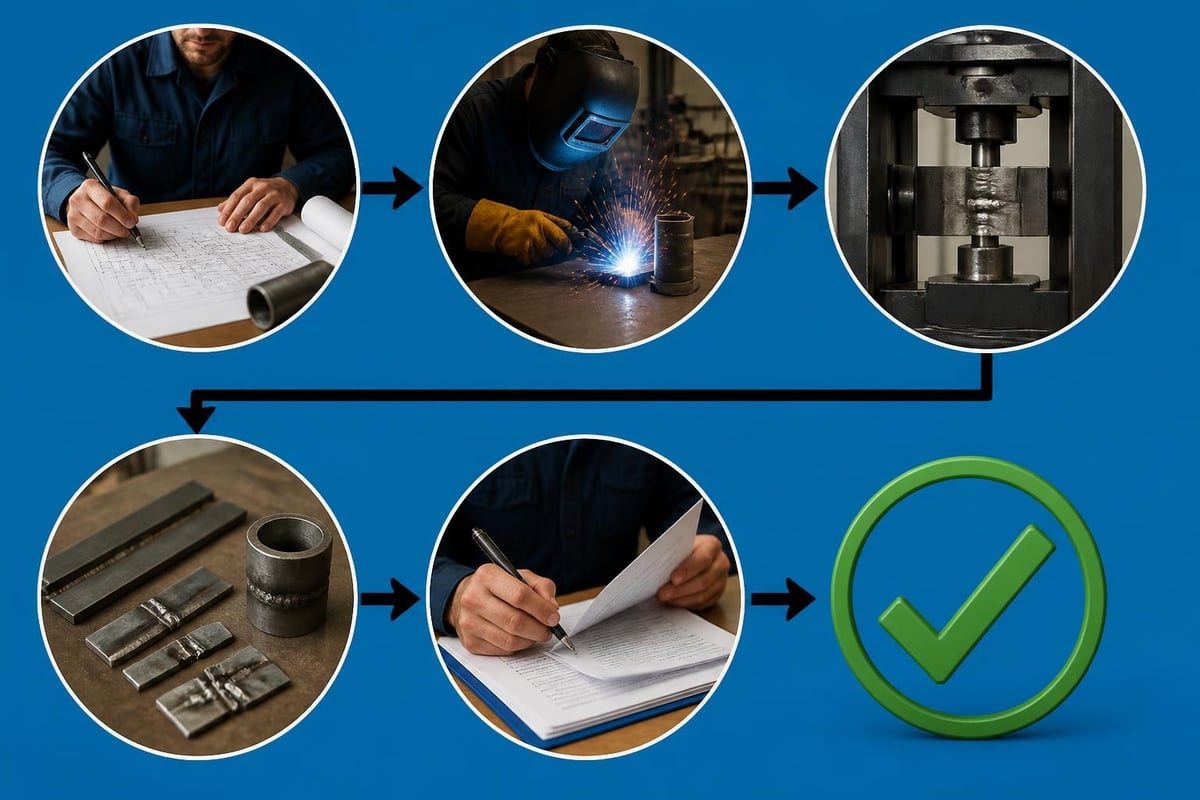
The development of a weld procedure specification follows a systematic process involving documentation, testing, and validation. This qualification process proves that the proposed parameters will consistently produce welds meeting all mechanical property, soundness, and serviceability requirements.
Procedure Qualification Record Requirements
Before implementing any welding procedure, fabricators must produce a Procedure Qualification Record (PQR) through physical testing. The PQR documents the actual welding parameters used during qualification testing and the results of all required examinations.
The qualification process involves welding test coupons using the proposed parameters, then subjecting those coupons to destructive and non-destructive testing. Required tests typically include:
| Test Type | Purpose | Acceptance Criteria |
|---|---|---|
| Tensile Testing | Verify strength meets base metal minimum | No failure below specified minimum |
| Bend Testing | Assess ductility and fusion quality | No cracks exceeding code limits |
| Macro-Examination | Evaluate fusion, penetration, and defects | Complete fusion, adequate penetration |
| Impact Testing (when required) | Verify toughness at service temperature | Minimum energy values per code |
| Hardness Testing (for sour service) | Ensure resistance to cracking mechanisms | Maximum hardness per specification |
The ISO 15614 series provides internationally recognized standards for welding procedure testing and qualification, offering guidance for various materials and applications.
Standard Welding Procedure Specifications
For common applications, fabricators may utilize prequalified or Standard Welding Procedure Specifications (SWPS) rather than developing custom procedures. The American Welding Society’s SWPS program provides pre-qualified procedures for routine welding applications, reducing qualification costs and timeline.
These standardized procedures are particularly valuable for:
- High-volume production environments
- Common material combinations
- Standard joint configurations
- Routine structural welding applications
However, specialized applications-such as oil and gas welding services involving sour service conditions, high-pressure systems, or exotic materials-typically require custom procedure development and qualification.
Critical Components of a Complete WPS Document
A properly formatted weld procedure specification contains specific sections that together provide complete guidance for welders and quality control personnel. The document structure follows code requirements while remaining practical for shop floor use.
Scope and Application Section
This opening section identifies:
- Applicable welding codes and standards
- Base material specifications and thicknesses
- Joint types and welding positions qualified
- Whether the procedure applies to production, repair, or both
- Any limitations or special requirements
Joint Design and Preparation Details
Clear joint geometry specifications prevent inconsistencies during fit-up and welding. This section includes:
Dimensional Requirements:
- Root opening tolerances
- Groove angle specifications
- Root face dimensions
- Backing bar requirements (if any)
Surface Preparation:
- Cleaning methods and extent
- Acceptable surface conditions
- Prohibited conditions (rust, mill scale, moisture)
- Grinding or machining requirements
For structural steel fabrication, precise joint preparation directly impacts weld quality and the efficiency of multi-pass welding operations.
Base Metal and Filler Metal Specifications
This critical section identifies all materials involved in the welding process with sufficient detail to prevent substitution errors.
| Specification Category | Required Information | Example |
|---|---|---|
| Base Metal | ASTM/ASME specification, grade, P-number | ASTM A516 Grade 70, P-No. 1 |
| Filler Metal | AWS classification, size, form | AWS A5.1 E7018, 1/8" diameter, electrode |
| Shielding Gas | Composition, purity, flow rate | 75% Ar / 25% CO₂, 30-40 CFH |
| Backing Material | Type and specification (if used) | Ceramic backing per AWS specification |
Welding Parameters and Technique
The parameters section provides the specific ranges for electrical characteristics, thermal conditions, and manipulation techniques. This information must be detailed enough to ensure consistency but flexible enough to accommodate normal variations in welding conditions.
Electrical Parameters:
- Current range (minimum and maximum amperage)
- Voltage range
- Travel speed range
- Wire feed speed (for semi-automatic processes)
- Heat input calculations and limits
Thermal Management:
- Minimum preheat temperature
- Maximum interpass temperature
- Post-weld heat treatment requirements (temperature, time, heating/cooling rates)
Companies specializing in welding for construction projects must carefully control these parameters to meet both structural codes and project specifications.
Industry-Specific WPS Applications and Considerations
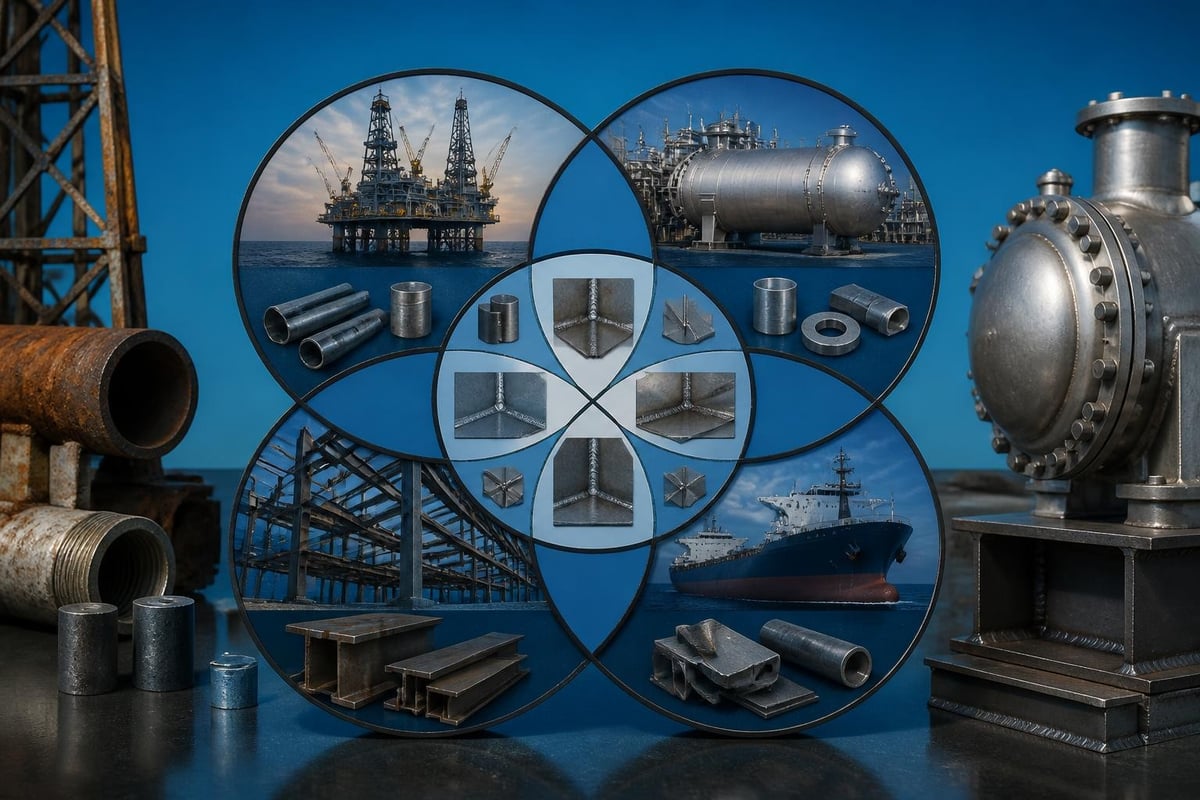
Different industries impose unique requirements on welding procedures based on service conditions, regulatory oversight, and failure consequences. Understanding these sector-specific demands ensures procedures address all relevant concerns.
Oil and Gas Industry Requirements
Welding procedures for oil and gas applications face stringent requirements due to hazardous service conditions, environmental exposure, and safety-critical applications. Sour service conditions containing hydrogen sulfide require special considerations to prevent sulfide stress cracking and hydrogen-induced cracking.
The AMPP standards (formerly NACE) provide critical guidance on procedure qualification for corrosive and sour service environments, including maximum hardness limits and impact testing requirements that must be incorporated into the weld procedure specification.
Key considerations include:
- Enhanced impact testing at service temperature
- Hardness testing to verify resistance to stress cracking
- Limitations on heat input to control microstructure
- Special preheat and post-weld heat treatment requirements
- Qualification of repair procedures for in-service equipment
Pressure Vessel and Boiler Applications
ASME Section IX governs procedure qualification for pressure vessels and boilers, establishing rigorous testing and documentation requirements. These procedures must address:
- Thickness ranges and diameter limitations
- Position qualifications (1G, 2G, 5G, 6G)
- Backing and non-backing qualifications
- Production testing requirements
- Weld procedure qualification record (WPQR) documentation
TWI’s technical guidance provides industry-authoritative explanations of the relationships between welding procedures, PQRs, and essential variables across different code systems.
Marine and Offshore Structural Applications
Classification societies govern welding procedures for marine vessels and offshore structures, with recent updates affecting qualification ranges and acceptance criteria. IACS unified requirements harmonize standards across classification societies, but individual societies may impose additional requirements.
Lloyd’s Register guidance addresses high-heat-input welding and procedure qualification for modern steels used in shipbuilding and offshore construction.
WPS Documentation, Control, and Continuous Improvement
Effective management of welding procedures requires robust document control systems, regular review processes, and mechanisms for incorporating lessons learned and technological advances.
Document Control Systems
A comprehensive document control system ensures:
Version Control:
- Unique identification numbers for each procedure
- Revision tracking with change documentation
- Effective date management
- Distribution control to prevent use of obsolete procedures
Access and Retrieval:
- Electronic database systems for quick reference
- Shop floor access to current procedures
- Mobile device compatibility for field applications
- Backup and disaster recovery provisions
Authorization Requirements:
- Qualified welding engineer approval
- Client or third-party review (when required)
- Quality assurance verification
- Management authorization
Welder Qualification and Procedure Implementation
A qualified weld procedure specification means nothing without qualified welders capable of following it correctly. Welder performance qualification (WPQ) testing verifies that individual welders can produce acceptable welds using specific procedures.
The qualification process involves:
- Welding test coupons using the applicable WPS
- Non-destructive examination (typically radiography or bend testing)
- Documentation linking the welder to qualified procedures and position ranges
- Periodic renewal and continuity requirements
For industrial service providers offering manufacturing projects across multiple sectors, maintaining a roster of qualified welders across various procedures and positions provides operational flexibility.
Procedure Optimization and Updates
Welding procedures should evolve based on:
Performance Data:
- Defect rates and rework requirements
- Production efficiency metrics
- Material consumption and cost analysis
- Welder feedback on usability
Technological Advances:
- New filler metal developments
- Process improvements (pulsed welding, advanced shielding gases)
- Equipment capabilities
- Mechanization and automation opportunities
Code and Standard Changes:
- Updated specifications and requirements
- New material grades and applications
- Revised testing protocols
- Industry best practice evolution
Practical Implementation Challenges and Solutions
Real-world application of welding procedures presents challenges that require practical problem-solving and experienced judgment.
Common Documentation Gaps
Incomplete or ambiguous procedure specifications lead to inconsistent results and compliance issues. Frequent gaps include:
- Insufficient detail on joint fit-up tolerances
- Vague terminology that allows varied interpretation
- Missing information on tack weld requirements
- Inadequate guidance on defect repair limitations
- Unclear acceptance criteria for visual inspection
Solution approaches:
- Detailed sketches and photographs supplementing text
- Specific numeric ranges rather than qualitative terms
- Cross-referencing to relevant code sections
- Step-by-step process sequences
- Examples of acceptable and unacceptable conditions
Field Application Considerations
Shop-developed procedures often require modification for field conditions where environmental control, positioning limitations, and access constraints affect welding execution. Considerations include:
| Challenge | Impact | Mitigation Strategy |
|---|---|---|
| Weather exposure | Wind affects shielding gas, temperature extremes impact materials | Environmental enclosures, procedure variables accounting for conditions |
| Position restrictions | Limited access requires out-of-position welding | Qualify additional positions, develop specialized techniques |
| Power limitations | Insufficient electrical capacity | Modify parameters, select appropriate processes for available power |
| Inspection access | Difficult NDT examination | Enhanced visual inspection, alternative examination methods |
Multi-Code Compliance
Projects subject to multiple codes-such as a pressure vessel on a structural support system-require careful procedure development addressing all applicable requirements. The AWS D1.1 vs API 1104 comparison illustrates how different codes approach similar applications with varying requirements.
Strategies for multi-code compliance:
- Identify the most restrictive requirements across all codes
- Develop procedures meeting the highest standard
- Document code applicability for each procedure section
- Obtain necessary approvals from all jurisdiction authorities
- Maintain clear records of which code governs specific aspects
Advanced WPS Topics for Specialized Applications
Certain applications demand enhanced procedure development addressing unique challenges beyond standard fabrication requirements.
Dissimilar Metal Welding
Joining different material types requires special consideration of:
- Filler metal selection for metallurgical compatibility
- Differential thermal expansion
- Galvanic corrosion potential
- Dilution calculations and composition control
- Post-weld heat treatment compatibility
Automated and Robotic Welding Procedures
Mechanized welding processes require additional procedure elements:
Process-Specific Parameters:
- Wire feed speed and stick-out distance
- Oscillation patterns and frequency
- Torch angles and work angles
- Travel speed consistency
- Seam tracking systems
Quality Verification:
- Real-time monitoring systems
- Statistical process control limits
- Automated documentation and traceability
- Periodic validation testing
Repair Welding Procedures
Repair procedures address unique challenges including:
- Unknown or variable base material composition
- Heat-affected zone from prior welding
- Geometry limitations from excavation requirements
- Residual stress considerations
- Temper bead technique qualification
For businesses offering comprehensive services including hydraulic equipment repair, qualified repair procedures enable restoration of damaged components to service condition.
Integrating WPS with Overall Quality Systems
The weld procedure specification functions as one component within a comprehensive quality management system, interacting with other quality controls and documentation.
Relationship to Other Quality Documents
Welding Procedure Specification connections:
- Inspection and Test Plans: Define when and how WPS compliance is verified
- Material Control Procedures: Ensure specified materials are provided and traceable
- Non-Conformance Procedures: Address deviations from WPS requirements
- Training Records: Document welder familiarization with applicable procedures
- Project Specifications: Translate customer requirements into WPS parameters
Digital Transformation and Industry 4.0
Modern manufacturing increasingly relies on digital systems for procedure management:
- Cloud-based WPS databases with mobile access
- QR codes linking physical materials to electronic procedures
- Integration with welding equipment for parameter monitoring
- Data analytics identifying optimization opportunities
- Automated reporting and compliance documentation
Continuous Auditing and Compliance Verification
Regular audits ensure ongoing WPS compliance:
Internal Audit Elements:
- Random verification of welding parameters against WPS requirements
- Review of completed weld documentation
- Welder qualification continuity verification
- Procedure currency and revision control checks
External Audit Preparation:
- Third-party inspector access to complete procedure files
- Supporting PQR documentation availability
- Traceability demonstration from raw material through finished weld
- Corrective action records for any previous non-conformances
Resources for WPS Development and Implementation
Organizations developing or implementing welding procedures benefit from authoritative references and professional resources.
Industry Standards and Code Resources
The AWS free resources page provides sample forms, procedure templates, and reference materials supporting WPS development. These standardized formats ensure procedures contain all required information in logical, user-friendly formats.
Key reference standards include:
- AWS B2.1: Specification for Welding Procedure and Performance Qualification
- ASME Section IX: Welding, Brazing, and Fusing Qualifications
- API 1104: Welding of Pipelines and Related Facilities
- AWS D1.1: Structural Welding Code – Steel
- ISO 15614 series: Specification and qualification of welding procedures for metallic materials
Professional Training and Certification
Developing effective welding procedures requires expertise best obtained through formal training:
- Certified Welding Inspector (CWI) programs
- Certified Welding Educator (CWE) credentials
- Welding engineering degree programs
- Code-specific training courses
- Industry association technical seminars
Building Internal Expertise
Organizations frequently performing welding operations benefit from developing in-house procedure development capabilities through:
- Dedicated welding engineering personnel
- Laboratory facilities for procedure qualification testing
- Relationships with accredited testing laboratories
- Participation in industry technical committees
- Investment in reference libraries and software tools
Effective weld procedure specification development and implementation form the foundation of quality welding operations across all industrial sectors. By thoroughly documenting essential variables, qualifying procedures through rigorous testing, and maintaining robust control systems, manufacturers ensure consistent, code-compliant results that meet safety and performance requirements. Whether you need support developing custom welding procedures, qualifying new processes, or executing complex fabrication projects across the Western United States, LTJ Industrial Services brings the technical expertise, certified personnel, and comprehensive capabilities to deliver high-quality welding, fabrication, and machining solutions tailored to your specific requirements.