In 2026, industries demand more from their equipment than ever, making reliability non-negotiable. Selecting quality welders is the foundation for producing consistent, high-grade results in today’s professional and industrial environments. The right welder can mean the difference between flawless productivity and costly downtime. This article takes you through nine essential quality welders designed to meet these rigorous standards. As new technologies and smarter features reshape the welding landscape, our guide will help you navigate the latest trends and confidently choose the best tools for the job.
What Defines a Quality Welder in 2026?
Choosing quality welders in 2026 means understanding a new set of standards shaped by technology, safety, and evolving industry needs. From advanced certifications to intuitive interfaces, today’s professionals require equipment that delivers consistent performance and adapts to a wide range of applications.
Evolving Industry Standards and Certifications
In 2026, quality welders must align with stringent industry certifications. Organizations like AWS and ISO continue to update their standards, driving innovation in equipment safety and performance. Many manufacturers now design machines specifically to meet or exceed these benchmarks.
For instance, compliance with pressure vessel welding standards is crucial in sectors where safety and reliability are non-negotiable. You can explore real-world examples of certifications in action through the Certified Pressure Vessel Welding service page, which highlights how up-to-date credentials impact equipment design.
Regulations also influence features, requiring built-in safety mechanisms and traceable data logs. These advancements ensure that quality welders are not just robust but also trusted for critical applications.
Technological Advancements and Smart Features
The rise of digital controls and automation has transformed quality welders. Smart interfaces now offer customizable settings, memory recall, and AI-assisted parameters that adapt to each user’s skill level.
These features improve weld consistency and efficiency. For example, integrated sensors monitor arc stability and adjust settings in real time, making it easier for professionals to achieve perfect results. Automation supports repetitive tasks, while digital diagnostics reduce troubleshooting time.
With each leap in technology, quality welders become more intuitive and capable, setting new standards for productivity and precision.
Durability, Portability, and Build Quality
Modern quality welders are engineered for tough environments. Manufacturers use advanced alloys and reinforced housings to extend lifespan and withstand daily use in both shop and field settings.
Portability is another vital factor. Many machines weigh less than 50 pounds and feature ergonomic handles, making transport between job sites effortless. Some even include rugged wheels and protective cases for outdoor work.
Quality welders are now judged by their ability to balance robust construction with lightweight convenience, ensuring professionals can rely on their equipment anywhere.
Power Versatility and Welding Processes
Quality welders in 2026 deliver unmatched flexibility. Multi-process machines can switch between MIG, TIG, Stick, and Flux-Core modes, adapting to various project demands and metal types.
These welders also accept multiple voltage inputs, supporting work in shops with stable power or remote sites with generator supplies. This adaptability maximizes uptime and reduces the need to own several specialized units.
For professionals, power versatility in quality welders means fewer limitations and a broader range of achievable results.
User Experience and Safety Enhancements
User-centric design is a defining trait of quality welders today. Intuitive interfaces, clear displays, and responsive controls simplify setup and adjustments, even for less experienced operators.
Safety remains paramount. Features like automatic shut-off, thermal overload protection, and real-time fault alerts greatly reduce accidents. According to recent industry data, these enhancements have led to measurable declines in workplace injuries and boosts in overall productivity.
In summary, quality welders in 2026 stand apart by uniting advanced technology, rigorous safety, and user-focused design, meeting the demands of modern professionals.
9 Essential Quality Welders for Reliable Results in 2026
Selecting from the top quality welders on the market can make all the difference for professionals and industrial teams in 2026. This curated list highlights nine standout machines, each offering a unique mix of advanced features, reliability, and adaptability to demanding job requirements. Whether you prioritize portability, versatility, or cutting-edge technology, these quality welders represent the best in class for reliable results.
Miller Multimatic 220 AC/DC
The Miller Multimatic 220 AC/DC stands at the forefront of quality welders, favored by professionals who need versatility on every job site. Priced around $3,199, it supports MIG, TIG (including AC/DC), and Stick welding, making it a true multi-process powerhouse.
This welder incorporates advanced inverter technology and Miller’s Auto-Set Elite, which simplifies setup for different materials and thicknesses. Its dual-voltage (120/240V) capability means you can use it virtually anywhere, whether in the shop or out in the field.
Portability is another strong point, as its compact design allows easy transport. Its intuitive controls reduce setup time, so welders can focus on producing high-quality results. For those who demand consistent performance from their quality welders, this model delivers.
Pros: Reliable, intuitive controls, exceptional arc quality
Cons: Higher price point, investment required for advanced features
Lincoln Electric Power MIG 210 MP
The Lincoln Electric Power MIG 210 MP is a multi-process machine designed for flexibility and ease of use. With a price tag around $1,499, it provides MIG, TIG, and Stick welding capabilities, covering most fabrication needs.
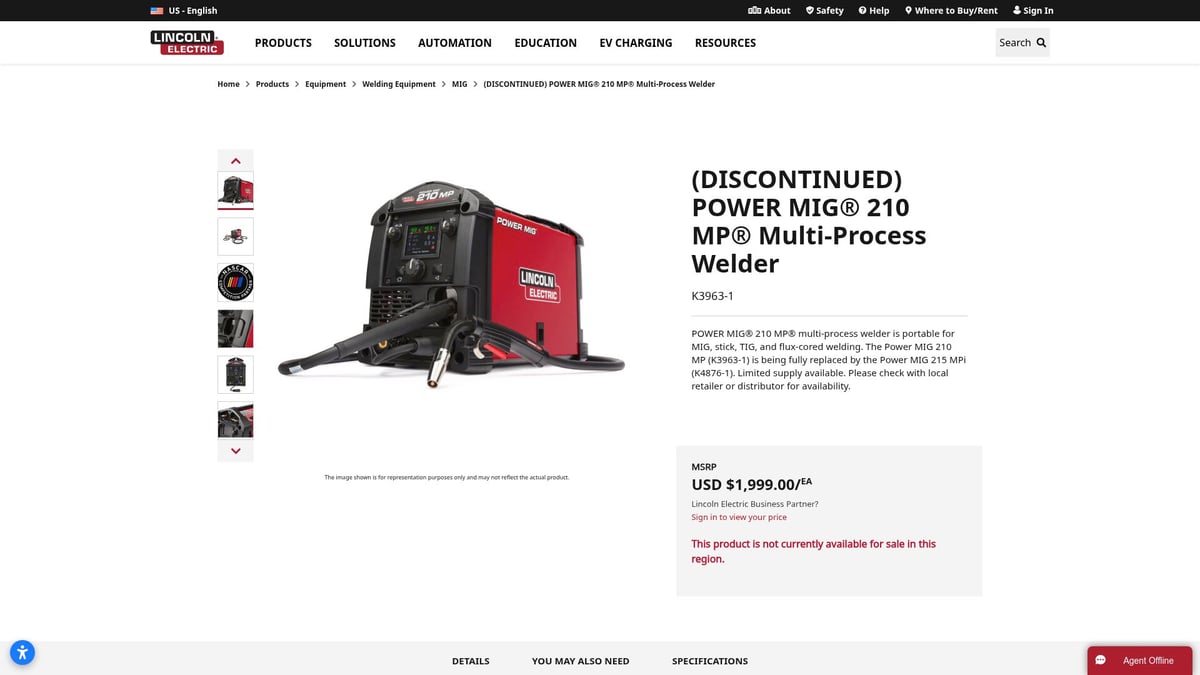
A standout feature is the color display with push-and-turn digital controls, making it especially user-friendly for both beginners and seasoned professionals. Weighing in at just over 40 pounds, its lightweight build makes it ideal for small shops, contractors, or hobbyists needing mobile quality welders.
Although the TIG torch is not included, users appreciate the welder’s overall affordability and straightforward operation. For those seeking quality welders that balance performance with budget, this model is a strong contender.
Pros: User-friendly interface, affordable, portable
Cons: TIG torch sold separately, limited maximum output
ESAB Rebel EMP 215ic
The ESAB Rebel EMP 215ic brings innovation and adaptability to the lineup of quality welders. Priced at about $1,799, it supports MIG, Flux-Cored, Stick, and TIG processes, giving users the flexibility needed for various applications.
Its unique sMIG (“smart MIG”) technology adapts arc performance to the user’s skill level, helping both novices and experts achieve consistent welds. The rugged, portable build ensures it can handle the rigors of field repairs or shop fabrication projects.
This welder is a favorite among fabrication shops and professionals who require a robust tool that learns and grows with them. While the sMIG technology introduces a slight learning curve, the increased control and quality make it a top pick for reliable results.
Pros: Adaptive arc performance, durable construction
Cons: sMIG learning curve, premium price for features
Hobart Handler 210 MVP
The Hobart Handler 210 MVP is a trusted name among quality welders, especially for those focused on MIG and Flux-Cored welding. At approximately $1,099, it combines affordability with reliable performance for automotive, farm, and maintenance work.
Its plug-and-play setup, with seven voltage settings and dual-voltage compatibility, makes it easy to switch between projects and job sites. The Handler 210 MVP is known for consistent arc starts and minimal spatter, attributes that matter for quality welders in daily operations.
Though it lacks TIG capabilities, its straightforward design and dependable build make it a go-to option for users needing a dedicated MIG/Flux-Cored machine.
Pros: Easy setup, reliable performance, dual-voltage
Cons: No TIG option, limited to MIG/Flux-Cored processes
Fronius TransSteel 2200
For those demanding precision and industrial-grade durability, the Fronius TransSteel 2200 is a premium choice among quality welders. Priced at around $2,900, it supports MIG, TIG, and Stick welding, with synergic digital controls that help optimize settings for every job.
Its compact yet robust construction is engineered for longevity, making it suitable for heavy-duty and industrial applications. The TransSteel 2200 excels at delivering precise, repeatable welds, a must for projects where quality cannot be compromised.
While the higher cost may be a consideration, many professionals find its performance and durability justify the investment. This welder is a clear leader for those prioritizing quality welders for intensive use.
Pros: Exceptional precision, rugged build, digital controls
Cons: Premium price, may be overkill for light users
Everlast PowerMTS 251Si
The Everlast PowerMTS 251Si brings extensive versatility to the field of quality welders. At about $1,350, it offers MIG, TIG, and Stick functions, supported by digital IGBT inverter technology for efficient power management.
A notable feature is its memory storage, allowing users to save and recall settings for different materials or projects. The high-duty cycle and multi-process capability make it well-suited for advanced users and small fabrication shops seeking adaptable quality welders.
Though Everlast is less established than some brands, the PowerMTS 251Si consistently receives praise for value and performance, making it a smart choice for those on a budget who still require professional-grade results.
Pros: Versatile, high-duty cycle, strong value
Cons: Less brand recognition, support network may be smaller
Forney Easy Weld 261
The Forney Easy Weld 261 is the entry-level champion among quality welders, ideal for beginners and light repair work. Priced at just $299, it is limited to flux-core welding but compensates with remarkable portability and simplicity.
Weighing only 19 pounds, this welder is easy to transport to job sites or around the home garage. Its simple dial controls enable new users to start welding quickly, making it a favorite for those learning the basics of quality welders.
While it cannot perform MIG, TIG, or Stick processes, its low cost and ease of use make it an accessible entry point for anyone starting in welding.
Pros: Affordable, lightweight, beginner-friendly
Cons: Limited to flux-core, not for heavy-duty tasks
PrimeWeld TIG225X
Precision work on aluminum and stainless steel calls for quality welders with advanced TIG capabilities, and the PrimeWeld TIG225X fits the bill. At $825, it offers both AC and DC TIG, along with Stick welding, using advanced inverter technology for smooth, stable arcs.
The included foot pedal and torch enhance control, especially for intricate projects where weld quality is paramount. Its pulse function allows welders to fine-tune heat input, crucial for thin metals and detailed work.
This model stands out for delivering professional-grade TIG performance at a reasonable price, making it a preferred choice for those who need quality welders tailored for precision. For more on specialized applications, see Aluminum and Stainless Steel Welding.
Pros: Excellent arc control, value for money, versatile
Cons: Not compatible with MIG welding, less suitable for general fabrication
AHP AlphaTIG 203Xi
The AHP AlphaTIG 203Xi rounds out our list of quality welders, offering TIG and Stick capabilities with advanced features at a budget-friendly $800 price point. Its digital display and pulse functions provide precision control, while the high-frequency start ensures reliable arc initiation.
This compact welder is perfect for hobbyists, small shops, and light industrial applications. While it may not match the duty cycle of larger models, it excels in delivering clean, controlled welds on a variety of materials.
Users appreciate its affordability and performance, making it a popular choice among those seeking quality welders without overspending.
Pros: Affordable, precise control, compact design
Cons: Not ideal for heavy-duty continuous use, limited process range
Summary Table: 9 Essential Quality Welders for 2026
| Model | Price | Processes | Best For | Key Feature |
|---|---|---|---|---|
| Miller Multimatic 220 AC/DC | $3,199 | MIG, TIG (AC/DC), Stick | Pros, field versatility | Auto-Set Elite |
| Lincoln Power MIG 210 MP | $1,499 | MIG, TIG, Stick | Small shops, contractors, DIY | Color display, easy controls |
| ESAB Rebel EMP 215ic | $1,799 | MIG, TIG, Stick, Flux | Fabrication, field repairs | sMIG adaptive tech |
| Hobart Handler 210 MVP | $1,099 | MIG, Flux-Cored | Automotive, maintenance, farms | Plug-and-play, reliability |
| Fronius TransSteel 2200 | $2,900 | MIG, TIG, Stick | Industrial, heavy-duty | Digital controls, precision |
| Everlast PowerMTS 251Si | $1,350 | MIG, TIG, Stick | Advanced users, small shops | Memory storage, duty cycle |
| Forney Easy Weld 261 | $299 | Flux-Cored | Beginners, light repairs | Lightweight, affordable |
| PrimeWeld TIG225X | $825 | TIG (AC/DC), Stick | Aluminum, stainless, precision | Pulse function, foot pedal |
| AHP AlphaTIG 203Xi | $800 | TIG (AC/DC), Stick | Hobbyists, light industrial | Digital pulse, compact |
Each of these quality welders excels in its own right, offering specialized features and strengths to meet the evolving demands of 2026’s industrial landscape. By matching the right welder to your specific needs, you ensure consistent, reliable results across every project.
How to Choose the Right Welder for Your Needs
Selecting from today’s quality welders requires more than just picking a machine with the right specs. To ensure your investment supports both productivity and safety, consider several critical factors before making your choice. The following guide breaks down the essential steps every professional and business should take.
Assessing Project Requirements and Materials
Understanding your specific welding applications is the first step in choosing quality welders. Identify the types of metals you will work with, their thickness, and the joint designs required. For example, aluminum may require AC TIG, while heavy steel structures are better suited to Stick or MIG processes.
List your most common tasks. Are you fabricating thin sheet metal or repairing heavy equipment? Matching the welder’s capabilities to your workflow ensures consistent, high quality results. Quality welders excel when their features align with actual project demands.
Evaluating Power Supply and Portability Needs
Fieldwork and shop-based welding have different power and portability requirements. Quality welders should support the voltage and amperage available at your worksite. Dual-voltage models offer flexibility for both 120V and 240V environments.
If you move between locations, prioritize lightweight, compact welders with built-in handles or wheels. For on-site repairs, portable units ensure you can deliver results wherever needed. Consider the convenience and safety of portable power options.
Budget Considerations and Total Cost of Ownership
While upfront price is important, evaluate the long-term costs of quality welders. Factor in maintenance, consumables, and energy efficiency. Machines with higher duty cycles may cost more initially but reduce downtime and repair expenses.
Look beyond the sticker price. Consider the value of a strong warranty and the availability of replacement parts. Quality welders with lower total cost of ownership provide better returns over time, especially for demanding industrial environments.
Brand Reputation, Support, and Warranty
A reputable brand is often a marker of reliability and service quality. Research customer reviews, warranty terms, and after-sales support before investing in quality welders. Access to local service centers and responsive technical help can minimize downtime.
For an overview of what professional support looks like, the Welding and Machine Services Overview page highlights what to expect from established providers. Prioritize brands known for honoring warranties and delivering consistent customer care.
Safety, Training, and Ease of Use
Modern quality welders feature advanced safety mechanisms, such as automatic shutoff, thermal overload protection, and ergonomic controls. These features help reduce accident rates and improve operator confidence.
Before purchase, check for comprehensive training resources, user manuals, and accessible controls. Investing in equipment that prioritizes user safety and intuitive operation sets your team up for success and fosters a safer work environment.
Future Trends in Welding Technology for 2026 and Beyond
The landscape for quality welders is rapidly changing as 2026 approaches. Manufacturers are embracing smarter, greener, and more connected solutions to meet evolving industry demands. Understanding these future trends is essential for anyone seeking reliable, high-performing welding equipment.
Automation, Robotics, and AI Integration
Automation is revolutionizing the way professionals use quality welders. Robotic welding systems are taking on complex, repetitive tasks, boosting productivity and precision in manufacturing environments.
AI-powered monitoring tools are now common, analyzing weld quality in real time and adjusting parameters for consistent results. Smart automation features, such as collaborative robots and adaptive controls, are making it easier for welders to achieve high-quality joints with minimal manual intervention.
For a deeper look at these advancements, see Top Welding Innovations in 2025, which explores the latest breakthroughs shaping tomorrow’s quality welders.
Sustainability and Eco-Friendly Welding Solutions
Sustainability is a driving force in the design of quality welders for 2026. Manufacturers are prioritizing energy-efficient inverter technologies, which reduce power consumption and lower operational costs.
Eco-friendly welders are also built with recyclable materials, helping companies meet environmental regulations and reduce their carbon footprint. Lower emissions and improved filtration systems are becoming standard, contributing to cleaner workspaces.
According to Emerging Trends in Welding Industry, the focus on green solutions is expected to grow as industries seek eco-conscious options without sacrificing performance.
Connectivity and Data-Driven Welding
Connectivity is transforming how professionals interact with quality welders. Modern machines feature wireless networking, enabling remote monitoring and diagnostics from any location.
Cloud-based analytics track machine health, usage patterns, and weld quality data, empowering teams to schedule maintenance proactively and minimize downtime. These data-driven insights lead to better decision-making and higher productivity.
With seamless integration into broader manufacturing systems, connected welders are setting new benchmarks for efficiency and reliability in industrial environments.
FAQ
Choosing the right welding equipment can feel overwhelming, especially with rapid advancements in technology and evolving industry standards. To help you make informed decisions, we have compiled detailed answers to the most common questions about quality welders, selection strategies, and the future of welding. Explore these expert insights to find solutions tailored to your needs.
What are the key features to look for in quality welders in 2026?
Look for multi-process capability, digital controls, advanced safety features, and robust build quality. Portability and a strong warranty are also essential. Smart technology and energy efficiency help ensure consistent, reliable performance from quality welders.
Which welder is best for both shop and field work?
Multi-process machines like the Miller Multimatic 220 AC/DC and ESAB Rebel EMP 215ic are designed for versatility and portability. These quality welders adapt easily to different environments, making them suitable for both field and workshop projects.
How do I choose the right welder for my specific projects?
Start by assessing the types of metals, thicknesses, and joints involved. Match these requirements with welder capabilities, considering power supply and portability. Focusing on quality welders that align with your project scope ensures dependable results.
Are inverter welders better than traditional transformer models?
Inverter-based quality welders are lighter, more energy-efficient, and offer superior arc control compared to transformer models. These advantages have made inverter welders the preferred choice for professionals in 2026.
What maintenance is required to keep welders performing reliably?
Regularly check cables, clean contact tips, and inspect gas connections. Update software when applicable and follow the manufacturer's maintenance schedule. Reliable quality welders benefit from consistent care, leading to longer service life.
How is welding technology expected to evolve after 2026?
Expect expanded use of automation, robotics, and AI for enhanced weld quality and process monitoring. For more on these trends and the growing demand for advanced quality welders, see Global Welding Market Growth Projections.
What’s the best welder for beginners?
The Forney Easy Weld 261 stands out for beginners due to its simple controls, lightweight design, and affordability. It helps new users gain confidence while delivering quality welders’ performance for basic tasks.
Can I get professional welding, fabrication, and machining services instead of buying a welder?
Absolutely. If you need expert welding, fabrication, or machining, consider hiring LTJ Industrial Services for reliable, high-quality solutions tailored to your business needs.
How do I contact LTJ Industrial Services for my welding and fabrication projects?
You can reach LTJ Industrial Services by visiting their website or calling (970) 625-9353 to discuss your welding, fabrication, and machining requirements with their experienced team.
As you consider which welder will best suit your projects in 2026, remember how much reliable equipment can impact your results and peace of mind. At LTJ Industrial Services, we understand the demands of modern industry—from precision fabrication to on site fieldwork—and we’re here to help you make the right choice. If you’d like expert guidance or need a tailored solution for your commercial or industrial needs, don’t hesitate to [Request a Quote](https://www.ltjindustrial.com/contact_us/. We’re ready to support your goals with the expertise and high quality service your business deserves.