Manufacturing operations across the Western United States increasingly rely on precision-engineered components to maintain competitive advantages and operational efficiency. Custom machining services have evolved into a critical capability for companies in recycling, aggregate, oil and gas, and heavy industrial sectors. Whether you need replacement parts for aging equipment, prototype components for new projects, or high-volume production runs, understanding how custom machining delivers value helps you make informed sourcing decisions and optimize your supply chain.
Understanding Custom Machining Services in Industrial Applications
Custom machining services encompass a range of subtractive manufacturing processes that remove material from workpieces to create precise geometries, tolerances, and surface finishes. Unlike off-the-shelf components, custom machined parts are produced to exact specifications tailored to your unique application requirements.
Modern machine shops combine traditional manual machining with computer numerical control (CNC) technology to deliver parts with tight tolerances, complex features, and repeatable quality. CNC machining has transformed the industry by enabling lights-out production, reducing human error, and supporting intricate geometries that would be impossible with manual methods alone.
Core Machining Processes and Capabilities
Different machining operations serve distinct purposes in the manufacturing workflow:
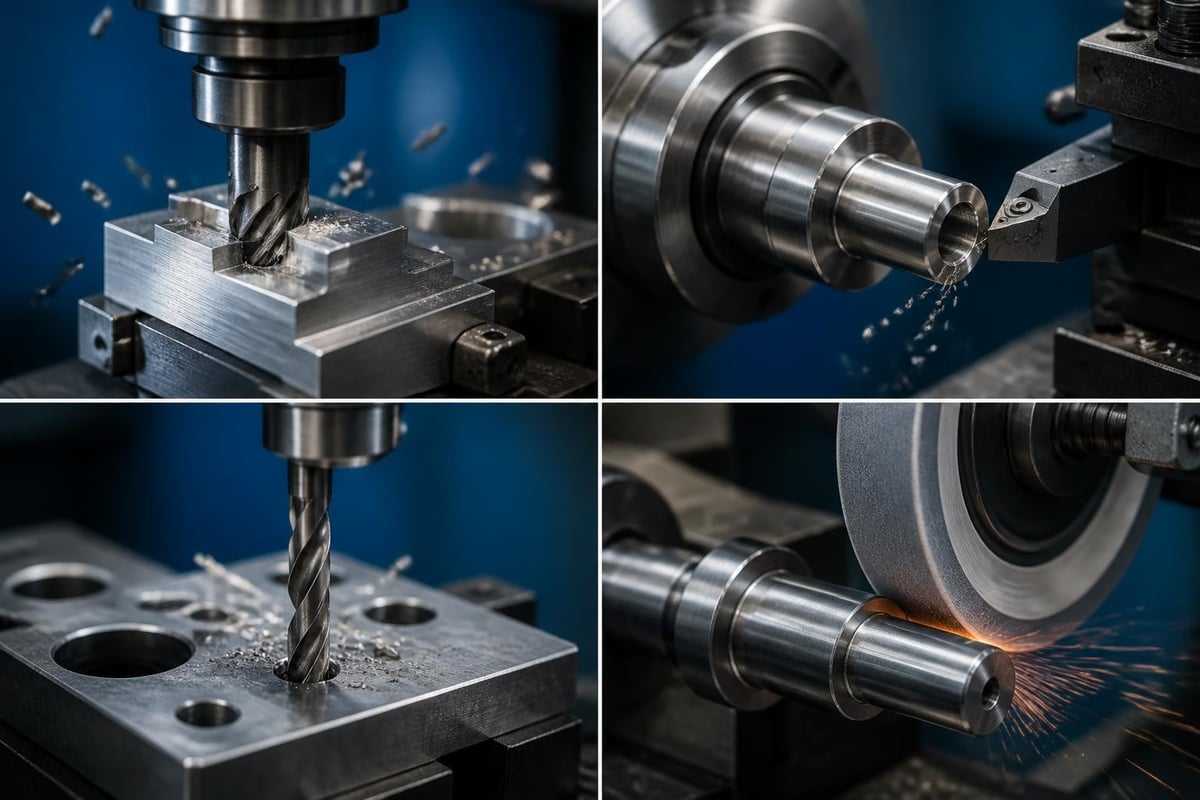
- CNC milling removes material using rotating cutting tools to create features like slots, pockets, and contoured surfaces
- CNC turning rotates the workpiece while stationary tools remove material, ideal for cylindrical parts like shafts and bushings
- Drilling and boring create precise holes with specific diameter tolerances and surface finishes
- Grinding achieves extremely tight tolerances and superior surface finishes for critical mating surfaces
- Electrical discharge machining (EDM) uses electrical sparks to machine hardened materials and intricate cavities
The Society of Manufacturing Engineers provides practical guidance on CNC machining capabilities and workforce training, helping businesses understand what modern machine shops can accomplish.
Material Selection and Machinability Considerations
Material choice profoundly impacts machining efficiency, part performance, and total cost. Industrial applications demand materials that balance mechanical properties, environmental resistance, and machinability.
Common Materials for Custom Machined Parts
| Material Category | Examples | Best Applications | Machining Considerations |
|---|---|---|---|
| Carbon Steels | 1018, 1045, 4140 | General structural components, shafts | Good machinability, cost-effective |
| Stainless Steels | 304, 316, 17-4 PH | Corrosive environments, food processing | Work-hardening requires sharp tools |
| Aluminum Alloys | 6061, 7075, 2024 | Lightweight assemblies, aerospace | Excellent machinability, thermal management needed |
| Tool Steels | A2, D2, O1 | Dies, punches, wear surfaces | Requires heat treatment, challenging to machine |
| Exotic Alloys | Inconel, titanium, Hastelloy | High-temperature, extreme environments | Slow speeds, specialized tooling required |
Companies serving the oil and gas sector often require materials that withstand extreme pressures, temperatures, and chemical exposure. Custom machining services that understand industrial manufacturing requirements can recommend appropriate material grades and heat treatment specifications.
Machinability ratings help predict cutting speeds, tool life, and surface finish outcomes. Free-machining grades contain additives like sulfur or lead that improve chip formation but may reduce mechanical properties. Engineers must balance ease of manufacturing with end-use performance requirements.
Tolerances, Specifications, and Quality Standards
Precision is the defining characteristic of professional custom machining services. Understanding how to specify and verify tolerances ensures parts function correctly in their assemblies.
Dimensional Tolerancing Fundamentals
Standard machining tolerances typically range from ±0.005" to ±0.030" depending on process capability and cost constraints. Tighter tolerances increase manufacturing complexity and inspection requirements.
Geometric dimensioning and tolerancing (GD&T) provides unambiguous communication between designers and machinists. The ASME Y14.5 standard defines symbols and practices for specifying form, orientation, profile, location, and runout tolerances that control part geometry beyond simple plus-minus dimensions.
Critical tolerance zones include:
- Positional tolerances that define acceptable deviation for hole patterns and mating features
- Perpendicularity and parallelism requirements for mounting surfaces and reference planes
- Concentricity and runout specifications for rotating components like shafts and bearing journals
- Surface finish requirements measured in microinches (Ra) or roughness average
Many custom metal machining operations integrate coordinate measuring machines (CMM) and optical comparators to verify complex geometries and provide certified inspection reports.
The Custom Machining Workflow: From Concept to Completion
Successful custom machining projects follow a structured workflow that manages technical requirements, timelines, and quality checkpoints.
Initial Consultation and Design Review
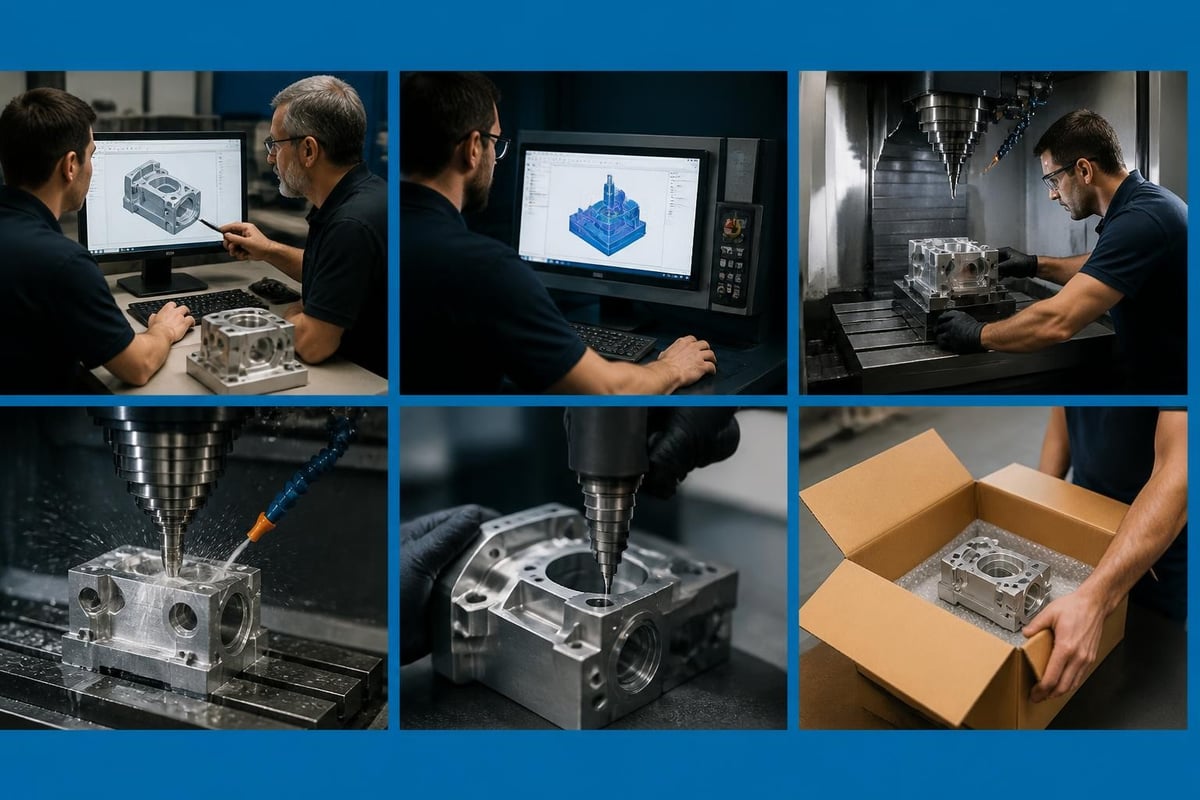
The process begins when you share technical drawings, CAD models, or physical samples with your machining partner. Experienced machinists review designs for:
- Manufacturability and process selection based on geometry, tolerances, and material
- Cost optimization opportunities through feature simplification or tolerance relaxation
- Tooling requirements and special fixturing needs
- Lead time estimates accounting for material procurement and production scheduling
Design-for-manufacturing guidance from the Department of Energy helps engineers optimize designs to reduce machining time and material waste while maintaining functional requirements.
Programming and Setup
CNC machinists translate part geometry into machine instructions using CAM (computer-aided manufacturing) software. This programming phase determines:
- Tool paths that minimize cycle time while maintaining quality
- Cutting parameters optimized for material and surface finish
- Workholding strategies that ensure stability and accessibility
- Tool selection balancing cost, speed, and finish requirements
First-article inspection verifies that programming and setup produce parts meeting specifications before committing to full production runs.
Production and Quality Control
Modern custom machining services implement statistical process control (SPC) to monitor dimensional trends and prevent defects. In-process inspection catches deviations before multiple parts are affected.
Quality documentation typically includes:
- Material certifications tracing chemistry and heat treatment
- Dimensional inspection reports with measured values
- Surface finish verification using profilometers
- Photographic documentation of critical features
The NIST Production Systems Group provides research and resources on measurement science and metrology practices that inform quality assurance protocols.
Cost Factors and Pricing Considerations
Understanding what drives custom machining costs enables better budgeting and supplier negotiations. Multiple variables influence final pricing.
Primary Cost Components
Material costs reflect raw stock prices plus waste from cutting operations. Near-net-shape blanks reduce material removal and associated labor.
Setup time represents the non-recurring cost of programming, fixturing, and first-article verification. This fixed cost spreads across production quantity, making larger runs more economical per piece.
Machining time varies with material hardness, tolerance requirements, and geometric complexity. Difficult-to-machine materials like Inconel or titanium increase cycle times substantially.
Tooling consumption accounts for cutting tool wear and replacement. Aggressive cutting parameters increase productivity but accelerate tool degradation.
Small manufacturers can benefit from NIST guidance on pricing models to develop consistent quoting processes that ensure profitability while remaining competitive.
Optimizing Project Economics
Consider these strategies to reduce custom machining costs without compromising quality:
- Standardize on common material grades and sizes your supplier stocks
- Relax non-critical tolerances to standard machining capability (±0.010" or wider)
- Consolidate orders to spread setup costs across larger quantities
- Provide complete, accurate drawings to minimize revision cycles
- Allow reasonable lead times that permit efficient scheduling
Companies requiring prototype machining and fabrication services should discuss cost-reduction opportunities during design reviews before finalizing specifications.
Integrating Machining with Welding and Fabrication
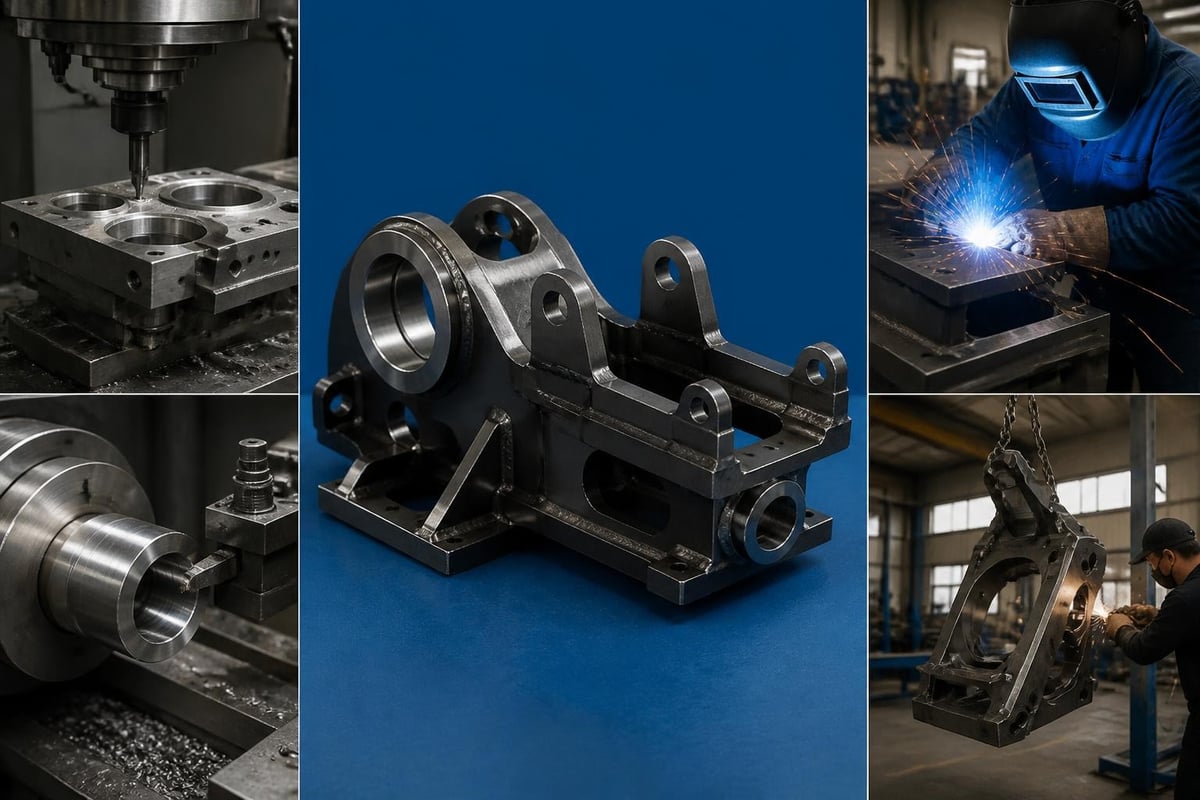
Many industrial projects require coordinated machining, welding, and fabrication capabilities under one roof. This integration eliminates handoffs, reduces lead times, and simplifies quality management.
Complementary Capabilities
Custom machining services often work alongside:
- Metal fabrication that produces weldments requiring precision-machined mounting surfaces
- Welding operations that join machined components into assemblies
- Finishing processes including painting, plating, and heat treatment
For example, a custom skid assembly might combine fabricated structural components with machined bearing housings and precisely toleranced shaft journals. Coordinating these operations through a single supplier streamlines project management and accountability.
Field Service and On-Site Machining
Industrial operations sometimes require machining performed in the field rather than in a traditional shop environment. Portable boring bars, line boring equipment, and mobile machining centers enable:
- Repair of large equipment that cannot be transported
- On-site alignment of bearing housings and structural components
- Emergency restoration of critical surfaces to minimize downtime
- Installation assistance requiring precision fitting and adjustment
Heavy equipment repair frequently combines field machining with welding to restore damaged components without removing equipment from service locations.
Industry-Specific Applications and Requirements
Different industrial sectors impose unique demands on custom machining services, from material specifications to quality certifications.
Oil and Gas Sector
Upstream, midstream, and downstream operations require components that withstand high pressures, corrosive fluids, and temperature extremes. Custom machining for this sector often involves:
- API-certified materials and processes for pressure-containing components
- Exotic alloys resistant to hydrogen sulfide and carbon dioxide
- Non-destructive testing (NDT) for critical welds and internal features
- Traceability documentation meeting regulatory requirements
Facilities providing oilfield maintenance understand these specialized requirements and maintain appropriate certifications.
Aggregate and Mining Equipment
Crushing, screening, and material handling equipment subjects components to extreme abrasion and impact loading. Machining services for this industry focus on:
- Wear-resistant materials including hardened steels and high-chrome alloys
- Hardfacing deposits applied to machined surfaces for extended service life
- Large-capacity machining for oversized shafts, drums, and structural components
- Field repair capabilities to minimize equipment downtime
Recycling and Waste Processing
Modern recycling facilities process diverse material streams using specialized equipment that requires custom components:
- Shredder shafts and cutting elements with precise geometries
- Conveyor components including machined sprockets and idlers
- Hydraulic cylinders and actuators for sorting equipment
- Specialized tooling for baling and compaction systems
Technology Trends Shaping Custom Machining Services
The manufacturing landscape continues evolving as new technologies, market pressures, and workforce dynamics reshape how custom machining services operate.
Automation and Lights-Out Manufacturing
Advanced machine shops increasingly implement robotic loading systems, pallet changers, and automated inspection to extend productive hours beyond traditional shifts. Lights-out production runs unmanned during nights and weekends, improving asset utilization and reducing lead times.
Bar feeders and gantry loaders eliminate manual part handling for high-volume production. Vision systems verify part presence and orientation before machining begins.
Supply Chain Resilience and Nearshoring
Deloitte’s Manufacturing Industry Outlook identifies supply chain resilience as a critical priority for industrial companies. Recent disruptions have prompted manufacturers to reconsider global sourcing strategies.
Regional custom machining services offer advantages including:
- Reduced transportation costs and lead times
- Better communication and technical collaboration
- Enhanced supply chain visibility and control
- Support for domestic manufacturing initiatives
Companies throughout the Western United States benefit from working with local providers that understand regional industry needs and can respond quickly to changing requirements.
Workforce Development and Skilled Trades
The machining industry faces ongoing challenges recruiting and retaining skilled workers. Successful custom machining services invest in:
- Apprenticeship programs that develop machinists from entry-level talent
- Cross-training initiatives that build versatility across CNC and manual equipment
- Technology adoption that enhances rather than replaces skilled workers
- Competitive compensation and career development opportunities
Selecting the Right Custom Machining Partner
Choosing a machining supplier involves evaluating technical capabilities, business practices, and cultural fit. Consider these criteria during your selection process.
Technical Capability Assessment
Review the shop's equipment list, capacity range, and process expertise:
- Machine size and capacity matching your part envelope and weight
- Tolerance capability demonstrated through sample parts or inspection reports
- Material experience with grades required for your applications
- Complementary services like welding, finishing, or assembly
Visiting the facility provides valuable insights into organization, equipment condition, and quality culture that websites cannot convey.
Business Practice Evaluation
Beyond technical capability, evaluate operational factors:
- Lead time performance and on-time delivery track record
- Communication responsiveness during quoting and production
- Quality system documentation including ISO certification if required
- Pricing transparency with clear breakdowns of cost components
Request references from customers in similar industries or applications to learn about real-world performance.
Location and Logistics Considerations
Geographic proximity affects communication effectiveness, shipping costs, and emergency response capability. Local custom fabrication services eliminate many logistical challenges while supporting regional economic development.
For projects requiring field service or on-site support, local providers offer significant advantages in response time and travel costs.
Quality Documentation and Traceability
Professional custom machining services maintain comprehensive documentation that proves conformance and enables failure analysis if issues arise.
Standard Documentation Packages
Most projects include:
| Document Type | Purpose | Typical Contents |
|---|---|---|
| Material Certifications | Verify chemistry and properties | Mill test reports, heat lot numbers |
| Dimensional Inspection | Prove conformance to drawings | CMM reports, measured values, GD&T verification |
| Process Certifications | Document special processes | Heat treatment charts, NDT results |
| First Article Inspection | Validate new production | Complete dimensional layout, material certs |
Traceability connects finished parts back through production records to raw material sources. This documentation becomes critical for regulated industries, warranty claims, and continuous improvement initiatives.
Handling Non-Conformances
Even with robust quality systems, occasional defects occur. Evaluate how suppliers manage non-conforming material:
- Prompt notification when issues are discovered
- Root cause analysis to prevent recurrence
- Corrective action plans with verification
- Transparent communication about impacts and recovery plans
The best custom machining services view non-conformances as improvement opportunities rather than problems to hide.
Maintenance, Repair, and Reverse Engineering
Beyond new part production, custom machining services support equipment maintenance and legacy system sustainment through specialized capabilities.
Repair Machining and Restoration
Worn or damaged components often regain functionality through machining operations:
- Shaft repair involving undersize machining and sleeve installation
- Bore restoration through welding buildup and re-boring to original dimensions
- Surface refinishing to restore sealing surfaces and bearing journals
- Thread repair using helicoil installation or oversize tapping
Industrial equipment repair frequently combines machining with welding to restore components at fraction of replacement cost.
Reverse Engineering Services
When original drawings are unavailable or equipment predates modern documentation, reverse engineering recreates specifications from physical samples:
- Precise measurement using CMM, optical comparators, or 3D scanning
- CAD model creation based on measured geometry
- Material analysis through spectroscopy or chemical testing
- Production of replacement parts from reverse-engineered specifications
This capability proves invaluable for maintaining older equipment or sourcing obsolete components.
Custom machining services deliver precision components that keep industrial operations running efficiently across diverse sectors. By understanding processes, tolerances, cost drivers, and quality requirements, you can source parts that meet technical specifications while optimizing project economics. LTJ Industrial Services combines custom machining expertise with welding, fabrication, and field service capabilities to support commercial and industrial manufacturing throughout the Western United States, delivering comprehensive solutions that help you focus on your core business objectives.