Industrial welding serves as the backbone of modern manufacturing, connecting metal components in everything from oil rigs to recycling equipment. This essential process combines technical expertise, precise methodology, and rigorous quality standards to create durable bonds that withstand extreme conditions. For businesses in the commercial and industrial manufacturing sectors throughout the Western United States, understanding the nuances of industrial welding capabilities, applications, and best practices is critical for maintaining operational efficiency and project success.
Understanding Industrial Welding Fundamentals
Industrial welding encompasses a diverse range of processes designed to join metals permanently through heat and pressure. Unlike light manufacturing or hobbyist applications, industrial welding operations demand higher precision, stronger welds, and comprehensive documentation to meet safety and performance requirements.
The primary distinction between industrial and commercial welding lies in scale, complexity, and regulatory oversight. Industrial applications typically involve heavier materials, more challenging environmental conditions, and stricter compliance requirements. Projects in the oil and gas sector, for instance, require welders certified to specific codes and standards that govern pipeline integrity and pressure vessel construction.
Core Welding Processes in Industrial Applications
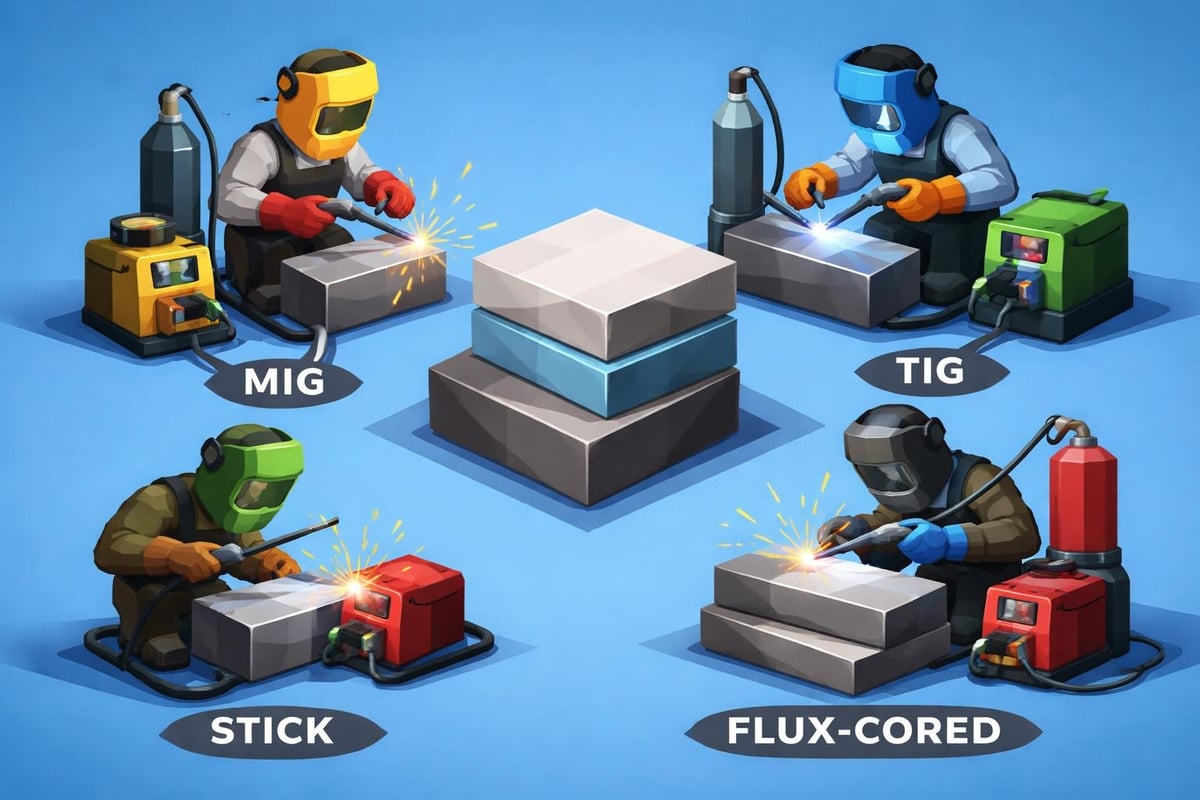
Several welding methods dominate industrial settings, each offering unique advantages for specific materials and applications:
- Gas Metal Arc Welding (GMAW/MIG): High-speed process ideal for production welding on carbon steel and aluminum
- Gas Tungsten Arc Welding (GTAW/TIG): Precision method for stainless steel, exotic alloys, and critical joints requiring superior quality
- Shielded Metal Arc Welding (SMAW/Stick): Versatile process excellent for field work and thick materials in outdoor conditions
- Flux-Cored Arc Welding (FCAW): Productive method combining advantages of MIG and stick welding for heavy fabrication
The selection of welding process depends on material type, thickness, position, production volume, and quality requirements. Metal fabrication and welding projects often utilize multiple processes to achieve optimal results across different components and assemblies.
Quality Standards and Certification Requirements
Industrial welding operates under stringent quality frameworks established by organizations like the American Welding Society (AWS), American Society of Mechanical Engineers (ASME), and American Petroleum Institute (API). These standards ensure weld integrity, worker safety, and compliance with industry-specific regulations.
The American Welding Society offers comprehensive guides and handbooks that define acceptable practices for various industrial applications. AWS D1.1 governs structural steel welding, while AWS D1.6 addresses stainless steel structures. Oil and gas operations frequently require API 1104 certification for pipeline welding.
Welder Qualification and Testing
Industrial welders must demonstrate competency through formal qualification testing. The process involves:
- Visual examination of completed test welds for surface defects
- Destructive testing including bend tests to verify ductility and penetration
- Non-destructive testing using radiography, ultrasonic, or magnetic particle inspection
- Documentation of qualified procedures and welder performance qualifications
- Periodic requalification to maintain certified status
Quality control extends beyond individual welder skills to encompass welding procedure specifications (WPS) and procedure qualification records (PQR). These documents detail every parameter-amperage, voltage, travel speed, preheat temperature-required to produce consistent, code-compliant welds.
| Quality Standard | Primary Application | Key Requirements |
|---|---|---|
| AWS D1.1 | Structural Steel | Prequalified joints, certified welders, visual inspection |
| ASME Section IX | Pressure Vessels | PQR testing, radiographic examination, impact testing |
| API 1104 | Pipeline Construction | Position qualification, destructive testing, repair procedures |
| AWS D1.6 | Stainless Steel | Special filler metals, cleanliness protocols, corrosion resistance |
Applications Across Industrial Sectors
Industrial welding supports critical infrastructure and manufacturing operations across diverse sectors. Each industry presents unique challenges that demand specialized knowledge and capabilities.
Oil and Gas Industry
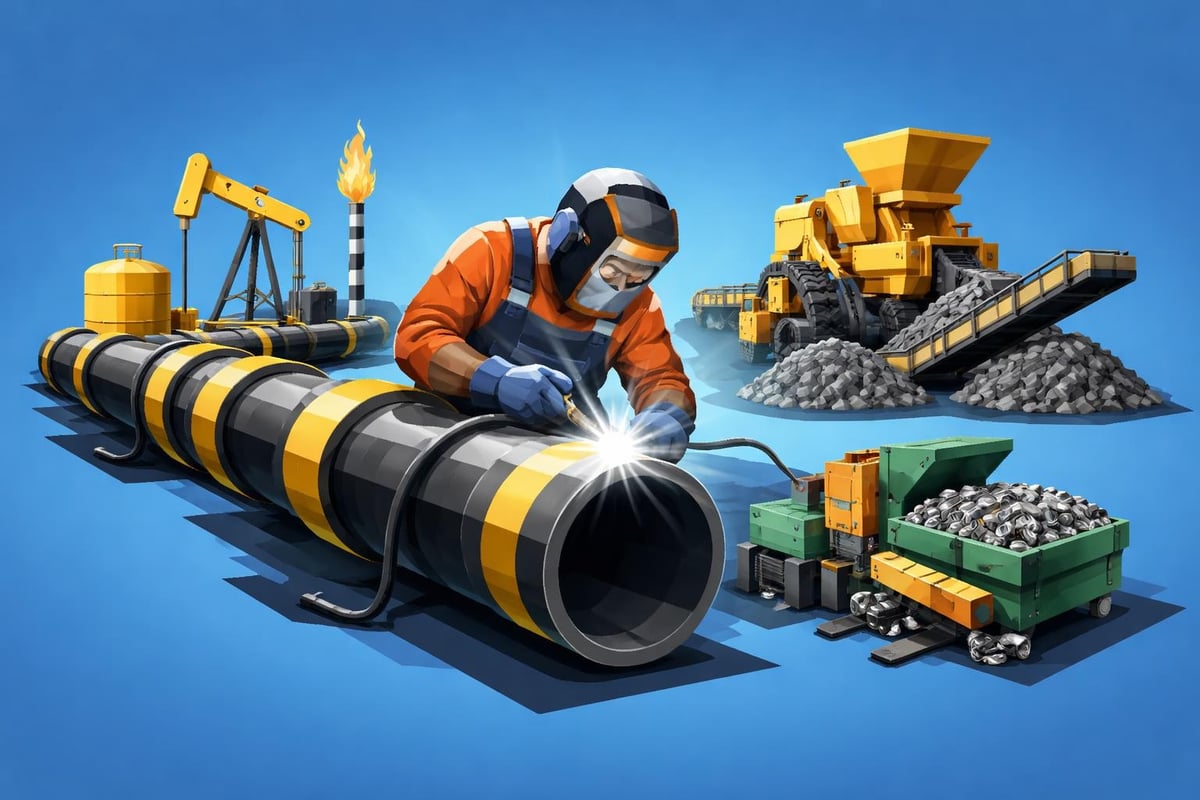
The oil and gas sector relies heavily on industrial welding for pipeline construction, refinery maintenance, and drilling equipment fabrication. Welders working in this field encounter high-pressure systems, corrosive environments, and extreme temperatures that require advanced materials and techniques.
Pipeline welding often occurs in remote locations with challenging weather conditions. Field welders must adapt to limited power availability, wind, precipitation, and temperature extremes while maintaining code compliance. The manufacturing and machining capabilities required extend to custom components that interface with welded assemblies.
Aggregate and Mining Operations
Aggregate processing facilities demand robust equipment that withstands constant abrasion, impact, and vibration. Industrial welding repairs and fabricates crushers, conveyors, screens, and hoppers that process millions of tons of material annually.
Hardfacing applications use specialized welding techniques to deposit wear-resistant alloys on high-stress surfaces. This extends equipment life significantly compared to base materials. Repair welding on manganese steel components requires specific preheat and interpass temperature control to prevent cracking.
Recycling and Waste Processing
The recycling industry presents unique welding challenges due to material contamination, mixed metals, and equipment subjected to repetitive stress. Shredders, balers, and sorting equipment require frequent repair and modification to maintain productivity.
Understanding common welding defects and their causes becomes particularly important in recycling applications where contaminated materials can introduce hydrogen, sulfur, or other elements that compromise weld integrity.
Advanced Materials and Specialized Techniques
Modern industrial welding extends beyond carbon steel to encompass exotic alloys, dissimilar metals, and advanced joining methods. These capabilities enable manufacturers to optimize performance, reduce weight, and improve corrosion resistance.
Stainless steel welding requires careful heat management to preserve corrosion resistance. Excessive heat input causes carbide precipitation along grain boundaries, reducing corrosion resistance in a phenomenon called sensitization. Industrial welders use low-heat-input processes, special filler metals, and controlled cooling to prevent this degradation.
Aluminum welding presents distinct challenges due to the metal's thermal conductivity, oxide layer, and susceptibility to porosity. AC TIG welding effectively removes the aluminum oxide layer while producing high-quality joints on thin and thick sections alike.
Orbital and Automated Welding Systems
Automation increases productivity, consistency, and quality in high-volume industrial applications. Orbital welding systems produce repeatable tube and pipe welds with minimal operator intervention. Research on model checking in cobot welding systems demonstrates how formal verification methods improve welding quality and efficiency through automated process control.
Robotic welding cells excel in repetitive fabrication tasks, freeing skilled welders for complex assemblies requiring human judgment. The integration of vision systems, seam tracking, and adaptive control enables robots to handle greater part variation than traditional fixed-path programming.
Field Welding Versus Shop Fabrication
Industrial welding occurs in two primary environments, each with distinct advantages and constraints. Understanding these differences helps project managers allocate resources effectively and establish realistic schedules.
Shop welding offers controlled conditions with consistent power, protected work areas, and access to overhead cranes and positioning equipment. Fabricators can optimize joint design, use higher productivity processes, and implement thorough quality control procedures. Custom metal fabrication projects benefit from the precision and efficiency possible in well-equipped shop environments.
Field welding addresses on-site installation, emergency repairs, and modifications to existing structures. Welders must adapt to variable conditions while maintaining quality standards. Mobile welding equipment, generator-powered machines, and specialized rod ovens enable field crews to deliver professional results despite environmental challenges.
| Consideration | Shop Welding | Field Welding |
|---|---|---|
| Environment Control | Climate controlled, weather protected | Exposed to wind, rain, temperature extremes |
| Equipment Access | Full tool inventory, overhead cranes | Portable equipment, manual handling |
| Quality Control | Comprehensive NDT, controlled inspection | Limited testing, visual examination primary |
| Productivity | Higher deposition rates, optimized processes | Travel time, setup constraints, position limitations |
| Cost Structure | Lower hourly rates, efficient material use | Premium rates, mobilization expenses, weather delays |
Safety Protocols and Hazard Management
Industrial welding environments contain multiple hazards requiring comprehensive safety programs. Arc flash, fume exposure, confined spaces, and hot work present risks that demand proactive management and worker training.
Personal protective equipment forms the first line of defense against welding hazards. Auto-darkening helmets protect eyes from ultraviolet and infrared radiation while improving productivity through better visibility. Flame-resistant clothing prevents burn injuries from sparks and spatter. Respiratory protection becomes mandatory when welding galvanized steel, stainless steel, or in confined spaces with limited ventilation.
Fume extraction systems remove harmful particulates and gases from the breathing zone. Industrial welding on materials containing zinc, chromium, manganese, or other toxic elements requires local exhaust ventilation or supplied-air respirators. Resources on welding and metal fabrication provide detailed guidance on identifying and controlling welding fume hazards.
Hot Work Permits and Fire Prevention
Industrial facilities implement hot work permit systems to prevent fires and explosions. The permit process includes:
- Fire watch assignment before, during, and after welding operations
- Removal or protection of combustible materials within 35 feet
- Fire extinguisher placement and accessibility verification
- Gas testing in areas where flammable vapors may be present
- Post-work inspection to ensure no smoldering materials remain
Inspection Methods and Quality Assurance
Weld inspection combines visual examination, non-destructive testing (NDT), and destructive testing to verify quality and compliance. The inspection level and methods depend on service conditions, code requirements, and consequence of failure.
Visual inspection remains the most cost-effective quality control method. Trained inspectors examine weld size, profile, surface finish, and obvious defects like cracks, porosity, or incomplete fusion. Weld gauges measure fillet leg size, reinforcement height, and undercut depth to verify dimensional compliance.
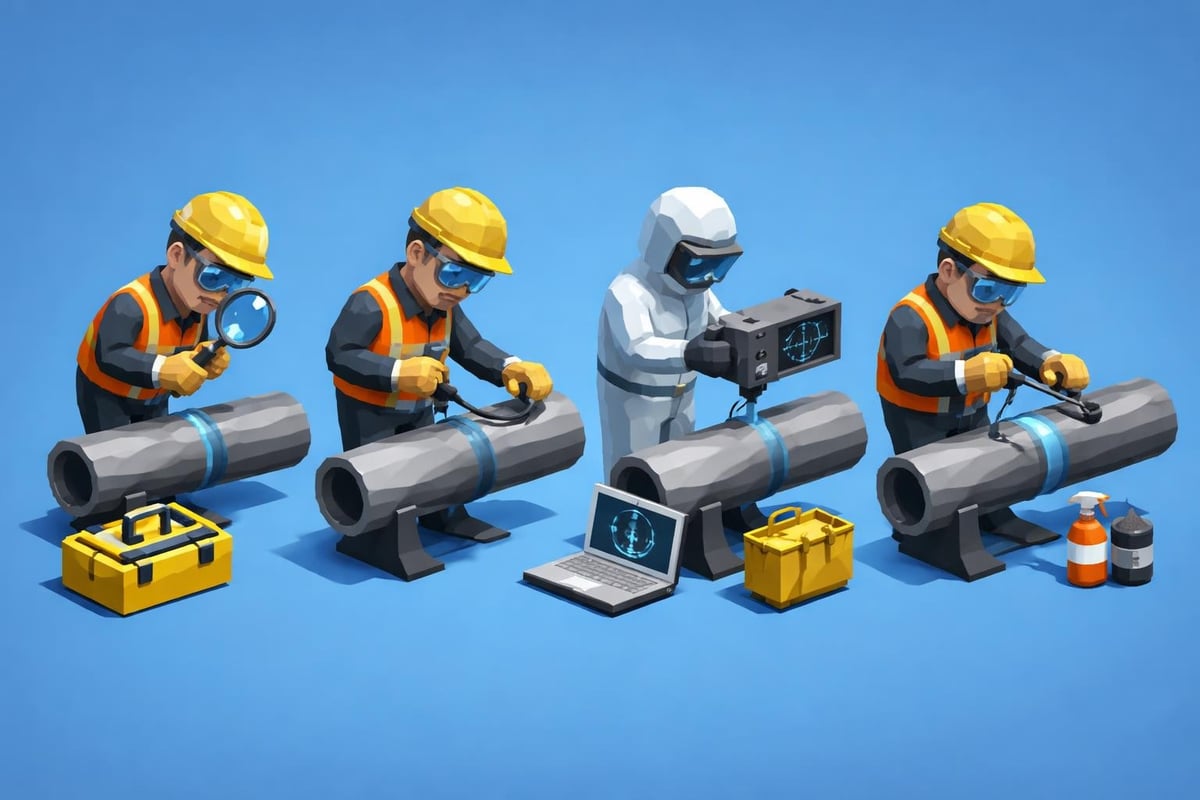
Non-destructive testing reveals internal discontinuities invisible to surface examination:
- Radiographic Testing (RT): X-ray or gamma ray imaging detects internal voids, inclusions, and lack of fusion
- Ultrasonic Testing (UT): Sound waves identify laminations, cracks, and incomplete penetration with precise depth measurement
- Magnetic Particle Testing (MT): Magnetic fields reveal surface and near-surface cracks in ferromagnetic materials
- Liquid Penetrant Testing (PT): Dye penetrants highlight surface-breaking defects in any material
The NIST welding data dictionary standardizes terminology and data elements used to document welding inspection results, facilitating digital data exchange between fabricators, inspectors, and clients.
Material Preparation and Joint Design
Successful industrial welding begins long before arc initiation. Proper material preparation and joint design significantly impact weld quality, productivity, and cost.
Base metal cleanliness directly affects weld soundness. Mill scale, rust, oil, paint, and other contaminants introduce defects or weaken joints. Grinding, wire brushing, or chemical cleaning removes surface contaminants before welding. Stainless steel requires special attention to prevent cross-contamination from carbon steel tools or work surfaces.
Joint Configuration and Fit-Up
Joint design balances weld strength, accessibility, distortion control, and cost. Complete joint penetration (CJP) welds provide full-strength connections but require precise fit-up and skilled welders. Partial joint penetration (PJP) welds reduce labor and filler metal consumption where full strength isn't required.
Fit-up tolerances directly impact weld quality and cost. Excessive gaps require multiple passes, increase filler metal consumption, and raise distortion risk. Industrial fabricators use strongbacks, tack welds, and fixtures to maintain proper alignment during welding.
Distortion Control and Residual Stress Management
Welding introduces localized heating and cooling cycles that cause expansion, contraction, and permanent deformation. Understanding and controlling distortion separates successful fabricators from those constantly fighting dimensional problems.
Heat input management provides the primary control over distortion. Lower amperage, faster travel speed, and intermittent welding reduce total heat input and associated distortion. Balanced welding sequences distribute heat evenly, preventing cumulative distortion from building up on one side of an assembly.
Mechanical methods supplement thermal control:
- Fixtures and clamps resist distortion forces during welding
- Strongbacks stiffen assemblies to prevent bowing and twisting
- Preheating reduces thermal gradients between weld and base metal
- Peening introduces compressive stress to counteract weld shrinkage
- Post-weld heat treatment relieves residual stresses in critical applications
Industrial fabrication services incorporate distortion control strategies from the design phase through final machining to deliver dimensionally accurate assemblies.
Documentation and Traceability Requirements
Industrial welding generates extensive documentation that provides traceability, quality evidence, and liability protection. The complexity of documentation systems varies with industry and application criticality.
Welding procedure specifications (WPS) detail every parameter required to produce acceptable welds. These documents specify base materials, filler metals, joint design, position, preheat requirements, interpass temperature, post-weld heat treatment, and acceptance criteria. Procedure qualification records (PQR) provide test results demonstrating that the WPS produces sound welds meeting code requirements.
Welder performance qualifications (WPQ) document individual welder competency for specific processes, materials, positions, and thickness ranges. These qualifications typically remain valid for six months of continuous welding activity or require requalification testing.
Material test reports (MTR) certify chemical composition and mechanical properties of base metals and filler materials. Traceability systems track material from certified mill source through fabrication to final installation, essential for nuclear, aerospace, and pressure vessel applications.
Emerging Technologies in Industrial Welding
Advanced technologies continue reshaping industrial welding capabilities, improving quality, productivity, and worker safety. Laser welding offers deep penetration, narrow heat-affected zones, and high travel speeds for precision applications. Hybrid laser-arc processes combine the benefits of both technologies for thick-section welding at production speeds.
Friction stir welding joins metals in solid state, eliminating fusion-related defects like porosity and hot cracking. This process excels on aluminum alloys that prove difficult to fusion weld, particularly in aerospace and transportation applications.
Additive manufacturing through directed energy deposition uses welding processes to build complex geometries layer by layer. This technology enables repair of high-value components, production of custom tooling, and manufacture of geometries impossible through conventional fabrication.
Digital welding management systems integrate power sources, quality monitoring, and documentation into unified platforms. Real-time weld parameter recording, automatic defect detection, and cloud-based data storage improve traceability while reducing manual documentation burden. General welding resources and welding technology guides provide additional information on emerging welding technologies and their industrial applications.
Workforce Development and Skills Training
The industrial welding industry faces persistent skilled labor shortages as experienced welders retire faster than new professionals enter the field. Addressing this challenge requires comprehensive training programs, competitive compensation, and clear career advancement paths.
Effective welder training combines classroom instruction on metallurgy, blueprint reading, and welding theory with extensive hands-on practice. Apprenticeship programs typically span 3-4 years, progressing from basic processes and positions to advanced techniques and certifications.
Continuing education keeps welders current with new technologies, materials, and code requirements. Advanced certifications in specialized processes, inspection methods, or supervisory roles create career progression beyond production welding. Essential books on welding provide foundational knowledge and advanced insights supporting ongoing professional development.
Equipment Selection and Maintenance
Industrial welding equipment represents significant capital investment requiring careful selection and diligent maintenance. Power source selection depends on processes, duty cycle, portability requirements, and advanced features like pulse capability or synergic control.
Constant current (CC) machines suit stick and TIG welding, delivering stable arc characteristics across varying arc lengths. Constant voltage (CV) power sources serve MIG and flux-cored welding, maintaining consistent wire burn-off rates as contact-to-work distance varies.
Multi-process machines consolidate stick, TIG, and MIG capabilities into single units, reducing equipment inventory and floor space requirements. Advanced inverter technology provides precise control, excellent arc characteristics, and reduced size and weight compared to traditional transformer machines.
Preventive Maintenance Programs
Regular maintenance prevents unexpected downtime and extends equipment life. Key maintenance tasks include:
- Drive roll inspection and cleaning to ensure consistent wire feeding
- Contact tip replacement before excessive wear causes arc instability
- Gas regulator calibration for proper shielding gas flow
- Cable inspection for damage, loose connections, or excessive resistance
- Cooling system service including antifreeze replacement and flow verification
Manufacturing projects benefit from well-maintained equipment that delivers consistent performance and minimizes production interruptions.
Industrial welding remains fundamental to manufacturing success across oil and gas, aggregate, recycling, and countless other sectors throughout the Western United States. Mastering the technical processes, quality standards, safety protocols, and documentation requirements separates capable providers from those struggling with rework and compliance issues. When your operation needs reliable industrial welding and fabrication services backed by comprehensive machining and field capabilities, LTJ Industrial Services delivers the expertise and quality your projects demand from our Rifle, Colorado facility serving commercial and industrial clients regionwide.