
The traditional model of manufacturing has long required significant capital investment in equipment, facilities, and specialized personnel. However, a paradigm shift is reshaping how businesses approach production. Manufacturing as a service represents a fundamental transformation in how companies access fabrication, welding, and machining capabilities without the burden of ownership. This model enables businesses to leverage specialized expertise and advanced equipment on demand, creating unprecedented flexibility and efficiency in meeting production requirements across industries from oil and gas to recycling and aggregate processing.
Understanding the Manufacturing as a Service Model
Manufacturing as a service fundamentally changes the relationship between production needs and capabilities. Rather than investing millions in equipment that may sit idle during slower periods, companies access manufacturing capabilities on demand through specialized service providers. This shift mirrors the transformation seen in software and infrastructure services over the past two decades.
The core principle involves treating manufacturing capacity as a flexible resource rather than a fixed asset. Businesses engage service providers who maintain the equipment, expertise, and facilities necessary for production tasks. This arrangement transforms capital expenditures into operational expenses while providing access to cutting-edge technology and specialized skills.
Key Components of Service-Based Manufacturing
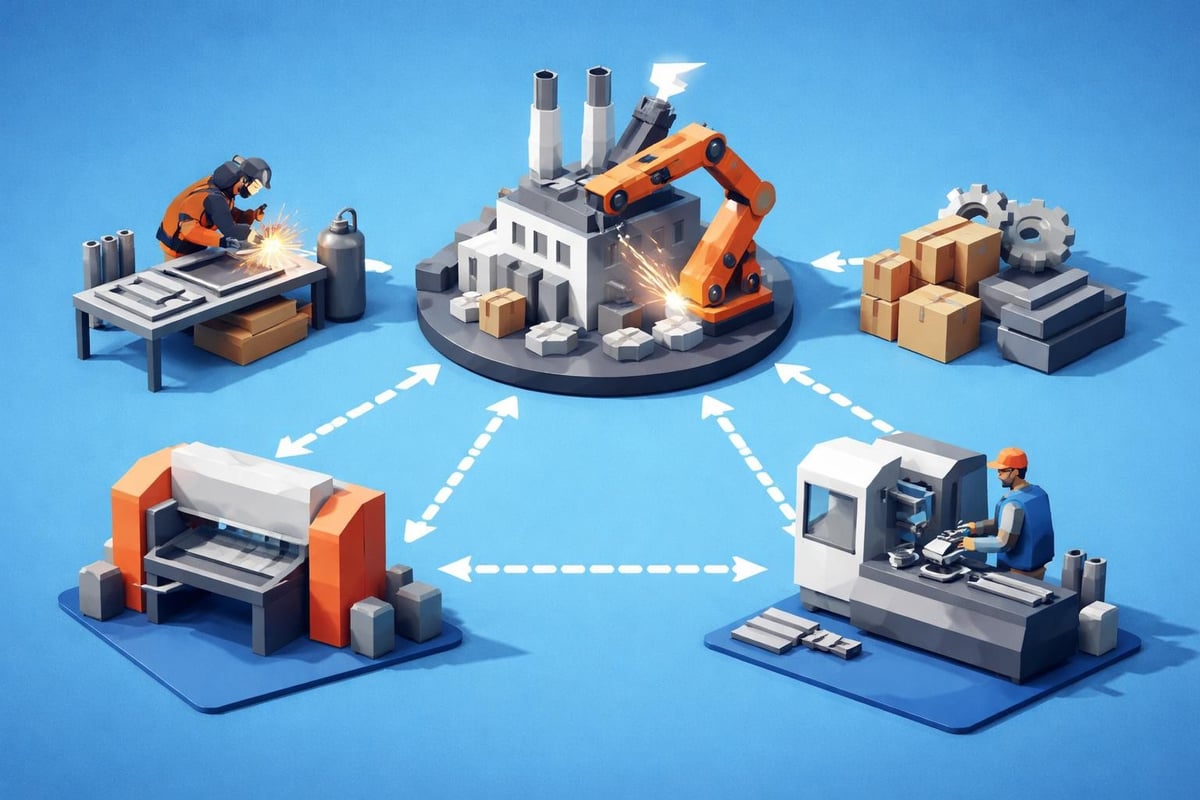
The manufacturing as a service ecosystem consists of several interconnected elements that work together to deliver value:
- On-Demand Access: Companies utilize production capacity only when needed, scaling up or down based on project requirements
- Specialized Expertise: Service providers maintain deep knowledge in specific processes like custom welding and fabrication
- Advanced Equipment: Access to state-of-the-art machinery without the burden of purchase, maintenance, or obsolescence
- Geographic Flexibility: Ability to engage providers across regions, including field services for on-site work
- Risk Mitigation: Reduced exposure to equipment downtime, technological obsolescence, and market fluctuations
Service providers in this model invest continuously in equipment upgrades, operator training, and process optimization. This specialization allows them to deliver higher quality results more efficiently than most in-house operations could achieve.
Strategic Advantages for Industrial Operations
Adopting manufacturing as a service delivers measurable benefits that extend beyond simple cost reduction. Companies operating in demanding sectors like oil and gas extraction, aggregate processing, and recycling facilities face unique challenges that this model addresses effectively.
Financial flexibility represents perhaps the most immediate advantage. Rather than allocating significant capital to purchase welding equipment, machining centers, or fabrication tools, businesses redirect those resources toward core operations. The predictable operational expense structure simplifies budgeting and improves cash flow management.
| Traditional Manufacturing | Manufacturing as a Service |
|---|---|
| High capital investment | Operational expense model |
| Fixed capacity | Scalable on demand |
| Equipment maintenance burden | Provider handles upkeep |
| Technology obsolescence risk | Access to latest equipment |
| In-house expertise required | Leverage specialist knowledge |
Operational Efficiency Gains
The service model introduces efficiencies that internal operations struggle to match. Specialized providers achieve economies of scale impossible for individual companies. They optimize workflows across multiple clients, maintain utilization rates that justify advanced equipment investments, and develop process expertise through repetitive execution.
For companies requiring metal fabrication and welding services, this means accessing capabilities that would require years to develop internally. A service provider specializing in these areas brings refined techniques, proven methodologies, and equipment calibrated for optimal performance.
Speed to market improves dramatically when companies eliminate the procurement and setup phases associated with new equipment. Instead of waiting months for equipment delivery and installation, businesses engage providers already equipped and ready to execute. This responsiveness proves critical in industries where production delays cascade into significant financial impacts.
Technology Integration and Digital Manufacturing
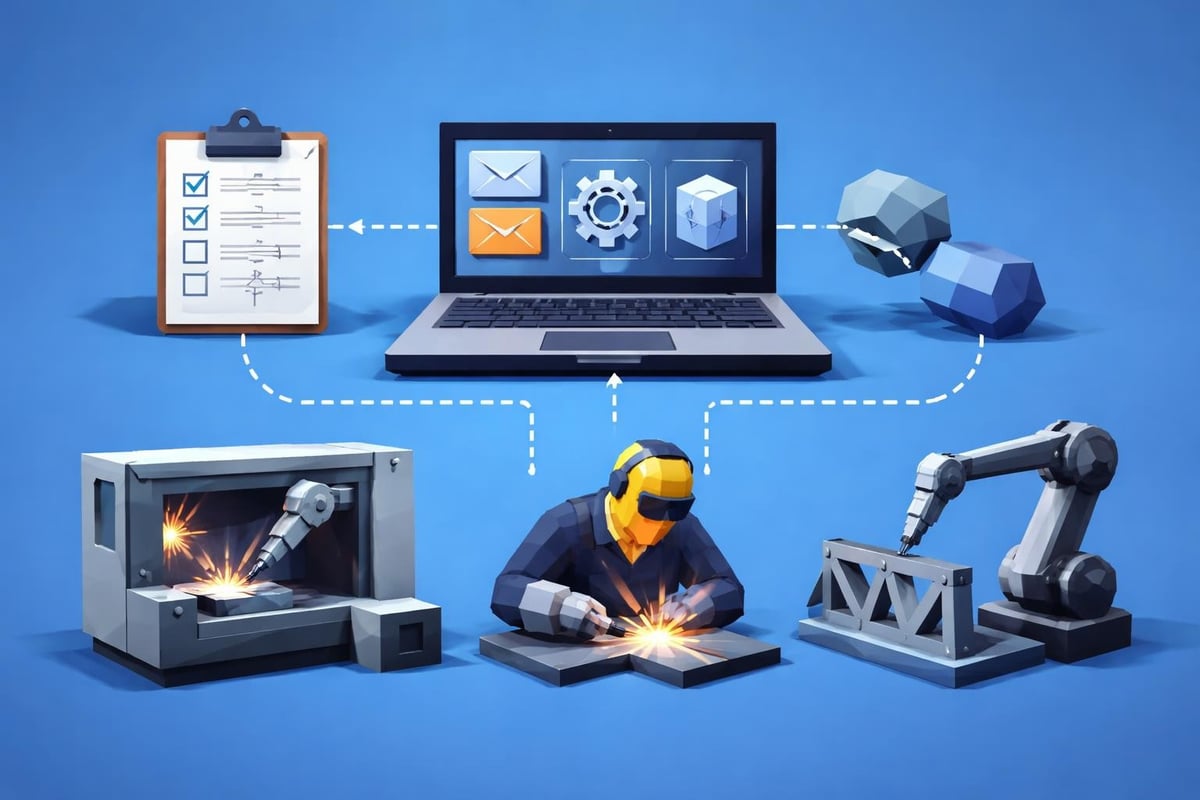
Modern manufacturing as a service leverages digital platforms that connect production requirements with available capabilities across distributed networks. These systems enable sophisticated matchmaking between project specifications and provider capabilities, streamlining the traditionally cumbersome process of sourcing manufacturing services.
Digital integration transforms how companies specify requirements, monitor progress, and receive deliverables. Cloud-based systems allow real-time visibility into production status, quality metrics, and delivery schedules. This transparency builds confidence while enabling proactive management of potential issues before they impact timelines.
Advanced Capabilities Through Service Networks
The service model provides access to capabilities that would be prohibitively expensive for individual companies to maintain. Fraunhofer IOSB research demonstrates how sophisticated digital ecosystems enable complex matchmaking between requirements and capabilities, utilizing artificial intelligence and microservice architectures to optimize resource allocation.
For industrial clients requiring manufacturing and machining services, this means accessing:
- Specialized Equipment: CNC machining centers, precision welding systems, and advanced fabrication tools
- Expert Operators: Certified welders, experienced machinists, and skilled fabricators
- Quality Systems: Established inspection protocols and certification processes
- Material Expertise: Knowledge of alloys, treatments, and material selection for specific applications
- Process Optimization: Refined techniques developed through extensive experience
The distributed nature of modern service networks enables geographic flexibility previously impossible. Companies can engage providers near project sites for field work while utilizing centralized shops for complex fabrication, optimizing logistics and reducing transportation costs.
Industry Applications and Use Cases
Manufacturing as a service finds particularly strong adoption in sectors characterized by variable demand, specialized requirements, and significant consequences for equipment downtime. The oil and gas industry exemplifies these characteristics, requiring sophisticated industrial machinery refurbishment and maintenance alongside custom fabrication for unique applications.
Recycling and Aggregate Operations
Recycling facilities and aggregate operations face unique challenges in equipment maintenance and custom fabrication. Conveyor systems, crushing equipment, and sorting machinery require ongoing repairs and modifications to maintain efficiency. Rather than maintaining in-house welding and machining capabilities for sporadic needs, operators increasingly engage service providers who respond quickly to breakdowns and execute planned maintenance during scheduled shutdowns.
The ability to scale services during major overhauls while minimizing fixed costs during normal operations proves financially advantageous. When a critical component fails, immediate access to custom metal fabrication capabilities prevents extended downtime that would otherwise halt production.
Construction and Infrastructure Projects
Large-scale metal fabrication for construction projects demonstrates another compelling application. Construction timelines demand flexibility as project requirements evolve and unforeseen challenges emerge. The service model allows general contractors and project managers to engage fabrication capabilities precisely when needed without maintaining those capabilities year-round.
This approach proves especially valuable for projects in remote locations throughout the Western United States where transporting materials proves more economical than transporting equipment. Service providers with mobile capabilities execute field fabrication and welding, reducing logistics complexity while maintaining quality standards.
Quality and Compliance Considerations
Transitioning to manufacturing as a service requires careful attention to quality standards and regulatory compliance. Industries like oil and gas operate under stringent regulations governing equipment integrity and worker safety. Service providers must demonstrate compliance with relevant codes and standards while maintaining consistent quality across all deliverables.
Establishing clear specifications and acceptance criteria forms the foundation of successful service relationships. Detailed drawings, material specifications, welding procedures, and inspection requirements ensure all parties share common expectations. This documentation becomes especially critical when work involves safety-critical components or applications subject to regulatory oversight.
Certification and Qualification Requirements
Professional service providers maintain certifications that validate their capabilities and compliance with industry standards:
- Welder Certifications: AWS, ASME, and API qualifications for specific processes and materials
- Quality Management Systems: ISO 9001 certification demonstrating systematic quality control
- Industry-Specific Accreditations: Relevant certifications for oil and gas, pressure vessel, or structural applications
- Safety Programs: OSHA compliance and industry-specific safety training
- Inspection Capabilities: Non-destructive testing equipment and certified inspectors
Companies engaging welding fabrication shops should verify these credentials before awarding projects. The service model's value proposition depends on providers delivering consistent quality that meets or exceeds the standards achievable through internal operations.

Building Effective Service Partnerships
Success with manufacturing as a service depends significantly on the partnerships companies establish with service providers. Unlike transactional vendor relationships, effective service partnerships involve ongoing collaboration, mutual understanding, and aligned objectives.
Selecting the right service provider requires evaluating capabilities beyond basic technical specifications. Geographic proximity matters for projects requiring frequent communication or field services. Providers serving the Western United States from strategically located facilities can respond quickly to urgent needs while maintaining competitive pricing through efficient logistics.
Evaluation Criteria for Service Providers
When assessing potential partners for manufacturing projects, consider these factors:
| Criterion | Importance | Evaluation Method |
|---|---|---|
| Technical Capabilities | Critical | Review equipment lists, process capabilities, and completed project examples |
| Quality Systems | Critical | Examine certifications, inspection procedures, and quality documentation |
| Responsiveness | High | Assess communication patterns and emergency response capabilities |
| Geographic Coverage | Medium-High | Evaluate facility locations and field service availability |
| Industry Experience | High | Review client references and relevant project history |
| Pricing Structure | Medium | Compare cost models and understand pricing drivers |
Establishing clear communication protocols prevents misunderstandings that could compromise project outcomes. Regular progress updates, accessible project documentation, and defined escalation paths for issues create transparency that builds trust over time.
Economic Impact and Market Trends
The manufacturing as a service market continues expanding as more companies recognize the model's advantages. Research published in ScienceDirect explores how this approach enhances value chain resilience and promotes circularity in manufacturing through dynamic distributed networks of resources.
Economic pressures accelerate adoption as businesses seek operational flexibility in uncertain markets. The ability to scale production capacity without corresponding capital investment becomes increasingly valuable as demand patterns grow less predictable. Companies appreciate the option to expand manufacturing capacity temporarily during busy periods while avoiding underutilized assets during slower times.
Regional Considerations in the Western United States
The Western United States presents unique characteristics that influence manufacturing as a service adoption. Vast geographic distances between industrial sites create challenges for companies attempting to maintain centralized manufacturing capabilities. The region's concentration of natural resource extraction, renewable energy development, and infrastructure projects generates substantial demand for specialized fabrication and machining services.
Service providers operating throughout this region develop expertise in logistics, field services, and rapid response to support clients across dispersed locations. The combination of shop-based capabilities for complex projects and mobile field services for on-site work addresses the geographic realities while maintaining economic efficiency.
Risk Management and Business Continuity
Manufacturing as a service contributes meaningfully to risk mitigation strategies by diversifying production capabilities across multiple providers. Companies relying exclusively on internal manufacturing face significant vulnerability to equipment failures, personnel changes, or capacity constraints. The service model enables businesses to maintain relationships with multiple qualified providers, ensuring continuity even when individual partners face temporary limitations.
This distributed approach to manufacturing capacity aligns with modern supply chain resilience thinking. Rather than concentrating risk in single-source dependencies, companies create flexible networks capable of adapting to disruptions. When one provider experiences delays, alternative partners can absorb overflow work, maintaining project timelines despite individual challenges.
Emergency Response Capabilities
Industrial operations occasionally require urgent manufacturing services to address equipment failures or unexpected project developments. The service manufacturing model excels in these scenarios by providing access to providers who maintain emergency response capabilities. Established relationships with service partners enable rapid mobilization when critical situations arise.
For facilities operating continuous processes where downtime translates directly into lost revenue, this responsiveness delivers substantial value. A service provider capable of dispatching field welders and machinists within hours can prevent or minimize costly production interruptions that would otherwise persist for days or weeks.
Implementation Strategies and Best Practices
Transitioning to manufacturing as a service requires thoughtful planning and systematic execution. Companies accustomed to internal manufacturing capabilities may need to adjust procurement processes, quality oversight, and project management approaches to optimize results from service relationships.
Beginning with pilot projects allows organizations to develop competency with the service model while limiting risk exposure. Select projects with clear specifications, manageable complexity, and defined success criteria. Use these initial engagements to establish communication patterns, refine documentation requirements, and build confidence in the approach.
Documentation and Communication Standards
Effective service relationships depend on clear, comprehensive documentation:
- Technical Specifications: Detailed drawings, material callouts, and dimensional tolerances
- Quality Requirements: Inspection criteria, acceptance standards, and testing protocols
- Schedule Expectations: Delivery timelines, milestone dates, and coordination requirements
- Communication Protocols: Contact information, update frequency, and escalation procedures
- Safety Requirements: Site-specific safety rules for field work and facility access procedures
Investing effort in thorough documentation during project initiation prevents costly misunderstandings and rework. When requesting a fabrication quote, comprehensive specifications enable providers to deliver accurate pricing while understanding exactly what the project requires.
Future Developments and Emerging Trends
The manufacturing as a service model continues evolving as new technologies enable enhanced capabilities and improved coordination. Digital platforms increasingly facilitate connections between production requirements and distributed manufacturing resources, making it easier for companies to identify qualified providers and manage complex projects across multiple partners.
Artificial intelligence and machine learning technologies promise to optimize the matchmaking between project requirements and provider capabilities. These systems analyze historical project data, provider performance metrics, and technical specifications to recommend optimal service partnerships for specific applications. As these technologies mature, the efficiency and reliability of service-based manufacturing will continue improving.
Sustainability considerations increasingly influence manufacturing decisions, with companies seeking to minimize environmental impacts while maintaining production efficiency. The service model supports sustainability objectives by improving equipment utilization rates, reducing redundant capacity, and enabling shared infrastructure investments that individual companies could not justify independently.
The ongoing evolution of US machining capabilities through advanced CNC technology, automation, and quality systems ensures that service providers can deliver increasingly sophisticated results. Companies accessing these capabilities through service relationships benefit from continuous improvement without managing the complexity of technology transitions internally.
Manufacturing as a service represents more than a cost optimization strategy; it fundamentally transforms how businesses access production capabilities while maintaining flexibility and quality. For companies operating across the Western United States in demanding sectors like oil and gas, recycling, and aggregate processing, this model delivers measurable advantages in responsiveness, capability access, and financial efficiency. LTJ Industrial Services provides comprehensive welding, fabrication, and machining services designed to support your operational objectives with the expertise and equipment necessary for demanding industrial applications.