
Materials welding represents one of the most critical processes in modern manufacturing, construction, and industrial operations. The ability to permanently join different metals and alloys while maintaining structural integrity determines the success of countless projects across industries ranging from oil and gas to aggregate processing. Understanding the complexities of materials welding requires knowledge of metallurgy, heat distribution, joint design, and quality assurance protocols that ensure every weld meets or exceeds performance specifications. For businesses throughout the Western United States, particularly those operating in demanding environments, selecting the right welding approach for specific material combinations can mean the difference between operational success and costly failures.
Understanding Materials Welding Fundamentals
Materials welding encompasses the science and art of joining two or more pieces of metal through the application of heat, pressure, or both. This process creates a metallurgical bond that fuses the base materials together, often with the addition of filler material to reinforce the joint. The fundamental principle behind materials welding involves heating the metals to their melting point or near-melting point, allowing atomic-level bonding to occur as the material solidifies.
The effectiveness of any welding operation depends heavily on understanding weldability, which refers to a material’s capacity to be welded under specific fabrication conditions and perform adequately in the intended application. Different metals exhibit varying degrees of weldability based on their chemical composition, thermal properties, and physical characteristics. According to the National Institute of Standards and Technology’s welding data dictionary, standardized terminology and data structures help ensure consistent communication across the welding industry.
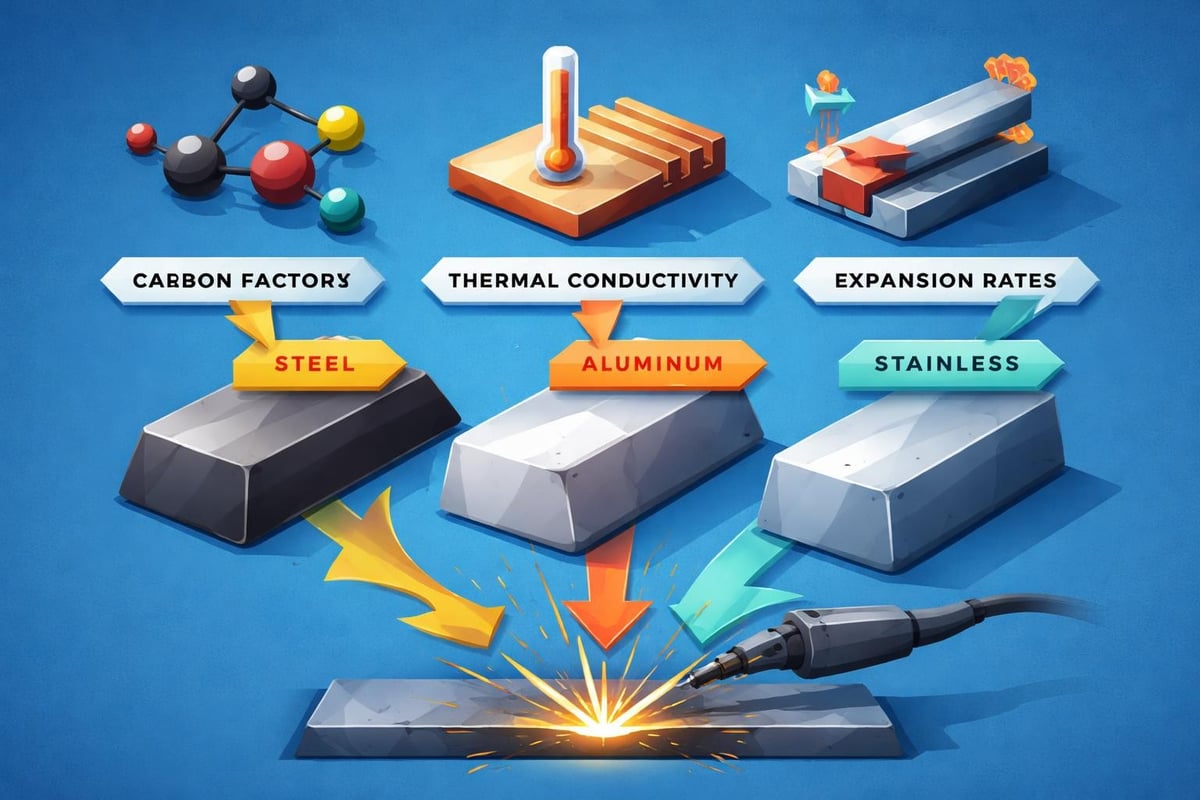
Key Factors Affecting Material Selection
When planning welding operations, several critical factors determine which materials can be successfully joined:
- Base metal composition: Carbon content, alloying elements, and impurities significantly impact weld quality
- Thermal expansion coefficients: Mismatched expansion rates can create residual stresses
- Melting point compatibility: Materials with vastly different melting temperatures present challenges
- Metallurgical compatibility: Some metal combinations form brittle intermetallic compounds
- Service environment requirements: Corrosion resistance, temperature extremes, and mechanical loading
The chemical composition of base metals plays perhaps the most crucial role in determining welding success. High-carbon steels, for example, require preheating and controlled cooling to prevent cracking, while low-carbon steels typically weld more easily. Understanding these nuances allows welding specialists to develop appropriate procedures for each unique application.
Common Welding Processes for Different Materials
Materials welding encompasses numerous techniques, each suited to specific material combinations and application requirements. The selection of an appropriate welding process depends on factors including material thickness, joint accessibility, production volume, and required weld quality.
Shielded Metal Arc Welding (SMAW)
SMAW, commonly known as stick welding, remains one of the most versatile materials welding processes for industrial applications. This technique uses a consumable electrode coated with flux to create the weld pool while protecting it from atmospheric contamination. SMAW works effectively on carbon steels, low-alloy steels, stainless steels, and cast iron, making it particularly valuable for field repair work and heavy equipment welding where portability is essential.
Gas Metal Arc Welding (GMAW)
GMAW, or MIG welding, feeds a continuous solid wire electrode through a welding gun while shielding gas protects the weld pool. This process offers higher deposition rates than SMAW and produces cleaner welds with minimal slag. For industries requiring high-volume production, GMAW provides excellent efficiency when working with materials like carbon steel, aluminum, and stainless steel. The custom fabrication services sector frequently employs GMAW for its combination of speed and quality.
Gas Tungsten Arc Welding (GTAW)
GTAW, also called TIG welding, uses a non-consumable tungsten electrode to produce precise, high-quality welds. This process excels when welding thin materials, exotic alloys, or applications requiring exceptional weld appearance and integrity. GTAW is the preferred choice for stainless steel, aluminum, magnesium, and titanium welding where precision matters more than production speed.
| Welding Process | Best Materials | Typical Applications | Key Advantages |
|---|---|---|---|
| SMAW | Carbon steel, stainless, cast iron | Field repairs, maintenance | Portability, wind resistance |
| GMAW | Steel, aluminum, stainless | Production fabrication | Speed, automation capability |
| GTAW | Aluminum, stainless, exotic alloys | Precision work, thin materials | Quality, control, versatility |
| FCAW | Structural steel, thick sections | Heavy fabrication, outdoor work | High deposition, penetration |
| SAW | Thick steel plates | Pressure vessels, shipbuilding | Extremely high deposition rates |
Flux-Cored Arc Welding (FCAW)
FCAW uses a tubular wire filled with flux compounds, combining advantages of SMAW’s self-shielding capabilities with GMAW’s continuous wire feed. This process performs exceptionally well on thicker materials and outdoor applications where wind might disperse shielding gas. Many structural steel fabrication projects utilize FCAW for its deep penetration and high deposition rates.
Material-Specific Welding Considerations
Different metals and alloys present unique challenges that require tailored approaches to achieve successful materials welding outcomes. Understanding these material-specific requirements ensures structural integrity and long-term performance.
Carbon and Low-Alloy Steels
Carbon steel remains the most commonly welded material in industrial applications due to its excellent weldability, availability, and cost-effectiveness. Low-carbon steels (containing less than 0.25% carbon) generally weld easily with minimal special precautions. However, as carbon content increases, materials welding becomes more challenging due to the formation of hard, brittle martensite in the heat-affected zone.
Best practices for carbon steel welding include:
- Preheating when carbon content exceeds 0.30% or section thickness is substantial
- Controlling interpass temperature to prevent excessive cooling rates
- Post-weld heat treatment for critical applications or high-carbon content
- Using low-hydrogen electrodes to minimize hydrogen-induced cracking
- Maintaining proper joint preparation and fit-up to reduce defect risk
Medium and high-carbon steels require increasingly stringent controls, including mandatory preheating and post-weld heat treatment to temper the hardened zones and relieve residual stresses.
Stainless Steel Alloys
Stainless steels contain chromium (typically 10.5% or more) and often nickel, providing excellent corrosion resistance. Materials welding of stainless steel requires attention to maintaining these corrosion-resistant properties while avoiding common issues like carbide precipitation, distortion, and heat tint oxidation.
The three main categories of stainless steel each present distinct welding characteristics:
- Austenitic stainless (300 series): Most weldable, but prone to distortion and carbide precipitation
- Ferritic stainless (400 series): Limited weldability, grain growth concerns in heat-affected zones
- Martensitic stainless (400 series): Requires preheating and post-weld heat treatment similar to high-carbon steels
When welding stainless steel, controlling heat input becomes critical. Excessive heat input increases distortion and can cause sensitization, where chromium carbides precipitate at grain boundaries, reducing corrosion resistance. Using techniques like pulsed welding and efficient heat sinks helps manage these challenges.

Aluminum and Aluminum Alloys
Aluminum presents several unique challenges for materials welding despite its widespread use in industrial applications. The metal’s high thermal conductivity requires significantly more heat input than steel, while its oxide layer (aluminum oxide) melts at a much higher temperature than the base metal itself, necessitating oxide removal before welding.
Key considerations for aluminum welding include:
- Oxide removal: Mechanical cleaning or chemical treatment immediately before welding
- Porosity prevention: Thorough cleaning to eliminate hydrocarbons and moisture
- Filler metal selection: Matching alloy composition to prevent hot cracking
- Heat management: Preheating thick sections while avoiding overheating thin sections
- Shielding gas purity: Using high-purity argon or argon-helium mixtures
Certain aluminum alloys, particularly the 2000 and 7000 series (copper and zinc additions respectively), exhibit poor weldability due to their susceptibility to hot cracking. The 5000 and 6000 series aluminum alloys generally provide better materials welding performance for structural applications.
Quality Control and Testing in Materials Welding
Ensuring weld quality requires comprehensive inspection and testing protocols that verify structural integrity, material properties, and compliance with specifications. Quality control begins long before the arc strikes and continues through post-weld evaluation.
Pre-Welding Quality Measures
Successful materials welding depends heavily on proper preparation. Base metal verification ensures materials meet specified composition and properties. Joint preparation must follow engineering drawings precisely, with proper beveling, root openings, and land dimensions. Filler metal selection requires confirming electrode or wire specifications match the base materials and application requirements.
Environmental controls also play a crucial role. Wind speed, humidity, and ambient temperature all affect weld quality, particularly for processes like GMAW that rely on external shielding gas. The American Welding Society’s guides and handbooks provide detailed specifications for environmental conditions and welding parameters.
Non-Destructive Testing Methods
Non-destructive testing (NDT) allows inspection of completed welds without damaging the finished product. Common NDT methods for materials welding include:
| NDT Method | Detection Capability | Applications | Limitations |
|---|---|---|---|
| Visual Inspection | Surface defects, dimensional accuracy | All welds, first-line inspection | Surface defects only |
| Liquid Penetrant | Surface-breaking cracks | Non-porous materials | Surface defects only |
| Magnetic Particle | Surface and near-surface defects | Ferromagnetic materials only | Limited to magnetic materials |
| Ultrasonic Testing | Internal defects, thickness measurement | Critical welds, pressure vessels | Requires skilled operators |
| Radiographic Testing | Internal defects, porosity, inclusions | Code-required applications | Radiation safety concerns |
Understanding welding defects and their causes helps inspectors identify issues and welders prevent them. Common defects include porosity, slag inclusions, incomplete fusion, undercut, and various forms of cracking.
Destructive Testing and Mechanical Properties
While NDT provides valuable information, destructive testing offers definitive proof of weld quality and mechanical properties. Tensile testing measures the weld’s strength compared to base metal requirements. Bend testing evaluates ductility and reveals internal defects that might escape other detection methods. Impact testing (Charpy V-notch) determines toughness at specified temperatures, critical for applications in cold environments.
For industries like oil and gas fabrication, where failure consequences can be catastrophic, comprehensive testing protocols ensure every weld meets stringent safety and performance standards.
Welding Procedure Specifications and Documentation
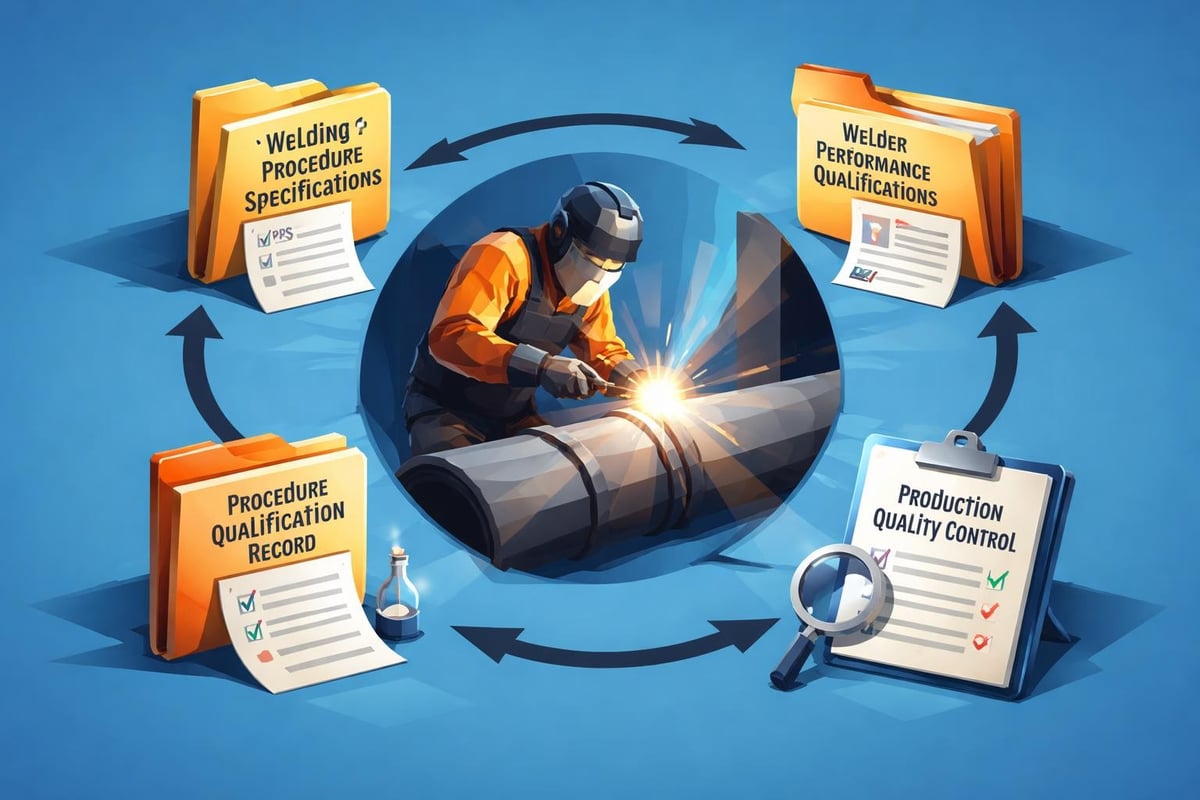
Materials welding in professional industrial settings requires formal documentation that ensures consistency, traceability, and compliance with applicable codes and standards. The Welding Procedure Specification (WPS) serves as the foundational document guiding welders through proper execution.
Essential WPS Components
A comprehensive WPS includes all parameters necessary to produce acceptable welds consistently:
- Base metal specifications: Material type, grade, thickness range, and group number
- Filler metal specifications: Electrode or wire classification and diameter
- Joint design details: Type of joint, groove angle, root opening, and backing requirements
- Welding process parameters: Current type and polarity, voltage range, travel speed, heat input
- Preheat and interpass temperatures: Minimum and maximum temperature requirements
- Post-weld heat treatment: Time, temperature, heating and cooling rates when required
- Shielding gas specifications: Type, flow rate, and purity requirements for applicable processes
Each WPS must be supported by a Procedure Qualification Record (PQR), which documents actual welding parameters used during qualification testing and the mechanical test results demonstrating the procedure produces acceptable welds.
Welder Qualification and Certification
Even with perfect procedures, materials welding quality ultimately depends on welder skill and qualification. Welder performance qualification tests verify that individual welders can execute specific WPS documents to produce sound welds. Qualification testing typically includes visual inspection and bend testing of welded test coupons.
Qualifications remain valid as long as welders regularly perform work using the qualified processes. Extended periods without welding in a particular process may require requalification. Manufacturing and machining operations maintain detailed records of welder qualifications to ensure compliance with project requirements.
Advanced Materials and Specialized Applications
As industries evolve, materials welding must address increasingly challenging applications involving exotic alloys, dissimilar materials, and extreme service conditions. These advanced applications require specialized knowledge and techniques beyond conventional welding practices.
Dissimilar Materials Welding
Joining dissimilar metals presents unique challenges due to differences in melting points, thermal expansion rates, and metallurgical compatibility. Common dissimilar metal combinations include carbon steel to stainless steel, steel to nickel alloys, and aluminum to steel.
Critical considerations for dissimilar materials welding:
- Filler metal selection often requires buttering layers or intermediate compositions
- Heat input management prevents excessive dilution and formation of brittle phases
- Joint design may incorporate backing materials or mechanical reinforcement
- Post-weld heat treatment schedules must accommodate both materials’ requirements
- Service conditions determine whether metallurgical incompatibility affects performance
The weldability of dissimilar metal joints depends heavily on whether the materials form solid solutions or brittle intermetallic compounds. Reference materials from institutions like Colorado Community College System’s welding resources provide valuable guidance for these complex applications.
High-Strength Low-Alloy Steels
HSLA steels offer strength levels significantly higher than conventional carbon steels while maintaining good weldability and formability. These materials are increasingly common in structural applications where weight reduction provides benefits. Materials welding of HSLA steels requires careful control to prevent the heat-affected zone from losing strength due to grain growth or transformation to softer microstructures.
Matching filler metals must meet or exceed the base metal’s strength while providing adequate toughness. Proper heat input control maintains favorable microstructures in the weld and heat-affected zones. For critical structural components in structural steel fabrication for mining equipment, these considerations directly impact safety and service life.
Composite and Advanced Materials
While traditional materials welding focuses on metallic materials, advanced manufacturing increasingly involves thermoplastic composites and hybrid metal-composite structures. Welding of advanced thermoplastic composites uses heat and pressure to fuse polymer matrix materials, creating joints in lightweight structures used in aerospace and automotive applications.
Joining metals to composites typically requires mechanical fastening or adhesive bonding rather than fusion welding. However, hybrid approaches combining welding with other joining methods enable innovative designs that leverage each material’s strengths.
Industry-Specific Materials Welding Applications
Different industrial sectors impose unique requirements on materials welding based on their operational environments, regulatory frameworks, and performance expectations. Understanding sector-specific needs enables fabricators to deliver solutions that meet or exceed customer requirements.
Oil and Gas Industry Requirements
The oil and gas sector demands materials welding that withstands extreme pressures, corrosive environments, and temperature fluctuations. Pipeline welding requires certified procedures and welders qualified to specific codes like API 1104. Pressure vessel fabrication follows ASME Section VIII requirements, mandating comprehensive documentation and inspection.
Sour service environments (hydrogen sulfide presence) require materials resistant to sulfide stress cracking and procedures that minimize hardness in the heat-affected zone. Materials selection and welding procedures must account for these harsh conditions from the design phase through final inspection.
Mining and Aggregate Processing
Equipment used in mining and aggregate processing faces severe abrasion, impact loading, and environmental exposure. Materials welding for these applications often involves hardfacing, where wear-resistant alloys are deposited on critical surfaces to extend component life. Build-up welding repairs worn equipment economically, adding material to restore original dimensions before applying wear-resistant overlays.
The cyclic loading and vibration common in processing equipment requires welds with excellent fatigue resistance. Full-penetration welds and proper joint design prevent crack initiation points that could lead to catastrophic failures during operation.
Recycling Industry Challenges
Recycling operations subject equipment to continuous abrasion from processed materials and impact from handling heavy objects. Materials welding in this sector frequently involves repair of conveyor components, shredder hammers, and sorting equipment. Quick turnaround times are essential since equipment downtime directly affects production capacity.
Field welding capabilities become particularly valuable when equipment cannot be easily transported to shop facilities. Mobile welding and fabrication services enable repairs at customer sites, minimizing operational disruptions.
Best Practices for Materials Welding Success
Achieving consistent, high-quality results in materials welding requires adherence to proven practices that address every aspect of the welding operation. These practices apply regardless of industry, material, or specific application.
Comprehensive Planning and Preparation
Successful materials welding begins long before striking an arc. Engineering review ensures joint designs are weldable and appropriate for service conditions. Material verification confirms base metals meet specifications and possess required certifications. Procedure selection matches processes and parameters to material combinations and application requirements.
Work area preparation includes establishing proper ventilation, lighting, and access for welders and inspection personnel. Material storage and handling procedures prevent contamination that could compromise weld quality. For complex projects, detailed welding sequences prevent distortion and residual stress accumulation.
Process Control and Monitoring
Maintaining consistent quality requires active monitoring of welding parameters throughout production. Modern welding equipment enables recording of actual voltage, current, and travel speed for documentation and quality assurance purposes. Interpass temperature monitoring prevents excessive heat buildup that could alter material properties or cause cracking.
Regular equipment maintenance and calibration ensure welding machines deliver specified outputs. Consumable control systems track electrode and wire lot numbers, enabling traceability if quality issues arise. Environmental monitoring confirms temperature, humidity, and wind conditions remain within acceptable ranges for the selected processes.
Continuous Improvement and Training
Materials welding technology and best practices continually evolve. Ongoing welder training keeps skills current and introduces new techniques that improve quality or efficiency. Regular review of welding procedures incorporates lessons learned from production experience and industry developments.
Quality metrics tracking enables data-driven improvements. Monitoring defect rates, rework frequency, and inspection findings identifies opportunities for procedure refinement or additional training. Collaboration between engineering, production, and quality assurance teams fosters a culture of continuous improvement.
Environmental and Safety Considerations
Materials welding operations generate hazards requiring comprehensive safety programs to protect workers and the environment. Understanding and mitigating these risks is both a legal requirement and an ethical obligation.
Occupational Health Hazards
Welding fumes contain metallic compounds and gases that can cause acute and chronic health effects. Proper ventilation systems remove fumes from the breathing zone, whether through local exhaust hoods or general dilution ventilation. Respiratory protection provides additional safeguarding when engineering controls cannot adequately reduce exposure.
Ultraviolet radiation from welding arcs can cause eye damage (arc eye) and skin burns. Appropriate shade number selection for welding helmets protects eyes from both UV radiation and intense visible light. Protective clothing covers all exposed skin to prevent burns from radiation and spatter.
Fire and Explosion Prevention
Hot work permits formalize the review process before welding in areas where combustible materials might be present. Fire watch personnel monitor for ignition during and after welding operations. Proper storage and handling of compressed gases prevents accidents from cylinder damage or valve failures.
Confined space entry procedures protect welders working inside tanks, vessels, or other enclosed areas. Atmospheric testing confirms oxygen levels are safe and no toxic or flammable gases are present. Continuous ventilation and monitoring maintain safe conditions throughout the work period.
Environmental Responsibility
Waste management programs properly dispose of electrode stubs, wire remnants, slag, and grinding dust. Some welding consumables and base metals contain substances requiring special handling to prevent environmental contamination. Recycling programs recover valuable metals from welding waste streams.
Noise control protects both welders and nearby workers from hearing damage. Engineering controls like sound-dampening enclosures reduce noise at the source. When engineering controls are insufficient, hearing protection provides necessary safeguarding.
Materials welding remains fundamental to industrial manufacturing and fabrication, requiring expertise in metallurgy, process selection, and quality control to deliver reliable results. From routine maintenance to complex custom fabrication projects, successful outcomes depend on understanding material properties, proper procedure development, and skilled execution. Whether your operation needs field machining support, custom welding solutions, or comprehensive fabrication capabilities, LTJ Industrial Services delivers the expertise and equipment necessary to keep your business running efficiently throughout the Western United States.