
A WPS procedure is the documented process for producing a welding procedure specification: a written set of instructions that tells a welder which process, materials, filler metals, preheat and parameters to use so a weld meets code and performs in service. You write it against a governing code, prove it with a test weld recorded on a procedure qualification record (PQR), and then release it to the shop or field.
For operations and maintenance managers, the document matters because it controls repair quality, inspection outcomes and liability on pressure equipment, structural steel and wear-prone machinery. This guide walks through each step, from picking the code to maintaining the finished record.
What Is a Welding Procedure Specification (WPS)?
A welding procedure specification is a written, code-based document that lists every variable a welder must follow to make an acceptable weld on a specific joint, material and thickness range. It is the instruction sheet. The PQR is the evidence that those instructions produce a sound weld.
The two documents work as a pair:
- WPS: the forward-looking instructions issued to welders and inspectors.
- PQR: the record of what was actually welded and tested during qualification, including measured values and lab results.
- WPQ (welder performance qualification): proof that an individual welder can follow the WPS and produce sound welds.
A single PQR can support several WPSs, as long as each WPS stays within the variable ranges the code allows. Our own overview of the meaning of WPS in welding covers the terminology in more depth.
Which Code Governs Your WPS Procedure?
The governing code determines the format, the essential variables and the tests required, so selecting it comes before any drafting. The code is usually set by the equipment, the contract or the jurisdiction, not by the welding contractor.
Common choices in industrial work include:
| Code | Typical application | Where it appears |
|---|---|---|
| AWS D1.1 | Structural steel | Buildings, equipment frames, platforms |
| ASME Section IX | Boilers and pressure vessels | Separators, heat exchangers, process piping |
| API 1104 | Pipelines | Oil and gas gathering and transmission lines |
| National Board (NBIC) | Repair and alteration of pressure equipment | In-service vessel and boiler repairs |
Some codes allow prequalified WPSs, which skip PQR testing when you stay within tightly defined limits. AWS D1.1 is the best-known example. ASME Section IX does not offer that route, so every WPS requires its own supporting PQR. If your site runs equipment under more than one code, plan to maintain separate procedure sets for each.
How to Write a WPS: Step-by-Step Procedure
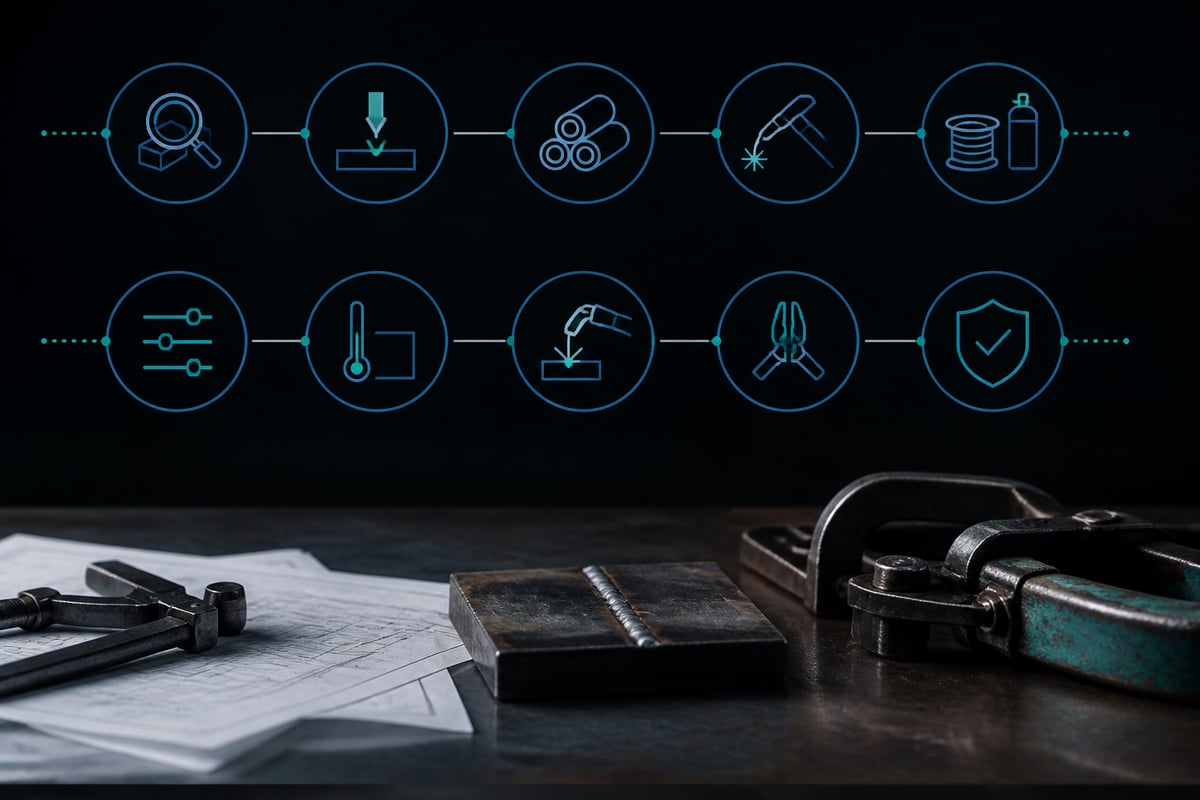
Writing a WPS follows a repeatable sequence, and skipping the planning steps is the most common reason a qualification test fails. Work through the following order.
- Confirm the code and the acceptance criteria. Identify the governing code, the edition in force and any owner or client requirements layered on top.
- Define the joint. Record the joint type (butt, fillet, groove), the groove angle, root opening, backing and the base metal thickness range the procedure will cover.
- Identify the base metals. Note the material specification and group number (P-number under ASME, group classification under AWS). Grouping lets one procedure cover several similar alloys.
- Select the welding process. Choose SMAW, GMAW, FCAW, GTAW or SAW based on position, access, deposition needs and whether the work happens in a shop or in the field.
- Choose the filler metal and shielding. Record the AWS classification, diameter, flux or shielding gas type and flow rate.
- Set the electrical and travel parameters. List current type and polarity, amperage and voltage ranges, wire feed speed and travel speed.
- Specify thermal controls. Document preheat, interpass temperature and any post-weld heat treatment, with hold times.
- Draft the technique. Record stringer or weave, number of passes, cleaning between passes, back gouging and peening if used.
- Weld and test the coupon. Run the qualification weld under supervision, record actual values on the PQR and send the coupon for the required tests.
- Release the WPS. Once the PQR passes, issue the WPS with ranges that sit inside the qualified limits and have it signed by the responsible party.
Essential Variables, Supplementary Variables and Nonessential Variables
Variables fall into three categories, and the category decides whether a change forces requalification. Getting this classification right is what keeps a WPS valid when field conditions shift.
- Essential variables affect the mechanical properties of the weld. Changing one beyond the qualified range requires a new PQR. Examples include base metal group, filler metal classification, a significant change in preheat, and the welding process itself.
- Supplementary essential variables apply only when notch toughness is required, such as in low-temperature service. They matter in oil and gas work where impact testing is specified.
- Nonessential variables can be adjusted without requalification, though the WPS must still be revised to reflect the change. Joint design details and certain technique choices often fall here.
A practical habit: when a maintenance planner proposes a substitute filler or a different heat input to speed a repair, check the variable category before approving it. A quick review can prevent a rejected weld during inspection.
What Is a PQR, and How Do You Qualify a Procedure?
A PQR is the record of the qualification weld and its test results, and it is what makes a WPS defensible to an inspector or auditor. The welder or welding engineer welds a test coupon using the proposed parameters and records exactly what was used, not a range.
The coupon then goes through destructive and nondestructive examination. Typical tests include:
- Visual and radiographic or ultrasonic examination to check for surface and internal discontinuities.
- Tensile tests to confirm the weld is at least as strong as the base metal.
- Guided bend tests (face, root or side) to confirm ductility and fusion.
- Charpy impact tests where low-temperature toughness is required.
- Macro-etch or hardness checks where the code calls for them.
The American Welding Society's WPS/PQR course covers document functions and formats, variable types, procedure qualification, PQR contents, and destructive and nondestructive tests, which makes it a useful reference for teams building their first procedure library. AWS also publishes free sample WPS and PQR forms, which can serve as formatting starting points.
What Are the Four Types of WPS?
The four commonly cited WPS types are prequalified, standard, qualified by testing and special, and the right one depends on the code and the application. The labels come mainly from AWS terminology.
- Prequalified WPS: accepted without testing because it stays within code-defined limits, available under AWS D1.1.
- Standard WPS (SWPS): a pre-written procedure published by AWS that an organization can adopt after meeting the stated conditions.
- Qualified by testing: supported by its own PQR, the standard route under ASME Section IX.
- Special or customized WPS: written for unusual materials, thicknesses or service conditions, usually requiring qualification testing and, at times, owner approval.
For most maintenance work on pressure equipment, expect to be working with procedures qualified by testing.

What Are 1G, 2G, 3G, 4G, 5G and 6G Welding Positions?
These designations describe the joint type and welding position, and they matter because a WPS and a welder's qualification are tied to the positions they cover. The "G" stands for groove weld; fillet welds use "F."
| Position | Joint orientation | Welding position |
|---|---|---|
| 1G | Plate, flat | Flat |
| 2G | Plate, vertical axis | Horizontal |
| 3G | Plate, vertical | Vertical |
| 4G | Plate, overhead | Overhead |
| 5G | Pipe, fixed horizontal | Welded around the pipe in all positions |
| 6G | Pipe, fixed at 45 degrees | All positions with restricted access |
Pipe positions 5G and 6G are generally the most demanding. Qualifying in 6G on pipe is often treated as a demanding benchmark for pipeline and process piping crews. A WPS should state the position range it covers so field crews do not weld outside the qualified envelope.
Common Mistakes That Invalidate a Weld Procedure
Most WPS failures trace back to a handful of avoidable errors rather than welding skill. Catching them early keeps repairs from being rejected after the work is done.
- Writing parameters as single values when the code permits a range, which makes the procedure harder to follow in real conditions.
- Welding the test coupon outside the planned parameters and then writing the WPS around the "ideal" numbers instead of the recorded ones.
- Using an outdated code edition without checking the owner's requirements.
- Changing an essential variable in the field, such as substituting filler metal, without a supporting PQR.
- Letting preheat and interpass limits go unmonitored, particularly on thick sections or cold-weather field jobs.
- Failing to record the WPS number on the traveler or work order, which breaks traceability.
Maintaining and Reviewing Your WPS Library
A WPS is a controlled document, and keeping it current is part of the procedure, not an afterthought. A disciplined library reduces audit findings and speeds mobilization when a breakdown calls for a repair on short notice.
Assign one person to own the library. Track each WPS against its supporting PQR, the code edition, the revision date and the welders qualified to it. Review the set whenever a code edition changes, when a new material enters service or when a procedure has gone unused long enough that continuity of welder qualification is in question. Link every WPS to the equipment or job type it serves so planners can select the right one without guessing.
For plants that do not want to build and maintain this documentation in-house, a certified contractor can supply the procedures alongside the labor. LTJ Industrial Services supports customers both in the shop and on site, and its welding work is performed to multiple codes. For structural fabrication, equipment repair and custom metal projects, see its certified welding service.
How a Welding Contractor Fits Into Your WPS Procedure
A qualified contractor should arrive with procedures already tied to the code on your equipment, or be able to qualify new ones before work begins. Ask for the WPS and PQR numbers up front, confirm the code edition and verify that the welders assigned hold current qualifications for the positions and processes involved.
A short pre-job checklist keeps expectations aligned:
- Which code and edition governs the repair or fabrication?
- Is an existing WPS applicable, or does the job require new qualification?
- Does the service condition call for impact testing or post-weld heat treatment?
- Who signs off on the procedure, and who retains the records?
Our page on the welding procedure specification definition offers a plain-language reference you can share with planners and purchasing staff. For projects that combine welding with cutting, machining and finishing, working with one provider reduces handoffs. LTJ Industrial Services handles fabrication and manufacturing, machining, hydraulics and finishing in one place, so procedure control stays consistent from the first cut to the final coating. You can also review the team's welding experts to see the experience behind that work.
FAQ
What is the difference between a WPS and a PQR?
A WPS is the set of written instructions welders follow, while a PQR is the record of the qualification weld and test results that proves those instructions work. One PQR can support multiple WPSs as long as each stays within the allowed variable ranges.
How long does a WPS remain valid?
A WPS does not expire on a calendar basis, but it must be revised when an essential variable changes or when the governing code requires an update. The welders using it must also maintain their own qualifications by continuing to weld within the process.
Do I need a new WPS for every repair?
Not necessarily. If an existing WPS covers the base metal, process, filler, thickness and position involved, it can be reused. A new procedure or PQR is needed only when the job falls outside the qualified ranges.
Start by listing the equipment on your site and the code each piece is governed by, then check whether a current WPS and PQR exist for the repairs you expect to need. If gaps turn up, certified welding from a contractor that already holds the right qualifications can close them without delaying your schedule. LTJ Industrial Services supports shops and field sites across the Western United States, and you can Request a Quote to discuss your procedure, qualification and repair needs with its team.