
In welding, WPS stands for welding procedure specification: a written document that lists the exact variables a welder must follow to produce a sound, repeatable weld. The meaning of WPS in welding goes beyond a simple definition, because the document works as the instruction set that connects a design code to the work performed in the shop or field. According to TWI, a WPS states the variables to use so that a welded joint can meet specified weld-quality and mechanical-property requirements. For operations and maintenance managers, a clear WPS is what separates a repair that passes inspection from one that gets cut out and redone.
What Is a WPS in Welding?
A WPS is a formal, written set of instructions that tells a welder how to make a specific weld on a specific joint, including process, materials, consumables, heat input, and technique. Think of it as a recipe that has been tested and approved against a governing code, such as ASME Section IX or AWS D1.1.
The document does not describe a welder's skill. It describes the method. A qualified welder follows the WPS, and the WPS itself is backed by test evidence showing that the method produces welds with acceptable strength and ductility.
You may also hear related terms. A welding procedure, a procedure specification, and a weld procedure sheet usually refer to the same thing. A pWPS, or preliminary WPS, is the draft version used to make a test weld before the procedure is approved. Our welding procedure overview covers how these documents fit into everyday shop and field work.
What Information Does a WPS Contain?
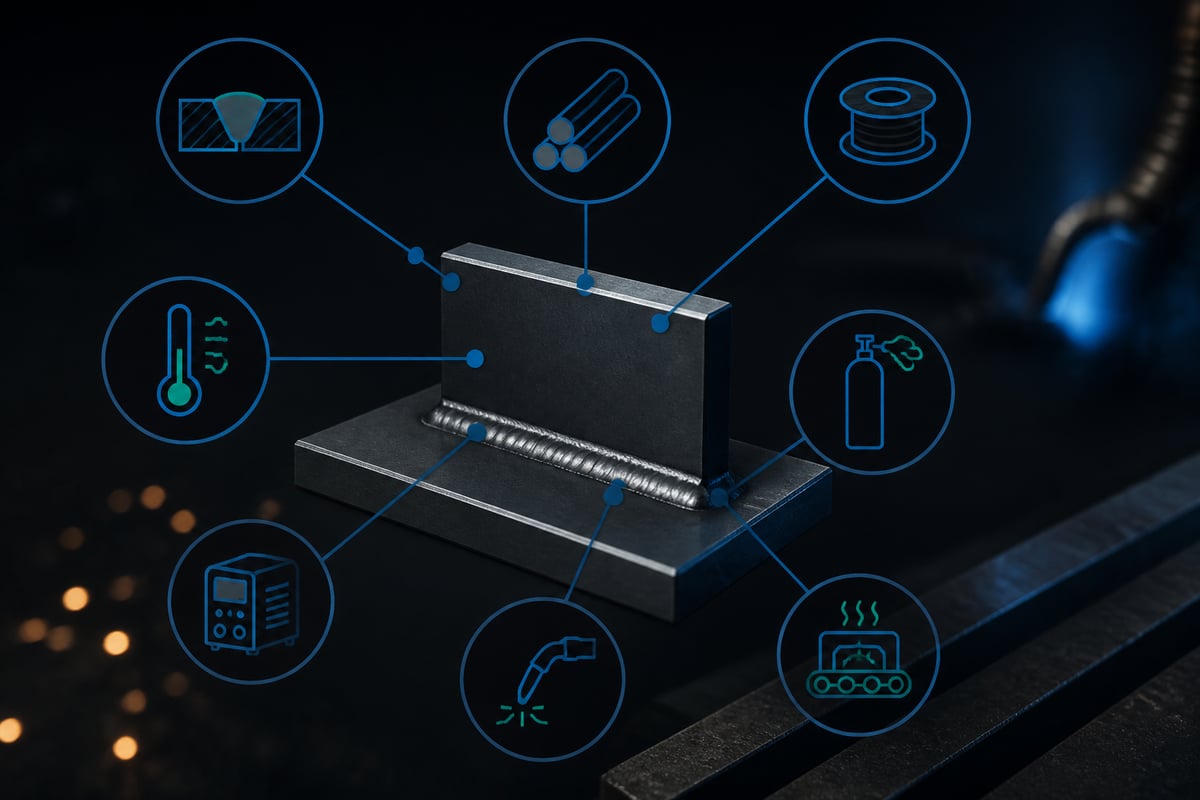
A complete WPS records every variable that could change weld quality, grouped into joint details, materials, process parameters, and technique. The exact layout varies by code, but most procedures include the following items:
- Welding process: SMAW, GMAW, GTAW, FCAW, SAW, or a combination
- Base metal: material specification, grade, and P-number or group
- Thickness range: the minimum and maximum thickness the procedure covers
- Filler metal: classification, diameter, and F-number or A-number
- Joint design: groove type, root opening, backing, and fit-up tolerances
- Position: flat, horizontal, vertical, or overhead
- Preheat and interpass temperature: minimum and maximum values
- Electrical characteristics: current type, amperage range, voltage range, and polarity
- Shielding gas: composition and flow rate
- Travel speed and technique: stringer or weave, number of passes
- Post-weld heat treatment: time and temperature, where required
Some of these are essential variables. TWI notes that essential variables can include material type, welding process, thickness range, and sometimes welding position, and that changes to them may affect weld quality or mechanical properties. When an essential variable falls outside the qualified range, the procedure usually needs to be requalified.
Why Is a WPS Required?
A WPS is required because most codes and customer specifications mandate documented, qualified procedures for any weld that carries load, holds pressure, or affects safety. Without one, there is no objective proof that a weld method produces acceptable results.
The practical reasons are straightforward:
- Code compliance. Pressure vessels, piping, structural steel, and pipelines all fall under codes that require qualified procedures.
- Repeatability. Different welders on different shifts produce consistent results when they follow the same documented parameters.
- Quality control. Inspectors have a written standard to check the work against.
- Traceability. If a failure occurs, the records show what was specified and what was performed.
- Safety and liability. Documented procedures reduce the risk of weld failures on pressurized equipment, lifting structures, and heavy machinery.
For oil and gas, mining, and recycling operations, a failed weld can mean unplanned downtime, environmental release, or injury. Customers and insurers increasingly ask to see procedure documentation before work begins, and teams that can supply it up front avoid delays at the start of a job. Our oil and gas welding services page explains how this requirement shapes field and shop work in that sector.
What Is a PQR, and How Does It Differ From a WPS?
A PQR, or procedure qualification record, is the documented test evidence that proves a welding procedure works; the WPS is the instruction, and the PQR is the proof behind it. TWI explains that a WPS is supported by records of how the weld was made and by examination and test results, called a WPAR under BS EN ISO 15614 or a PQR under ASME.
The PQR captures what actually happened during the test weld, including the parameters used and the results of mechanical tests. One PQR can support several WPSs, as long as each WPS stays within the qualified ranges.
| Document | Purpose | Contents | Who uses it |
|---|---|---|---|
| WPS | Instructs welders how to weld | Allowable variable ranges | Welders, supervisors, inspectors |
| PQR | Proves the procedure produces acceptable welds | Actual test values and test results | Engineers, inspectors, auditors |
| WPQ/WQR | Proves a welder can follow the procedure | Welder's test results and qualified range | Welders, quality managers |
The third record in that table matters just as much. A WPS qualifies the method, while a welder performance qualification shows that an individual can execute it. A shop needs both to be code compliant. Our welding specifications resource covers how these records connect to project requirements.
How Do You Qualify a WPS?
Qualifying a WPS means welding a test joint under controlled conditions, testing it, and recording the results so the procedure can be approved against a code. The steps below reflect the common route under ASME Section IX and similar standards.
- Draft a preliminary WPS. TWI notes that a common route starts with a pWPS, which a competent welder uses to make a test joint.
- Weld the test coupon. The welder follows the pWPS while an inspector or welding engineer records actual parameters.
- Perform nondestructive and destructive testing. Typical tests include visual inspection, radiography or ultrasonic testing, tensile tests, and guided bend tests.
- Document the results in a PQR. Actual values and test outcomes are recorded and signed.
- Finalize the WPS. The approval record is used to finalize one or more WPSs covering the ranges the test supports.
- Qualify the welders. Each welder who will use the WPS demonstrates the skill to follow it.
Codes handle this differently. ASME Section IX requires a welding procedure test and PQR, while AWS D1.1 permits prequalified procedures within the specification's stated limits. A prequalified WPS still needs to be written, reviewed, and followed.

Which Standards and Codes Govern a WPS?
Several codes govern how a WPS is written and qualified, and the right one depends on what is being welded and who the end customer is. Standards used in procedure work include ASME IX, EN ISO 15609-1, and AWS D1.1.
Common codes in industrial work include:
- ASME Section IX: boilers, pressure vessels, and process piping
- AWS D1.1: structural steel
- API 1104: pipelines and related facilities
- National Board (NBIC): repairs and alterations to pressure-retaining items
- EN ISO 15614 and 15609: widely used outside the United States, and covered in TWI's overview of UK joining-industry qualification standards
Many projects in the Western US involve more than one code in the same facility. A gas compressor station might include API 1104 pipeline tie-ins, ASME piping, and AWS D1.1 structural supports. Understanding what ASME welding certification means in practice helps buyers confirm that a contractor's credentials match the code their project requires.

How Should a WPS Be Used on the Shop Floor and in the Field?
A WPS only protects quality when it is available at the point of work, understood by the welder, and checked by a supervisor or inspector. A procedure filed in an office cabinet does nothing for the weld being made at a remote site.
Good practice includes these points:
- Issue the current revision. Make sure the welder and the inspector are working from the same version.
- Match the welder to the procedure. Confirm the welder's qualification covers the process, position, and thickness on the WPS.
- Verify the setup before the arc is struck. Check the filler metal, gas, preheat, and joint fit-up against the document.
- Record actual values when required. Some projects call for interpass temperature logs and parameter monitoring.
- Stop when a variable changes. A different heat of material, a new filler type, or a position outside the range may need engineering review.
Field conditions add pressure. Wind affects shielding gas coverage, cold ambient temperatures affect preheat, and access limits can change the position used. A procedure written for shop conditions may need a field-specific version or additional controls. Our comparison of field welding vs shop welding explains how those conditions influence procedure planning.
What Should You Check Before Hiring a Welding Contractor?
Before hiring a contractor for code work, confirm that they hold qualified procedures for your process, material, and code, and that their welders are qualified to those procedures. Ask direct questions rather than accepting a general statement that the shop is certified.
A short checklist helps:
- Which codes are their procedures qualified under, and can they show the WPS and PQR for your joint type?
- Are the welders who will do your job currently qualified for that process and position?
- What is their process for handling a variable that falls outside the qualified range?
- Can they work in the shop and on-site, depending on where your equipment sits?
- How are inspection records and documentation delivered at the end of the job?
A contractor who answers these questions clearly and quickly usually has a mature quality system. One who hesitates may be relying on informal practice. For teams comparing options, our guide to ASME certified welding outlines what to look for in documentation and credentials.
LTJ Industrial Services supports customers in its shop and on-site, and it handles fabrication, machining, hydraulics, and finishing in one place. Fabrication, machining, hydraulics, and finishing are handled in one place, which keeps procedure documentation and quality records under a single point of accountability.
FAQ
What are welding specifications?
Welding specifications are the documents and code requirements that define how welding must be performed on a project. They include the governing code, the approved WPS, material and filler requirements, and inspection criteria.
Does every welding job need a WPS?
Not every weld requires a formal procedure, but any weld covered by a code, a customer specification, or a safety-critical application typically does. Pressure equipment, structural steel, and pipelines almost always fall under that requirement.
Can one WPS cover several welders and jobs?
Yes. A single qualified WPS can be used by any welder who holds a valid qualification for the process and position, and on any job whose variables stay inside the qualified ranges.
When does a WPS need to be requalified?
A WPS needs requalification when an essential variable changes beyond what the code allows, such as a new base metal group, a different welding process, or a thickness outside the qualified range. Always check the specific code before assuming a change is minor.
Start by pulling the welding procedure specifications and qualification records tied to your most critical equipment, and confirm they match the code your inspector or customer requires. If gaps appear, or you need a partner who can weld, fabricate, and machine to qualified procedures in the shop or in the field, the team at LTJ Industrial Services can review your requirements and help you request a quote for your next project. Our WPS welding procedure page is a good place to see how we approach documentation.