
The United States fabrication industry stands as a cornerstone of American manufacturing, supporting critical sectors from aerospace and automotive to energy and infrastructure. As commercial and industrial operations throughout the Western United States continue to evolve, understanding the current landscape of us fabrication becomes essential for businesses seeking competitive advantages. This comprehensive examination explores market dynamics, technological innovations, and best practices that define modern fabrication services in 2026.
The Current State of US Fabrication Markets
The us fabrication sector has experienced substantial transformation over recent years, driven by technological advancement and shifting market demands. According to market analysis of the U.S. metal fabrication industry, rising demand from automotive and aerospace sectors continues to fuel growth, while infrastructure investments create new opportunities for fabrication specialists.
Manufacturing facilities across Colorado and the broader Western region now face unique challenges. Supply chain resilience has become paramount as companies seek reliable metal fabrication and welding partners who can deliver consistent quality without delays. The recycling, aggregate, and oil & gas industries particularly depend on fabrication services that meet exacting standards while maintaining operational efficiency.
Market Segments Driving Demand
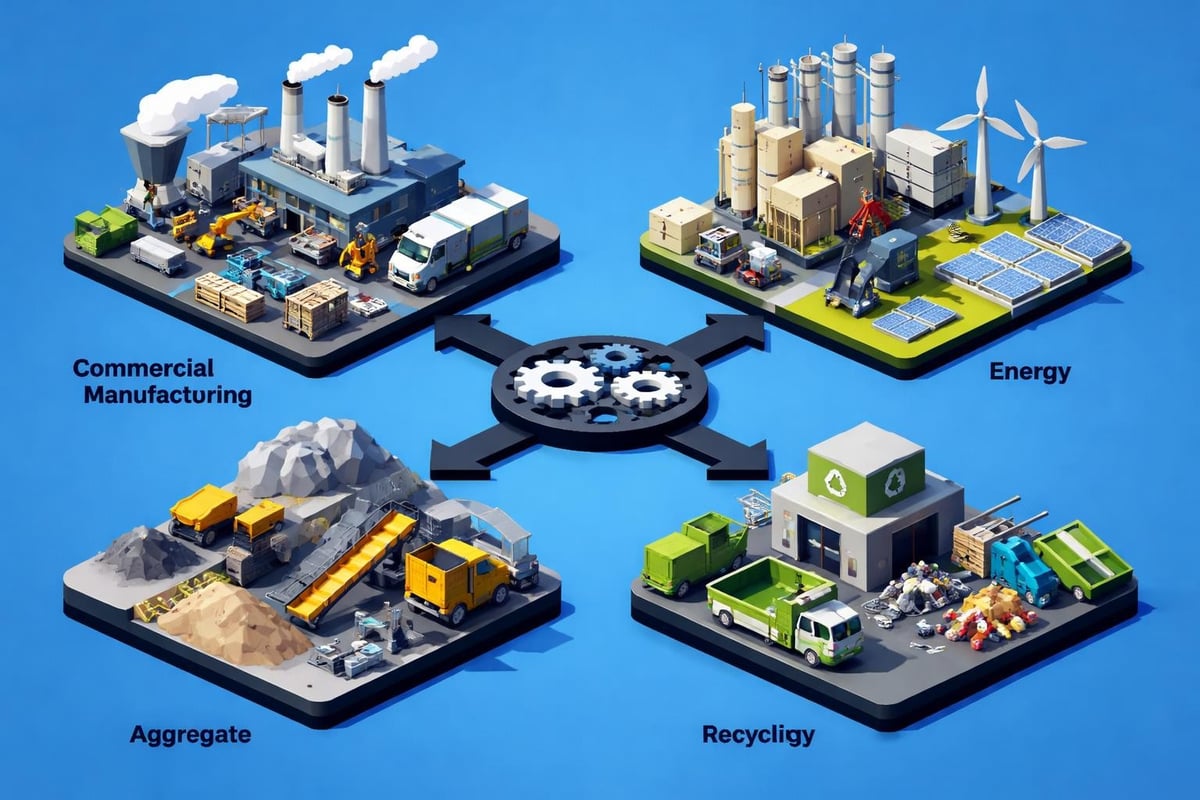
The us fabrication landscape encompasses several distinct market segments, each with specific requirements:
- Commercial Manufacturing: Custom solutions for production equipment, conveyor systems, and processing machinery
- Energy Sector: Specialized fabrication for oil & gas operations, including wellhead components and pipeline infrastructure
- Aggregate Processing: Heavy-duty equipment fabrication designed to withstand extreme wear conditions
- Recycling Operations: Custom sorting systems, containment structures, and material handling equipment
Regional dynamics significantly influence fabrication requirements. Western states present unique environmental conditions demanding corrosion-resistant materials and specialized welding techniques that account for temperature variations and exposure to harsh elements.
Advanced Fabrication Techniques Reshaping the Industry
Modern us fabrication has moved far beyond basic cutting and welding operations. Today's fabricators integrate multiple disciplines to deliver comprehensive solutions that address complex engineering challenges. The convergence of traditional craftsmanship with digital precision creates unprecedented capabilities.
Precision Machining Integration
Manufacturing and machining services now work hand-in-hand with fabrication operations. Computer numerical control (CNC) technology enables fabricators to achieve tolerances measured in thousandths of an inch, critical for components requiring exact fits. This precision proves essential when fabricating parts for:
- Hydraulic systems where seal surfaces demand perfect flatness
- Rotating equipment requiring precise balance and alignment
- Assembly fixtures where repeatability determines production efficiency
- Replacement parts that must match original equipment specifications exactly
The integration of machining capabilities within fabrication shops eliminates coordination delays and quality inconsistencies that arise when outsourcing different operations. Businesses benefit from single-source accountability and faster project completion timelines.
Welding Innovation and Certification
Welding remains at the heart of us fabrication, but the techniques and standards continue to evolve. Modern fabrication operations employ multiple welding processes selected based on material properties, joint configurations, and performance requirements:
| Welding Process | Primary Applications | Key Advantages |
|---|---|---|
| GTAW (TIG) | Stainless steel, aluminum, exotic alloys | Superior quality, precision control |
| GMAW (MIG) | Structural steel, general fabrication | High productivity, versatility |
| FCAW | Heavy structural work, field repairs | Deep penetration, wind resistance |
| SMAW (Stick) | Field fabrication, maintenance work | Portability, works in adverse conditions |
Certified welders bring critical expertise to fabrication projects, ensuring joints meet or exceed code requirements. Industries like oil & gas demand stringent documentation and non-destructive testing verification, making welder qualification and procedure development essential elements of quality us fabrication.
Material Selection Considerations for US Fabrication Projects
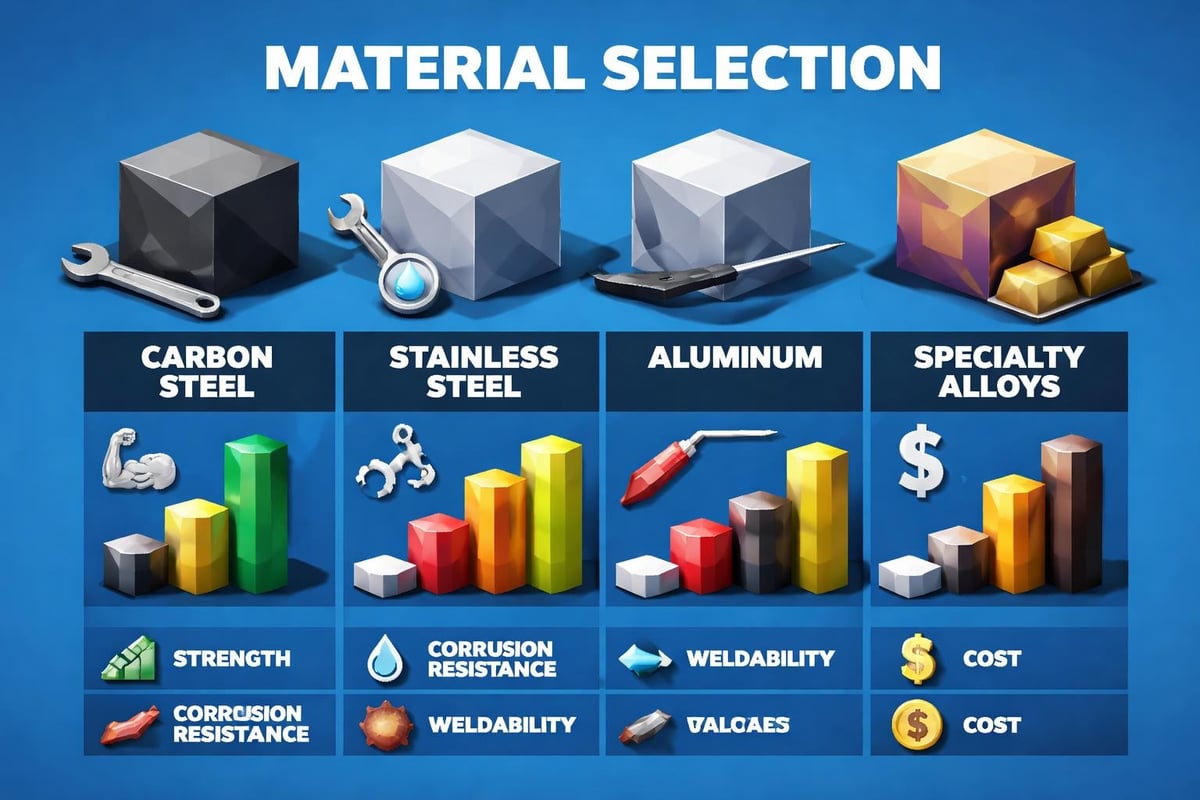
Choosing appropriate materials represents one of the most consequential decisions in any fabrication project. The Western United States environment presents specific challenges that influence material selection, from temperature extremes in Colorado's mountain regions to corrosive conditions in industrial processing facilities.
Carbon steel remains the workhorse material for structural fabrication, offering excellent strength-to-cost ratios for frames, supports, and general fabrication work. However, applications involving moisture, chemicals, or high temperatures often require specialized alloys. Stainless steel grades provide corrosion resistance essential for food processing, chemical handling, and outdoor installations where maintenance access proves difficult.
Emerging Material Trends
The us fabrication industry increasingly works with advanced materials that offer performance characteristics unavailable from traditional options:
- High-strength low-alloy (HSLA) steels: Reduced weight without sacrificing strength for mobile equipment and structures
- Abrasion-resistant plates: Extended service life for material handling and processing equipment in aggregate operations
- Duplex stainless steels: Superior corrosion resistance combined with higher strength for challenging environments
- Aluminum alloys: Weight reduction for components where mass affects operational efficiency
Material selection directly impacts fabrication techniques required. According to research on emerging trends in metal fabrication, advanced materials demand specialized cutting methods, heat treatment protocols, and welding procedures that distinguish experienced fabricators from general metal shops.
Quality Assurance in Modern US Fabrication
Quality control separates exceptional us fabrication from adequate metalwork. Commercial and industrial clients cannot afford failures that result in production downtime, safety hazards, or costly repairs. Comprehensive quality programs address fabrication quality at every stage from initial design through final delivery.
Dimensional verification ensures fabricated components match engineering specifications. Modern coordinate measuring machines (CMM) provide three-dimensional mapping of complex geometries, confirming that angles, hole positions, and surface profiles fall within specified tolerances. For simpler components, precision measurement tools verify critical dimensions before components leave the shop floor.
Non-Destructive Testing Methods
Weld quality verification employs various non-destructive testing (NDT) methods depending on application criticality and code requirements:
- Visual inspection: First-line quality check examining weld appearance, size, and discontinuities
- Dye penetrant testing: Reveals surface-breaking defects in non-magnetic materials
- Magnetic particle testing: Detects surface and near-surface flaws in ferromagnetic materials
- Ultrasonic testing: Identifies internal discontinuities in critical welds
- Radiographic testing: Provides permanent records of weld internal quality for code documentation
The North American contract fabrication services market demonstrates increasing emphasis on quality certifications and documented processes as buyers seek fabrication partners capable of meeting stringent industry standards.
Field Services and On-Site Fabrication Capabilities
While shop fabrication offers controlled environments and full tooling access, many projects require field fabrication capabilities. Equipment breakdowns, facility modifications, and emergency repairs demand fabricators who can deliver quality work outside traditional shop settings. This flexibility proves particularly valuable for industries operating in remote locations throughout the Western United States.
Field welding requires adaptability and problem-solving skills beyond shop welding. Environmental conditions affect welding parameters, requiring experienced personnel who understand how wind, temperature, and humidity influence weld quality. Portable equipment must deliver comparable results to shop-based machinery while operating from generators or temporary power sources.
Mobile Machining Solutions
On-site machining addresses challenges where component size, installation constraints, or operational continuity prevent shop-based work. Mobile machining equipment brings precision capabilities directly to customer facilities for:
- In-place boring and line boring: Bearing housing repairs without equipment disassembly
- Flange facing: Restoring sealing surfaces on installed piping and pressure vessels
- Portable milling: Creating mounting surfaces and keyways on large equipment frames
- Emergency repairs: Addressing critical failures requiring immediate attention
Companies offering both shop and field capabilities provide clients with comprehensive solutions regardless of project location or constraints. This versatility distinguishes full-service fabricators from shops limited to work within their facilities.
The Role of Custom Fabrication in Industrial Operations
Generic, off-the-shelf components rarely address the unique requirements of specialized industrial operations. Custom metal fabrication enables businesses to optimize equipment performance, integrate with existing systems, and solve problems that standard products cannot address. This customization drives efficiency improvements and competitive advantages across industries.
Custom fabrication begins with understanding operational challenges and engineering constraints. Experienced fabricators collaborate with clients during design development, contributing practical insights about manufacturability, material selection, and cost optimization. This partnership approach yields solutions that balance performance requirements with budget realities.
Value-Added Fabrication Services
Modern us fabrication extends beyond basic cutting and welding to include complementary services that deliver finished components ready for installation:
| Service Category | Applications | Client Benefits |
|---|---|---|
| Surface preparation and coating | Corrosion protection, wear resistance | Extended equipment life, reduced maintenance |
| Assembly and sub-assembly | Complex components, tested units | Reduced field installation time |
| Hydraulic system integration | Power units, cylinders, manifolds | Single-source hydraulic solutions |
| Water jetting and cleaning | Surface preparation, coating removal | Safe alternative to chemical or abrasive methods |
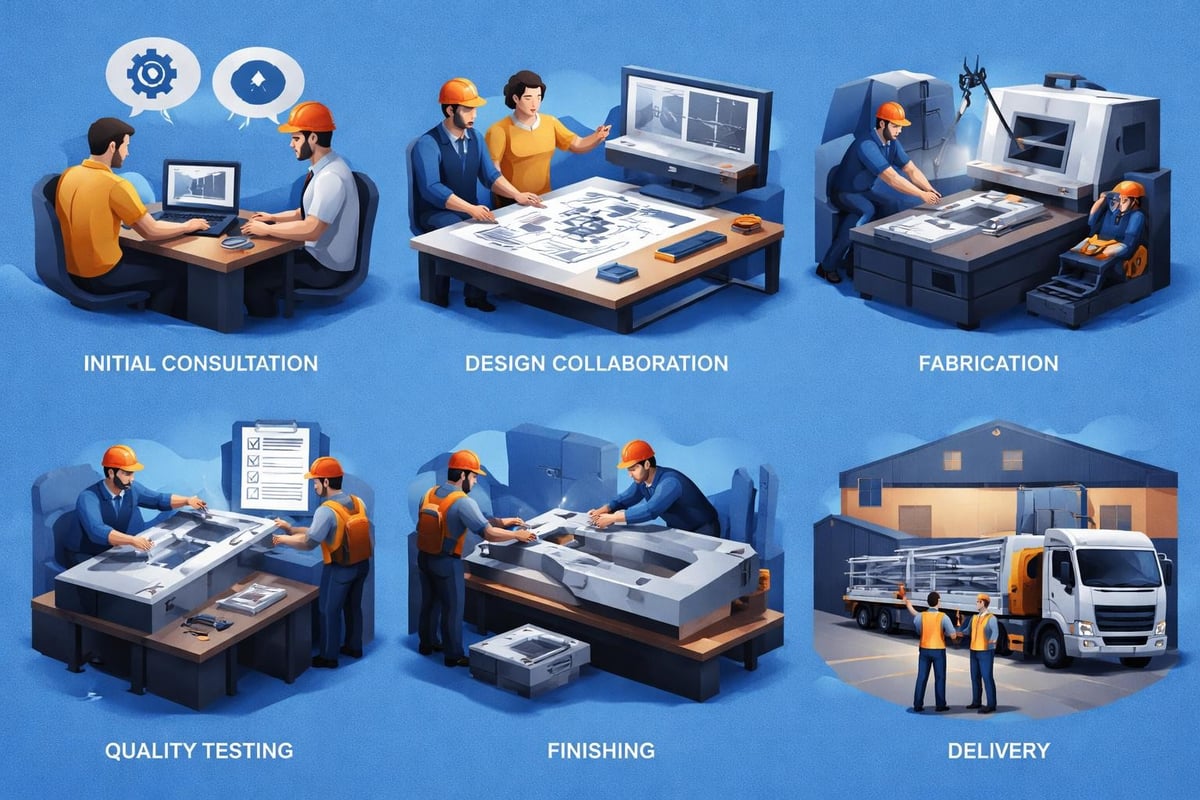
Businesses benefit from fabrication partners who offer these value-added services, consolidating vendor relationships and improving project coordination. Single-source responsibility simplifies procurement, reduces communication overhead, and establishes clear accountability for project outcomes.
Equipment Refurbishment and Lifecycle Extension
New equipment purchases represent significant capital investments that many businesses prefer to defer when existing assets can be restored to reliable service. Equipment refurbishment through skilled us fabrication extends operational lifecycles while delivering performance comparable to new machinery at fraction of replacement costs. This approach proves particularly valuable for specialized equipment with long lead times or discontinued models.
The industrial machinery refurbishment and maintenance process begins with comprehensive assessment identifying wear patterns, structural damage, and component failures. Fabricators then develop restoration plans addressing mechanical, structural, and system-level improvements. The result breathes new life into equipment previously considered ready for scrap.
Refurbishment Project Components
Successful refurbishment projects typically address multiple equipment systems:
- Structural repairs: Crack repair, reinforcement addition, frame straightening
- Wear surface restoration: Hard-facing application, dimensional restoration through welding buildup
- Component replacement: Manufacturing obsolete parts no longer available from original equipment manufacturers
- System upgrades: Integration of modern controls, safety features, or efficiency improvements
Refurbishment offers economic advantages beyond initial cost savings. Familiar equipment requires less operator retraining, maintains process continuity, and avoids production disruptions associated with new equipment commissioning. For operations in recycling, aggregate processing, and similar industries, extending equipment life through strategic refurbishment optimizes capital allocation.
Industry-Specific Fabrication Requirements
Different industrial sectors impose unique demands on us fabrication services, requiring specialized knowledge and capabilities. Understanding these sector-specific requirements enables fabricators to deliver solutions that address industry challenges while meeting regulatory and performance standards. The diversity of industries served throughout the Western United States creates demand for broad fabrication expertise.
Oil and Gas Fabrication Standards
Energy sector fabrication demands compliance with rigorous codes and standards governing pressure vessel construction, piping systems, and wellhead equipment. The U.S. steel fabrication market reflects continued demand from oil and gas operations despite market volatility, with fabricators serving both upstream production and midstream infrastructure projects.
Material traceability, welding procedure qualification, and non-destructive testing documentation separate compliant fabrication from general metalwork. Energy companies require fabricators who understand API standards, ASME codes, and industry-specific safety requirements that govern equipment design and construction.
Aggregate and Recycling Industry Needs
Aggregate processing and recycling operations subject equipment to extreme abrasion, impact loading, and environmental exposure. Fabrication for these industries emphasizes durability and maintainability:
- Material selection: Abrasion-resistant steels and wear plates that extend service intervals
- Replaceable wear components: Designed for quick changeout minimizing downtime
- Robust construction: Heavy-duty welding and reinforcement addressing impact loads
- Access considerations: Maintenance features enabling efficient inspection and repair
Equipment longevity directly impacts operational profitability in industries where production interruptions incur significant costs. Strategic fabrication design anticipates wear patterns and incorporates features that simplify maintenance, reducing total ownership costs over equipment lifecycles.
Technology Integration in US Fabrication Operations
Digital transformation reshapes us fabrication through technologies that enhance precision, efficiency, and capability. The state of U.S. manufacturing in 2024 highlights technological advancement as a defining characteristic of competitive manufacturers, with fabrication operations increasingly adopting digital tools alongside traditional craftsmanship.
Computer-aided design (CAD) software enables detailed modeling before metal cutting begins, identifying potential issues and optimizing material utilization. Three-dimensional models facilitate client communication, ensuring fabricated components meet expectations before production commits resources. This digital approach reduces costly errors and change orders that plague projects developed through traditional two-dimensional drawings alone.
Automation and Robotics Applications
Automated equipment handles repetitive fabrication tasks with consistency impossible through manual processes. CNC plasma and laser cutting systems follow digital patterns precisely, producing identical parts regardless of quantity. Robotic welding delivers uniform weld quality for high-volume production runs, freeing skilled welders to focus on complex joints requiring human judgment and adaptability.
However, automation complements rather than replaces skilled fabricators. Complex projects still demand the problem-solving abilities, adaptability, and craftsmanship that experienced personnel bring to challenging work. The most effective us fabrication operations balance technological capabilities with human expertise, deploying each where it delivers maximum value.
Project Management and Client Collaboration
Successful fabrication projects require more than technical expertise. Effective project management ensures work progresses on schedule, within budget, and according to specifications. Clear communication between fabricators and clients prevents misunderstandings that lead to rework, delays, and cost overruns. This collaborative approach defines professional us fabrication services.
Initial project discussions establish scope, requirements, and success criteria. Experienced fabricators ask questions that uncover unstated assumptions and identify potential challenges before they impact schedules. This discovery process creates shared understanding between clients and fabricators, aligning expectations and defining deliverables clearly.
Transparent Communication Protocols
Regular progress updates keep clients informed without creating communication overhead that slows production. Effective fabricators establish check-in schedules appropriate to project complexity and timeline:
- Daily updates: Large, time-critical projects requiring close coordination
- Weekly reports: Standard projects with multi-week timelines
- Milestone reviews: Long-duration work best managed through phase completion assessments
- As-needed communication: Emergency repairs and expedited work requiring real-time coordination
Documentation provides permanent records supporting quality verification, regulatory compliance, and warranty claims. Material certifications, welding records, inspection reports, and dimensional verification establish audit trails demonstrating work quality and procedure adherence. This documentation proves particularly valuable for industries with strict regulatory oversight or long equipment lifecycles where service history guides future maintenance decisions.
Cost Optimization Strategies for Fabrication Projects
Fabrication costs reflect material expenses, labor requirements, equipment utilization, and overhead allocation. Understanding cost drivers enables clients to make informed decisions balancing performance requirements against budget constraints. Strategic choices during project planning significantly influence total costs while maintaining quality and functionality.
Material selection represents the most obvious cost variable. Premium alloys and specialty steels command higher prices than commodity carbon steel, but application requirements may justify these expenses through extended service life or reduced maintenance needs. Value engineering examines whether less expensive materials meeting performance specifications can substitute for initially specified options.
Design for Fabrication Principles
Component geometry directly impacts fabrication complexity and therefore cost. Designs incorporating these principles typically yield more economical fabrication:
| Design Consideration | Cost Impact | Implementation Strategy |
|---|---|---|
| Standard material sizes | Reduces waste, minimizes cutting | Design around common plate dimensions, tube sizes, and structural shapes |
| Simple joint configurations | Decreases welding time, improves quality | Use fillet welds over groove welds where structural requirements permit |
| Accessibility for welding | Enables efficient positioning, reduces difficulty | Consider welder access when locating joints and designing assemblies |
| Tolerance appropriateness | Avoids unnecessary precision machining | Specify tightest tolerances only where function demands precision |
Working with fabricators during design development identifies opportunities for cost reduction without compromising performance. This collaborative approach leverages fabrication expertise to optimize designs before production begins, when changes cost least and deliver maximum value.
Safety Considerations in Fabrication Environments
Welding, cutting, and machining operations present inherent hazards requiring comprehensive safety programs. Professional us fabrication operations prioritize worker safety through training, proper equipment, and hazard recognition. This commitment protects personnel while demonstrating professionalism that clients value when selecting fabrication partners.
Personal protective equipment (PPE) forms the first defense against fabrication hazards. Welding helmets with appropriate shade ratings protect eyes from arc radiation, while respirators prevent inhalation of welding fumes. Cut-resistant gloves, safety glasses, steel-toed boots, and hearing protection address additional hazards present in fabrication environments.
Hazard Mitigation Protocols
Beyond PPE, fabrication shops implement engineering controls and safe work practices that minimize risk:
- Ventilation systems: Remove welding fumes, grinding dust, and other airborne contaminants
- Machine guarding: Prevent contact with rotating equipment and moving machinery
- Lockout/tagout procedures: Ensure equipment cannot energize during maintenance or setup
- Fire prevention: Proper storage of flammable materials, hot work permits, and fire suppression equipment
Safety culture extends to field operations where environmental variables create additional challenges. Experienced field fabricators assess site conditions, identify hazards, and implement controls appropriate to specific situations. This proactive approach prevents accidents while maintaining productivity and project progress.
Environmental Responsibility in Modern Fabrication
Sustainable practices increasingly influence us fabrication operations as environmental awareness grows across industries. Responsible fabricators minimize waste, recycle scrap materials, and employ processes that reduce environmental impact. These practices align with client sustainability goals while often improving operational efficiency and reducing costs.
Material waste reduction begins with optimized cutting patterns that maximize usable parts from each sheet or plate. Nesting software arranges components to minimize scrap, with remnants sorted for future projects rather than immediate disposal. Ferrous and non-ferrous scrap metals retain significant value, making recycling both environmentally responsible and economically sensible.
Sustainable Process Improvements
Modern fabrication technologies support environmental objectives through efficiency improvements and reduced resource consumption:
- LED lighting systems: Dramatically reduced electrical consumption in fabrication facilities
- Plasma and laser cutting: Precise cuts minimize material waste compared to mechanical cutting methods
- Water-based rust preventatives: Replace solvent-based coatings with safer alternatives
- Efficient welding processes: Modern inverter-based equipment uses less electricity than transformer-based predecessors
- Waste heat recovery: Captures thermal energy from cutting operations for facility heating
Clients increasingly consider environmental practices when selecting fabrication partners, particularly in industries facing regulatory pressure or corporate sustainability mandates. Demonstrating environmental responsibility differentiates fabricators in competitive markets while contributing to broader sustainability goals.
Modern us fabrication combines traditional craftsmanship with advanced technology to deliver solutions across diverse industrial sectors. From precision machining and certified welding to field services and equipment refurbishment, comprehensive fabrication capabilities support operations throughout the Western United States. Whether your business needs custom fabrication solutions, emergency repairs, or complex manufacturing projects, LTJ Industrial Services brings the expertise, equipment, and commitment to quality that keeps your operations running efficiently.