
The structural steel fabrication process represents the backbone of modern commercial and industrial construction, transforming raw steel into the frameworks that support everything from manufacturing facilities to oil refineries. For businesses in sectors like aggregate processing, recycling operations, and energy production throughout the Western United States, understanding each phase of this process ensures project success, regulatory compliance, and long-term structural integrity. This comprehensive guide examines every critical step fabricators employ to deliver precision-engineered steel components.
Understanding the Structural Steel Fabrication Workflow
The structural steel fabrication process begins long before the first cut or weld. Fabrication shops receive detailed engineering drawings and specifications that define every dimension, material grade, connection detail, and quality requirement. These documents serve as the blueprint for transforming standard steel shapes-wide-flange beams, channels, angles, and plates-into custom structural components.
Modern fabrication facilities integrate advanced software systems that convert two-dimensional drawings into three-dimensional models. This digital transformation allows fabricators to identify potential conflicts, optimize material usage, and generate precise cutting instructions for CNC equipment. The coordination between engineering, procurement, and production teams during this phase prevents costly errors downstream.
Material Selection and Procurement
Selecting the appropriate steel grade forms a critical decision in the structural steel fabrication process. Common grades include ASTM A36 for general structural applications, A572 for high-strength requirements, and A588 for weathering steel applications. Each grade offers distinct mechanical properties, weldability characteristics, and cost considerations.
Key material considerations include:
- Yield strength and tensile strength requirements
- Corrosion resistance needs based on operating environment
- Welding procedure compatibility
- Impact toughness for low-temperature service
- Mill certification and traceability documentation
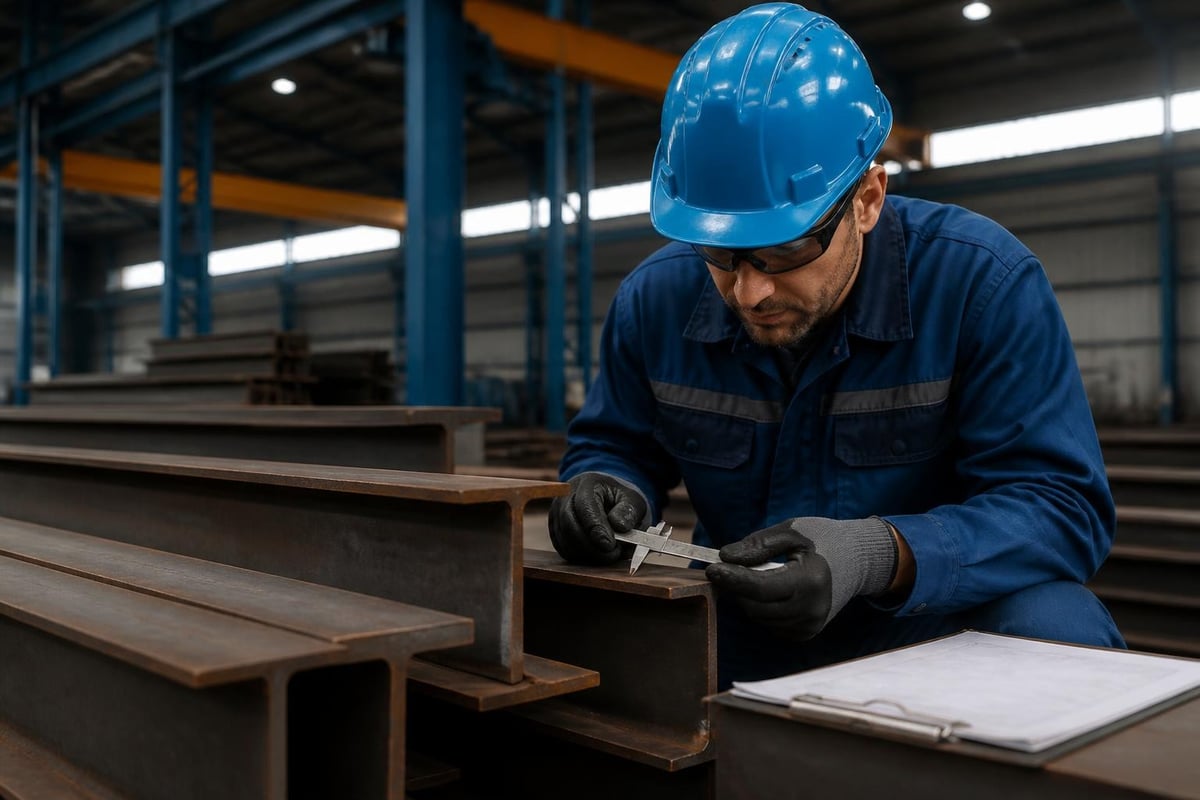
Material procurement requires coordination with steel mills and suppliers to ensure timely delivery of certified materials. Fabricators maintain inventory of common sizes while ordering specialized sections for specific projects. Upon receipt, incoming inspection verifies material dimensions, grade markings, and mill test reports against purchase specifications.
Cutting and Shaping Operations
Once materials are verified and released for production, the structural steel fabrication process advances to cutting operations. Modern fabrication shops employ multiple cutting technologies, each suited to specific applications and material thicknesses.
Primary Cutting Methods
| Cutting Method | Typical Thickness Range | Advantages | Best Applications |
|---|---|---|---|
| Oxy-fuel Cutting | 1/4" to 12"+ | Cost-effective, portable | Heavy plate, field work |
| Plasma Cutting | 1/16" to 2" | Fast, clean cuts | Medium plate, complex shapes |
| Waterjet Cutting | Any thickness | No heat-affected zone | Heat-sensitive materials |
| Laser Cutting | Up to 1" | Precision, automation | Thin to medium plate |
Waterjet cutting vs plasma cutting decisions depend on material thickness, edge quality requirements, and production volume. For structural components requiring tight tolerances and minimal heat input, waterjet technology offers distinct advantages despite higher operating costs.
CNC-controlled cutting systems read digital files generated during the design phase, ensuring dimensional accuracy and repeatability across multiple identical components. Operators verify first-piece dimensions before authorizing full production runs, preventing systematic errors that could compromise an entire batch.
Forming and Bending
The structural steel fabrication process frequently requires forming operations to create angles, curves, and custom profiles. Press brakes bend plate and flat bar to specified angles, while section bending equipment (angle rolls, plate rolls) creates curved beams and arched components.
Forming operations require careful attention to material properties and springback characteristics. Experienced fabricators account for elastic recovery by over-bending to achieve final specified dimensions. Heat may be applied to facilitate bending of heavy sections or tight radii, though this introduces residual stresses that require consideration.
Welding and Assembly Phase
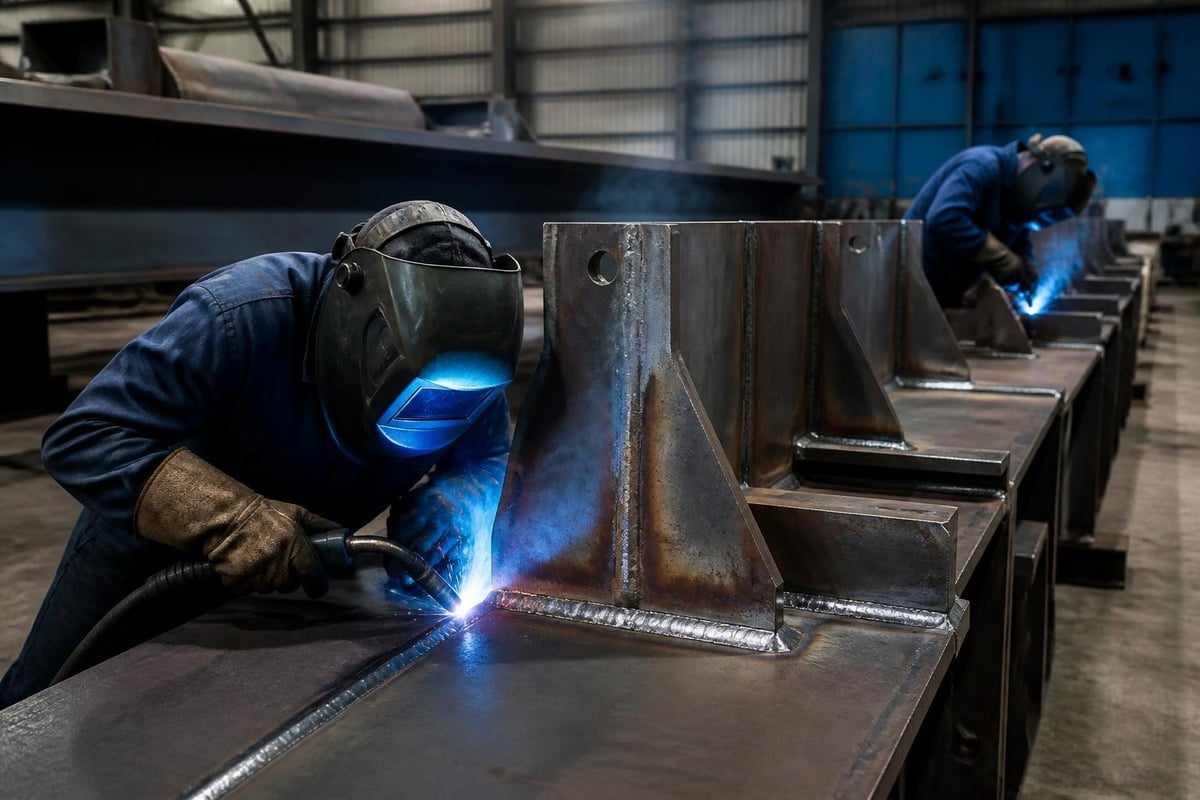
Welding represents the most critical aspect of the structural steel fabrication process, permanently joining components to create load-bearing assemblies. The quality and integrity of welded connections directly impact structural performance and safety.
Welding Process Selection
Structural fabrication employs several welding processes, with selection driven by joint configuration, position, production requirements, and quality specifications:
- Shielded Metal Arc Welding (SMAW) – Versatile stick welding for field and shop applications
- Gas Metal Arc Welding (GMAW/MIG) – High-deposition semi-automatic process for production welding
- Flux-Cored Arc Welding (FCAW) – All-position capability with high deposition rates
- Submerged Arc Welding (SAW) – Automated process for long seam welds in flat position
The AWS D1.1/D1.1M Structural Welding Code establishes comprehensive requirements for welding procedures, welder qualification, inspection, and acceptance criteria. Fabricators develop and qualify Welding Procedure Specifications (WPS) that document all essential variables-base metals, filler metals, preheat, interpass temperature, and shielding gas-for each joint configuration.
Understanding what ASME certification means becomes important when fabricating pressure vessels or boiler components alongside structural elements, as these applications require additional certifications beyond structural welding qualifications.
Fit-Up and Tack Welding
Proper fit-up establishes the foundation for quality welds in the structural steel fabrication process. Components must be aligned within specified tolerances, with appropriate root openings and gaps maintained throughout the joint length. Fabricators use fixtures, jigs, and strongbacks to maintain alignment during tack welding and final welding operations.
Critical fit-up parameters include:
- Root opening dimension and uniformity
- Joint alignment and mismatch limits
- Backing bar placement and condition
- Cleanliness of joint surfaces
- Preheat application when required
Tack welds temporarily secure components in position, sized and spaced to prevent distortion while supporting the assembly during handling and final welding. These tacks often become incorporated into final welds, requiring the same quality standards as production welding.
Production Welding and Distortion Control
As welders execute final welds according to qualified procedures, heat input management prevents excessive distortion and residual stresses. Welding sequence, pass progression, and thermal management strategies minimize dimensional changes that could compromise fit-up of mating components.
Large structural assemblies may require post-weld straightening or stress relieving to bring final dimensions within tolerance. Fabricators employ mechanical straightening (press straightening, flame straightening) or thermal stress relief depending on material specifications and code requirements.
Surface Preparation and Coating Application
The structural steel fabrication process extends beyond cutting and welding to include surface preparation and protective coatings that ensure long-term durability. Industrial environments-particularly in aggregate, recycling, and energy sectors-subject steel structures to corrosive conditions requiring robust protection systems.
Abrasive Blast Cleaning
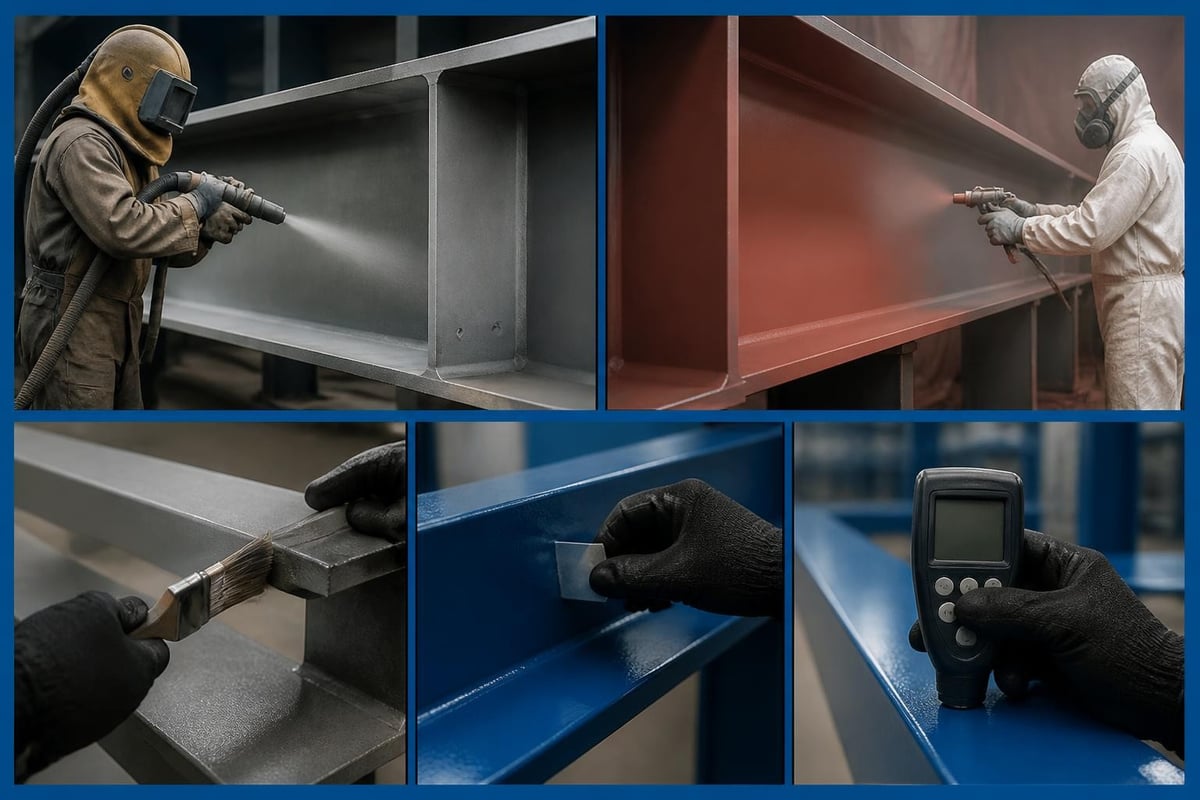
Industry standards, including SSPC-SP 10 Near-White Metal Blast Cleaning, define surface preparation requirements that remove mill scale, rust, and contaminants before coating application. Abrasive blasting creates the anchor profile necessary for coating adhesion while achieving the specified cleanliness level.
Different surface preparation grades serve specific coating systems and service environments:
| SSPC Standard | Description | Typical Application |
|---|---|---|
| SP 7 | Brush-off Blast | Minimal exposure environments |
| SP 6 | Commercial Blast | General industrial applications |
| SP 10 | Near-White Blast | Immersion or severe exposure |
| SP 5 | White Metal Blast | Maximum performance requirements |
Comparing powder coating vs paint durability helps fabricators recommend appropriate coating systems based on service conditions, maintenance requirements, and lifecycle costs.
Coating System Selection
Protective coatings serve as the first line of defense against corrosion in structural steel applications. The structural steel fabrication process concludes with application of multi-layer coating systems tailored to environmental exposure and performance requirements.
Common coating systems include:
- Zinc-rich primers with epoxy or polyurethane topcoats for industrial environments
- High-build epoxies for chemical and abrasion resistance
- Inorganic zinc for maximum corrosion protection in severe exposures
- Intumescent coatings for fire protection applications
Environmental conditions during coating application-temperature, humidity, dewpoint-must meet manufacturer specifications to ensure proper cure and adhesion. Quality coating application requires controlled environments, calibrated equipment, and trained applicators following written procedures.
Quality Control and Inspection Procedures
Throughout the structural steel fabrication process, systematic quality control ensures compliance with engineering specifications, building codes, and industry standards. Inspection activities occur at multiple stages, from incoming material verification through final dimensional checks before shipment.
Dimensional Inspection
Fabricators verify critical dimensions using calibrated measuring equipment-tapes, squares, levels, templates, and coordinate measuring machines for complex geometries. Tolerances specified in project documents or industry standards (AISC Code of Standard Practice) define acceptance criteria for:
- Overall member length and width
- Hole locations and diameters
- Squareness and straightness
- Camber and sweep
- Connection plate positions
First-piece inspection confirms that production setup achieves specified dimensions before authorizing completion of multiple identical pieces. In-process checks during fabrication detect drift or systematic errors before significant rework becomes necessary.
Weld Quality Assurance
Welding inspection represents a critical quality control element in the structural steel fabrication process. Visual inspection by certified weld inspectors (CWI) examines all welds for conformance to acceptance criteria defined in applicable codes. Inspectors verify proper size, length, profile, and freedom from rejectable discontinuities.
Visual inspection criteria include:
- Weld size and throat dimension
- Undercut depth and length
- Porosity size and distribution
- Crack absence in weld and heat-affected zone
- Complete fusion at root and toes
Beyond visual inspection, project specifications may require nondestructive testing (NDT) using ultrasonic testing, magnetic particle testing, or radiographic testing to detect internal discontinuities. The extent of NDT depends on loading conditions, service environment, and criticality of connections.
Understanding ASME welding certification meaning helps distinguish between structural welding qualifications and pressure vessel welding requirements when projects involve multiple code jurisdictions.
Documentation and Traceability Requirements
Complete documentation throughout the structural steel fabrication process provides traceability, supports quality verification, and satisfies regulatory requirements. Fabricators maintain comprehensive records from material procurement through final inspection and shipping.
Essential Fabrication Records
Manufacturing documentation packages typically include:
- Material certifications and mill test reports
- Welding procedure specifications (WPS)
- Welder qualification records (WQR/PQR)
- Inspection and test reports
- Nonconformance and corrective action records
- Final dimensional inspection reports
- Coating inspection reports and dry film thickness measurements
Digital documentation systems allow fabricators to organize, retrieve, and transmit records efficiently while maintaining permanent archives. Many industrial clients require certified material test reports (CMTRs) and complete traceability for critical components, particularly in oil and gas applications where component failures carry significant consequences.
Packaging and Shipping Considerations
The final phase of the structural steel fabrication process addresses protection during transportation and delivery logistics. Proper packaging prevents damage to finished components while facilitating safe, efficient handling at the construction site.
Heavy structural components require specialized lifting equipment and transportation considerations. Fabricators mark components with identification corresponding to erection drawings, indicating piece marks, orientation, and connection details. Protective measures prevent coating damage during handling and transportation:
- Padding at contact points and lifting locations
- Bundling of similar components for efficient loading
- Weather protection for extended transportation or storage
- Segregation of finished components from raw materials
Coordination with steel erectors ensures that delivery sequences align with construction schedules and site access capabilities. Just-in-time delivery minimizes on-site storage requirements while maintaining project momentum. For projects throughout the Western United States, transportation planning accounts for distance, route restrictions, and delivery timing to remote industrial locations.
Advanced Technologies in Modern Fabrication
Contemporary fabrication shops integrate advanced technologies that enhance precision, efficiency, and capabilities within the structural steel fabrication process. Building Information Modeling (BIM) coordinates structural, mechanical, and architectural elements in three-dimensional space, detecting conflicts before fabrication begins.
Robotic welding systems provide consistent quality for repetitive welding operations, particularly on standardized components or long production runs. While manual welding remains essential for complex assemblies and field work, automation increases throughput for suitable applications.
3D laser scanning verifies as-built dimensions of existing structures when fabricating retrofit components or modifications to operating facilities. This technology captures precise spatial data, ensuring new fabrications fit existing conditions without expensive field modifications.
Thermal cutting optimization software nests parts efficiently on raw material sheets, minimizing scrap while maintaining grain direction requirements for critical components. These systems generate CNC programs automatically, reducing programming time and human error while maximizing material utilization.
Material Handling and Shop Organization
Efficient material flow through the structural steel fabrication process requires thoughtful shop layout and material handling systems. Raw materials enter receiving areas for inspection and storage, then progress through cutting, forming, welding, finishing, and shipping departments in logical sequence.
Overhead cranes, forklifts, and material carts transport components between workstations while minimizing handling damage and worker injury risks. Color-coding, bar-coding, or RFID tagging tracks work-in-process inventory, preventing loss of components and supporting just-in-time production strategies.
Dedicated welding bays equipped with proper ventilation, adequate power supply, and appropriate fixturing improve welder productivity and weld quality. Separate blast and paint booths isolate surface preparation and coating operations, protecting other shop areas from abrasive media and overspray contamination.
Mastering each phase of the structural steel fabrication process-from precise cutting through certified welding to protective coating application-delivers the quality, reliability, and performance that commercial and industrial operations demand. When your aggregate processing equipment, recycling facility infrastructure, or oil and gas installations require expert fabrication backed by comprehensive welding, machining, and field services throughout Colorado and the Western United States, LTJ Industrial Services brings the precision craftsmanship and technical expertise to support your most critical projects.