
The mining industry demands equipment capable of withstanding extreme conditions, continuous operation, and heavy loads while maintaining safety and productivity. Mining equipment fabrication represents a specialized discipline that combines metallurgical expertise, precision engineering, and rigorous quality control to produce machinery that can perform reliably in the harshest environments. From excavation systems to processing equipment, the fabrication process directly impacts operational efficiency, equipment longevity, and worker safety across mining operations throughout the Western United States and beyond.
Engineering Standards and Specifications for Mining Fabrication
Mining equipment fabrication begins with adherence to industry-recognized standards that govern design, material selection, and construction methods. The AWS D14 Committee establishes comprehensive welding specifications that address weld design, procedures, and inspection protocols specifically for heavy equipment fabrication.
Material Selection and Performance Requirements
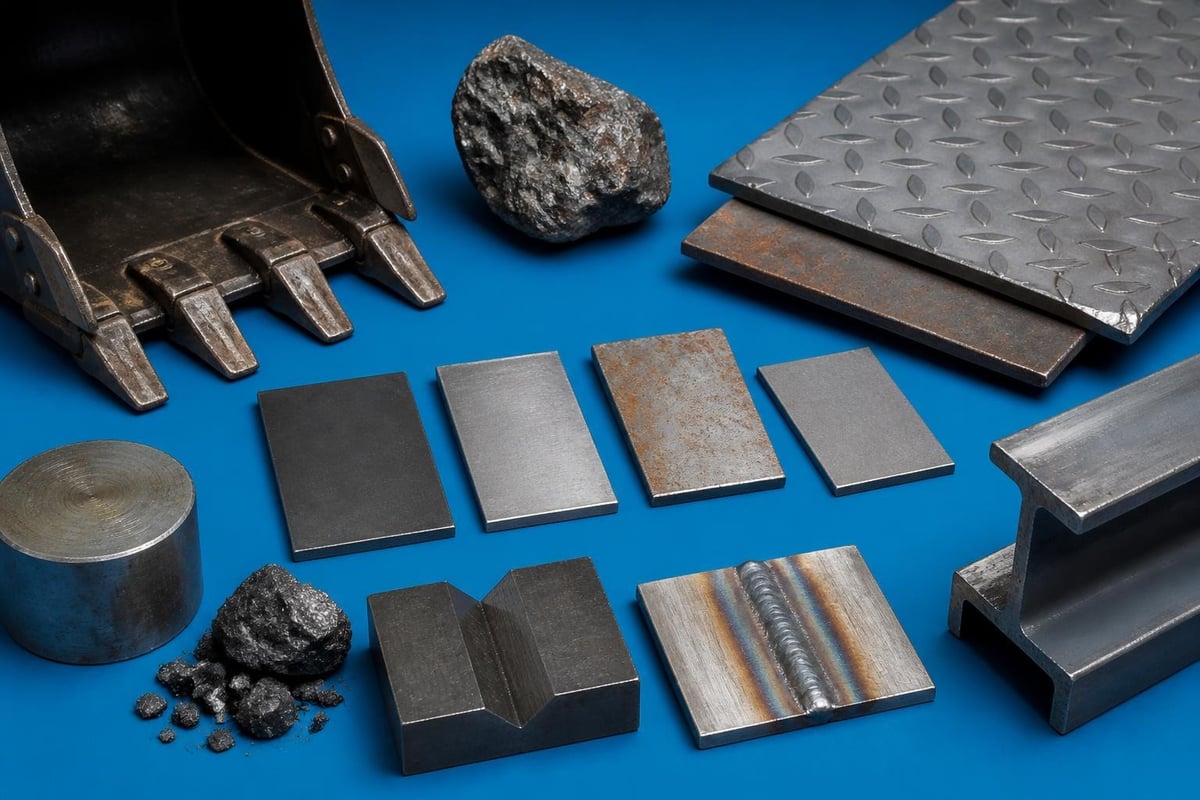
Choosing appropriate materials represents a critical decision point in the fabrication process. Mining equipment must resist abrasion, impact, corrosion, and fatigue while maintaining structural integrity under dynamic loading conditions.
Common materials used in mining equipment fabrication include:
- High-strength low-alloy (HSLA) steel for structural components
- Abrasion-resistant (AR) steel plates for wear surfaces
- Stainless steel alloys for corrosive environments
- Chrome-moly steel for high-stress applications
- Manganese steel for impact-resistant components
The selection process considers factors beyond initial material costs. Total cost of ownership calculations account for expected service life, maintenance requirements, and replacement intervals. Fabricators working in the industrial and manufacturing sectors understand these long-term performance considerations.
Dimensional Accuracy and Tolerance Control
Mining equipment operates with components that must fit precisely despite massive scale. Conveyor systems spanning hundreds of feet, crusher assemblies weighing dozens of tons, and processing modules requiring exact alignment all depend on fabrication tolerances measured in fractions of an inch.
| Component Type | Typical Tolerance | Critical Dimension | Measurement Method |
|---|---|---|---|
| Structural frames | ±1/8 inch | Overall length | Laser measurement |
| Bearing housings | ±0.005 inch | Bore diameter | CMM inspection |
| Mounting plates | ±1/16 inch | Bolt hole spacing | Template verification |
| Shaft journals | ±0.002 inch | Surface finish | Profilometer |
Modern fabrication shops employ coordinate measuring machines (CMM), laser tracking systems, and digital templates to verify dimensional compliance throughout the fabrication process.
Welding Processes and Joint Design for Heavy Equipment
The integrity of welded connections determines equipment reliability under operational stresses. Mining equipment fabrication utilizes multiple welding processes, each selected based on material thickness, joint configuration, and service requirements.
Primary Welding Methods in Mining Fabrication
Shielded Metal Arc Welding (SMAW) remains prevalent for field repairs and heavy sections where accessibility challenges limit process options. The versatility of stick welding makes it valuable for maintenance applications.
Gas Metal Arc Welding (GMAW) provides higher deposition rates for production fabrication. Both solid wire and flux-cored variants serve different applications within mining equipment construction.
Flux-Cored Arc Welding (FCAW) offers advantages for out-of-position welding and thick sections. The process handles contamination better than GMAW while maintaining good productivity.
Submerged Arc Welding (SAW) delivers maximum deposition rates for long seams in flat positions. Automated SAW systems produce consistent quality on repetitive joints common in mining equipment frames and structures.
Specialized applications may require certified pipeline welding contractors who bring expertise in high-integrity joining processes to equipment that includes fluid handling systems.
Weld Joint Design Considerations
- Accessibility for welding and inspection determines joint configuration
- Load distribution influences groove angle and root opening
- Material thickness dictates minimum leg size for fillet welds
- Fatigue resistance requires attention to stress concentration points
- Inspection requirements may mandate complete joint penetration
Joint designs must balance structural performance against fabrication economy. Over-welding increases costs and introduces unnecessary residual stress, while under-designed joints compromise equipment safety and longevity.
Machining and Precision Finishing Operations
Mining equipment fabrication extends beyond welding to include extensive machining operations that create precise surfaces, accurate bores, and true alignments essential for mechanical performance.
Critical Machining Processes
Boring operations create accurate holes for bearings, bushings, and pivot pins. Large-capacity horizontal boring mills handle the massive components characteristic of mining equipment, maintaining positional accuracy across extended workpiece dimensions.
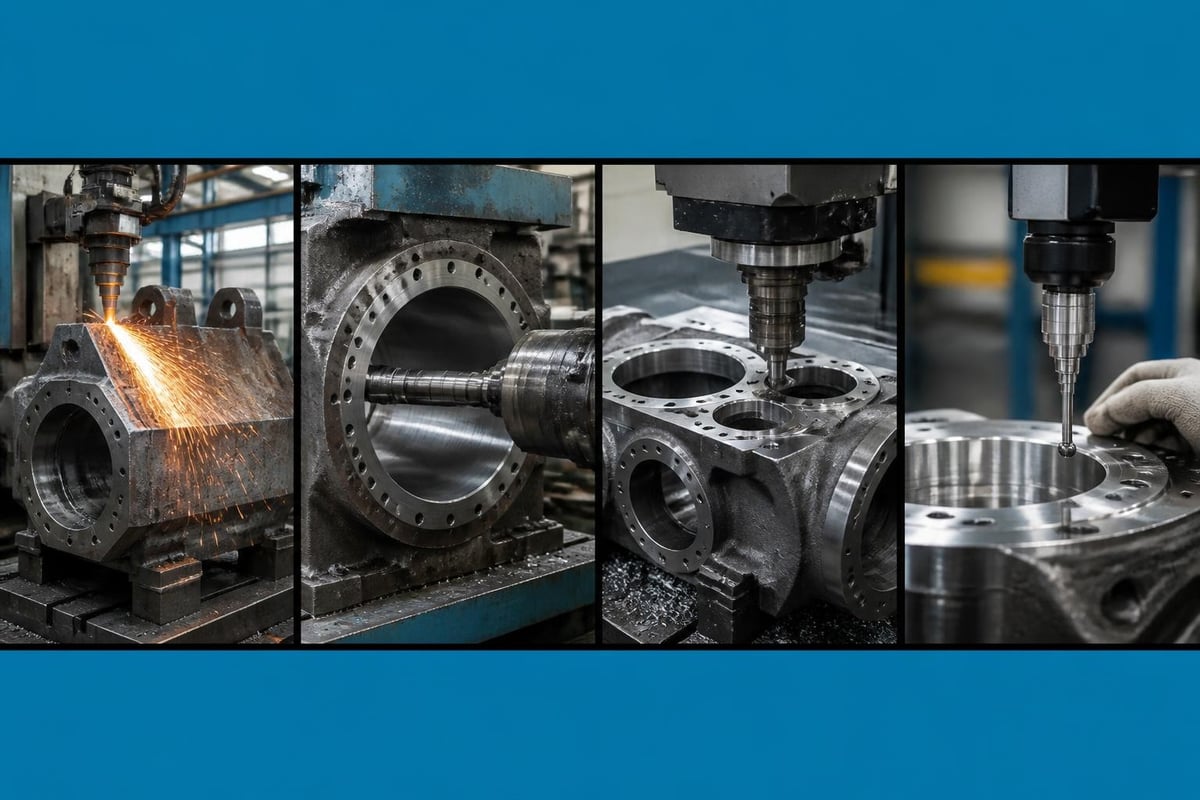
Milling operations produce flat reference surfaces, machine mounting pads, and create complex geometries impossible to achieve through welding alone. Multi-axis CNC mills enable sophisticated part geometries while maintaining repeatability across production runs.
Turning operations generate:
- Cylindrical surfaces for rotating components
- Tapered sections for interference fits
- Precision shoulders for bearing installation
- Threaded connections for assembly
Grinding provides final surface finishes where tight tolerances or superior surface quality impact component performance. Precision grinding of gear teeth, bearing journals, and sealing surfaces ensures proper function and extended service life.
Quality Control and Inspection Protocols
Mining equipment fabrication demands rigorous inspection programs that verify compliance with engineering specifications and industry standards. Multi-stage inspection catches defects early when correction remains economical.
Non-Destructive Testing Methods
| Test Method | Application | Detection Capability | Industry Standard |
|---|---|---|---|
| Visual inspection | All welds | Surface discontinuities | AWS D1.1 |
| Magnetic particle | Ferrous materials | Surface/near-surface cracks | ASTM E1444 |
| Liquid penetrant | Non-magnetic materials | Surface-breaking defects | ASTM E1417 |
| Ultrasonic testing | Thick sections | Internal discontinuities | AWS D1.1 |
| Radiographic testing | Critical joints | Volumetric defects | ASTM E1742 |
The Mining Technology buyer’s guide provides comprehensive coverage of fabrication capabilities and quality assurance practices employed across the industry.
Dimensional Verification and Documentation
Fabrication quality extends beyond weld integrity to encompass dimensional accuracy. Inspection plans specify measurement points, acceptable tolerances, and documentation requirements. First article inspections validate fabrication procedures before full production begins.
Modern fabrication facilities maintain digital records linking inspection data to specific equipment serial numbers. This traceability supports warranty claims, facilitates targeted maintenance, and provides valuable feedback for continuous improvement initiatives.
Protective Coatings and Corrosion Management
Mining equipment operates in chemically aggressive environments where moisture, minerals, and process chemicals accelerate corrosion. Protective coating systems form an integral part of equipment fabrication, directly impacting service life and maintenance costs.
The AMPP provides technical standards addressing coating selection, surface preparation, and application procedures specifically developed for fabricated steel in mining applications.
Surface Preparation Requirements
Coating performance depends fundamentally on surface preparation quality. Mining equipment fabrication follows established procedures to achieve specified cleanliness and profile.
- Solvent cleaning removes oils, greases, and organic contaminants
- Abrasive blasting creates anchor profile and removes mill scale
- Profile depth verification ensures coating mechanical bonding
- Contamination testing confirms surface cleanliness before coating
- Environmental monitoring validates temperature and humidity conditions
Coating System Selection
Different equipment areas require varied protection levels based on exposure conditions. Structural components may receive basic epoxy primers, while components exposed to abrasive slurries demand specialized ceramic-reinforced coatings.
Common coating systems include:
- Zinc-rich primers for atmospheric corrosion protection
- Epoxy coatings for chemical resistance
- Polyurethane topcoats for UV stability
- Specialized linings for abrasion resistance
Advanced coating technologies incorporate nanotechnology and hybrid chemistry to deliver enhanced performance in extreme service conditions encountered throughout mining operations.
Fabrication Process Planning and Workflow Management
Efficient mining equipment fabrication requires detailed process planning that sequences operations, allocates resources, and manages material flow through the production facility.
Fabrication Sequence Development
Process planners analyze engineering drawings to identify critical path operations, determine fixturing requirements, and establish quality checkpoints. The sequence balances competing priorities of quality, cost, and delivery schedule.
Typical fabrication workflow:
- Material receipt and inspection
- Cutting and preparation operations
- Sub-assembly fabrication
- Major component welding
- Stress relief heat treatment (when required)
- Machining operations
- Assembly and fit-up
- Final welding
- Non-destructive testing
- Coating application
- Final inspection and testing
Just as construction projects require careful planning across multiple trades, mining equipment fabrication coordinates welding, machining, and finishing operations to maintain project momentum. Large-scale fabrication shares planning methodologies with major construction initiatives, adapting project management techniques proven across diverse industries.

Resource Allocation and Capacity Planning
Fabrication facilities balance workload across available equipment and skilled personnel. Capacity planning considers equipment capability, operator certification requirements, and infrastructure limitations.
| Resource Type | Typical Utilization | Bottleneck Factor | Mitigation Strategy |
|---|---|---|---|
| Welding stations | 70-85% | Operator skill level | Cross-training programs |
| Large boring mill | 50-65% | Setup time | Batch processing |
| Blast/paint bay | 60-75% | Cure time | Additional capacity |
| Inspection personnel | 80-90% | Certification limits | Third-party services |
Field Service Integration and Installation Support
Mining equipment fabrication frequently extends beyond shop delivery to include field installation, alignment verification, and commissioning support. Fabricators providing comprehensive service deliver value throughout equipment lifecycle.
On-Site Assembly and Alignment
Equipment size often necessitates field assembly, requiring fabricators to provide installation engineering, skilled personnel, and specialized tooling. Field teams work within operating mines, coordinating with production schedules to minimize disruption.
Precision alignment of processing equipment, conveyor systems, and rotating machinery demands expertise in optical measurement, laser alignment, and conventional survey techniques. Field mechanics combine mechanical aptitude with measurement skills to achieve specifications under less-than-ideal conditions.
Companies offering water jetting services understand the importance of integrated capabilities that address diverse field requirements beyond initial fabrication.
Commissioning and Performance Verification
Fabricators increasingly participate in equipment commissioning, verifying that installed systems perform as designed. This involvement closes the feedback loop between fabrication practices and operational performance, driving continuous improvement in fabrication procedures.
Performance verification may include vibration analysis, alignment checks, load testing, and operational trials under supervision. Documentation of baseline performance provides reference data for future maintenance and condition monitoring programs.
Sustainability and Lifecycle Considerations
Modern mining equipment fabrication incorporates sustainability principles that extend beyond initial construction to encompass total lifecycle impact. The Consolidated Mining Standard Initiative establishes expectations for equipment specification, lifecycle design, and fabrication choices that minimize environmental impact.
Design for Maintainability and Repair
Fabrication decisions directly impact maintenance costs and equipment availability throughout service life. Design features that facilitate inspection, component replacement, and repair reduce total cost of ownership while extending useful equipment life.
Maintainability considerations include:
- Access provisions for inspection and service
- Modular design enabling component replacement
- Standardized fasteners and connections
- Wear surface replacement provisions
- Protective coatings in high-wear areas
Equipment designed for repair rather than replacement aligns with sustainability objectives while reducing operating costs. Fabricators contribute expertise regarding practical maintenance access and realistic service intervals.
Material Recovery and End-of-Life Planning
Responsible fabricators consider equipment disposal and material recovery from the design phase. Steel fabrications offer high recyclability, but mixed materials, coatings, and embedded components complicate recycling streams.
Design practices that facilitate material separation, hazardous material identification, and component recovery support circular economy principles increasingly important to mining operators managing environmental performance.
Advanced Fabrication Technologies
Innovation continues transforming mining equipment fabrication through automation, digital technologies, and advanced processes that improve quality while reducing costs.
Automated Welding Systems
Robotic welding cells deliver consistent quality on repetitive joints while freeing skilled welders for complex tasks requiring human judgment. Automated systems equipped with seam tracking, adaptive control, and real-time monitoring produce superior results compared to manual processes.
Collaborative robots working alongside human welders combine automation efficiency with human flexibility. These systems handle heavy components, maintain precise positioning, and execute programmed weld sequences under operator supervision.
Additive Manufacturing Applications
While traditional fabrication dominates mining equipment production, additive manufacturing finds application in tooling, complex geometries, and rapid prototyping. Metal 3D printing creates intricate cooling passages, optimized structures, and custom components economically impractical through conventional fabrication.
Hybrid approaches combine additive manufacturing for complex features with traditional fabrication for primary structure. This integration leverages advantages of each technology while managing limitations.
Digital Twin Technology
Advanced fabricators develop digital models linking design data, fabrication processes, inspection results, and field performance. These digital twins support predictive maintenance, process optimization, and continuous improvement initiatives.
Real-time monitoring during fabrication captures process parameters, environmental conditions, and quality metrics. Analysis of this data identifies process drift, predicts quality issues, and validates fabrication procedures against actual results.
Workforce Development and Skills Training
Mining equipment fabrication success depends fundamentally on skilled craftspeople who combine theoretical knowledge with practical expertise. Industry faces ongoing challenges recruiting and developing qualified personnel.
Essential Skill Sets
Welders require certification in multiple processes, understanding of metallurgy, and ability to interpret complex drawings. Specialty certifications in processes like submerged arc welding or advanced procedures demonstrate competency for critical applications.
Machinists must understand blueprint reading, precision measurement, machine operation, and increasingly, CNC programming. Modern machining centers demand computer literacy alongside traditional machining knowledge.
Quality inspectors need training in non-destructive testing methods, dimensional measurement, and quality standards interpretation. Certification through recognized bodies like AWS or ASNT validates competency.
Apprenticeship and Training Programs
Structured apprenticeship programs combining classroom instruction with supervised practice develop well-rounded fabricators. Multi-year programs progress through increasing complexity, building competency systematically.
Continuing education keeps experienced fabricators current with evolving technologies, new materials, and advanced processes. Investment in workforce development distinguishes leading fabricators from competitors relying on outdated practices.
Regulatory Compliance and Safety Standards
Mining equipment fabrication operates within regulatory frameworks addressing workplace safety, environmental protection, and equipment performance. Compliance represents baseline expectations, not competitive differentiators.
Occupational Safety Requirements
Fabrication facilities implement comprehensive safety programs addressing hazards inherent in metalworking operations. Welding fume control, machine guarding, material handling safety, and personal protective equipment requirements protect workers while maintaining productivity.
Safety performance metrics track incident rates, near-miss reporting, and training compliance. Leading fabricators cultivate safety cultures where every employee accepts responsibility for hazard identification and risk mitigation.
Environmental Regulations
Fabrication operations generate waste streams requiring proper management. Metal grinding dust, coating overspray, used abrasives, and chemical waste demand controlled handling and disposal per environmental regulations.
Air quality permits regulate welding fumes and coating emissions. Water discharge permits govern wastewater from parts washing and coating operations. Compliance programs ensure fabrication activities meet applicable environmental standards.
Mining equipment fabrication demands specialized expertise integrating welding, machining, coating, and quality control disciplines to produce reliable equipment for demanding applications. Success requires technical competency, rigorous process control, and commitment to continuous improvement throughout every fabrication stage. LTJ Industrial Services brings comprehensive fabrication, welding, and machining capabilities to support mining and industrial manufacturing operations throughout the Western United States, delivering precision-engineered solutions backed by decades of expertise serving the most demanding applications.