Manufacturing and industrial operations depend on precision welding services to maintain equipment, fabricate custom components, and ensure structural integrity across diverse sectors. An industrial welding company serves as a critical partner for businesses in oil and gas, recycling, aggregate processing, and commercial manufacturing, providing both shop-based fabrication and field services that keep operations running efficiently. The quality of welding work directly impacts equipment reliability, worker safety, and operational downtime, making the selection of a qualified provider essential for long-term success.
Core Services Provided by Industrial Welding Companies
Comprehensive Welding and Fabrication Capabilities
A full-service industrial welding company offers multiple welding processes to address different materials, applications, and environmental conditions. MIG (Metal Inert Gas) welding provides fast, clean welds suitable for production environments and general fabrication work. TIG (Tungsten Inert Gas) welding delivers precise, high-quality welds for thin materials, stainless steel, and aluminum applications where appearance and strength matter equally.
Stick welding remains valuable for outdoor field work and situations where portability outweighs the need for perfectly clean welds. Flux-cored arc welding excels in heavy industrial applications, particularly where thick materials require deep penetration.
Metal fabrication services extend beyond basic welding to include:
- Custom component design and engineering
- Sheet metal fabrication and forming
- Structural steel fabrication
- Assembly and finishing services
- Prototype development and production runs
Machining and Precision Work
Machining capabilities complement welding services by enabling complete project execution without outsourcing. CNC machining produces precise components with tight tolerances, while manual machining handles custom one-off pieces and repair work. Hydraulic system repair and fabrication represents another specialized service area, particularly for industrial equipment operating in demanding environments.
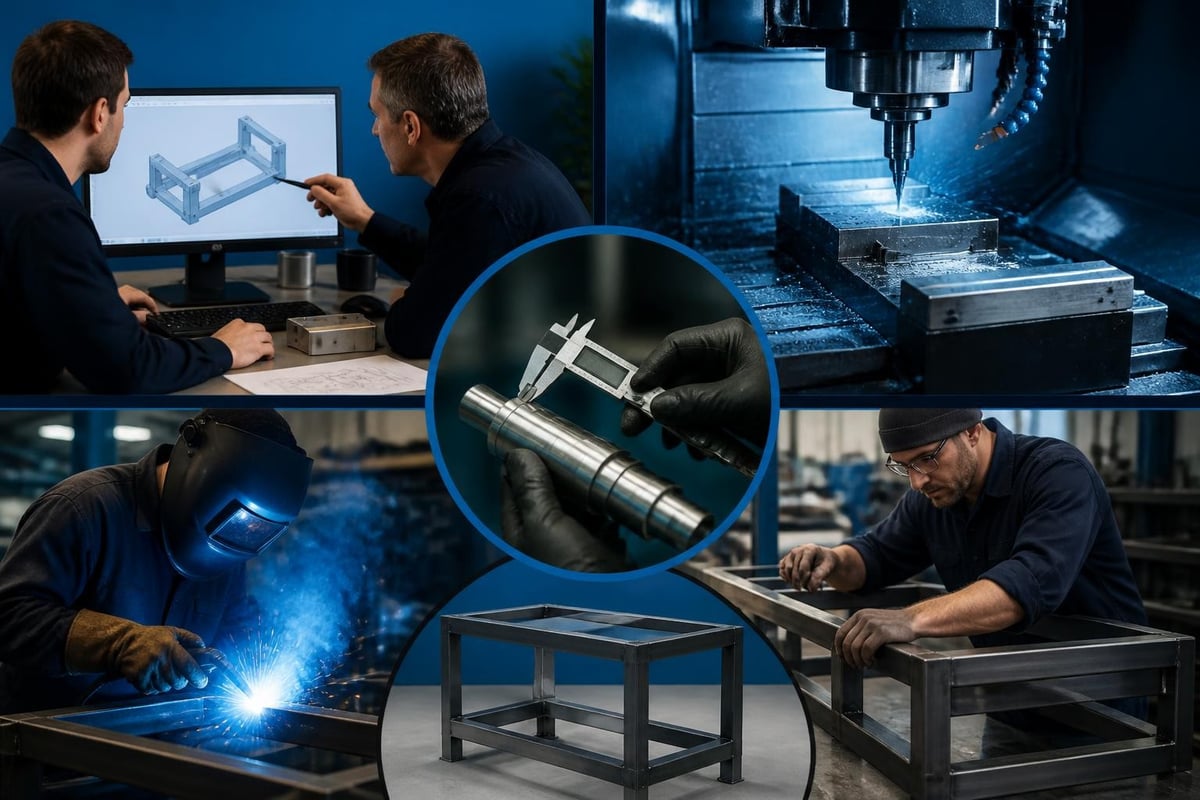
Water jetting services provide solutions for cutting, cleaning, and surface preparation tasks that traditional methods cannot safely or effectively accomplish. This technology proves particularly valuable in confined spaces or situations requiring cold cutting to prevent heat-affected zone concerns.
Safety Standards and Regulatory Compliance
OSHA Requirements for Industrial Welding Operations
Safety protocols form the foundation of professional welding operations. OSHA welding standards establish baseline requirements for ventilation, personal protective equipment, fire prevention, and electrical safety across general industry, maritime, and construction applications.
Key safety considerations include:
- Ventilation systems to control fumes and gases in enclosed spaces
- Fire watch procedures for hot work in areas with combustible materials
- Electrical safety protocols for welding equipment and power sources
- Personal protective equipment including helmets, gloves, and flame-resistant clothing
- Confined space entry procedures for tank and vessel work
An industrial welding company committed to safety maintains comprehensive training programs, documented safety procedures, and regular equipment inspections. The safety commitment demonstrated by WMC Inc., including maintaining OSHA-certified safety directors and up-to-date training, illustrates the level of dedication required in this field.
Industry Certifications and Quality Standards
Professional certifications validate an industrial welding company's technical capabilities and commitment to quality. AWS standards and publications provide over 350 technical documents covering welding practices, procedures, and qualification requirements that serve as industry benchmarks.
| Certification | Scope | Value to Customers |
|---|---|---|
| AWS D1.1 Structural Welding Code | Structural steel welding | Ensures building and bridge work meets safety requirements |
| ASME Section IX | Boiler and pressure vessel welding | Validates welder qualification for critical pressure equipment |
| AISC Certified Fabricator | Structural steel fabrication | Demonstrates quality management systems for steel structures |
| ISO 9001 | Quality management systems | Shows commitment to consistent quality and continuous improvement |
| API 1104 | Pipeline welding | Specific to oil and gas pipeline construction and repair |
These certifications require regular audits, welder testing, and documented quality control procedures. GSM Industrial’s approach to certifications demonstrates how ASME, AISC, and AWS credentials work together to ensure comprehensive quality across projects.
Field Services vs. Shop-Based Operations
Mobile Welding and On-Site Repairs
Field welding services bring capabilities directly to customer facilities, minimizing equipment downtime and transportation costs. On-site repairs allow machinery to remain in place during maintenance, reducing the logistical complexity of moving heavy equipment. Mobile welding units equipped with generators, welding machines, and tooling can address emergency breakdowns, scheduled maintenance, and modification projects.
Field service advantages include:
- Immediate response to equipment failures
- Elimination of disassembly and transportation costs
- Work performed during scheduled shutdowns
- Reduced overall project timelines
- Minimal disruption to ongoing operations
Geographic coverage matters significantly for industrial operations spread across large areas. An industrial welding company serving the Western United States can respond to facilities in multiple states, providing consistent quality regardless of location.
Controlled Shop Environment Benefits
Shop-based fabrication offers environmental control, specialized equipment access, and efficient workflow organization that field conditions cannot match. Climate control ensures proper welding conditions year-round, while overhead cranes and positioning equipment enable efficient handling of heavy components.
Quality control measures function more effectively in shop settings where dedicated inspection areas, testing equipment, and controlled processes support consistent results. Complex assemblies requiring multiple operations benefit from the coordinated workflow possible in a well-equipped fabrication shop.
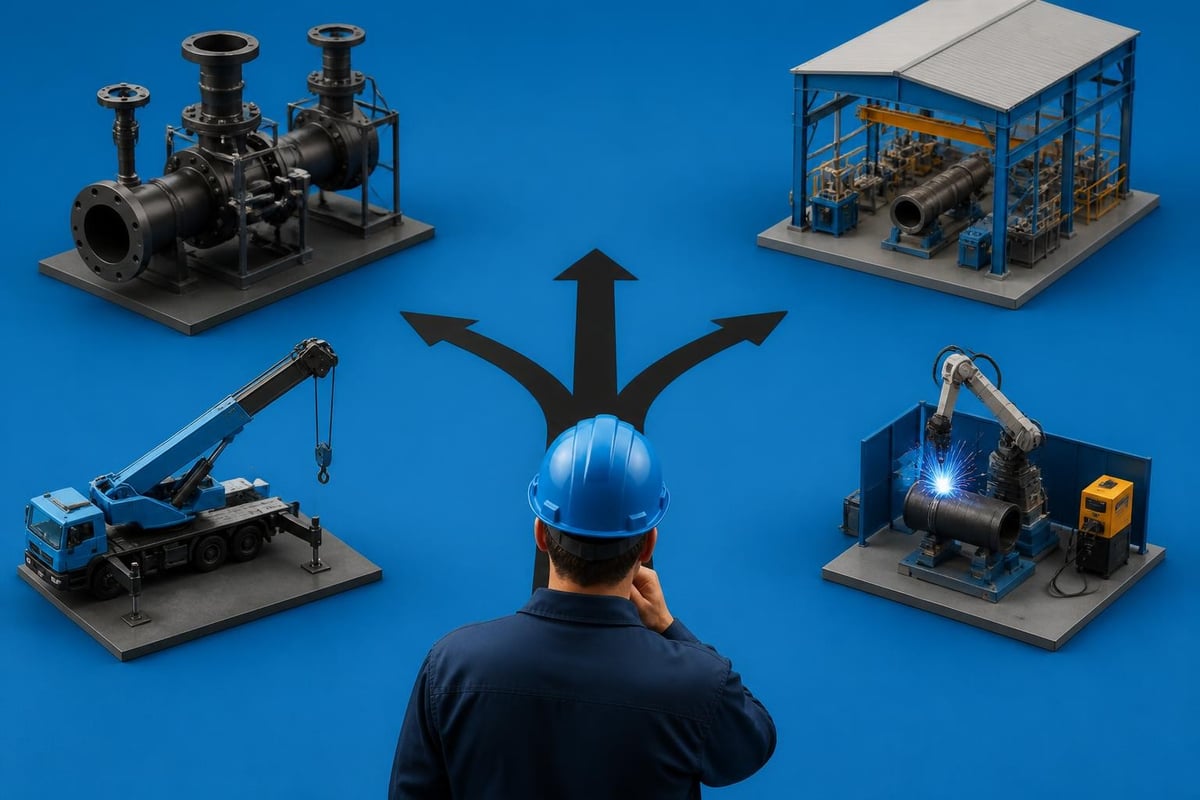
Serving Specialized Industrial Sectors
Oil and Gas Industry Applications
The oil and gas sector demands welding services that meet stringent safety and quality requirements for pressure vessels, piping systems, and processing equipment. Pipeline repairs require certified welders familiar with API 1104 standards and X-ray inspection procedures. Equipment modifications must account for hazardous area classifications and material compatibility with hydrocarbons.
An industrial welding company serving this sector typically maintains:
- API and ASME certified welders
- Documented welding procedure specifications (WPS)
- Non-destructive testing capabilities or partnerships
- Emergency response availability
- Experience with exotic materials and high-pressure applications
Aggregate and Recycling Equipment Maintenance
Crushing, screening, and conveying equipment in aggregate operations experiences significant wear from abrasive materials and continuous operation. Wear plate installation, crusher component repair, and structural reinforcement represent common service requirements. Recycling facilities face similar challenges with added complexity from mixed material streams and contamination concerns.
Custom fabrication solves unique equipment challenges where standard parts prove unavailable or inadequate. Chute liners, hopper modifications, and material handling solutions extend equipment life and improve operational efficiency.
Commercial Manufacturing Support
Manufacturing facilities require responsive maintenance partners who understand production schedules and quality requirements. Preventive maintenance welding addresses small issues before they escalate into costly failures. Production equipment modifications adapt machinery to new products or process improvements.
Project coordination becomes critical when welding work affects production schedules. An experienced industrial welding company develops detailed work plans, coordinates with facility personnel, and executes efficiently to minimize downtime impact.
Quality Control and Testing Procedures
Inspection Methods and Documentation
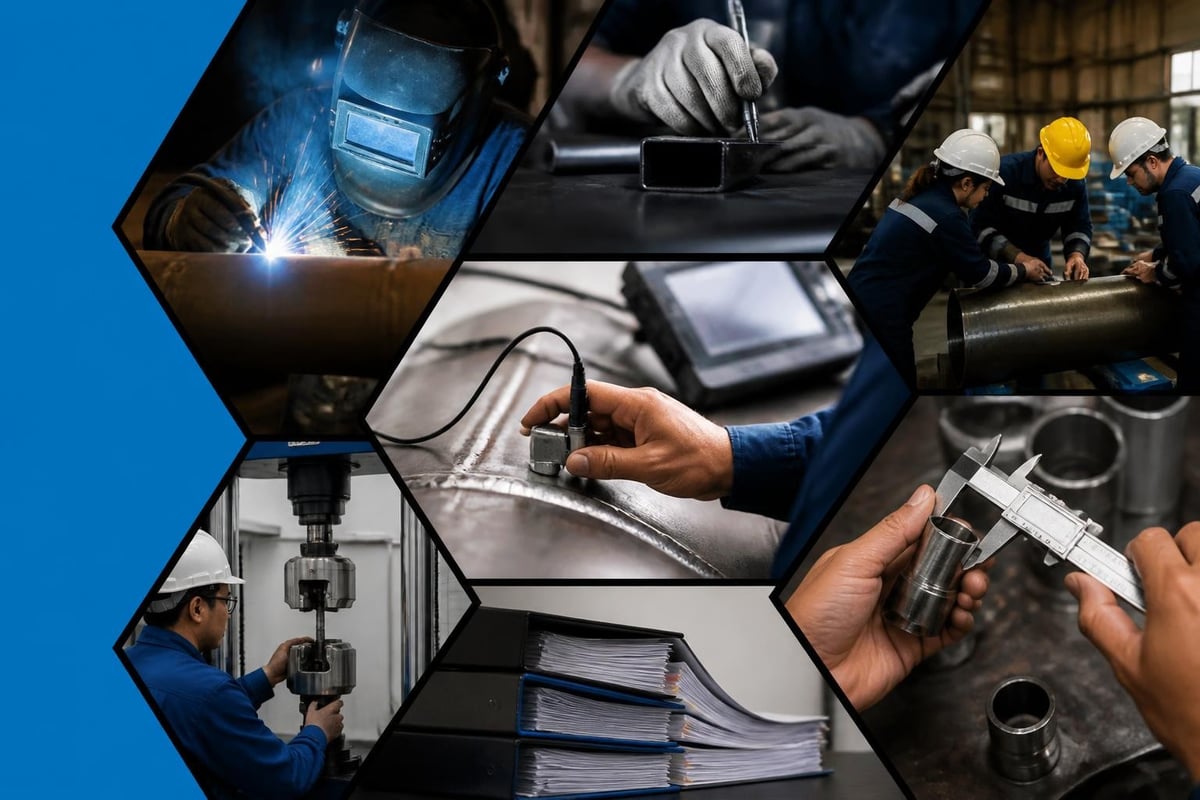
Quality assurance begins with qualified welders following documented procedures and extends through multiple inspection stages. Visual inspection catches obvious defects, dimensional errors, and workmanship issues before proceeding to more sophisticated testing methods.
Non-destructive testing (NDT) methods validate weld integrity without damaging components:
| Testing Method | Application | What It Detects |
|---|---|---|
| Radiographic (X-ray) | Pressure vessels, structural welds | Internal porosity, cracks, incomplete fusion |
| Ultrasonic | Thick materials, critical joints | Subsurface defects, depth measurement |
| Magnetic Particle | Ferromagnetic materials | Surface and near-surface cracks |
| Dye Penetrant | Non-magnetic materials | Surface-breaking cracks and porosity |
| Visual | All welds | Surface defects, dimensions, workmanship |
Documentation requirements vary by industry and application but typically include welder certifications, procedure qualifications, material certifications, and inspection records. Industrial welding safety standards emphasize the connection between proper procedures and safe, effective operations.
Material Traceability and Certification
Material certification ensures that metals meet specified chemical composition and mechanical properties. Mill test reports provide documented evidence of material properties from the steel mill or material supplier. This traceability becomes critical for pressure vessels, structural applications, and situations where material failure could create safety hazards.
An industrial welding company working on sophisticated projects maintains systems for tracking materials from receipt through fabrication and installation. Bar coding, heat number tracking, and organized storage prevent material mix-ups that could compromise project integrity.
Equipment and Technology Investment
Modern Welding Equipment Capabilities
Advanced welding equipment improves quality, efficiency, and operator safety compared to older technology. Inverter-based power sources provide precise arc control, reduced energy consumption, and lighter weight for portable applications. Synergic welding systems with pre-programmed parameters simplify setup and improve consistency for operators working with multiple materials.
Automation and mechanization extend capabilities beyond manual welding:
- Orbital welding systems for pipe fabrication
- Robotic welding cells for repetitive production work
- Column and boom manipulators for large vessel work
- Positioning equipment for optimal joint access
Technology selection depends on the project mix, volume requirements, and material specifications an industrial welding company regularly encounters.
Machining and Fabrication Tools
Precision machining requires substantial capital investment in CNC mills, lathes, and specialized equipment. Multi-axis machining centers complete complex parts in single setups, reducing errors and improving dimensional accuracy. Quality measurement equipment including coordinate measuring machines (CMM) and precision inspection tools validate finished dimensions against specifications.
Fabrication shops benefit from hydraulic press brakes, ironworkers, saws, and material handling equipment that improve productivity and worker safety. Plasma and oxy-fuel cutting systems complement welding capabilities by preparing materials efficiently.
Emergency Response and Maintenance Scheduling
Unplanned Equipment Failures
Manufacturing operations cannot always predict equipment failures despite preventive maintenance efforts. An industrial welding company offering emergency response services provides value beyond scheduled work by minimizing downtime during critical breakdowns. 24/7 availability for urgent situations demonstrates commitment to customer operations.
Response capabilities should include:
- Rapid assessment and diagnosis
- Mobilization of qualified welders and equipment
- Temporary repairs to restore production
- Permanent solutions implemented during scheduled downtime
- Root cause analysis to prevent recurrence
Geographic proximity matters for emergency response, making regional providers with multiple service areas valuable partners for multi-site operations.
Planned Shutdown Coordination
Scheduled maintenance shutdowns present opportunities to complete major repairs, modifications, and upgrades without impacting daily production. Critical path planning ensures welding work integrates with other maintenance activities, inspection requirements, and operational deadlines.
Successful shutdown execution requires:
- Detailed scope development and work planning
- Material procurement and staging before shutdown begins
- Coordination with other contractors and facility personnel
- Contingency planning for unexpected conditions
- Documentation of completed work for maintenance records
An experienced industrial welding company brings shutdown management expertise that reduces turnaround time and ensures work completion within the planned window.
Custom Fabrication and Engineering Support
Design Collaboration and Problem Solving
Complex projects benefit from early collaboration between customers and fabrication teams. Value engineering identifies cost-saving opportunities without compromising functionality or safety. Design for manufacturability ensures that engineered solutions can be efficiently fabricated with available equipment and processes.
Custom solutions address unique challenges where standard equipment proves inadequate. Conveyor systems for specialized materials, custom tanks and vessels, equipment modifications, and structural supports all represent opportunities for tailored fabrication work.
For industries requiring specialized electrical systems, tools like X/D Loom provide professional wiring diagram capabilities that complement custom fabrication projects requiring integrated electrical and mechanical systems, particularly in mobile equipment and custom machinery applications.
Prototyping and Production Runs
New product development often requires prototype fabrication to validate designs before committing to production tooling. An industrial welding company with diverse capabilities can produce small quantities efficiently, allowing design iteration without large minimum orders.
Production fabrication scales prototype designs to higher volumes while maintaining quality and dimensional consistency. Documented procedures, fixture development, and process optimization ensure that production units match prototype specifications.
Selecting an Industrial Welding Company Partner
Evaluation Criteria and Considerations
Choosing the right industrial welding company impacts project outcomes, costs, and long-term operational success. Technical capabilities provide the foundation, but operational factors determine partnership effectiveness.
Key evaluation factors include:
| Category | Evaluation Points |
|---|---|
| Technical Capabilities | Welding processes, materials experience, equipment capacity |
| Certifications | AWS, ASME, AISC, ISO credentials and current status |
| Safety Record | Incident rates, training programs, safety culture |
| Geographic Coverage | Service area, response times, multi-location support |
| Project Experience | Similar applications, industry knowledge, reference projects |
| Quality Systems | Inspection procedures, documentation, testing capabilities |
References from existing customers in similar industries provide insight into actual performance beyond marketing claims. Site visits to fabrication facilities reveal equipment conditions, housekeeping standards, and overall operational professionalism.
Long-Term Partnership Value
Developing relationships with reliable service providers creates operational advantages beyond individual project execution. Familiarity with equipment allows welders to work more efficiently on repeat visits, reducing labor costs and minimizing disruption.
Proactive maintenance recommendations from experienced partners prevent small issues from becoming major failures. An industrial welding company invested in customer success identifies wear patterns, suggests improvements, and helps optimize maintenance schedules based on actual equipment conditions.
Consistent quality from trusted providers eliminates the risk and overhead associated with qualifying new vendors for each project. Established relationships streamline procurement, reduce bidding cycles, and enable faster response when urgent needs arise.
Regional Considerations for Western United States Operations
Geographic and Environmental Challenges
Industrial operations across the Western United States face unique challenges from vast distances, varied climates, and remote facility locations. An industrial welding company serving this region must accommodate:
- High altitude welding considerations affecting shielding gas and procedure selection
- Extreme temperature variations from desert heat to mountain cold
- Remote locations requiring self-sufficient mobile operations
- Multi-state regulatory compliance for contractors
- Long-distance mobilization and logistics coordination
Experience with these regional factors separates local providers familiar with Western conditions from companies attempting to extend coverage beyond their core service areas.
Industry Concentration and Specialization
The Western United States hosts significant concentrations of mining, oil and gas, agriculture, and aggregate operations. Understanding industry-specific requirements, seasonal patterns, and operational priorities enables more effective service delivery. Recycling facilities processing mixed materials, aggregate operations with silica dust concerns, and oil field equipment exposed to corrosive environments all present distinct challenges requiring appropriate expertise.
Selecting an industrial welding company partner requires evaluating technical capabilities, safety commitment, quality systems, and industry experience to ensure reliable project execution. Whether your operation needs emergency field repairs, scheduled maintenance support, or custom fabrication services, working with qualified professionals protects your equipment investment and operational continuity. LTJ Industrial Services brings comprehensive welding, fabrication, and machining capabilities to commercial and industrial manufacturing sectors throughout the Western United States, combining shop precision with responsive field service to keep your operations running efficiently.