
The industrial manufacturing industry stands at a pivotal moment in 2026, experiencing rapid transformation driven by technological innovation, sustainability imperatives, and evolving market demands. From automation and artificial intelligence to advanced fabrication techniques, manufacturers across sectors are reimagining their operations to remain competitive in an increasingly complex global marketplace. This evolution affects every aspect of production, from welding and machining to hydraulics and material processing, creating both challenges and opportunities for businesses that serve this dynamic sector.
The Current State of Industrial Manufacturing
The industrial manufacturing industry encompasses a diverse array of sectors, including oil and gas, recycling, aggregate processing, and commercial production. Recent data reveals that manufacturers are experiencing unprecedented pressure to modernize while maintaining quality standards and controlling costs.
According to PwC’s Global Industrial Manufacturing Sector Outlook, companies are planning to more than double automation in key processes by 2030. This represents a fundamental shift in how production facilities operate, with implications for everything from workforce planning to capital investment strategies.
Market Dynamics Shaping the Sector
Several forces are reshaping the competitive landscape:
- Supply chain resilience has become a strategic priority following global disruptions
- Domestic manufacturing is experiencing renewed investment, particularly in the Western United States
- Skilled labor shortages are driving automation adoption and training initiatives
- Regulatory compliance requirements continue to expand, especially for pressure systems and safety-critical applications
The NIST Annual Report on the U.S. Manufacturing Economy highlights how American manufacturers are leveraging these trends to strengthen their competitive position through quality, innovation, and specialized capabilities.
Technology Transformation in Manufacturing Operations
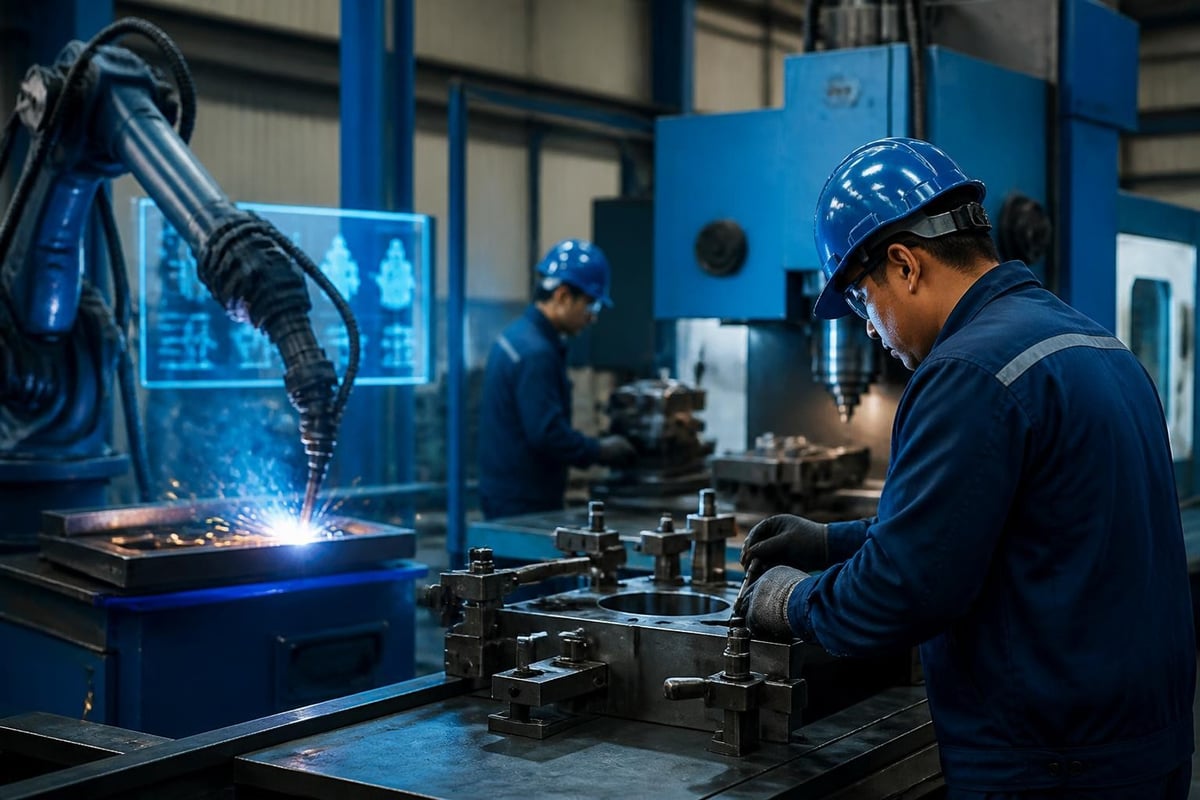
The industrial manufacturing industry is witnessing a technology revolution that extends far beyond simple mechanization. Companies are implementing intelligent systems that connect previously isolated processes into cohesive, data-driven operations.
Automation and Smart Manufacturing
The World Economic Forum’s Intelligent Industrial Operations Outlook 2026 maps the evolution from traditional automation to connected, autonomous systems. This progression follows a NOW-NEAR-NEXT framework that helps manufacturers understand where to focus their technology investments.
Current automation trends include:
- Robotic welding systems that deliver consistent quality for high-volume production
- CNC machining centers with advanced tool management and predictive maintenance
- Automated material handling that reduces manual labor and improves safety
- Digital inspection systems using vision technology and dimensional scanning
- Integrated hydraulic systems with real-time performance monitoring
For businesses seeking to implement these technologies, manufacturing and machining services that combine traditional expertise with modern capabilities provide a practical pathway to modernization.
Artificial Intelligence and Data Analytics
Artificial intelligence is moving from experimental applications to production deployment across the industrial manufacturing industry. Machine learning algorithms now optimize everything from production scheduling to quality control.
| Application Area | AI Benefit | Implementation Complexity |
|---|---|---|
| Predictive Maintenance | 25-40% reduction in downtime | Medium |
| Quality Inspection | 99%+ defect detection rate | High |
| Production Scheduling | 15-30% efficiency gain | Medium |
| Energy Optimization | 10-20% cost reduction | Low to Medium |
| Supply Chain Planning | Improved delivery accuracy | High |
The 2026 Roadmap on Artificial Intelligence and Machine Learning for Smart Manufacturing identifies how AI advances applications in digital twins, robotics, and sustainable manufacturing, providing a research-based perspective on future developments.
Sustainability and Environmental Responsibility
Environmental performance has evolved from a compliance issue to a competitive differentiator in the industrial manufacturing industry. Companies are discovering that sustainable practices often align with operational efficiency and cost reduction.
Green Manufacturing Initiatives
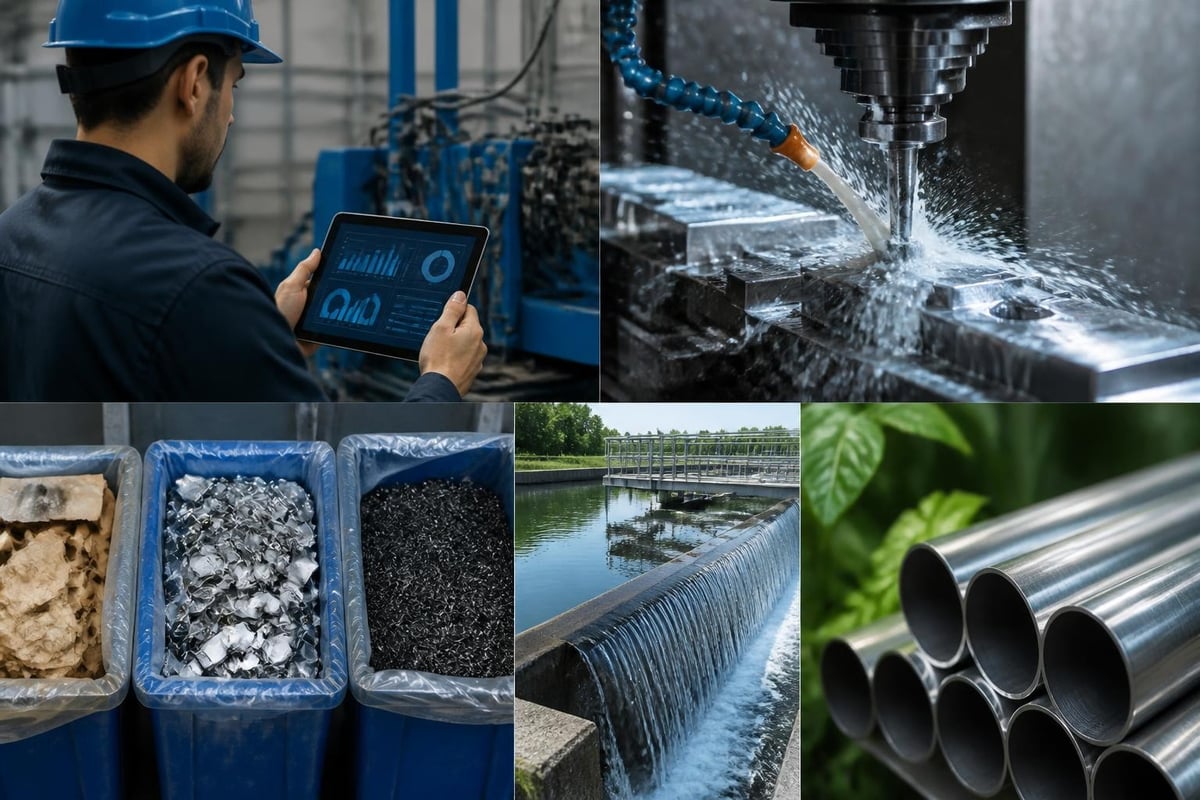
Manufacturers are implementing comprehensive sustainability programs that address multiple environmental dimensions:
- Energy efficiency through optimized equipment and process design
- Waste reduction via improved material utilization and recycling
- Emissions control using advanced filtration and capture systems
- Water conservation through closed-loop cooling and process water treatment
- Sustainable materials selection and lifecycle assessment
Research on data-driven sustainability assessment of advanced manufacturing processes explores how manufacturers can use lifecycle assessment and AI-driven decision frameworks to evaluate and improve their environmental performance across additive, subtractive, and formative processes.
Regulatory Compliance and Industry Standards
The industrial manufacturing industry operates under increasingly stringent environmental and safety regulations. Compliance requires both technical expertise and systematic documentation.
For pressure systems and critical applications, ASME code welding services ensure that fabrication meets rigorous industry standards while supporting environmental objectives through proper material selection and process control.
Advanced Fabrication and Precision Engineering
Core manufacturing processes continue to evolve, with traditional skills being enhanced by new tools, materials, and methodologies. The industrial manufacturing industry demands ever-higher precision and quality standards.
Welding Technology Advancements
Modern welding has progressed far beyond basic arc processes. Today's welding services for businesses incorporate multiple technologies and quality systems:
Process innovations include:
- Automated parameter control for consistent penetration and bead appearance
- Multi-process capabilities combining MIG, TIG, stick, and flux-core methods
- Advanced filler materials designed for specific applications and base metals
- Real-time monitoring systems that detect defects during welding
- Specialized techniques for exotic alloys and dissimilar materials
Field welding for oil and gas infrastructure requires particular expertise, as detailed in resources about oil and gas pipeline fabrication, where contractors must balance quality, safety, and efficiency in challenging environments.
Precision Machining Capabilities
Machining technology continues to advance, enabling tighter tolerances and more complex geometries. Modern machine shops serve the industrial manufacturing industry with capabilities that were impossible just a decade ago.
| Machining Method | Typical Tolerance | Common Applications |
|---|---|---|
| CNC Milling | ±0.001" – ±0.0001" | Complex parts, tooling |
| CNC Turning | ±0.0005" – ±0.0001" | Shafts, cylinders, fittings |
| Wire EDM | ±0.0001" – ±0.00004" | Die making, precision components |
| Grinding | ±0.0001" or better | High-precision surfaces |
| Waterjet Cutting | ±0.005" – ±0.001" | Plate cutting, complex shapes |
Companies offering water jetting services provide versatile cutting solutions that avoid heat-affected zones, making them ideal for heat-sensitive materials and applications requiring minimal material distortion.
Specialized Services Supporting Industrial Manufacturing
The industrial manufacturing industry relies on a network of specialized service providers who deliver expertise in niche areas. These partnerships allow manufacturers to access capabilities without maintaining every skill in-house.
Hydraulic Systems and Fluid Power
Hydraulic systems power critical equipment across manufacturing facilities, from presses and lifts to material handling systems. Modern hydraulics manufacturing services combine component fabrication with system design, installation, and maintenance.
Hydraulic expertise encompasses:
- Custom cylinder design and fabrication
- Hose and fitting assembly with proper routing
- Pump and motor selection for specific applications
- Filtration systems to protect components
- Troubleshooting and performance optimization
Custom Fabrication Solutions
When standard components won't meet requirements, custom fabrication becomes essential. The industrial manufacturing industry frequently requires one-off solutions or short production runs for specialized applications.
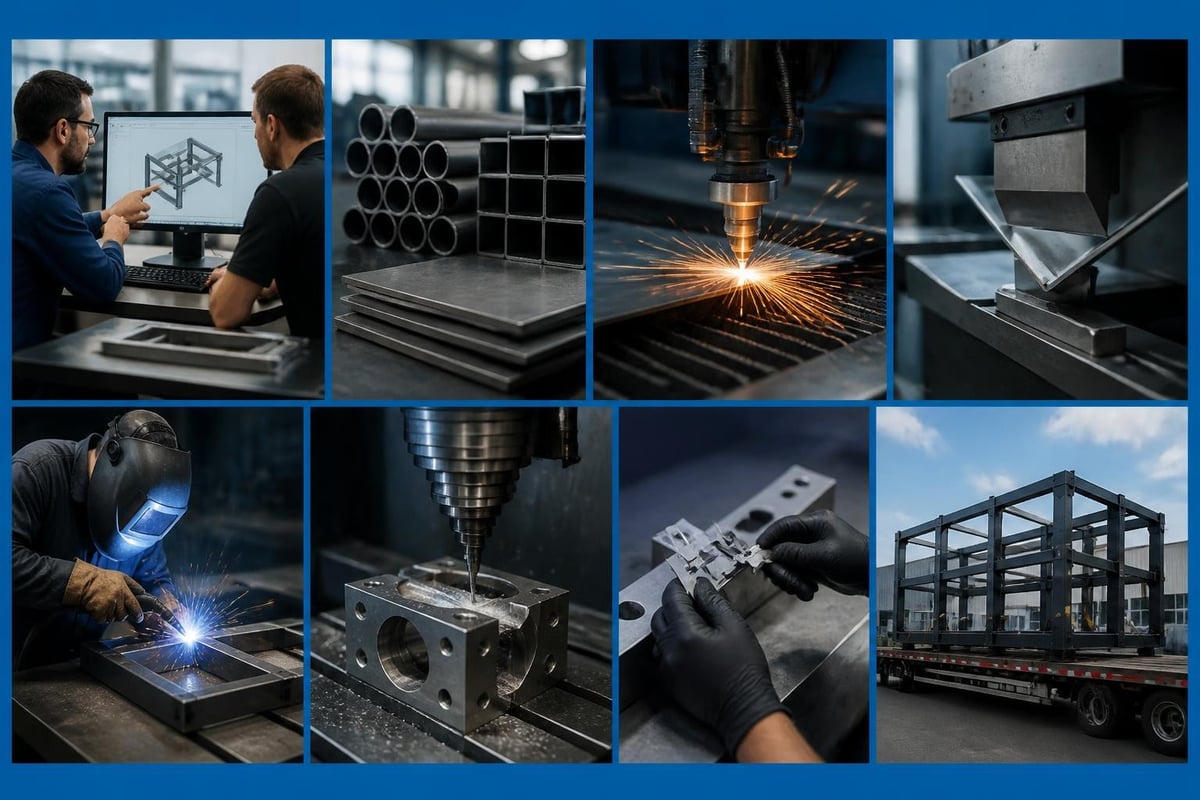
Fabrication services for businesses deliver value through:
- Design collaboration to optimize manufacturability and performance
- Material expertise covering carbon steel, stainless steel, aluminum, and exotic alloys
- Process flexibility utilizing cutting, forming, welding, and machining as needed
- Quality assurance with inspection and testing appropriate to the application
- Project management coordinating multiple disciplines and meeting deadlines
Workforce Development and Skills Training
The industrial manufacturing industry faces a significant workforce challenge as experienced professionals retire while demand for specialized skills increases. Addressing this gap requires strategic investment in training and career development.
Critical Skill Areas
Manufacturing employers are prioritizing development in several key competencies:
- Advanced welding certifications for structural, pipe, and pressure vessel applications
- CNC programming and setup for multi-axis machining centers
- Hydraulic troubleshooting and system design principles
- Blueprint reading and geometric dimensioning and tolerancing (GD&T)
- Quality control methods including statistical process control
Companies that invest in career development opportunities create competitive advantage by building skilled teams capable of tackling complex projects and adapting to new technologies.
Apprenticeship and On-the-Job Training
Traditional apprenticeship models remain highly effective for developing manufacturing expertise. Combining classroom instruction with supervised practice allows trainees to build both theoretical knowledge and practical skills.
Successful training programs incorporate:
- Structured progression through increasing complexity
- Mentorship from experienced journeymen
- Safety training integrated throughout the curriculum
- Exposure to multiple processes and equipment types
- Certification preparation for industry-recognized credentials
Regional Manufacturing Hubs and Market Opportunities
The industrial manufacturing industry in the Western United States presents unique opportunities and challenges. Regional characteristics influence everything from labor availability to material sourcing and customer relationships.
Western U.S. Industrial Landscape
Manufacturing activity in states like Colorado, Utah, Wyoming, and New Mexico spans diverse sectors:
Energy and natural resources:
- Oil and gas extraction and processing
- Mining and mineral processing
- Renewable energy installations
Infrastructure and construction:
- Commercial building systems
- Industrial facility maintenance
- Pipeline and transportation projects
Specialized manufacturing:
- Aggregate and concrete production
- Recycling and waste processing
- Food processing and agriculture support
Building Strong Customer Relationships
Success in the industrial manufacturing industry depends on understanding customer needs and delivering consistent value. Service providers who develop deep industry knowledge and responsive support systems earn long-term partnerships.
Reviewing case studies of completed projects helps potential customers understand capabilities and approach, building confidence before committing to new partnerships.
Future Trends Reshaping Manufacturing
Looking ahead, several emerging trends will continue to transform the industrial manufacturing industry through the remainder of this decade and beyond.
Digital Twin Technology
Digital twins create virtual replicas of physical assets, enabling simulation, optimization, and predictive maintenance. According to KPMG’s Global Tech Report on Industrial Manufacturing, industrial firms are scaling digital twin applications alongside AI and edge computing to build resilient data environments.
Connected Factory Ecosystems
The 2026 Trends in Manufacturing Automation from EOSYS highlights human-machine collaboration, Industrial Internet of Things (IIoT), private 5G networks, and carbon transparency as key developments shaping operational practices.
These technologies enable:
- Real-time visibility across production processes
- Remote monitoring and control capabilities
- Data-driven decision making at all organizational levels
- Integration between shop floor equipment and enterprise systems
- Predictive analytics for maintenance and quality
Reshoring and Supply Chain Localization
Global supply chain disruptions have accelerated interest in domestic manufacturing capacity. The industrial manufacturing industry is seeing increased investment in U.S.-based production, particularly for critical components and strategic materials.
This trend creates opportunities for service providers who can support manufacturers expanding or relocating operations. From facility modifications to equipment installation and ongoing maintenance support, comprehensive capabilities become increasingly valuable.
Quality Systems and Continuous Improvement
Maintaining competitive advantage in the industrial manufacturing industry requires relentless focus on quality and efficiency. Systematic improvement methodologies help organizations incrementally enhance performance.
Lean Manufacturing Principles
Lean thinking identifies and eliminates waste in all forms:
| Waste Type | Manufacturing Example | Elimination Strategy |
|---|---|---|
| Overproduction | Making parts before needed | Pull-based production |
| Waiting | Idle time between operations | Process balancing |
| Transportation | Excessive material movement | Layout optimization |
| Overprocessing | Unnecessary precision | Value stream analysis |
| Inventory | Excess work-in-process | Just-in-time delivery |
| Motion | Inefficient operator movement | Ergonomic workstation design |
| Defects | Rework and scrap | Error-proofing (poka-yoke) |
Quality Management Systems
Formal quality systems provide structure for consistent execution and continuous improvement. ISO 9001, AS9100, and industry-specific standards establish frameworks for:
- Document control and revision management
- Calibration and measurement systems
- Supplier qualification and monitoring
- Nonconformance handling and corrective action
- Internal audit and management review
Companies serving the metal manufacturing industry often maintain multiple certifications to meet diverse customer requirements across sectors.
Collaboration Between Manufacturers and Service Providers
The complexity of modern manufacturing creates natural partnerships between production companies and specialized service providers. Understanding how to structure these relationships maximizes value for both parties.
Strategic Partnership Benefits
Rather than transactional vendor relationships, strategic partnerships deliver advantages including:
- Capacity flexibility to handle peak demand without fixed overhead
- Specialized expertise for occasional requirements
- Capital efficiency by outsourcing equipment-intensive processes
- Risk sharing on new processes or challenging projects
- Innovation access through partners' technology investments
Effective Communication and Project Management
Successful projects require clear communication from initial inquiry through final delivery. Best practices include:
- Detailed specifications with drawings, materials, and quality requirements
- Regular progress updates and milestone reviews
- Proactive problem-solving when issues arise
- Documentation of changes and approvals
- Post-project reviews to improve future collaboration
The industrial manufacturing industry continues to evolve rapidly, driven by technology adoption, sustainability requirements, and changing market dynamics. Success requires balancing traditional expertise with modern capabilities, strategic partnerships, and continuous improvement. Whether you need precision machining, custom fabrication, welding services, or hydraulic systems support across the Western United States, LTJ Industrial Services delivers comprehensive shop and field solutions that help your operation maintain focus on core business goals while meeting the highest quality standards.