
Preparing a comprehensive Request for Quotation (RFQ) is critical for securing reliable fabrication services at competitive prices. Whether you need custom steel assemblies, precision machining, or complex welding projects for oil & gas, aggregate, or recycling operations, knowing how to write a fabrication RFQ determines whether you receive accurate, comparable bids or vague estimates that lead to costly surprises. A well-structured RFQ communicates your exact requirements, timeline, and evaluation criteria, allowing fabrication shops to provide detailed pricing and demonstrate their capabilities. This guide covers the essential components, technical specifications, documentation standards, and supplier evaluation methods that turn a basic request into a professional procurement tool.
Understanding RFQ Fundamentals for Fabrication Projects
A fabrication RFQ serves as your primary communication tool when soliciting formal price quotes from welding, machining, and metal fabrication vendors. Unlike informal inquiries, an RFQ establishes clear expectations and creates a level playing field for all bidders.
The GSA guidance on RFIs, RFQs, and RFPs clarifies that an RFQ focuses specifically on price and delivery for well-defined products or services. This distinction matters because fabrication work often involves both standard processes and custom requirements.
Key Components Every Fabrication RFQ Must Include
When learning how to write a fabrication rfq, start with these mandatory elements:
- Project overview and scope of work describing what you need fabricated
- Technical specifications including materials, dimensions, and tolerances
- Quality standards and inspection requirements defining acceptance criteria
- Delivery timeline and location specifying when and where parts are needed
- Submission instructions explaining how vendors should format and submit quotes
- Evaluation criteria outlining how you will compare and select bids
Each component plays a specific role in eliminating ambiguity. The project overview sets context, while technical specifications provide measurable details that fabrication shops use for material takeoffs and labor estimates.

Choosing Between RFQ, RFI, and RFP Formats
Understanding when to use each procurement document type prevents confusion and delays. An RFI (Request for Information) gathers general capabilities before you finalize designs. An RFP (Request for Proposal) seeks creative solutions and detailed methodologies for complex or undefined projects. An RFQ assumes you already know exactly what you need and simply want pricing from qualified vendors.
For most fabrication work involving defined parts, assemblies, or recurring production runs, the RFQ format delivers faster, more comparable responses. If your project involves manufacturing projects with established specifications, an RFQ is the appropriate choice.
Defining Technical Specifications and Material Requirements
Technical accuracy separates professional RFQs from amateur requests. Fabricators need precise information to calculate material costs, machining time, welding procedures, and quality control measures.
Material Callouts and Industry Standards
Specify materials using standardized designations rather than generic descriptions. Instead of "carbon steel plate," call out "ASTM A36 hot-rolled steel plate, 1/2 inch thickness, mill test reports required." This precision allows fabricators to quote exact material costs and confirm availability.
Common material specification standards include:
- ASTM (American Society for Testing and Materials) for metals, alloys, and fasteners
- AISI/SAE grades for steel alloys
- Aluminum Association designations for aluminum alloys
- ASME specifications for pressure vessel materials
Always indicate whether material certifications, mill test reports, or third-party verification are required. These documentation requirements significantly impact pricing and lead times.
Dimensional Tolerances and GD&T Requirements
Learning how to write a fabrication rfq includes mastering tolerance communication. General tolerances cover most features, while critical dimensions need specific callouts. Reference the ASME Y14.5 dimensioning and tolerancing standard to ensure your RFQ uses universally recognized geometric dimensioning and tolerancing (GD&T) symbols.
| Tolerance Type | When to Use | Example Application |
|---|---|---|
| Bilateral | Features where variation in both directions is acceptable | ±0.005 on shaft diameter |
| Unilateral | Features where variation in only one direction is acceptable | +0.000/-0.010 on bore depth |
| Geometric | Complex features requiring position, flatness, perpendicularity control | Position tolerance for bolt holes |
| Surface Finish | Functional surfaces, sealing faces, bearing surfaces | 32 Ra max on mating surface |
Include a general tolerance block on all drawings and call out tighter tolerances only where functionally necessary. Over-specifying tolerances increases costs without adding value.
Creating Complete Drawing Packages
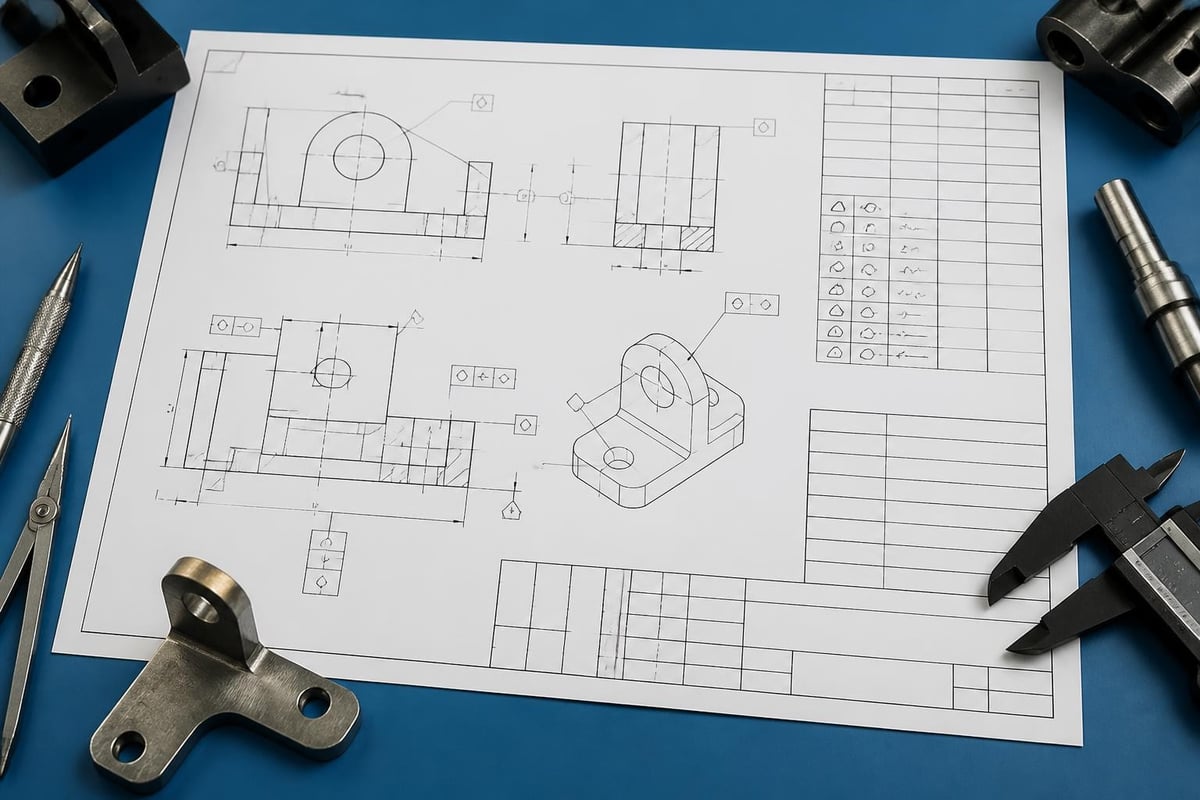
Drawings form the backbone of any fabrication RFQ. Incomplete or ambiguous drawings generate inconsistent quotes and lead to production delays when clarifications are needed.
Essential Drawing Views and Details
Provide orthographic projections (top, front, side) for all fabricated components, supplemented with isometric or 3D views for complex geometries. Include section views to show internal features, welded joints, and assembly relationships.
Each drawing should contain:
- Title block with part number, revision, date, and material specification
- Bill of materials listing all components in assemblies
- Weld symbols showing joint type, size, length, and inspection requirements
- Finish callouts specifying surface treatments, coatings, or painting
- Inspection notes identifying critical dimensions and required certifications
The AWS technical article on welding symbols provides essential guidance for correctly applying welding symbols to ensure fabricators understand your exact requirements without interpretation errors.
Digital File Formats and Revision Control
Modern fabrication shops work with both paper drawings and digital files. Specify which formats you will provide:
- PDF for universal viewing and printing
- DWG/DXF for CAD import and programming
- STEP/IGES for 3D modeling and CAM programming
- Native CAD files (SolidWorks, Inventor, etc.) if applicable
Implement clear revision control by dating all drawings and noting changes in revision blocks. The ASME Y14 standards establish best practices for engineering drawing preparation, revision tracking, and digital data exchange that professional fabricators expect.
Specifying Welding and Fabrication Processes
Process specifications directly impact quality, cost, and schedule. When considering how to write a fabrication rfq, clearly define required welding processes, joint preparations, and acceptance criteria.
Welding Process and Procedure Requirements
Identify acceptable welding processes based on your application requirements. Common processes include:
- SMAW (Shielded Metal Arc Welding) for field work and heavy sections
- GMAW (Gas Metal Arc Welding) for production efficiency
- GTAW (Gas Tungsten Arc Welding) for critical applications and thin materials
- FCAW (Flux-Cored Arc Welding) for high deposition rates
Reference applicable codes and standards from the AWS standards hub to establish minimum requirements for welder qualifications, welding procedure specifications (WPS), and procedure qualification records (PQR).
Quality Standards and Inspection Criteria
Define acceptance criteria using recognized standards rather than subjective terms. Specify visual inspection requirements, non-destructive testing (NDT) methods, and acceptance limits.
| Inspection Method | Application | Typical Standard |
|---|---|---|
| Visual Inspection | All welds, surface finish, dimensional check | AWS D1.1, ASME Section IX |
| Radiographic Testing (RT) | Critical structural welds, pressure vessels | ASME Section V, AWS D1.1 |
| Ultrasonic Testing (UT) | Thick sections, pipe welds | ASME Section V |
| Magnetic Particle Testing (MT) | Ferrous materials, surface cracks | ASTM E1444 |
| Liquid Penetrant Testing (PT) | Non-ferrous materials, surface defects | ASTM E1417 |
Clarify who performs inspections (fabricator, third-party, owner's inspector) and who pays for testing. These details prevent disputes and quote discrepancies.
Establishing Delivery Requirements and Logistics
Schedule and logistics requirements significantly impact fabrication planning and pricing. Clearly communicate your timeline expectations and delivery constraints.
Lead Time and Milestone Requirements
Specify your required delivery date or range, but also ask vendors to provide their standard lead time for comparison. Rush work carries premium pricing, so understanding typical production cycles helps you plan realistically.
Break complex projects into milestones:
- Engineering review and submittal approval
- Material procurement and certification delivery
- First article inspection (FAI) for production runs
- Partial shipments for phased installation
- Final delivery and documentation
This phased approach allows early detection of problems and maintains project momentum even if production extends longer than anticipated.
Packaging, Shipping, and Delivery Terms
Define who arranges transportation and bears shipping costs using standard Incoterms (FOB Origin, FOB Destination, etc.). Specify any special packaging requirements for delicate finishes, precision machining, or long-distance transport.
Include delivery location details with dock hours, equipment availability (forklift, crane), and any site access restrictions. Projects in remote locations or facilities with limited access may require special shipping arrangements that affect pricing.
Formatting Vendor Submission Requirements
Standardized submission formats make quote comparison straightforward. When learning how to write a fabrication rfq, establishing clear submission instructions saves time and prevents confusion.
Pricing Tables and Cost Breakdown
Provide a pricing template that all vendors must complete. This structure enables apples-to-apples comparison across multiple bidders.
Request line-item pricing for:
- Material costs with itemized quantities and specifications
- Labor hours by process type (welding, machining, assembly)
- Outsourced services (heat treating, plating, industrial powder coating, industrial sandblasting)
- Tooling or fixturing if amortized over production quantity
- Inspection and testing including certifications and documentation
- Packaging and freight separated from fabrication costs
The Smartsheet construction RFQ format template provides a practical pricing table structure adaptable for fabrication work.
Required Vendor Information and Qualifications
Ask vendors to provide capability documentation that demonstrates their qualification for your specific work:
- Company overview including years in business and facility location
- Equipment list showing relevant machinery (presses, mills, lathes, welding equipment)
- Quality certifications (ISO 9001, AWS certification, ASME stamps)
- Relevant project examples with similar complexity or industry requirements
- Insurance certificates showing liability and workers' compensation coverage
This information supports your evaluation process and verifies that bidders can actually execute the work as specified. The NIST Manufacturing Extension Partnership guidance offers insights on supplier vetting and qualification criteria for manufacturing RFQs.

Setting Evaluation Criteria and Award Process
Transparent evaluation criteria demonstrate fairness and help vendors understand what factors influence your decision beyond price alone.
Weighted Scoring Matrix
Establish a scoring system that reflects your priorities. Price matters, but quality, schedule reliability, and technical capability also influence project success.
Sample evaluation weights:
- Price competitiveness (40%)
- Technical capability and equipment (25%)
- Quality systems and certifications (15%)
- Schedule and delivery commitment (10%)
- References and past performance (10%)
Adjust these percentages based on your specific project. Critical applications in oil & gas may weight quality higher, while simple commodity fabrication emphasizes price.
Timeline for Quote Submission and Award
Provide a clear schedule that allows vendors adequate time to prepare thorough quotes:
- RFQ release date when document becomes available
- Pre-bid meeting (optional) for site visits or clarifications
- Question deadline allowing written inquiries
- Addendum release publishing answers and clarifications
- Quote submission deadline with specific time and delivery method
- Award notification indicating when you will announce the selection
Allow at least two weeks for complex fabrication work, longer for projects requiring extensive material research or engineering analysis. The GSA Multiple Award Schedule ordering guide provides useful timeline frameworks applicable to commercial fabrication procurement.
Including Terms, Conditions, and Legal Requirements
Professional RFQs address contractual, payment, and liability matters upfront to prevent disputes after award.
Payment Terms and Invoicing Requirements
Clearly state your standard payment terms (Net 30, Net 60, etc.) and any deposit or progress payment structure for large projects. Specify required invoice documentation:
- Itemized labor and material costs matching quote breakdown
- Certified material test reports for specified materials
- Inspection reports and certifications
- Proof of delivery (signed bill of lading, delivery receipt)
For projects involving surface preparation and finishing work, coordinate payment milestones with completion of specific phases like sandblasting, coating, and final inspection.
Warranty, Liability, and Indemnification
Define warranty expectations for fabricated items, typically covering:
- Workmanship defects for a specified period (commonly 1 year)
- Material defects covered by mill warranties or certifications
- Exclusions for normal wear, misuse, or modifications by others
Address liability and indemnification according to your organization's risk management policies and legal counsel guidance. These provisions protect both parties and establish clear responsibility for different types of failures or damages.
Optimizing RFQ Communication and Clarification Process
Even well-written RFQs generate questions. Establishing a structured communication process maintains fairness and creates a documented record.
Managing Vendor Questions and Addenda
Designate a single point of contact and require all questions in writing by email. This prevents informal communications that could give some bidders information advantages.
Compile all questions and publish answers as numbered addenda that all bidders receive simultaneously. Track each addendum and require vendors to acknowledge receipt and incorporation into their quotes.
Document changes carefully:
- Addendum number and issue date
- Question exactly as submitted (may be anonymized)
- Answer with any specification changes or clarifications
- Drawing revisions if technical changes are required
This process maintains procurement integrity and provides clear documentation if disputes arise later.
Pre-Bid Meetings and Site Visits
For complex projects or work in existing facilities, consider hosting a pre-bid meeting. This gathering allows vendors to:
- Ask questions in real-time with immediate clarification
- Inspect existing conditions that affect fabrication requirements
- Understand site access, delivery constraints, and installation conditions
- Meet key project personnel and understand organizational expectations
Document all discussions and publish minutes as an addendum to ensure non-attending bidders receive the same information.
Common RFQ Mistakes and How to Avoid Them
Understanding typical pitfalls helps you write more effective fabrication RFQs that generate accurate, comparable responses.
Insufficient Technical Detail
Vague specifications like "weld as needed" or "machine to fit" force vendors to make assumptions that rarely align with your actual expectations. Every assumption introduces price variation and quality risk.
Provide complete information:
- Specific weld sizes, lengths, and inspection requirements
- Exact tolerance requirements for machined features
- Surface finish specifications with numerical Ra values
- Assembly sequence and fit-up requirements
When information is truly unknown or flexible, explicitly state "contractor's choice" or "engineer to approve" so vendors know to include engineering time or request clarification.
Unrealistic Timeline Expectations
Fabrication work involves material lead times, process sequences, inspection holds, and finishing cycles that cannot be compressed arbitrarily. Requesting quotes with insufficient response time generates rushed, incomplete bids.
Allow realistic periods:
- Simple parts, small quantities: 1-2 weeks quote preparation
- Complex assemblies, moderate quantities: 2-3 weeks quote preparation
- Engineered solutions, large production: 3-4 weeks quote preparation
Similarly, understand typical fabrication lead times for your industry. Custom steel fabrication commonly requires 6-12 weeks from order to delivery, depending on material availability and shop capacity.
Incomplete Evaluation Criteria
When learning how to write a fabrication rfq, many overlook the importance of clearly stated evaluation criteria. Vendors who understand your priorities can highlight relevant strengths in their proposals.
Ambiguous statements like "best value" or "most qualified" leave vendors guessing. Instead, specify whether you prioritize price, schedule acceleration, local presence, specific certifications, or specialized equipment capabilities.
Leveraging Templates and Standard Formats
Starting from established templates accelerates RFQ development and ensures you include all necessary components.
Adapting Industry-Standard Templates
Review templates from procurement organizations, industry associations, and successful past projects. Customize these frameworks rather than creating documents from scratch.
Key template sections to adapt:
- Cover sheet with project identification and key dates
- Instructions to bidders explaining submission format and requirements
- Scope of work describing technical requirements
- Specifications detailing materials, processes, and quality standards
- Drawing list indexing all included technical documents
- Pricing form with standardized cost breakdown structure
- Vendor qualification form requesting capability information
Maintain consistency across all your RFQs by using the same template structure, updating only project-specific technical details.
Electronic RFQ Management Systems
Consider digital platforms that streamline RFQ distribution, question tracking, and quote comparison. These systems provide:
- Automated distribution to qualified vendor lists
- Built-in question and answer tracking with audit trails
- Side-by-side quote comparison tools
- Secure bid submission with time-stamp verification
- Document version control preventing outdated information
Even simple tools like shared spreadsheets or project management platforms improve organization compared to email-based processes.
Industry-Specific Considerations for Western U.S. Markets
Projects in oil & gas, aggregate, recycling, and related industries throughout the Western United States face unique requirements that should inform how to write a fabrication rfq.
Environmental and Safety Requirements
Many facilities in extractive and processing industries maintain strict safety protocols and environmental compliance standards. Specify any required certifications for work in these environments:
- OSHA 10/30 certification for personnel working on site
- H2S safety training for oil & gas facility work
- Confined space entry certification for tank or vessel fabrication
- Environmental compliance for waste handling and disposal
Include safety requirements in your RFQ to ensure vendors price appropriate training, equipment, and procedures.
Remote Location and Field Service Capabilities
Projects in rural areas of Colorado, Wyoming, Utah, and surrounding states may require field fabrication, on-site welding, or installation support. Clarify whether vendors must provide:
- Mobile welding and machining equipment
- Per diem and travel costs for technicians
- Temporary housing or accommodations
- Emergency repair response capabilities
Vendors with field service experience can better estimate these costs and mobilization requirements.
Writing a comprehensive fabrication RFQ transforms procurement from guesswork into a structured process that generates accurate, comparable quotes from qualified vendors. By including complete technical specifications, clear evaluation criteria, realistic timelines, and standardized submission requirements, you enable fabrication shops to provide detailed pricing while demonstrating their capabilities. Whether you need custom steel assemblies, precision machining, or complex welding for oil & gas, aggregate, or recycling operations throughout the Western United States, LTJ Industrial Services brings the expertise, equipment, and quality systems to deliver reliable results on schedule.