The AWS D1.1 structural welding code is the American Welding Society standard that sets requirements for welding carbon and low-alloy structural steel, covering design of welded connections, procedure qualification, welder qualification, fabrication, inspection and repair. If your shop builds or repairs steel frames, equipment skids, platforms, conveyors or support structures, this code is usually the governing document, and your contract will likely name a specific edition. This guide walks through what the code covers, how its main requirements work, what changed in the 2025 edition, and how to choose a fabrication partner who can document compliance.
What Is the Code for Structural Welding?
The primary code for structural steel welding in the United States is AWS D1.1/D1.1M, published by the American Welding Society. According to the AWS D1 Committee on Structural Welding, the code covers welded structures made from commonly used carbon and low-alloy constructional steels, and Clauses 1 through 11 provide the rules for welding in steel construction.
The document is more than a set of weld symbols and acceptance limits. The committee notes that it also includes eight normative annexes, eleven informative annexes and a commentary. Normative annexes are mandatory when the code is invoked. Informative annexes and the commentary explain intent and offer guidance, but they do not carry the same contractual weight.
For operations and maintenance managers, the practical meaning is simple. When a drawing, purchase order or specification says "welded per AWS D1.1," every weld on that scope must follow the code's rules for procedures, personnel, materials, workmanship and inspection. A fabricator who cannot show those records has not met the requirement, even if the welds look sound.
What Does the AWS D1.1 Structural Welding Code Cover?
The AWS D1.1 structural welding code covers general requirements, design of welded connections, prequalification, qualification, fabrication, inspection, stud welding and the strengthening or repair of existing structures. Each of these areas is addressed in its own clause, so a project team can locate the rules for a given activity quickly.
The major topics break down as follows:
- General provisions and scope: definitions, limitations and the base metals the code addresses.
- Design of welded connections: requirements for statically loaded and cyclically loaded structures, including tubular connections.
- Prequalified procedures: joint details, processes and filler metals that may be used without further procedure testing.
- Qualification: the testing needed for procedures and for welders, welding operators and tack welders.
- Fabrication: preparation of base metal, assembly, preheat, control of distortion and workmanship.
- Inspection: inspector qualifications, visual examination and nondestructive testing acceptance criteria.
- Stud welding: requirements for headed studs and deformed bar anchors.
- Existing structures: evaluation, repair and modification of steel already in service.
The code is written for structural applications. It is not intended to govern pressure vessels, process piping or pipelines, which fall under other documents. This comparison of AWS D1.1 and API 1104 explains where each applies, which matters for oil and gas customers who work with both structural and pipeline scopes.
What Is a Welding Procedure Specification and Why Does D1.1 Require One?
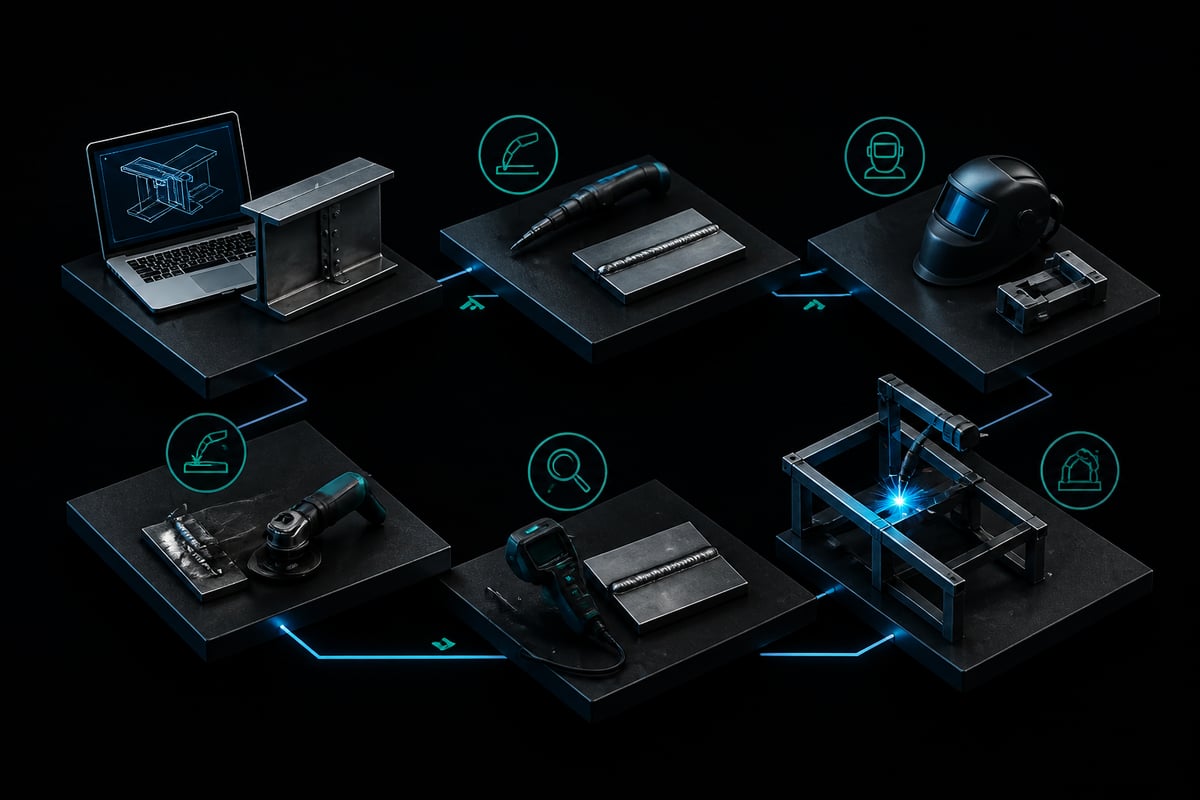
A welding procedure specification, or WPS, is a written document that tells welders exactly how to make a particular weld, and D1.1 requires one for all code welding so that results are repeatable and verifiable. It lists the process, base metal, filler metal, joint design, position, preheat, interpass temperature, electrical parameters, travel speed and technique.
The WPS is supported by a procedure qualification record, or PQR, when the procedure is not prequalified. The PQR is the record of the actual test weld, including the parameters used and the mechanical test results. Together they show that the written procedure produces a sound weld in the specified material.
For a deeper look at the terminology, LTJ Industrial Services publishes plain-language explainers on what a WPS means in welding and the formal welding procedure specification definition.
Prequalified Versus Qualified Procedures
Prequalified procedures are WPSs whose joint details, processes, filler metals and parameters fall within limits the code already accepts, so no procedure testing is required. The fabricator still must write the WPS, follow it and keep it available. Anything outside those limits needs a qualification test with a PQR.
Prequalification saves time on common work such as fillet welds and standard groove joints in A36 or A572 plate. Qualification becomes necessary when you use a nonstandard joint, an unlisted material combination, or process variables beyond the prequalified ranges. Fabricators who plan ahead can qualify procedures for the materials they weld most often, which shortens startup on repeat work.
How Are Welders Qualified Under D1.1?
Welders qualify under D1.1 by welding test plates in a specific process, position and thickness range, then passing visual inspection and bend tests or radiographic examination as the code prescribes. Passing the test qualifies the welder for the conditions tested and for a defined range of related conditions.
Several points govern how that qualification is managed:
- Process-specific: a welder qualified in shielded metal arc welding is not automatically qualified in flux-cored arc welding.
- Position-specific: a test in the flat position does not qualify a welder for vertical or overhead production welds.
- Thickness and diameter limits: a plate test covers a defined range of production thicknesses.
- Continuity: qualification generally remains valid while the welder keeps working in the process, but records of continued use must be kept.
- Employer responsibility: the fabricator must hold the records, and the welder's credentials should be traceable to the shop that performs the work.
A common error on industrial projects is assuming a welder certification card from a prior employer transfers freely. Under D1.1 the contractor is responsible for qualification records, so a shop should verify or retest before assigning code work. AWS offers a D1.1 endorsement for professionals who want to demonstrate working knowledge of the code.
What Does Inspection Look Like on a D1.1 Project?
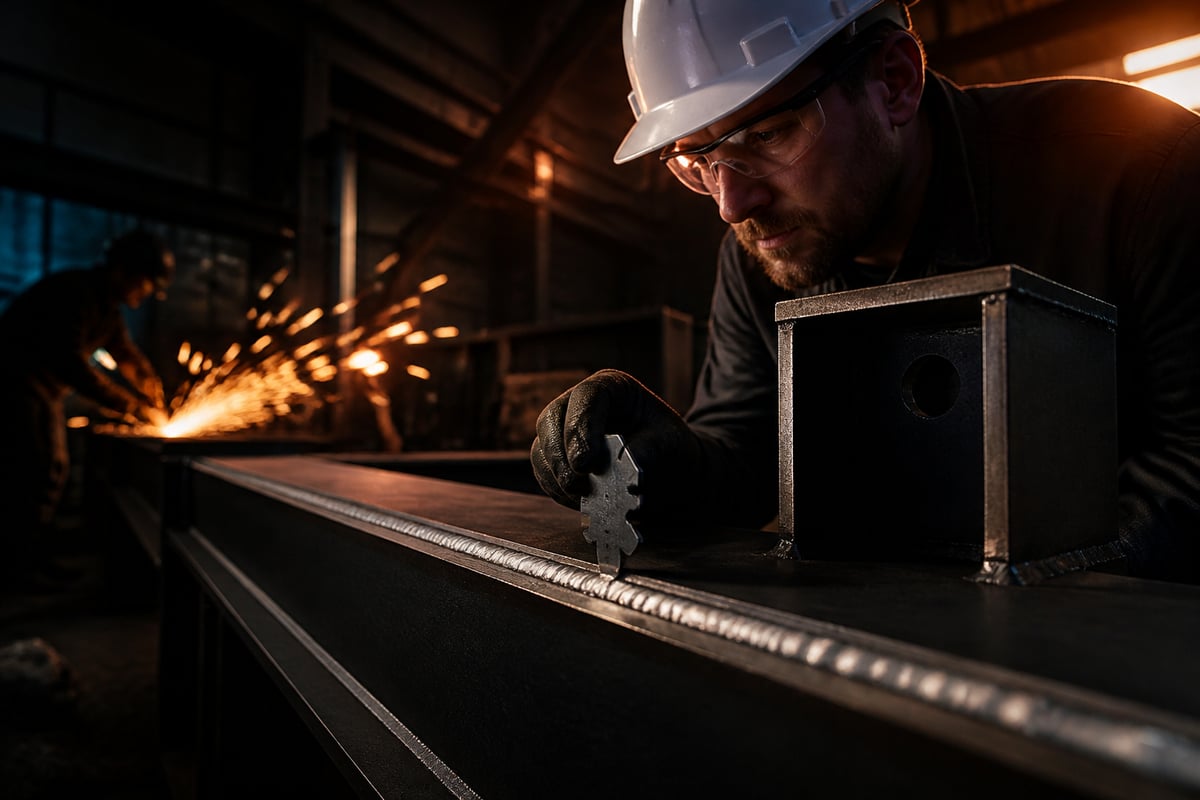
Inspection under D1.1 combines fabricator quality control with verification by an owner's representative, and it relies on visual examination plus nondestructive testing where the contract requires it. Visual inspection is the baseline: the code sets acceptance criteria for cracks, fusion, undercut, porosity, weld profile and size.
Nondestructive testing methods commonly specified include:
- Magnetic particle testing for surface and near-surface discontinuities in ferromagnetic steel.
- Dye penetrant testing for surface-breaking flaws.
- Ultrasonic testing for internal discontinuities in groove welds.
- Radiographic testing for internal soundness when a project calls for it.
The code distinguishes between statically loaded and cyclically loaded structures, and acceptance limits tighten for cyclic service because fatigue makes small discontinuities more consequential. Crane supports, vibrating screens, crusher frames and similar equipment structures deserve attention here, since repeated loading is part of their normal duty.
What Changed in the 2025 Edition of AWS D1.1?
The 2025 edition, D1.1/D1.1M:2025, was announced by AWS on April 17, 2025 and is the current version. AWS describes the broad areas of change from the prior edition on its D1.1 code page.
Changes that fabricators should review include:
- Terminology alignment: language is more consistent across clauses, which reduces ambiguity in how requirements are read.
- WPS qualification updates: adjustments to how procedures are qualified and documented.
- Prequalified tables reorganized: tables were restructured, so familiar lookups may be in new locations.
- Fabrication and heat treatment revisions: updates to requirements that affect shop practice.
- Inspection and personnel qualification: refinements to who may inspect and how.
- Stud welding: stud welding requirements are part of the code's scope.
- New steel grade: AWS Welding Journal covers high-strength structural steels relevant to the code's updated scope.
Which edition governs a given job depends on the contract, not on the publication date. Many specifications reference an earlier edition, and the contract edition controls until it is formally changed. Confirm the edition in writing before procedures are written or qualified, because a WPS prepared to one edition may need revision for another.
How Do You Choose the Right Edition and Documentation Package?
Choose the edition named in your contract documents, then ask the fabricator for a documentation package that proves compliance with that edition. When the contract is silent, request clarification from the engineer of record rather than assuming the newest edition applies.
A complete package typically includes:
| Document | What it proves |
|---|---|
| WPS and supporting PQRs | The method is written, tested where required, and repeatable |
| Welder qualification records | Each welder is qualified for the process, position and thickness used |
| Material certifications | Base metal and filler metal meet the specification |
| Inspection and NDT reports | Welds meet the acceptance criteria |
| Calibration records | Welding equipment and instruments are within tolerance |
Request these before work starts, not after. Reviewing them early lets you catch a missing procedure or lapsed qualification while it is still a scheduling issue instead of a rework problem. Ongoing machine maintenance supports compliance too, since drifting amperage or voltage can push a weld outside the qualified range, and welding machine service keeps equipment dependable.
How Does D1.1 Apply to Oil and Gas, Mining, Recycling and Aggregate Work?
D1.1 applies wherever steel structures and structural equipment are welded, which includes pipe racks, equipment skids, platforms, conveyor frames, hoppers, chutes, crusher supports and structural repairs on heavy equipment. Industrial customers often work under more than one code at the same site, so knowing the boundary between them prevents mistakes.
A typical split looks like this:
- Structural steel and equipment frames: AWS D1.1.
- Pressure piping and boilers: ASME codes, covered in ASME code welding services for pressure piping.
- Cross-country pipelines: API 1104.
In aggregate and recycling operations, repairs frequently involve high-wear, cyclically loaded components, so documented procedures and sound inspection matter as much as the weld itself. In oil and gas, a single facility may need structural supports under D1.1 alongside piping under ASME, and a shop certified across several codes can handle both without handing work between vendors. LTJ Industrial Services outlines this kind of work on its oil and gas welding services page and its overview of welding for construction projects.
What Should You Look for in a D1.1 Fabrication Partner?
Look for a fabricator that can produce current procedures and welder records on request, supports both shop and field work, and communicates clearly about scope, edition and inspection. Certification is a starting point, and the quality of the paperwork behind it tells you how the shop runs.
LTJ Industrial Services offers certified welding for structural fabrication, equipment repair and custom metal projects, in the shop or on site. Fabrication, machining, hydraulics and finishing are handled in one place, which helps when a repair involves a welded structure and a machined component. Details on the company's approach to code work are on its AWS D1.1 page, and its certified welding service covers structural fabrication, equipment repair and custom metal projects.
When evaluating any shop, ask these questions:
- Which edition of D1.1 do your procedures reference?
- Can you provide WPS and PQR documents for my materials and joints?
- Are welder qualification records current and tied to your company?
- How do you handle inspection and nondestructive testing?
- Can you mobilize to the site if the repair cannot be moved?
FAQ
What is a D1.5 welding certification?
AWS D1.5 is the Bridge Welding Code, a separate standard from D1.1 that governs welding on highway bridges and similar structures. It has its own qualification and inspection rules, so a D1.1 certification does not satisfy a D1.5 requirement.
What does AWS D1.2 mean?
AWS D1.2 is the Structural Welding Code for Aluminum. It applies to welded aluminum structures, while D1.1 applies to carbon and low-alloy structural steel.
Does a project always have to use the newest edition of D1.1?
No. The edition named in the contract documents governs the work, even when a newer edition has been published. If the contract does not name an edition, ask the engineer of record to specify one before procedures are written.
Can one fabricator weld under both D1.1 and ASME requirements?
Yes, provided the shop holds the procedures and welder qualifications each code requires. Each code has its own qualification records, so confirm that both sets are current before assigning work.