Selecting the appropriate welding standard for your fabrication project is critical to ensuring structural integrity, regulatory compliance, and project success. The aws d11 vs api 1104 debate represents one of the most common dilemmas facing welding professionals, fabricators, and quality control personnel across industries ranging from structural steel construction to pipeline infrastructure. While both standards govern welding procedures and welder qualification, they serve distinctly different applications and impose varying requirements on inspection, acceptance criteria, and documentation. Understanding these differences enables fabrication shops and field welding crews to apply the correct standard, avoid costly rework, and meet client specifications with confidence.
Fundamental Scope Differences Between AWS D1.1 and API 1104
The primary distinction in the aws d11 vs api 1104 comparison lies in their intended applications. AWS D1.1 (Structural Welding Code – Steel) governs welding of structural steel members used in buildings, bridges, towers, and general fabrication where static and dynamic loads must be supported. This standard addresses a broad range of joint configurations, base materials, and welding processes commonly encountered in structural applications.
Conversely, API 1104 (Welding of Pipelines and Related Facilities) specifically addresses welding requirements for carbon and low-alloy steel pipelines used in transportation of petroleum, natural gas, and other fluid products. The standard focuses on circumferential and longitudinal welds in pipe, branch connections, and related appurtenances where pressure containment and leak integrity are paramount.
Application Contexts and Industry Use
Manufacturing and fabrication facilities typically rely on AWS D1.1 when producing:
- Structural steel frames and supports
- Equipment skids and platforms
- Material handling systems
- Processing equipment structures
- General metal fabrication assemblies
Pipeline contractors and facilities working with pressurized piping systems apply API 1104 for:
- Cross-country transmission pipelines
- Distribution pipeline networks
- Gathering and flowline systems
- Pipeline repair and maintenance
- Station piping and manifolds
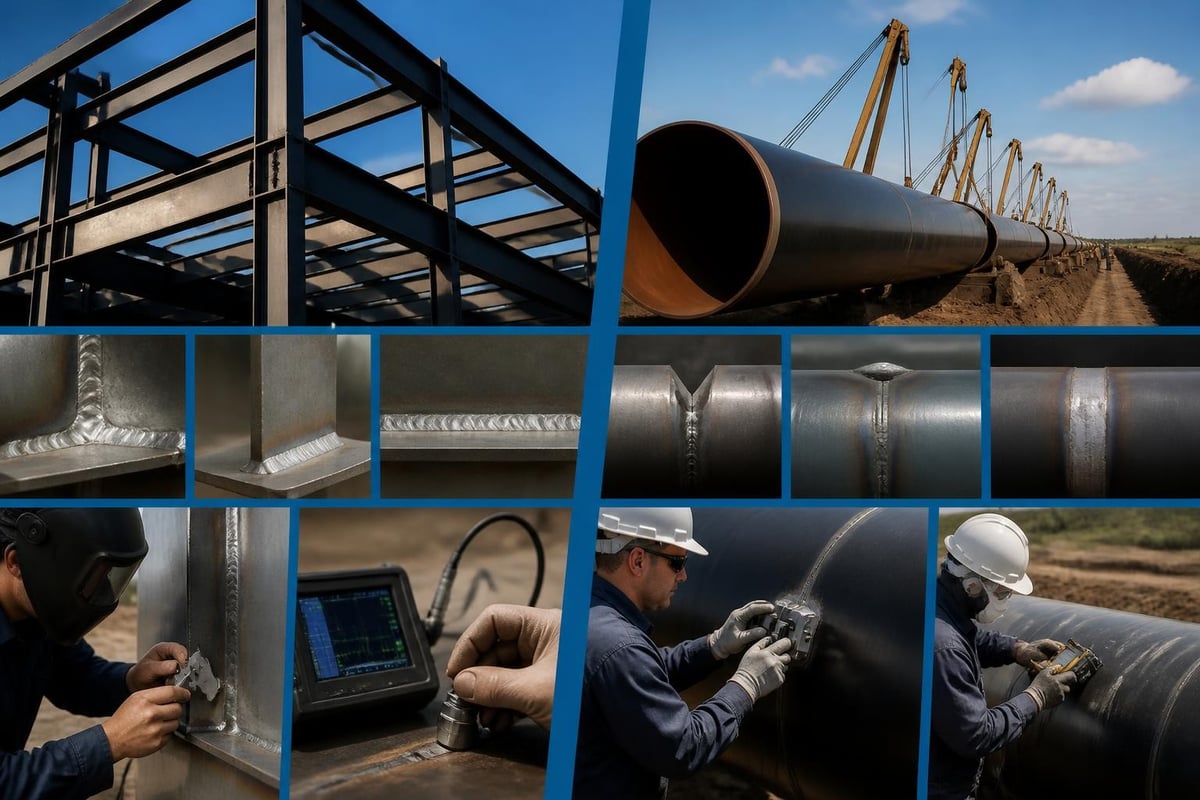
For companies like LTJ Industrial Services serving the oil and gas, aggregate, and manufacturing sectors throughout the Western United States, understanding when each standard applies ensures proper procedure development and welder qualification management.
Welding Procedure Specification Development
When evaluating aws d11 vs api 1104 requirements, procedure qualification represents a critical area of divergence. Both standards require Welding Procedure Specifications (WPS) supported by Procedure Qualification Records (PQR), but the essential variables, testing requirements, and documentation formats differ significantly.
AWS D1.1 employs a prequalified WPS approach for specific joint configurations, base material groups, and welding processes that meet prescribed parameters. This provision allows fabricators to implement certain procedures without conducting formal qualification testing, provided all prequalification requirements are satisfied. For non-prequalified procedures, AWS D1.1 requires PQR development through qualification testing that includes tensile, bend, and potentially impact or fracture toughness tests depending on application severity.
API 1104 does not offer prequalified procedures. Every WPS must be supported by a PQR developed through actual welding and mechanical testing. The API 1104 qualification process typically includes tensile testing, nick-break examination, and bend testing. Additional tests such as hardness surveys or impact testing may be required based on material specification, wall thickness, or purchaser requirements.
Essential Variables and Their Impact
| Essential Variable Category | AWS D1.1 Approach | API 1104 Approach |
|---|---|---|
| Base Material | P-number grouping system | API material grouping by specification |
| Filler Metal | F-number classification | Filler metal classification by AWS specification |
| Position Changes | Vertical up/down separate qualifications | Position qualified by test coupon orientation |
| Thickness Range | Qualified thickness based on test coupon | Different thickness qualification rules |
| Process Changes | Separate qualification required | Process change requires new qualification |
| Heat Input | Not typically an essential variable | May be specified by purchaser requirement |
The aws d11 vs api 1104 distinction becomes particularly important when welders transition between structural and pipeline work. A welder qualified under AWS D1.1 for structural fabrication cannot automatically perform pipeline welding under API 1104 without appropriate qualification testing specific to that standard.
Welder Qualification and Performance Testing
Both standards require welder qualification through performance testing, but the test configurations, acceptance criteria, and qualification ranges differ substantially. Understanding these variations is essential when managing welder certifications and project mobilization.
AWS D1.1 welder qualification typically uses plate or pipe test coupons depending on the production work to be performed. The test joint is welded, visually inspected, and then subjected to destructive testing through bend specimens or radiographic examination. Qualification ranges are established for:
- Base material thickness (limited or unlimited)
- Welding position (1G, 2G, 3G, 4G for groove; 1F, 2F, 3F, 4F for fillet)
- Welding process
- Filler metal diameter range
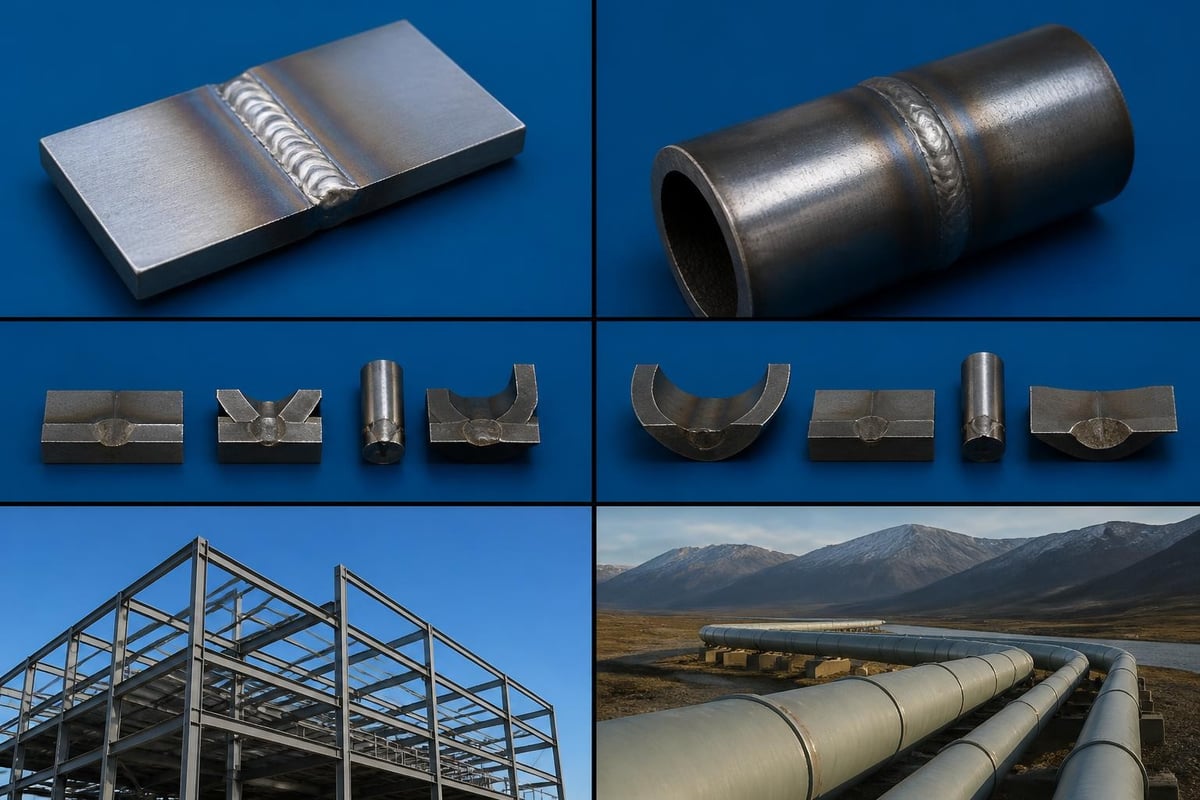
API 1104 welder qualification focuses primarily on pipe test coupons that replicate production conditions. The standard specifies test coupon diameters, wall thicknesses, and welding positions that must align with production parameters. Key qualification ranges include:
- Pipe diameter (limited by test coupon size)
- Wall thickness (qualified range based on test thickness)
- Welding position (5G, 6G, or specific position testing)
- Pipe-to-plate or pipe-to-pipe configurations
For custom welding services across multiple industries, maintaining welder qualifications under both standards may be necessary to serve diverse client needs effectively.
Inspection Methods and Acceptance Criteria
The aws d11 vs api 1104 comparison reveals significant differences in nondestructive examination (NDE) requirements and weld discontinuity acceptance limits. These variations directly impact quality control procedures, inspection frequency, and final acceptance decisions.
Visual Inspection Standards
Both codes require 100 percent visual inspection of completed welds, but the acceptance criteria differ:
AWS D1.1 Visual Acceptance:
- Undercut depth limited to 1/32 inch (0.8 mm) for certain applications
- Porosity size and distribution limits based on weld size
- Profile requirements for reinforcement and concavity
- Specific requirements for statically versus cyclically loaded structures
API 1104 Visual Acceptance:
- More stringent undercut limitations in certain positions
- Complete penetration required for pipe welds
- Burn-through, excessive penetration evaluated case by case
- Surface porosity and crater restrictions
Radiographic Testing Comparison
Radiographic acceptance criteria represent one of the most distinctive areas when comparing aws d11 vs api 1104 requirements. AWS D1.1 categorizes discontinuities into prohibited (cracks, incomplete fusion, incomplete penetration in certain applications) and acceptable-with-limits categories (porosity, slag inclusions within defined parameters).
API 1104 employs a workmanship-based acceptance approach where individual discontinuities are evaluated based on size, type, and distribution. The standard provides:
- Maximum individual porosity size limits
- Cluster porosity spacing and density restrictions
- Slag inclusion length and distribution limitations
- Specific criteria for incomplete penetration and incomplete fusion
| Discontinuity Type | AWS D1.1 Acceptance | API 1104 Acceptance |
|---|---|---|
| Porosity (scattered) | Limited by size and distribution | 1/3 wall thickness, limited spacing |
| Porosity (cluster) | Specific area percentage limits | Defined cluster size and number limits |
| Slag inclusions | Length and distribution limits | Maximum length 2 inches, limited number |
| Incomplete fusion | Prohibited for most applications | Prohibited |
| Incomplete penetration | Prohibited for complete penetration welds | Prohibited for pipeline welds |
| Cracks | Always prohibited | Always prohibited |
Heat Input and Interpass Temperature Control
Material performance and weld metal properties can be significantly influenced by thermal conditions during welding. The aws d11 vs api 1104 standards address heat input and temperature control differently, reflecting their distinct application priorities.
AWS D1.1 specifies maximum interpass temperatures for certain base materials, particularly higher-strength steels and materials requiring impact toughness. The standard provides guidance on:
- Preheat requirements based on material thickness and carbon equivalent
- Maximum interpass temperature limits to control heat-affected zone properties
- Cooling rate considerations for specific material grades
These requirements help prevent cracking, control microstructure, and ensure mechanical properties meet design requirements for structural applications.
API 1104 approaches thermal control with greater flexibility, typically deferring specific preheat and interpass temperature requirements to the purchaser specification or engineering design. However, the standard acknowledges that excessive heat input can affect:
- Weld metal and HAZ toughness
- Hydrogen-induced cracking susceptibility
- Mechanical property degradation
- Distortion and alignment control
For precision machining services and fabrication operations where dimensional accuracy is critical, understanding heat input effects on distortion becomes particularly important regardless of which standard governs the welding.
Documentation and Quality System Requirements
Professional welding operations require comprehensive documentation systems to demonstrate compliance, facilitate traceability, and support continuous improvement initiatives. The aws d11 vs api 1104 standards impose different documentation expectations that shape quality management systems.
AWS D1.1 documentation typically includes:
- WPS and supporting PQR for each procedure
- Welder qualification test records (WQTR)
- Visual inspection reports
- NDE reports (radiographic, ultrasonic, magnetic particle, liquid penetrant)
- Material certifications and traceability
- Weld maps or joint identification systems
The standard emphasizes inspector qualifications, requiring visual welding inspectors to be certified as Certified Welding Inspectors (CWI) or hold equivalent qualifications for certain applications.
API 1104 documentation requirements align with pipeline quality requirements:
- Procedure specifications and qualification records
- Welder performance qualification records
- Daily production weld logs
- Complete NDE documentation with disposition decisions
- Repair procedures and repair tracking
- Line-up and fit-up inspection records
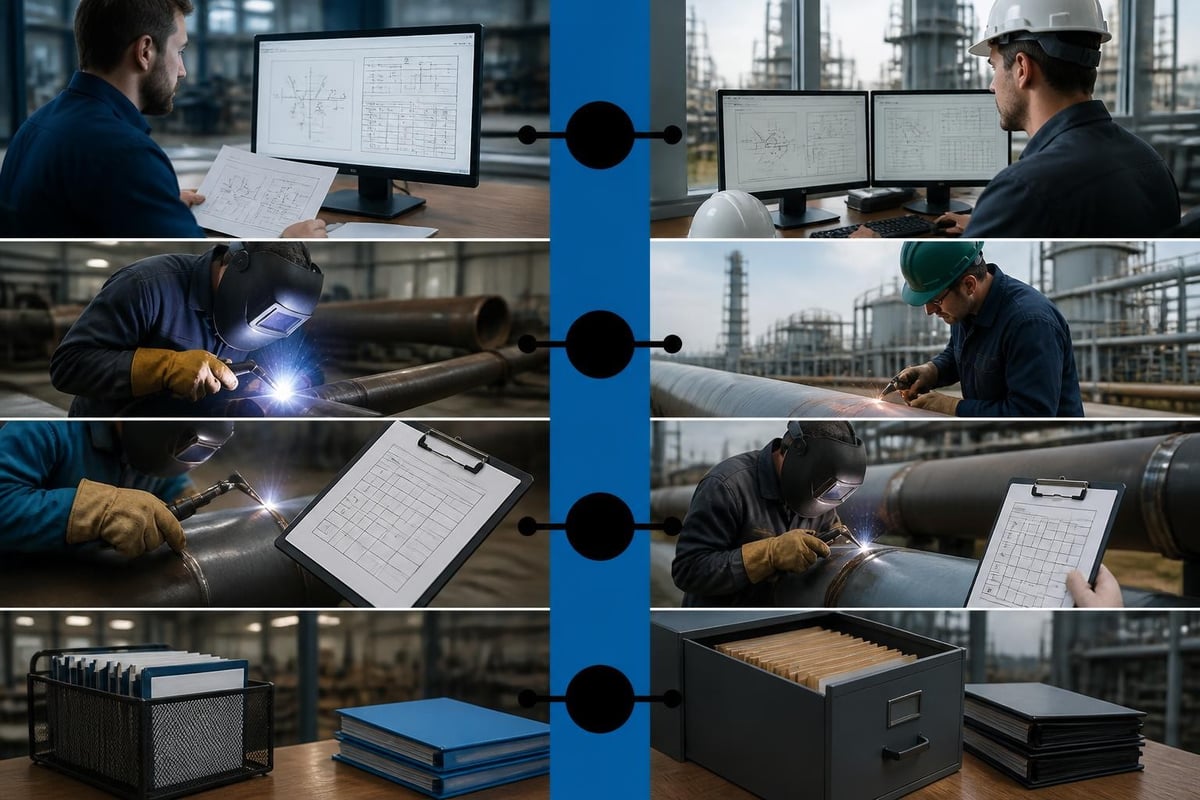
NDT programs supporting API 1104 pipeline projects typically require more extensive documentation traceability due to regulatory oversight from agencies such as PHMSA (Pipeline and Hazardous Materials Safety Administration) and the integration with pipeline integrity management programs.
Repair Procedures and Limitations
Weld repair represents a critical quality control consideration in both standards, but the aws d11 vs api 1104 comparison reveals different philosophies regarding repair authorization and limitations.
AWS D1.1 permits weld repairs following documented procedures, with specific requirements for:
- Defect removal by gouging, grinding, or machining
- Cavity preparation and cleaning
- Preheat application prior to repair welding
- Number of repair attempts (generally unlimited if proper procedures followed)
- Re-inspection after repair using same acceptance criteria
The standard emphasizes that repair procedures must be qualified if they involve parameters outside the original WPS qualification range.
API 1104 takes a more restrictive approach to pipeline weld repairs:
- Repair procedures must be established before production welding
- Maximum number of repairs may be limited by purchaser
- Complete removal and re-welding may be required for certain defects
- Heat input during repair must be controlled
- Additional NDE may be required after repair
For field welding operations where repair logistics affect project schedules and costs, understanding these repair protocol differences is essential to resource planning and quality budget development.
Hybrid Applications and Standard Selection
Modern industrial projects occasionally involve structures or systems where both structural and pressure boundary considerations exist. The aws d11 vs api 1104 decision in these situations requires careful engineering analysis and clear contract specifications.
Common hybrid scenarios include:
- Pipe supports and structural attachments to pipelines
- Process equipment with structural frames and pressure vessels
- Modular facilities combining structural skids with piping systems
- Retrofit projects adding piping to existing structural platforms
Decision Framework for Standard Selection
When multiple standards could potentially apply, selection criteria should include:
Primary Function Analysis:
- Is the weld primarily load-bearing (structural) or pressure-containing (pipeline)?
- What failure mode presents greater safety or operational risk?
- Which regulatory agencies have jurisdiction?
Contract and Specification Review:
- What does the engineering specification require?
- Are client preferences or industry practices established?
- What inspection and testing resources are available?
Qualification and Resource Availability:
- Which welders are qualified under which standards?
- What inspection capabilities and certifications exist?
- How do schedule and cost constraints influence the decision?
For diversified industrial service providers offering both structural fabrication and pipeline-related welding, maintaining capabilities under both standards provides maximum flexibility to serve client needs across project types.
Cross-Qualification Considerations
Welding professionals frequently ask whether qualification under one standard provides any recognition under the other. The aws d11 vs api 1104 standards operate independently, and qualifications are not automatically transferable.
However, practical considerations exist:
Skill Transfer:
A welder proficient in structural welding positions often adapts quickly to pipeline welding techniques, though formal qualification testing remains required. The fundamental hand-eye coordination, heat control, and technique development transfer across applications.
Procedure Development Efficiency:
Engineers experienced in developing WPS under either standard can apply metallurgical knowledge and welding engineering principles to the other standard, though specific formatting, essential variables, and testing protocols must be learned.
Inspector Cross-Training:
Welding inspectors certified under AWS programs (CWI) possess foundational knowledge applicable to both standards, though API 1104-specific training enhances pipeline inspection effectiveness.
Professional welding services maintaining dual-standard capabilities invest in ongoing training, separate qualification programs, and quality system infrastructure to support both structural and pipeline project requirements effectively.
Comparison with Other Welding Codes
While this article focuses on aws d11 vs api 1104, the broader welding standards landscape includes additional codes that may apply to specific applications. Understanding how these standards relate provides context for industrial fabrication decision-making.
ASME Section IX (Welding and Brazing Qualifications) represents a third major qualification system, primarily used for pressure vessels, boilers, and power piping. Key distinctions include:
- ASME qualifications are typically broader in scope than AWS or API
- Base material P-numbers and F-numbers differ from AWS groupings
- Essential variables and qualification ranges follow different logic
- Often specified for pressure equipment in petrochemical and power generation
Other specialized standards include:
- AWS D1.5 for bridge welding (specific toughness requirements)
- AWS D1.6 for stainless steel structural welding
- AWS D15.1 for railroad welding applications
- ISO standards for international projects
Industrial service providers supporting diverse manufacturing sectors may encounter multiple standards across their project portfolio, requiring flexible quality systems and multi-standard welder qualifications.
Technology Integration and Modern Welding
Contemporary fabrication operations increasingly integrate digital technologies with traditional welding standards compliance. The aws d11 vs api 1104 comparison extends into how modern tools support each standard's requirements.
Digital welding management systems now provide:
- Electronic WPS libraries with code-compliant formatting
- Welder qualification database management
- Production weld tracking and traceability
- Automated inspection report generation
- Non-conformance and corrective action workflows
These systems can be configured for either AWS D1.1 or API 1104 requirements, with appropriate templates, essential variable tracking, and acceptance criteria embedded in the software.
Advanced welding processes also intersect with code requirements:
Mechanized and Automated Welding:
Both standards address mechanized processes, but with different qualification approaches. AWS D1.1 includes specific provisions for submerged arc welding (SAW) and other automated processes common in structural fabrication. API 1104 Appendix A provides alternative qualification requirements for automatic welding systems frequently used in pipeline construction.
Advanced Filler Metals:
New consumable developments including metal-cored wires, advanced flux systems, and specialty electrodes require evaluation under each standard's classification system and may necessitate specific procedure qualification testing to verify properties.
For companies providing comprehensive fabrication and machining services across Western states, staying current with both code requirements and welding technology advancements ensures competitive capabilities and quality outcomes.
Cost and Schedule Implications
Project economics represent a practical consideration in the aws d11 vs api 1104 comparison. The different qualification requirements, inspection intensities, and documentation expectations directly impact project budgets and timelines.
Qualification Cost Factors:
| Cost Element | AWS D1.1 Impact | API 1104 Impact |
|---|---|---|
| Procedure qualification | Prequalified options reduce testing | All procedures require PQR testing |
| Welder qualification | Multiple positions may require separate tests | Pipe testing typically more expensive |
| Consumable testing | Standard mechanical tests | Similar mechanical test requirements |
| Re-qualification frequency | Typically six-month continuity requirement | Six-month or quarterly continuity |
Production Inspection Costs:
Inspection intensity varies by project specification, but general patterns emerge:
- AWS D1.1 projects may specify visual-only for certain joint categories
- API 1104 pipeline projects typically require 100% radiography or advanced NDE
- Repair rates influence overall inspection costs through re-examination requirements
- Inspector certification and experience levels affect labor rates
Schedule Considerations:
Timeline impacts include:
- Mobilization time for qualified welders varies by labor market and qualification inventory
- NDE inspection rates (linear feet per day for radiography) affect production pace
- Repair cycles add schedule contingency requirements
- Documentation review and approval processes vary by client and regulatory oversight
Accurate cost estimating for projects governed by either standard requires detailed understanding of specific contract requirements, inspection specifications, and quality acceptance criteria beyond the base code minimums.
Choosing between AWS D1.1 and API 1104 depends entirely on your application, regulatory requirements, and project specifications, with each standard offering rigorous quality frameworks suited to their respective domains. Whether your operation requires structural fabrication compliance or pipeline welding certification, understanding these distinctions ensures proper procedure development, welder qualification, and inspection protocols. LTJ Industrial Services maintains certified welding capabilities supporting both structural and specialized welding applications throughout the Western United States, delivering code-compliant fabrication, field welding, and quality documentation to help your projects succeed.