AWS D1.1/D1.1M is the American Welding Society's Structural Welding Code for steel, and it sets the minimum requirements for designing, welding, qualifying and inspecting welded steel structures. The "D1.1" version uses U.S. customary units and "D1.1M" is the metric edition. If you manage maintenance or fabrication for an oil and gas, mining, aggregate or recycling operation, this code usually decides whether a welded repair or new structure is accepted or rejected. Understanding aws d1 1 d1 1m before you issue a work order helps you write better scopes, ask better questions of your welding partner and avoid rework.
What Is the AWS D1.1/D1.1M Structural Welding Code?
AWS D1.1/D1.1M is a consensus standard that governs welding of carbon and low-alloy structural steel, and it is written and maintained by the AWS D1 Committee on Structural Welding. According to the AWS D1 Committee, the code covers welding requirements for structures made from commonly used carbon and low-alloy constructional steels, with Clauses 1 through 11 regulating welding in steel construction.
The same committee page notes that the 2025 code contains eight normative annexes and eleven informative annexes, and includes a commentary. Normative annexes are mandatory when the code is invoked. Informative annexes and the commentary explain intent and offer guidance, but they do not carry contractual weight on their own.
The code is not a design standard for every welded product. It applies to structures such as frames, platforms, supports, walkways, equipment bases and similar load-carrying assemblies. Pressure vessels, boilers and pipelines fall under other standards, which is why a capable shop holds several certifications rather than one.
Why the D1.1 and D1.1M Designations Both Exist
The two designations exist because the same technical content is published in two unit systems. D1.1 presents dimensions, strengths and temperatures in inch-pound units. D1.1M presents the same requirements in SI units.
In practice, most North American industrial work references the customary-unit version. The "M" matters when a project, an owner specification or an international partner requires metric documentation. Confirm which edition year and unit system your contract cites, because the edition year controls which rules apply to your procedures and inspections.
How Is the Code Organized?
The code is organized into numbered clauses that follow a job from general requirements through design, procedure qualification, fabrication, inspection and special applications. Knowing where each topic lives saves time when a question arises on the shop floor or in a purchase order review.
| Clause area | What it addresses |
|---|---|
| General requirements | Scope, definitions, base metals, responsibilities of the engineer and contractor |
| Design of welded connections | Allowable stresses, joint geometry and detailing for statically and cyclically loaded structures |
| Prequalification | Joint designs, processes and materials that may be used without further testing |
| Qualification | Welding procedure specification and welder performance testing |
| Fabrication | Preparation, assembly, preheat, workmanship and repair of welds |
| Inspection | Qualifications of inspectors, acceptance criteria and nondestructive testing |
| Stud welding | Requirements for welded shear connectors and fasteners |
| Specific structure types | Provisions for tubular connections and existing structures |
The exact clause numbers and their titles vary in detail by edition, so always check the edition your project cites. For a reader who just wants orientation, this is the logic: design rules say what the weld must carry, qualification proves the process can produce it, fabrication rules govern how it is made, and inspection confirms the result.
What Does a Shop Need to Comply With AWS D1.1?
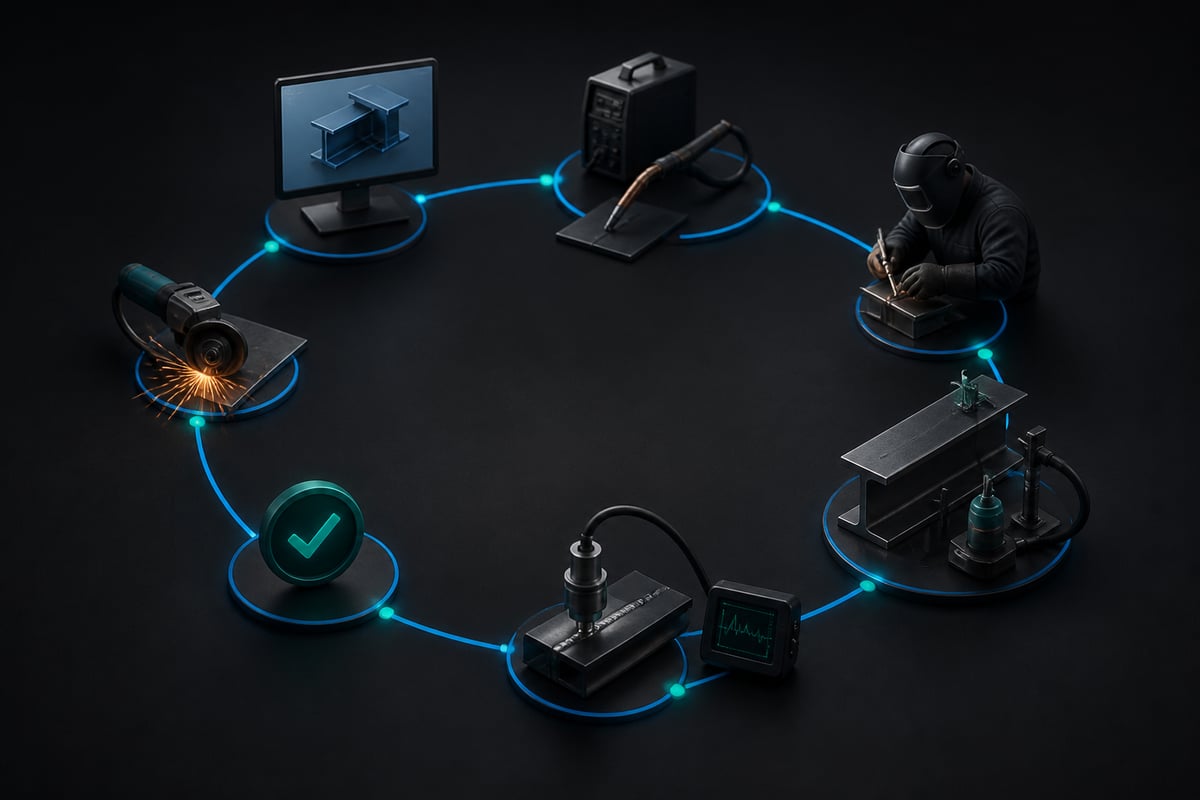
A shop needs three things to comply: a qualified welding procedure for each joint type, welders qualified to run those procedures, and an inspection process that checks the finished weld against the code's acceptance criteria. Each element is documented, and documentation is what an auditor or owner will ask to see first.
- Welding procedure specifications (WPS): the written instructions for process, filler metal, position, preheat, interpass temperature and parameters.
- Procedure qualification records (PQR): the test evidence that a WPS produces sound welds, unless the joint is prequalified.
- Welder performance qualification: tests that show an individual welder can make acceptable welds in a given process, position and material thickness range.
- Inspection and records: visual inspection plus any contractually required nondestructive testing, with results retained.
A well-run shop maintains these records so they are available at the start of a job, not assembled after a question is raised. LTJ Industrial Services states that its welders are certified across multiple codes, including ASME, National Board, AWS D1.1 and API 1104, and that it supports customers in the shop and on site to minimize downtime. For a maintenance manager, that combination matters because a single repair can touch structural steel, a pressure-retaining component and a pipe weld within the same shutdown.
How Do Prequalified and Qualified Procedures Differ?
A prequalified procedure uses joint designs, processes and materials that the code accepts without testing, while a qualified procedure must be proven through a documented test. Prequalification is a time saver, but it carries strict limits on joint geometry, filler metal classification and essential variables.
If a repair falls outside those limits, the shop must qualify the procedure by welding a test coupon and having it examined and tested. This is common in field repair work, where a worn component may need a nonstandard joint, a different base metal or a heavier section than a textbook detail assumes.
The strength of the base metal also affects which route applies. Per the AWS Welding Journal, A913 Grade 80 is the only prequalified base metal in its strength category in the 2025 code. Higher-strength steels generally demand closer attention to preheat, heat input and filler selection, so confirm the grade before you request a quote.
What Changed in the 2025 Edition?
The 2025 edition updated several technical areas that affect procedure documents and shop practice. According to the AWS D1.1 2025 code overview, the edition revised preheat and interpass temperature qualification, macroetch acceptance criteria and WPS qualification tables. It also added provisions for Type D studs and clarified requirements for T-, Y- and K-connection procedures.
For an operations team, the practical consequences are straightforward:
- Existing WPS documents may need review against the revised qualification tables.
- Preheat and interpass temperature records may be evaluated differently than under earlier editions.
- Tubular connection work, common in support frames and structural trusses, should be checked against the clarified procedure language.
- Stud welding on decking or composite assemblies should reference the new Type D stud provisions where they apply.
Contracts often lock in a specific edition year. Do not assume the newest edition governs your job. Ask the engineer of record or owner which edition applies, and make sure your fabrication partner is working from the same one.
How Is Weld Quality Inspected and Accepted?
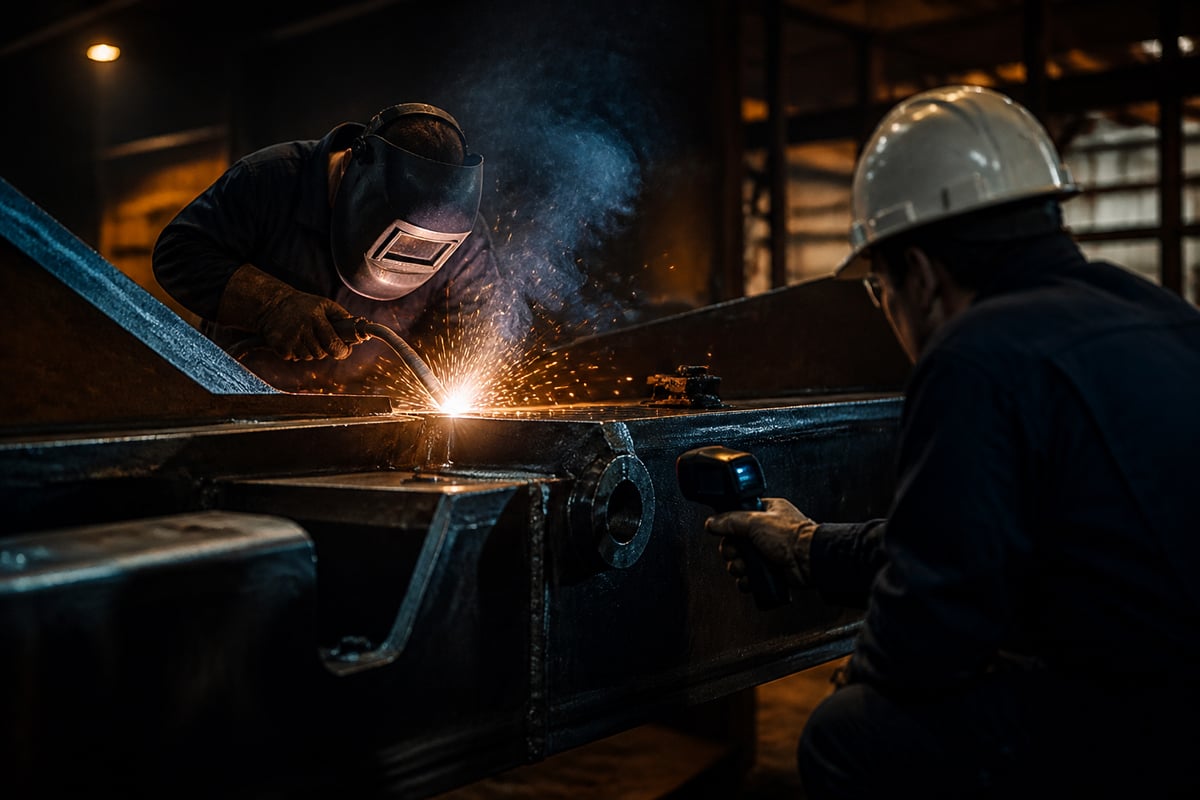
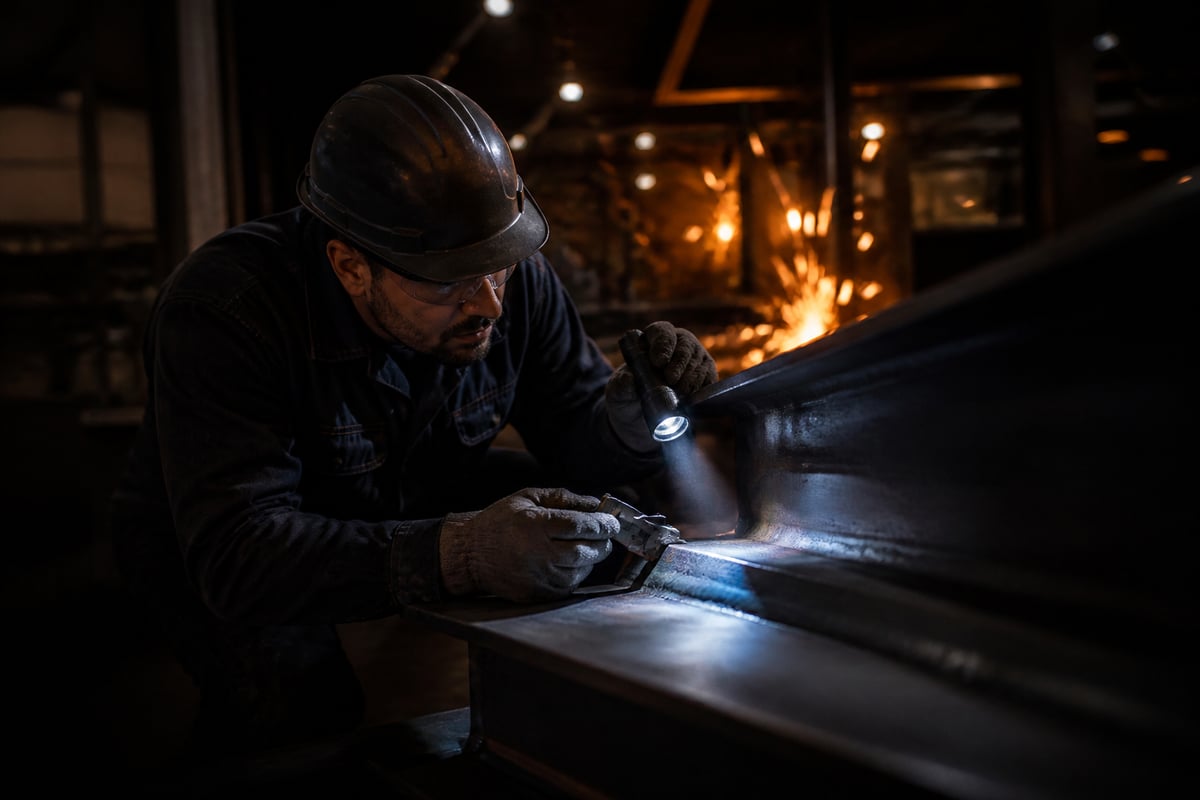
Weld quality under D1.1 is judged against defined acceptance criteria using visual inspection first and nondestructive testing when the contract calls for it. Visual inspection checks profile, size, undercut, porosity, cracks and fusion at the surface, and it happens before, during and after welding.
When the specification requires more, the typical methods include:
- Magnetic particle testing for surface and near-surface discontinuities in ferromagnetic steel.
- Liquid penetrant testing for surface-breaking flaws.
- Ultrasonic testing for internal discontinuities in groove welds.
- Radiographic testing where the contract or project requires a permanent image record.
The code distinguishes between statically loaded and cyclically loaded structures, and cyclic loading is where fatigue becomes a central concern. A conveyor support, crusher frame or drill rig mast sees repeated loading, so that distinction is not academic for a maintenance team.
AWS also publishes information on its D1.1 endorsement page about the subjects an inspector working to the code should understand.
Where Does AWS D1.1 Apply in Oil and Gas, Mining, Aggregate and Recycling?
D1.1 applies wherever welded steel carries load and is not covered by a more specific code. In industrial settings, that covers a wide range of everyday assets.
- Oil and gas: skid frames, pipe racks, walkways, equipment supports and lifting lugs.
- Mining and aggregate: conveyor frames, chute and hopper structures, screen supports and platform steel.
- Recycling: shredder bases, baler frames, sorting line supports and wear-prone housings.
- Construction: structural frames, embeds, stairs and handrails.
The question is often which code governs a particular weld. A pipeline tie-in is typically an API 1104 matter, a pressure vessel is an ASME matter and a structural support is a D1.1 matter. LTJ Industrial Services has a page comparing AWS D1.1 and API 1104 that helps clarify those boundaries. When a repair crosses categories, the owner or engineer should name the governing code for each component in writing.
Wear surfaces add another layer. Hardfacing and overlay work on buckets, chutes and crusher parts has its own procedure considerations, and LTJ Industrial Services lists hardfacing among its services.
How Do You Evaluate a Welding Partner for D1.1 Work?
Evaluate a partner by asking for documents and specifics rather than general assurances. A capable shop can answer the following questions quickly and in writing.
- Which edition year of AWS D1.1/D1.1M do your current procedures reference?
- Can you provide WPS and PQR documents for the joint types in my scope?
- Are the welders assigned to my job qualified for the process, position and thickness involved?
- Who performs visual inspection, and what NDT can you arrange if the contract requires it?
- How are repairs, rejected welds and deviations documented and communicated?
- Can you work both in your shop and at my site if the asset cannot be moved?
Clear communication and follow-through matter as much as certification. A shop that returns calls, documents what it did and flags issues before they become delays reduces the risk on a shutdown schedule. LTJ Industrial Services describes its approach as communicating clearly and following through on every project, and it handles fabrication, machining, hydraulics and finishing in one place, which can reduce the number of vendors you coordinate.
For structural fabrication, equipment repair and custom metal projects, LTJ Industrial Services offers certified welding in the shop or on site. If you want to see the kind of work involved, its project gallery is a reasonable place to start, and its welding procedure page outlines how procedures fit into a job.
What Should Go Into a D1.1 Scope of Work?
A good scope of work states the governing code, edition, materials and acceptance requirements in plain terms so the shop can price and plan accurately. Vague scopes lead to change orders, so include the following details when you request a quote:
- The code and edition year, for example AWS D1.1/D1.1M with the specific year named.
- Base metal specification and grade, including any high-strength steel.
- Loading condition, static or cyclic, since it affects acceptance criteria.
- Required inspection level and any NDT methods.
- Documentation deliverables such as WPS, PQR, welder qualification records and inspection reports.
- Location of the work, shop or field, and any access or safety constraints.
Hypothetical example: a plant needs to repair a cracked support frame under a conveyor drive. A strong scope names the code and edition, identifies the base steel, notes that the frame sees repeated loading, requires visual inspection plus magnetic particle testing on the repaired joint and asks for the WPS and welder qualification records at closeout.
Common Mistakes to Avoid With AWS D1.1
Most D1.1 problems come from process gaps rather than welding skill. Watch for these.
- Wrong edition cited. Procedures qualified to one edition may not satisfy a contract that names another.
- Unqualified or expired welder records. Confirm continuity and qualification scope before assigning personnel.
- Ignoring preheat. Thick sections and higher-strength steels are sensitive to preheat and interpass temperature, and the 2025 revisions to preheat qualification make those records worth checking.
- Treating all welds the same. A pressure-retaining or pipeline weld may need a different code than a structural support.
- Inspection as an afterthought. Plan inspection and NDT at the quoting stage so they do not delay closeout.
Frequently Asked Questions
The questions below are answered in the structured data at the end of this article so they can be read by search engines and AI assistants without repeating them in the body.
Start by pulling the drawing or spec for your next structural repair and writing down the code, edition year, base steel grade and inspection requirements so you can request a quote with a complete scope. LTJ Industrial Services can then review that scope, and its certified welding team works in the shop or on site across AWS D1.1, ASME, National Board and API 1104 work. If you have a repair, fabrication or machining project in the Western United States, Request a Quote from LTJ Industrial Services and get the details in front of a team that follows through.