The American Welding Society D1.1 structural welding code stands as the most widely recognized standard for steel fabrication in North America. For industrial fabricators working across oil and gas, aggregate processing, and manufacturing sectors, understanding and implementing this code determines project success, regulatory compliance, and structural integrity. Whether you're preparing welding procedure specifications (WPS) for a new project or qualifying welders for critical infrastructure work, the american welding society d1 1 code provides the technical foundation for every structural steel weld.
Understanding the AWS D1.1 Structural Welding Code
The american welding society d1 1 code establishes comprehensive requirements for welding carbon and low-alloy structural steels. Published by the American Welding Society, this standard covers everything from base metal specifications and weld joint design to inspection criteria and welder qualification protocols.
Core Components of the D1.1 Standard
The code divides into distinct sections addressing specific aspects of structural welding. Each section builds upon foundational principles while maintaining practical application for field and shop fabrication environments.
Key sections include:
- General requirements and scope of application
- Design of welded connections including allowable stresses
- Prequalification of welding procedure specifications
- Welding procedure qualification and welder performance qualification
- Fabrication requirements and techniques
- Inspection criteria and acceptance standards
- Stud welding provisions
- Strengthening and repair of existing structures
The official AWS D1.1:2025 code represents the 25th edition, incorporating updated provisions that reflect current industry practices and materials science advances.
Application Across Industrial Sectors
For companies serving Western United States manufacturing and industrial sectors, the american welding society d1 1 code applies across diverse applications. Structural steel frameworks in aggregate processing facilities, pressure vessel supports in oil and gas operations, and conveyor system structures in recycling plants all fall under D1.1 jurisdiction when specified by engineering requirements or local building codes.
Welding Procedure Specifications Under AWS D1.1
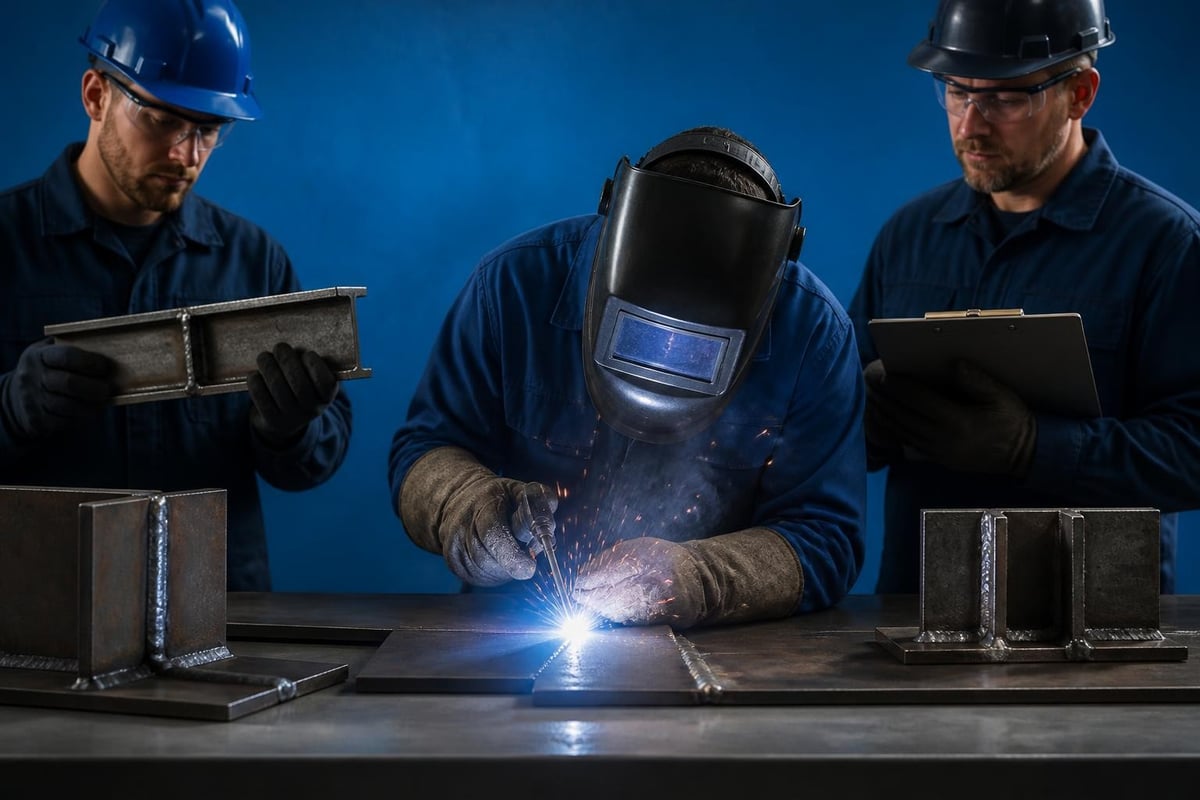
Developing compliant welding procedure specifications represents a critical step in D1.1 compliance. The code offers two pathways: prequalified WPS and qualified WPS through testing.
Prequalified WPS Requirements
Prequalified procedures follow specific parameters outlined in Clause 3 of the code. These procedures don't require qualification testing when all essential variables remain within prescribed limits.
Prequalification requirements include:
- Base metal limited to specific ASTM grades listed in Table 3.1
- Joint designs conforming to prequalified configurations
- Filler metal selection from approved specifications
- Specific preheat and interpass temperature ranges
- Welding position restrictions based on process
| Essential Variable | Prequalified Range | Impact if Exceeded |
|---|---|---|
| Base metal thickness | Per joint design tables | Requires PQR testing |
| Preheat temperature | Minimum per Table 3.2 | Complete requalification |
| Filler metal group | F-number per AWS A5.XX | New procedure required |
| Welding process | SMAW, GMAW, FCAW, SAW | Separate qualification |
Procedure Qualification Record Development
When prequalification isn't feasible due to materials, joint geometry, or welding parameters, a procedure qualification record (PQR) becomes mandatory. The PWHT and PQR guide provides detailed technical guidance for developing these qualification records under AWS D1.1:2025 requirements.
Testing protocols for PQRs involve producing test assemblies that duplicate production conditions. Tensile testing, bend testing, and sometimes impact testing verify mechanical properties meet code minimums. Each essential variable change triggers specific requalification requirements.
Welder and Welding Operator Qualification
The american welding society d1 1 code mandates qualification testing for all welders and welding operators before production work begins. These qualifications ensure individual skill competency within specific process, position, and material parameters.
Performance Qualification Testing
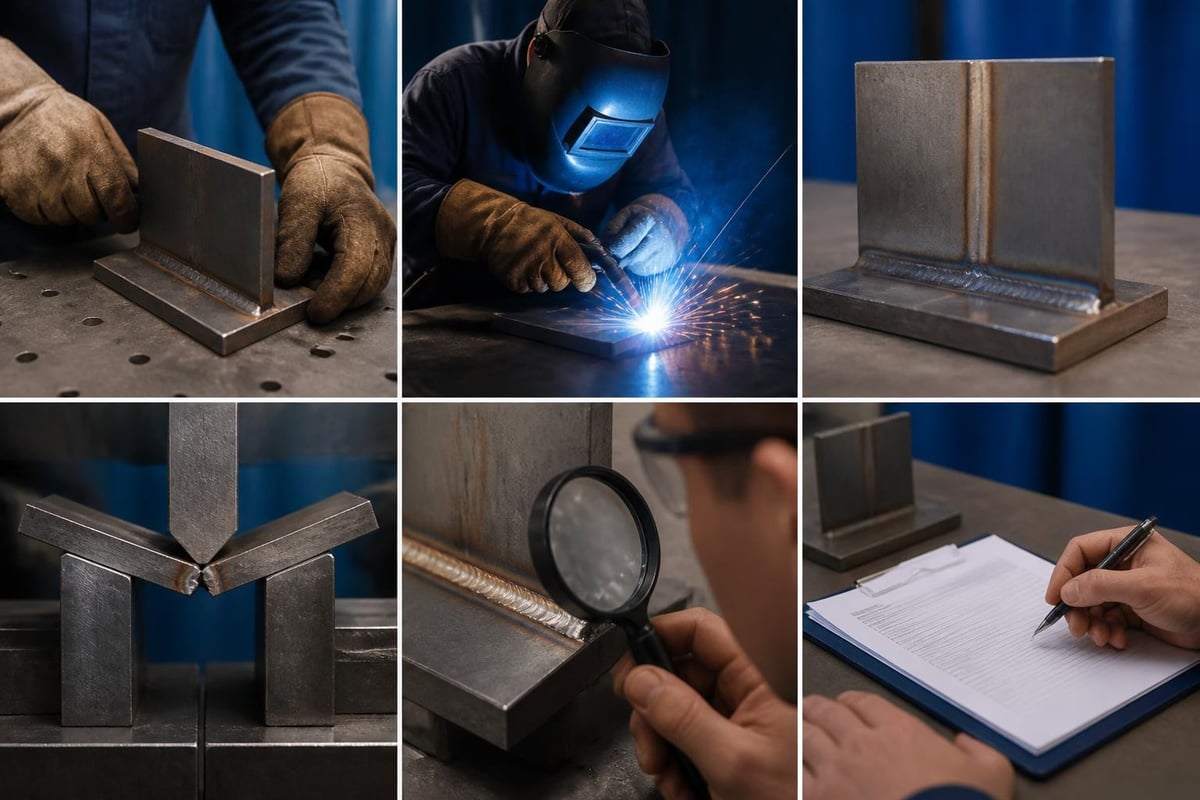
Welder qualification under Clause 4 requires producing test welds that undergo visual inspection and destructive testing. The test assemblies must demonstrate proficiency in the specific welding process, position, and thickness range.
Qualification variables that determine test requirements:
- Welding process (SMAW, GMAW, FCAW, SAW, GTAW)
- Welding position (flat, horizontal, vertical, overhead)
- Base metal thickness (plate vs. pipe)
- Filler metal diameter and type
- Backing conditions (with or without backing)
Test welds undergo visual inspection for surface discontinuities, followed by bend tests or radiographic examination. Face bends, root bends, and side bends verify weld soundness and fusion quality throughout the joint cross-section.
Qualification Expiration and Renewal
Welder qualifications remain valid indefinitely unless the welder doesn't use a specific process for six months or longer. Many fabrication shops maintain welding continuity logs documenting each welder's process usage to preserve qualifications and avoid costly retesting.
For companies performing ASME code welding services alongside structural work, maintaining dual qualifications under both AWS D1.1 and ASME Section IX requires careful tracking of different renewal and continuity requirements.
Inspection and Quality Control Requirements
The code establishes detailed inspection criteria ensuring fabricated structures meet safety and performance standards. Understanding these requirements helps fabricators implement effective quality control programs and avoid costly rejections.
Visual Inspection Criteria
Visual inspection represents the primary quality control method under the american welding society d1 1 standard. Qualified inspectors examine welds for surface discontinuities including cracks, incomplete fusion, inadequate joint penetration, undercut, and porosity.
Acceptance criteria vary based on the weld type and loading conditions. Statically loaded structures permit certain discontinuities that would be rejectable in cyclically loaded applications. Table 6.1 in the code provides specific dimensional limits for various discontinuity types.
Nondestructive Testing Methods
Beyond visual examination, D1.1 specifies requirements for nondestructive testing (NDT) when required by contract documents or engineering specifications. The American Society for Nondestructive Testing provides comprehensive guidance on radiographic and ultrasonic testing methods commonly applied to structural welds.
Common NDT methods for D1.1 compliance:
- Radiographic testing (RT) for internal discontinuity detection
- Ultrasonic testing (UT) for thick sections and critical joints
- Magnetic particle testing (MT) for surface and near-surface defects
- Liquid penetrant testing (PT) for nonmagnetic materials
| Testing Method | Primary Application | Acceptance Standards |
|---|---|---|
| Visual | All welds | Clause 6.9, Table 6.1 |
| Radiographic | Tubular joints, critical welds | Clause 6.10, 6.11 |
| Ultrasonic | Thick plates, repairs | Clause 6.13 |
| Magnetic Particle | Groove welds, repairs | Clause 6.14 |
Special Considerations for Tubular Structures
Hollow structural sections (HSS) and tubular connections present unique challenges addressed specifically in AWS D1.1. The Steel Tube Institute’s technical article clarifies provisions for tubular versus plate connections under the code.
Tubular Joint Design Requirements
Tubular connections require careful attention to joint design, fit-up tolerances, and welding sequence. The code provides specific requirements for branch-to-chord connections, including dihedral angle limitations and effective throat calculations.
Gap tolerances between tube members critically affect weld quality and structural performance. D1.1 specifies maximum allowable gaps and mandates increased filler metal deposition when gaps exceed certain limits. For complex tubular fabrications in industrial structures, proper fixturing and fit-up procedures prevent costly rework.
Preheat Requirements for Tubular Members
Preheat temperatures for tubular structures follow the same base metal thickness and grade requirements as plate structures. However, tubular geometry affects heat dissipation rates and cooling speeds. Welding on cold substrates increases hardness in the heat-affected zone and raises cracking susceptibility.
Establishing preheat involves measuring temperature on the base metal surface at a distance equal to the material thickness from the weld joint, with a minimum distance of three inches. For tubular members, this measurement location must account for circumferential heat flow and ensure uniform heating around the joint perimeter.
Major Changes in AWS D1.1:2025 Edition
The 2025 edition of the american welding society d1 1 code introduced significant updates affecting fabrication procedures, inspection criteria, and material specifications. Understanding these changes ensures compliance with the current standard. The detailed change summary provides technical analysis of major revisions.
Updated Material Specifications
New ASTM specifications and steel grades received approval for use under the 2025 code. These additions expand design options while maintaining safety margins established through decades of structural performance data.
Notable material additions:
- ASTM A1085 high-strength low-alloy structural steel
- Expanded coverage of weathering steel grades
- Updated filler metal classifications
- Revised impact testing temperature requirements
Revised Inspection and Testing Provisions
The 2025 edition clarified acceptance criteria for specific discontinuity types and updated radiographic interpretation standards. These changes align AWS D1.1 more closely with international welding standards while preserving the code's primary focus on structural safety.
Modified ultrasonic testing procedures now reference current ASTM standards for calibration blocks and scanning techniques. For fabricators investing in advanced NDT equipment, these updates ensure consistency between inspection methods and acceptance criteria.
Integration with Federal and State Specifications
Many infrastructure projects incorporate AWS D1.1 by reference within broader specification documents. Understanding how agencies adopt and modify the code helps fabricators navigate complex project requirements.
Highway and Bridge Applications
The Federal Highway Administration establishes policies for structural design standards used in federally funded bridge projects. State departments of transportation commonly reference AWS D1.1 while adding supplementary requirements specific to local conditions and material availability.
California's Department of Transportation, for example, incorporates D1.1 provisions within Caltrans Standard Specifications while mandating additional testing and documentation for seismic-resistant structures. Fabricators working on public infrastructure must reconcile multiple specification layers to achieve full compliance.

Cross-Border Considerations: AWS D1.1 vs. CSA Standards
Companies serving clients across North America encounter differences between American and Canadian welding standards. The CWB Group comparison guide explains key distinctions between AWS D1.1 and CSA W59 standards.
WPS and Welder Qualification Differences
While both standards share similar objectives, specific requirements for procedure development and welder testing differ in important ways. CSA W59 uses different essential variables and permits some variations in prequalification ranges not allowed under AWS D1.1.
Key differences affecting fabricators:
- Essential variable definitions and change limits
- Prequalified joint design configurations
- Welder qualification test piece dimensions
- Inspection frequency and sampling requirements
For fabricators like those providing custom welding services across the Western United States, maintaining awareness of these differences becomes critical when projects cross international borders or when clients specify Canadian standards for American facilities.
Implementing AWS D1.1 in Shop and Field Operations
Practical implementation of the american welding society d1 1 code requires systematic quality management systems integrating procedure control, welder qualification tracking, and inspection documentation.
Quality Management System Components
Effective D1.1 compliance programs establish clear procedures for each code requirement. Documentation systems track WPS approval, welder qualifications, inspection records, and nonconformance reports throughout project lifecycles.
Essential quality system elements:
- WPS library with current, approved procedures
- Welder qualification database with continuity tracking
- Inspection and testing plan templates
- Nonconformance and corrective action procedures
- Material traceability and identification systems
- Calibration programs for welding and inspection equipment
Manufacturing sectors including recycling equipment fabrication, aggregate processing machinery, and oilfield structures benefit from welding specifications that integrate D1.1 requirements with industry-specific performance demands.
Field Fabrication Challenges
Field welding under AWS D1.1 introduces environmental variables absent in controlled shop environments. Wind, precipitation, extreme temperatures, and limited access for inspection equipment require modified approaches while maintaining code compliance.
Preheat application in field conditions demands portable heating equipment capable of achieving and maintaining specified temperatures. Temperature-indicating crayons or contact pyrometers verify preheat compliance before welding begins. For overhead and vertical welds in the field, modified backing techniques and travel speeds compensate for gravity effects on molten weld pools.
Training and Certification for D1.1 Compliance
Maintaining workforce competency in AWS D1.1 requirements involves ongoing training beyond initial welder qualification testing. Certified Welding Inspectors (CWI) play crucial roles in ensuring fabrication meets code requirements.
Certified Welding Inspector Requirements
CWIs certified through the American Welding Society demonstrate comprehensive knowledge of welding processes, metallurgy, inspection techniques, and code interpretation. These professionals provide third-party verification that fabrication procedures and practices comply with D1.1 requirements.
For fabrication companies serving multiple industrial sectors, employing or contracting CWI services ensures internal quality control programs remain aligned with current code provisions. Inspector involvement from project planning through final inspection reduces rejection rates and rework costs.
Continuing Education and Code Updates
AWS publishes code updates, interpretations, and errata documents between major code revisions. Staying current with these technical updates requires systematic review of AWS standards publications and participation in industry training programs.
Welding supervisors, quality managers, and engineering staff benefit from formal training courses covering new code provisions, revised inspection criteria, and updated material specifications. Many community colleges and technical schools offer AWS-accredited courses addressing specific D1.1 topics.
Material Selection and Compatibility
Base metal selection significantly impacts welding procedure requirements and joint performance under the american welding society d1 1 code. Understanding material groupings and compatibility requirements prevents specification errors that complicate fabrication.
ASTM Steel Grade Classifications
D1.1 categorizes structural steels by ASTM specification and assigns each to material groups based on chemical composition and mechanical properties. These groupings determine prequalification eligibility, preheat requirements, and filler metal selection.
Common structural steel grades include ASTM A36, A572, A588, and A992, each with specific strength levels and weldability characteristics. High-strength steels above 70 ksi yield strength require special attention to hydrogen control, preheat temperatures, and heat input limits.
| Steel Grade | Yield Strength (ksi) | Typical Applications | Special Requirements |
|---|---|---|---|
| A36 | 36 | General structures | Standard preheat |
| A572 Gr. 50 | 50 | Buildings, bridges | Minimum preheat |
| A588 | 50 | Weathering structures | Atmospheric corrosion |
| A992 | 50-65 | Wide-flange shapes | Controlled chemistry |
Filler Metal Selection Criteria
Matching filler metal to base metal ensures weld deposits achieve required strength, ductility, and toughness. D1.1 provides tables correlating base metal groups with appropriate electrode classifications for various welding processes.
Notch toughness requirements for cyclically loaded or low-temperature service demand filler metals with proven impact properties. Supplementary specifications often mandate Charpy V-notch testing at temperatures below ambient conditions to verify adequate toughness for specific applications.
Documentation and Record Retention
Comprehensive documentation demonstrates D1.1 compliance and provides traceability for liability protection and warranty claims. Understanding minimum record retention requirements prevents premature disposal of critical quality documents.
Essential Quality Records
Project quality files must include WPS documentation, PQRs supporting qualified procedures, welder qualification test records, inspection reports, and material certifications. These documents collectively prove that fabrication occurred under controlled conditions meeting code requirements.
Minimum records for D1.1 compliance:
- Approved welding procedure specifications
- Supporting procedure qualification records
- Welder performance qualification test reports
- Daily inspection reports and weld maps
- Nondestructive testing reports and radiographs
- Material test reports and heat traceability
Many fabricators maintain these records indefinitely for structures with long service lives or potential liability exposure. Digital document management systems facilitate long-term storage while enabling rapid retrieval when questions arise years after fabrication completion.
Traceability Systems
Material traceability connects finished welds to specific heat numbers, test reports, and chemical compositions. Heat stamping, color coding, or electronic tracking systems maintain this traceability from raw material receipt through final assembly.
For critical applications in oil and gas processing or pressure vessel fabrication, traceability extends to individual welds through weld maps correlating each joint to specific welders, dates, procedures, and inspection results. This granular tracking supports root cause analysis if service failures occur and demonstrates due diligence in quality control.
Repair and Rework Procedures
Even with rigorous quality control, occasional weld defects require removal and repair. AWS D1.1 establishes specific requirements for evaluating, repairing, and reinspecting nonconforming welds.
Defect Evaluation and Removal
When inspection reveals rejectable discontinuities, qualified personnel must evaluate the defect extent and develop appropriate repair procedures. Complete defect removal through grinding, gouging, or machining precedes any repair welding.
Repair procedures follow the same essential variables as original WPS documents, though preheat requirements may increase due to prior thermal cycles and potential hardening in the heat-affected zone. For cracks, removal must extend beyond visible crack tips to ensure complete elimination of stress concentrations.
Repair Weld Qualification
Extensive repairs or repairs using procedures different from original fabrication may require separate qualification testing. The code permits limited repairs under original WPS provisions but mandates additional controls when repairs involve multiple attempts or deep excavations.
Repair documentation becomes part of permanent project records, identifying defect locations, removal extent, repair procedures, and reinspection results. This documentation proves particularly important for cyclically loaded structures where repair quality directly affects fatigue life.
Mastering the american welding society d1 1 code requirements ensures structural integrity, regulatory compliance, and project success across industrial fabrication applications. From WPS development and welder qualification through inspection and documentation, each code element contributes to safe, reliable welded structures. Whether your project involves aggregate processing equipment, oilfield infrastructure, or custom manufacturing solutions, LTJ Industrial Services delivers AWS D1.1-compliant welding, fabrication, and machining services throughout the Western United States. Contact our team to discuss how our certified welders and comprehensive quality systems can support your next structural fabrication project.
{
“@context”: “https://schema.org”,
“@type”: “FAQPage”,
“mainEntity”: [
{
“@type”: “Question”,
“name”: “What is AWS D1.1 and why is it important for structural welding?”,
“acceptedAnswer”: {
“@type”: “Answer”,
“text”: “AWS D1.1 is the American Welding Society’s Structural Welding Code for Steel, establishing comprehensive requirements for welding carbon and low-alloy structural steels. It is important because it provides standardized specifications for weld joint design, welding procedure qualifications, welder performance testing, fabrication techniques, and inspection criteria that ensure structural integrity and safety across commercial and industrial applications.”
}
},
{
“@type”: “Question”,
“name”: “What is the difference between a prequalified WPS and a qualified WPS under AWS D1.1?”,
“acceptedAnswer”: {
“@type”: “Answer”,
“text”: “A prequalified WPS follows specific parameters outlined in Clause 3 of AWS D1.1 and does not require qualification testing when all essential variables remain within prescribed limits. A qualified WPS requires testing through a Procedure Qualification Record (PQR) when prequalification is not feasible due to materials, joint geometry, or welding parameters that fall outside prequalified ranges.”
}
},
{
“@type”: “Question”,
“name”: “How long do welder qualifications remain valid under AWS D1.1?”,
“acceptedAnswer”: {
“@type”: “Answer”,
“text”: “Welder qualifications under AWS D1.1 remain valid indefinitely unless the welder does not use a specific welding process for six months or longer. Many fabrication shops maintain welding continuity logs documenting each welder’s process usage to preserve qualifications and avoid costly retesting.”
}
},
{
“@type”: “Question”,
“name”: “What are the main nondestructive testing methods used for AWS D1.1 compliance?”,
“acceptedAnswer”: {
“@type”: “Answer”,
“text”: “The main NDT methods for AWS D1.1 compliance include visual inspection for all welds, radiographic testing for internal discontinuity detection in tubular joints and critical welds, ultrasonic testing for thick sections, magnetic particle testing for surface and near-surface defects, and liquid penetrant testing for nonmagnetic materials. Each method has specific acceptance standards defined in the code.”
}
},
{
“@type”: “Question”,
“name”: “What preheat requirements does AWS D1.1 specify for structural steel welding?”,
“acceptedAnswer”: {
“@type”: “Answer”,
“text”: “AWS D1.1 preheat requirements depend on base metal thickness, steel grade, and ambient temperature. Minimum preheat temperatures are specified in Table 3.2 of the code and must be measured on the base metal surface at a distance equal to the material thickness from the weld joint, with a minimum distance of three inches. Preheat reduces cooling rates, prevents hardening in the heat-affected zone, and minimizes cracking susceptibility.”
}
},
{
“@type”: “Question”,
“name”: “What major changes were introduced in AWS D1.1:2025?”,
“acceptedAnswer”: {
“@type”: “Answer”,
“text”: “The AWS D1.1:2025 edition introduced updates including new ASTM material specifications such as A1085 high-strength low-alloy steel, expanded weathering steel grade coverage, updated filler metal classifications, revised impact testing temperature requirements, clarified acceptance criteria for specific discontinuity types, and updated radiographic interpretation standards aligned with current ASTM standards.”
}
},
{
“@type”: “Question”,
“name”: “How does AWS D1.1 differ from CSA W59 for Canadian projects?”,
“acceptedAnswer”: {
“@type”: “Answer”,
“text”: “While AWS D1.1 and CSA W59 share similar objectives, key differences include essential variable definitions and change limits, prequalified joint design configurations, welder qualification test piece dimensions, and inspection frequency requirements. Fabricators working on cross-border projects must understand these distinctions to maintain compliance with the specified standard.”
}
},
{
“@type”: “Question”,
“name”: “What documentation is required to demonstrate AWS D1.1 compliance?”,
“acceptedAnswer”: {
“@type”: “Answer”,
“text”: “Essential documentation for AWS D1.1 compliance includes approved welding procedure specifications, supporting procedure qualification records, welder performance qualification test reports, daily inspection reports and weld maps, nondestructive testing reports and radiographs, and material test reports with heat traceability. These records collectively prove fabrication occurred under controlled conditions meeting code requirements.”
}
},
{
“@type”: “Question”,
“name”: “Can LTJ Industrial Services help with AWS D1.1 compliant welding for my project?”,
“acceptedAnswer”: {
“@type”: “Answer”,
“text”: “Yes, LTJ Industrial Services provides comprehensive AWS D1.1-compliant welding, fabrication, and machining services for commercial and industrial manufacturing sectors throughout the Western United States. Our certified welders, qualified procedures, and systematic quality control programs ensure your structural fabrication meets all code requirements for projects in oil and gas, aggregate processing, recycling, and custom manufacturing applications.”
}
}
]
}
{
“@context”: “https://schema.org”,
“@type”: “Article”,
“headline”: “AWS D1.1: Essential Guide to Structural Welding Code”,
“description”: “Comprehensive guide to American Welding Society D1.1 structural welding code for fabricators. Learn requirements, compliance, and best practices.”,
“image”: “https://ltjindustrial.com/aws-d1-1-featured-image.jpg”,
“datePublished”: “2026-11-04”,
“dateModified”: “2026-11-04”,
“author”: {
“@type”: “Organization”,
“name”: “LTJ Industrial Services”,
“url”: “https://ltjindustrial.com”
},
“publisher”: {
“@type”: “Organization”,
“name”: “LTJ Industrial Services”,
“logo”: {
“@type”: “ImageObject”,
“url”: “https://ltjindustrial.com/logo.png”
}
},
“mainEntityOfPage”: {
“@type”: “WebPage”,
“@id”: “https://www.ltjindustrial.com/aws-d1-1”
},
“articleSection”: “Welding Standards”,
“keywords”: [“AWS D1.1”, “structural welding code”, “welding procedure specification”, “welder qualification”, “WPS”, “PQR”, “NDT testing”, “structural steel fabrication”],
“articleBody”: “The American Welding Society D1.1 structural welding code stands as the most widely recognized standard for steel fabrication in North America. For industrial fabricators working across oil and gas, aggregate processing, and manufacturing sectors, understanding and implementing this code determines project success, regulatory compliance, and structural integrity.”
}