
Manufacturing excellence in commercial and industrial sectors depends on understanding all fabrication processes available to modern businesses. From metal cutting and forming to advanced welding and machining, these techniques transform raw materials into functional components that power critical industries across the Western United States. Whether you operate in aggregate production, oil and gas extraction, or recycling operations, mastering the full spectrum of fabrication methods ensures operational efficiency and competitive advantage in 2026.
Understanding All Fabrication Processes
All fabrication encompasses the complete range of manufacturing techniques used to convert raw materials into finished products. This comprehensive approach combines cutting, forming, joining, and finishing operations into integrated workflows that deliver precision components for industrial applications.
Core Fabrication Categories
The fundamental fabrication techniques and processes divide into several distinct categories, each serving specific manufacturing needs:
- Cutting operations: Plasma cutting, laser cutting, waterjet cutting, and mechanical shearing
- Forming processes: Bending, rolling, stamping, and press brake operations
- Joining methods: Welding, brazing, soldering, and mechanical fastening
- Machining techniques: Milling, turning, drilling, and grinding
- Finishing procedures: Sandblasting, powder coating, and surface treatment
These categories represent the foundation of all fabrication work performed in modern industrial facilities.
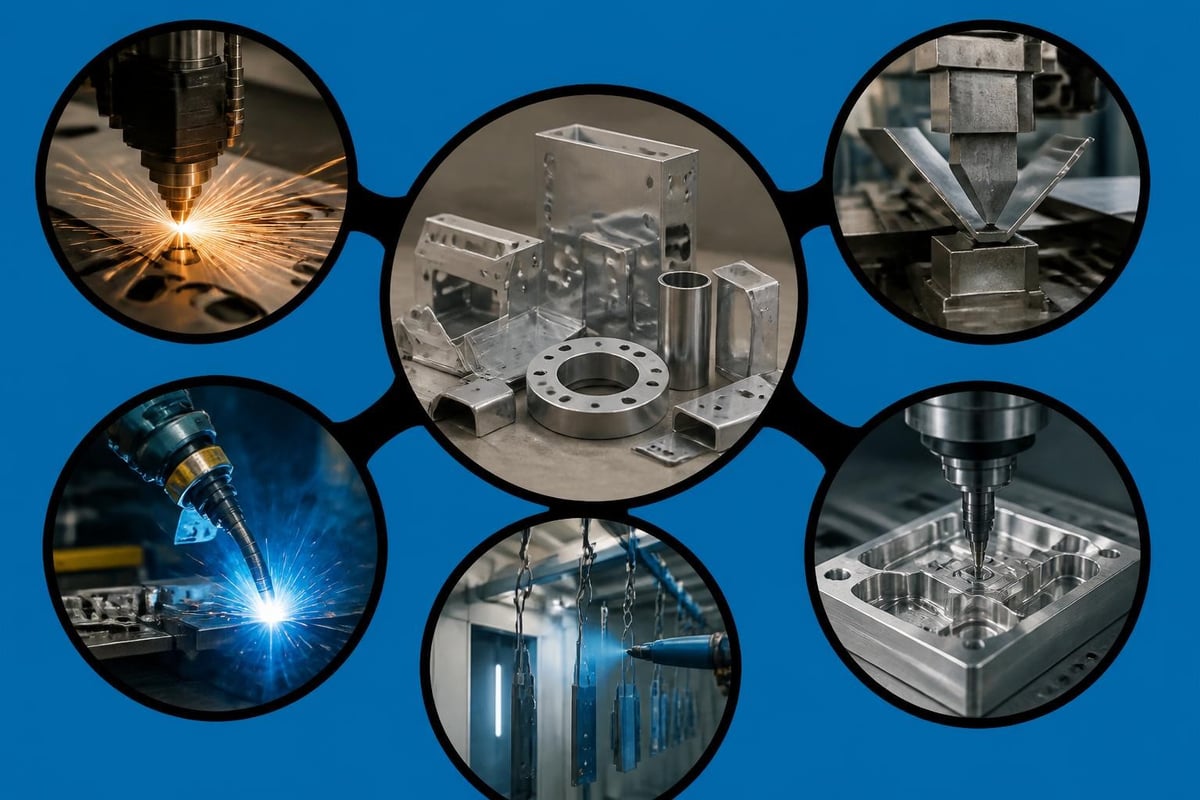
Modern manufacturing demands integration across all fabrication disciplines. A single project might require cutting steel plate, forming it into specific shapes, welding assemblies together, machining critical surfaces, and applying protective finishes.
Metal Cutting and Separation Methods
Metal cutting represents the essential first step in all fabrication projects. Advanced cutting methods enable precision material separation that defines component dimensions and prepares surfaces for subsequent operations.
Thermal Cutting Technologies
Thermal cutting methods dominate heavy industrial applications where thick materials require precise separation:
| Method | Thickness Range | Material Types | Primary Advantages |
|---|---|---|---|
| Plasma Cutting | 1/8" to 2" | Conductive metals | Speed, portability |
| Oxy-Fuel Cutting | 1/2" to 12" | Carbon steel | Thick material capability |
| Laser Cutting | 1/16" to 1" | Various metals | Extreme precision |
| Waterjet Cutting | Any thickness | All materials | No heat-affected zone |
Waterjet cutting stands out for all fabrication applications requiring zero thermal distortion. This method uses high-pressure water mixed with abrasive particles to cut through materials without altering their metallurgical properties.
Mechanical Cutting Approaches
Shearing, sawing, and nibbling provide cost-effective alternatives for specific all fabrication requirements. These mechanical methods excel in high-volume production environments where tooling costs can be amortized across thousands of parts.
Shearing operations work best for straight cuts in sheet metal up to 1/2 inch thick. Modern CNC shears deliver repeatable accuracy within ±0.010 inches across production runs.
Band sawing remains the preferred method for cutting structural shapes, bars, and tubes where cut quality matters less than material utilization and setup time.
Forming and Shaping Techniques
Forming processes in manufacturing reshape metal without removing material, making them highly efficient for all fabrication projects requiring specific geometries.
Press Brake Operations
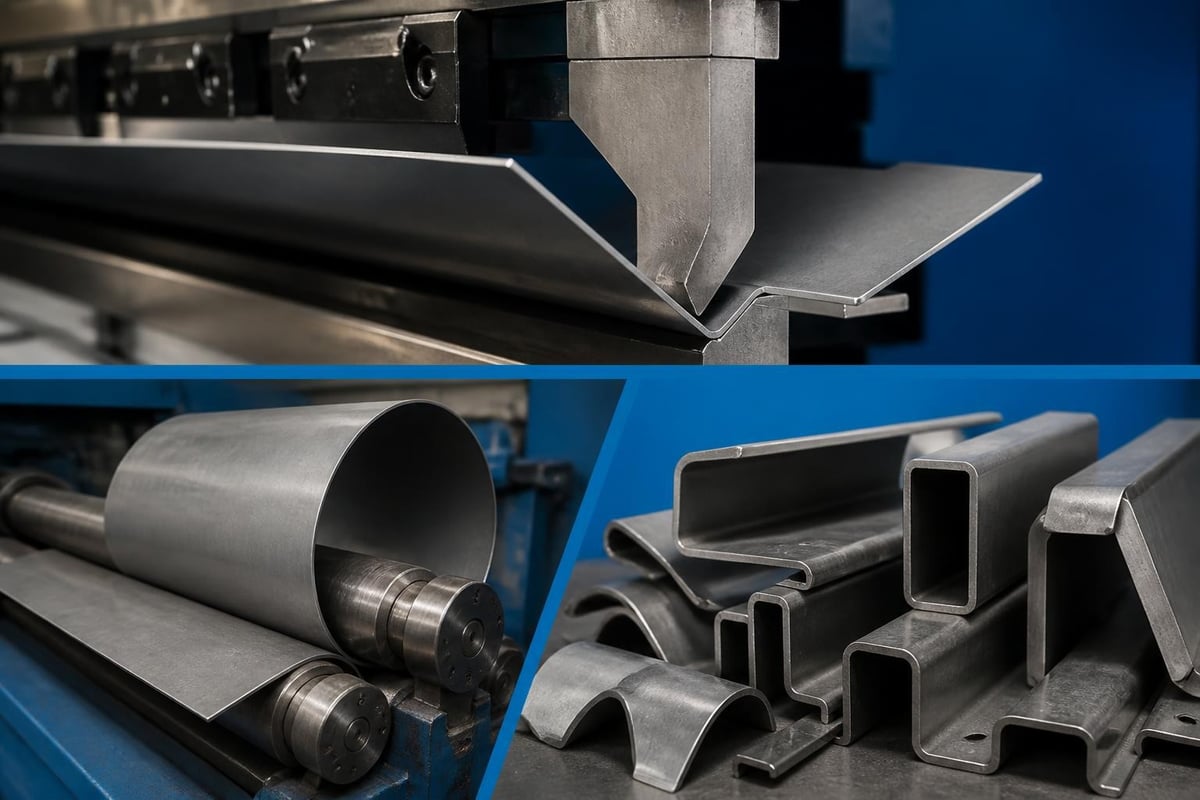
Press brake forming creates precise bends in sheet metal through controlled force application. Modern CNC press brakes feature:
- Multi-axis back gauge positioning
- Automatic tool changing systems
- Crowning compensation for consistent bend angles
- Offline programming capabilities
Air bending, bottoming, and coining represent the three fundamental press brake techniques used across all fabrication disciplines. Each method offers distinct advantages for specific material thicknesses and tolerance requirements.
Rolling and Curve Forming
Rolling operations transform flat plate and structural shapes into cylindrical and conical forms essential for pressure vessels, tanks, and architectural elements.
Plate rolling capacity determines maximum thickness and width capabilities. Industrial plate rolls handle materials from 16-gauge sheet metal to 4-inch thick plate, creating diameters from 12 inches to 30 feet.
Section rolling bends structural shapes including angles, channels, beams, and pipes. This specialized all fabrication technique requires precise tooling to prevent distortion and maintain dimensional accuracy.
Welding and Joining Solutions
Welding represents the most critical joining method across all fabrication applications. The expertise of skilled welders determines structural integrity, appearance, and long-term performance of fabricated assemblies.
Primary Welding Processes
Each welding process offers distinct advantages for specific all fabrication requirements:
- SMAW (Stick Welding): Versatile field welding for structural steel and repair work
- GMAW (MIG Welding): High-speed production welding for sheet metal and light structural applications
- GTAW (TIG Welding): Precision welding for stainless steel, aluminum, and critical joints
- FCAW (Flux-Cored Welding): Heavy structural welding with excellent penetration characteristics
- SAW (Submerged Arc Welding): Automated high-deposition welding for thick materials
The choice between these essential metal fabrication techniques depends on material type, thickness, position, and quality requirements.
Certification and Quality Control
All fabrication welding must meet industry standards established by organizations including AWS (American Welding Society), ASME (American Society of Mechanical Engineers), and API (American Petroleum Institute).
Welder qualification ensures personnel competency across specific processes, materials, and positions. Most commercial and industrial projects require certified welders who have demonstrated proficiency through rigorous testing.
Non-destructive testing verifies weld quality without damaging components. Radiographic testing, ultrasonic examination, magnetic particle inspection, and dye penetrant testing identify defects that could compromise structural integrity.
Machining and Precision Operations
Machining complements all fabrication workflows by creating precise features, smooth surfaces, and tight tolerances that other processes cannot achieve. Professional machining services transform rough-cut or formed components into finished parts ready for assembly.
Conventional Machining Methods
Traditional machining remains essential for all fabrication despite advances in CNC technology:
- Milling: Creates flat surfaces, slots, pockets, and complex contours
- Turning: Produces cylindrical features including shafts, bushings, and threaded components
- Drilling: Establishes precise hole locations and diameters
- Boring: Enlarges existing holes to exact specifications
- Grinding: Achieves superior surface finishes and dimensional accuracy
Manual machining offers flexibility for one-off parts and prototype development where programming time would exceed actual machining time.
CNC Machining Advantages
Computer numerical control revolutionized all fabrication by enabling repeatable precision across production quantities from one to thousands:
| Feature | Benefit | Application |
|---|---|---|
| Multi-axis capability | Complex geometry creation | Aerospace components |
| Tool management | Automated tool changes | Lights-out manufacturing |
| Inspection probes | In-process verification | Quality assurance |
| Simulation software | Error prevention | First-part accuracy |
CNC machining integrates seamlessly with custom metal fabrication workflows, enabling efficient production of components that combine welded assemblies with machined features.
Industry Applications and Specializations
The U.S. fabricated metals industry supports diverse sectors through specialized all fabrication capabilities tailored to unique operational requirements.
Oil and Gas Sector Requirements
Oil and gas operations demand all fabrication services that meet stringent safety and performance standards:
Pressure vessels require ASME certification and specialized welding procedures to contain high-pressure fluids safely. Wall thickness calculations, material selection, and heat treatment protocols ensure long-term reliability in demanding environments.
Structural steel for drilling platforms and processing facilities must withstand extreme weather, corrosive atmospheres, and dynamic loading conditions. Hot-dip galvanizing or specialized coating systems protect against accelerated corrosion.
Piping systems integrate welding, machining, and precision fitting to maintain flow efficiency and prevent leaks. Orbital welding and automated pipe cutting ensure consistent quality across miles of interconnected systems.
Aggregate and Mining Applications
Aggregate production and mining operations require robust all fabrication solutions that withstand continuous abrasion and impact:
- Crusher components with hardened wear surfaces
- Conveyor systems spanning hundreds of feet
- Screening equipment handling tons per hour
- Hopper and chute assemblies directing material flow
Wear-resistant materials including AR400, AR500, and Hardox steel extend service life in high-abrasion environments. Proper material selection during all fabrication planning reduces downtime and replacement costs.
Material Selection and Properties
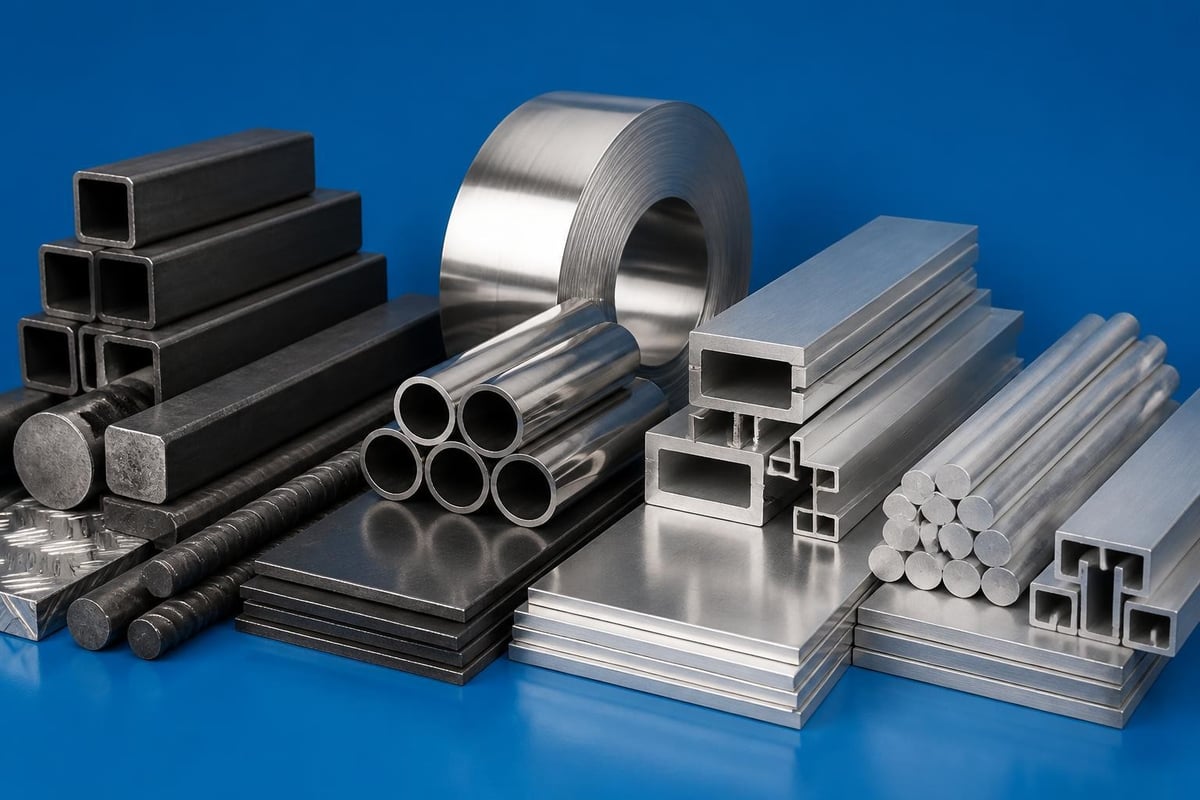
All fabrication begins with appropriate material selection based on mechanical properties, environmental conditions, and economic considerations.
Carbon Steel Grades
Carbon steel dominates industrial all fabrication due to favorable characteristics:
- A36: General structural applications with 36 ksi minimum yield strength
- A572: High-strength low-alloy steel for weight-sensitive structures
- A514: Quenched and tempered alloy steel for critical load-bearing components
Weldability varies significantly across carbon steel grades. Higher carbon content increases hardness but reduces weldability, requiring preheat and post-weld heat treatment to prevent cracking.
Stainless Steel Options
Stainless steel provides corrosion resistance essential for food processing, chemical handling, and marine all fabrication applications:
| Grade | Type | Primary Use | Fabrication Notes |
|---|---|---|---|
| 304 | Austenitic | General purpose | Excellent formability |
| 316 | Austenitic | Chemical resistance | Superior corrosion resistance |
| 410 | Martensitic | Wear resistance | Heat treatable |
| 2205 | Duplex | High strength | Challenging to weld |
Material certifications document chemical composition and mechanical properties. Mill test reports (MTRs) provide traceability required for regulated industries and critical applications.
Advanced Fabrication Technologies
Modern all fabrication increasingly incorporates advanced technologies that enhance capability, precision, and efficiency beyond traditional methods.
Robotic Welding Systems
Automated welding transforms high-volume all fabrication by delivering consistent quality at speeds impossible with manual techniques:
Six-axis robots maneuver welding torches through complex paths while maintaining precise torch angles and travel speeds. Programming flexibility allows rapid changeover between different part configurations.
Welding sensors provide real-time monitoring of arc characteristics, detecting variations that indicate problems before they create defects. Adaptive control systems automatically adjust parameters to compensate for fit-up variations.
Part fixturing positions components accurately and holds them rigidly during welding. Modular fixture systems accommodate multiple part families, maximizing robot utilization across diverse all fabrication projects.
3D Scanning and Measurement
Coordinate measuring machines (CMMs) and laser scanners verify dimensional accuracy throughout all fabrication processes:
- Pre-fabrication material verification
- In-process inspection during critical operations
- Final assembly confirmation before shipment
- Reverse engineering of existing components
Digital quality records support continuous improvement initiatives by identifying trends in dimensional variation across production runs.
Project Planning and Execution
Successful all fabrication requires comprehensive planning that coordinates materials, processes, equipment, and personnel into efficient workflows.
Design for Manufacturability
Engineering designs that consider fabrication limitations prevent costly revisions and delays:
Weld accessibility ensures welders can reach all joints with appropriate equipment. Designs should avoid blind corners and confined spaces requiring specialized fixtures or exotic welding processes.
Tolerance stacking accounts for cumulative variation across multiple operations. Critical dimensions should be established through machining rather than relying on welding and forming to maintain tight tolerances.
Material utilization minimizes waste through efficient nesting of parts on stock sheets and plates. Computer-aided nesting software optimizes layouts automatically, reducing material costs by 10-15 percent.
Quality Management Systems
All fabrication facilities serving commercial and industrial sectors implement quality systems that ensure consistent results:
- Document control: Maintains current revisions of drawings, procedures, and specifications
- Process control: Establishes parameters for critical operations with verification requirements
- Inspection planning: Defines hold points and acceptance criteria throughout fabrication
- Nonconformance handling: Documents and resolves deviations from specifications
- Corrective action: Prevents recurrence of quality issues through root cause analysis
ISO 9001 certification demonstrates organizational commitment to quality management across all fabrication activities. Many customers require third-party certification as a prerequisite for supplier qualification.
Field Services and On-Site Capabilities
While shop-based all fabrication offers controlled environments and full equipment access, many projects require on-site services that bring capabilities directly to operating facilities.
Mobile Welding Applications
Field welding addresses repair needs and installation requirements that cannot be accommodated in fabrication shops:
Emergency repairs minimize downtime by dispatching qualified welders with portable equipment to failed components. Conveyor systems, structural supports, and process equipment often require immediate attention to restore production.
New installations integrate fabricated components into existing infrastructure. Large assemblies may be pre-fabricated in sections, then welded together on-site to eliminate transportation limitations.
Modification projects adapt facilities to changing operational requirements. Custom welding solutions enable quick turnaround on upgrades without extended shutdowns.
Portable Machining Equipment
Line boring, flange facing, and in-situ machining restore dimensional accuracy without removing equipment from service locations:
- Bearing journals machined to precise diameters and surface finishes
- Mounting flanges faced flat within 0.002 inches
- Bolt holes re-drilled to correct alignment issues
- Gear teeth repaired through specialized machining techniques
Access limitations often determine whether portable machining represents the most practical solution. Equipment that would require weeks to disassemble and transport might be machined in place within days.
Hydraulic Systems Integration
All fabrication frequently incorporates hydraulic components that enable motion control, force application, and power transmission across industrial equipment.
Hydraulic Fabrication Requirements
Hydraulic systems demand exceptional cleanliness and precision during all fabrication operations:
Tube bending creates fluid routing without restrictive fittings that introduce pressure drop and potential leak points. CNC tube benders produce consistent bends with precise angles and radii.
Manifold machining consolidates multiple valve and port connections into compact assemblies. Complex internal passages require careful planning to ensure proper fluid flow and eliminate trapped air.
Cylinder fabrication combines welding, machining, and honing to create actuators that perform reliably across millions of cycles. Surface finish requirements on piston rods and cylinder bores directly impact seal life.
Testing and Validation
Hydraulic all fabrication requires comprehensive testing before components enter service:
- Pressure testing: Verifies structural integrity at 150 percent of rated working pressure
- Leak detection: Ensures all connections seal properly under operating conditions
- Flow verification: Confirms adequate flow rates through passages and fittings
- Contamination control: Validates cleanliness levels meet ISO 4406 requirements
System documentation includes hydraulic schematics, parts lists, and maintenance procedures that support long-term operation and troubleshooting.
Cost Optimization Strategies
Effective all fabrication balances quality requirements against economic constraints through strategic process selection and resource management.
Material Cost Management
Raw material represents 40-60 percent of total all fabrication costs, making material management critical to profitability:
Just-in-time purchasing reduces inventory carrying costs but requires reliable supplier relationships and accurate project scheduling. Large fabricators maintain vendor-managed inventory agreements that transfer storage costs while ensuring material availability.
Remnant utilization captures value from cutoffs and surplus material through organized storage and tracking systems. Small parts nested from remnants reduce material purchases significantly over time.
Process Selection Economics
Choosing optimal processes for specific all fabrication requirements minimizes total production costs:
| Consideration | Low-Cost Option | High-Cost Option | Decision Factors |
|---|---|---|---|
| Cutting method | Oxy-fuel | Laser | Precision requirements, thickness |
| Welding process | SMAW | Robotic GMAW | Production volume, repeatability |
| Forming technique | Manual brake | CNC press brake | Complexity, quantity |
| Finishing | Wire brushing | Powder coating | Environmental exposure |
Labor efficiency drives process economics across all fabrication operations. Automated systems justify capital investment when production volumes support rapid payback through reduced touch time.
Understanding all fabrication processes enables informed decisions about manufacturing capabilities, quality expectations, and project feasibility across commercial and industrial applications. Whether your operation requires emergency repairs, custom component fabrication, or complete system installations, partnering with experienced fabrication professionals ensures optimal results. LTJ Industrial Services delivers comprehensive welding, machining, and fabrication solutions throughout the Western United States, combining shop capabilities with mobile field services to keep your operations running efficiently.