The oil and gas industry operates in some of the most demanding environments in the Western United States, where equipment reliability directly impacts safety, production, and profitability. Effective oilfield maintenance programs ensure critical assets continue operating at peak performance while minimizing unplanned downtime and extending the service life of expensive capital equipment. For operators throughout Colorado, Wyoming, Utah, and neighboring states, implementing comprehensive maintenance strategies requires specialized expertise in welding, machining, and fabrication services that can respond rapidly to both planned and emergency needs.
Critical Components of Oilfield Maintenance Programs
Oilfield maintenance encompasses a wide range of activities designed to keep production facilities, drilling rigs, pipelines, and processing equipment operating safely and efficiently. The scope extends from routine inspections and lubrication to complex overhauls requiring advanced welding and machining capabilities.
Preventive Maintenance Fundamentals
Preventive maintenance forms the backbone of any successful oilfield operation. This proactive approach involves regularly scheduled inspections, servicing, and component replacements based on manufacturer recommendations and operational experience.
Key preventive maintenance activities include:
- Routine equipment inspections following API’s standards for in-service equipment
- Lubrication schedules for rotating equipment and hydraulic systems
- Filter replacements for compressors, engines, and hydraulic circuits
- Torque verification on critical bolted connections
- Vibration analysis and alignment checks on pumps and motors
- Pressure testing of piping systems and vessels
Establishing a consistent preventive maintenance schedule reduces the likelihood of catastrophic failures and helps operators budget for repairs rather than facing unexpected emergency costs. Many Western U.S. operators work with manufacturing and machining specialists who can fabricate replacement components before failures occur.
Predictive Maintenance Technologies
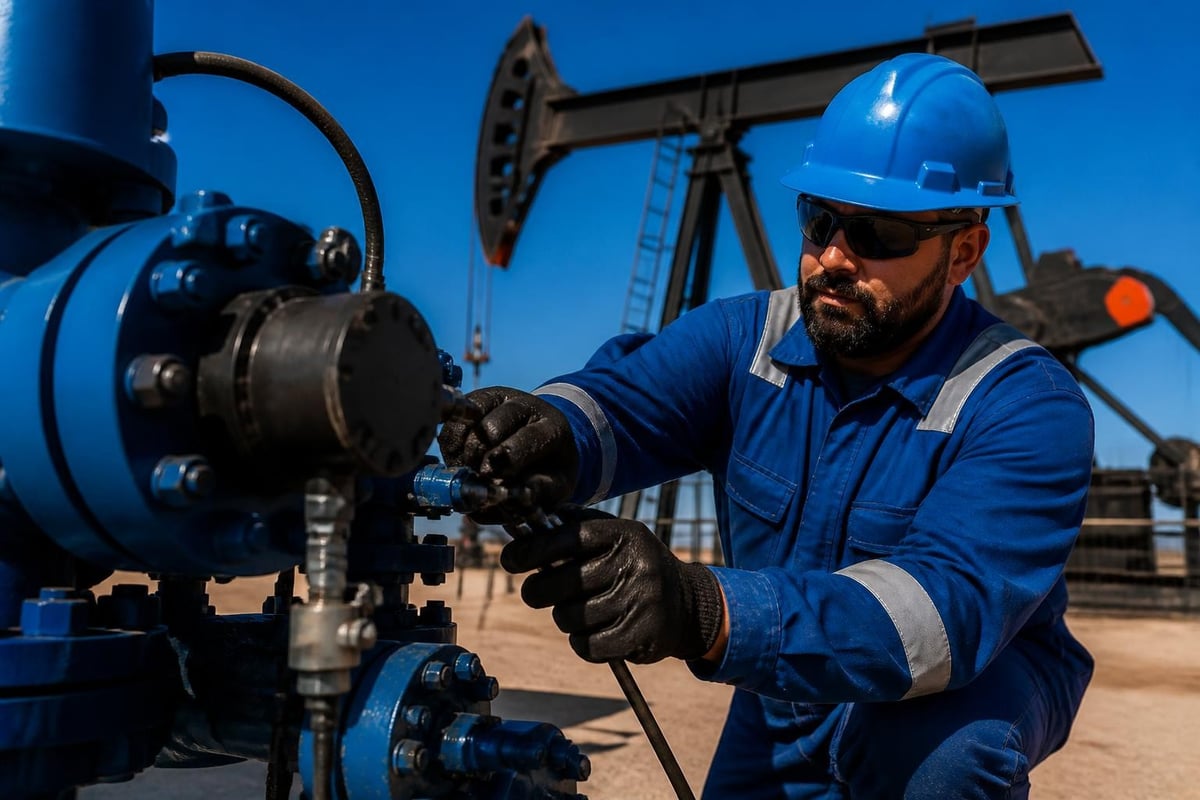
Modern oilfield maintenance has evolved beyond time-based schedules to incorporate condition-based monitoring that predicts failures before they occur. Predictive maintenance leverages sensors, data analytics, and emerging artificial intelligence to identify deteriorating conditions.
Advanced operators now deploy vibration sensors on critical rotating equipment, infrared thermography to detect electrical hotspots, and ultrasonic testing to identify bearing defects. Recent research published in Springer journals demonstrates how AI-powered predictive models can forecast pump failures and optimize maintenance intervals based on actual equipment condition rather than arbitrary time periods.
| Monitoring Technology | Equipment Application | Failure Detection |
|---|---|---|
| Vibration Analysis | Pumps, Compressors, Motors | Bearing wear, Imbalance, Misalignment |
| Infrared Thermography | Electrical Systems, Bearings | Overheating, Connection Resistance |
| Ultrasonic Testing | Pressure Vessels, Piping | Leaks, Wall Thinning, Cracks |
| Oil Analysis | Engines, Gearboxes, Hydraulics | Contamination, Wear Metals, Degradation |
The integration of these technologies allows maintenance teams to prioritize work based on actual risk rather than simply following calendar schedules. This data-driven approach maximizes equipment availability while minimizing maintenance costs.
Welding and Fabrication in Oilfield Maintenance
Specialized welding and fabrication capabilities are essential for maintaining oilfield infrastructure throughout its operational life. From emergency pipeline repairs to fabricating custom components, skilled welders and fabricators keep operations running when standard parts are unavailable or when modifications are needed.
Emergency Repair Capabilities
Unplanned equipment failures demand rapid response from quality welders who can mobilize to remote locations and perform critical repairs under challenging conditions. Field welding on high-pressure piping, structural steel repairs, and tank modifications require certifications and expertise beyond standard manufacturing work.
Emergency oilfield maintenance scenarios often involve:
- Pipeline leak repairs requiring hot tapping or sleeve installations
- Structural steel reinforcement on drilling rigs and production platforms
- Pressure vessel repairs following inspection findings
- Hydraulic system modifications to accommodate new equipment
- Custom bracket fabrication for retrofit installations
The ability to fabricate and install custom solutions in the field distinguishes comprehensive maintenance providers from basic repair services. Companies offering both shop and industrial field capabilities can prefabricate components under controlled conditions, then perform final installation and welding on-site.
Corrosion Control and Coating Maintenance
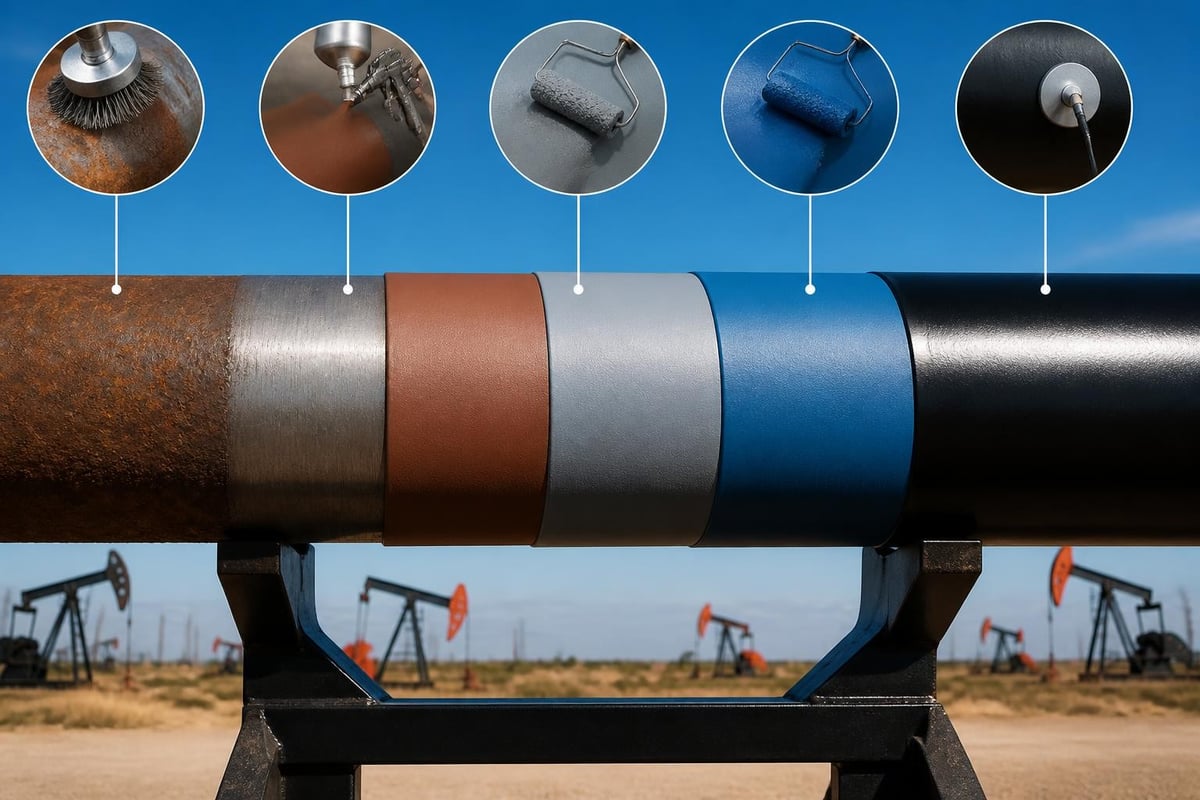
Corrosion represents one of the most persistent challenges in oilfield maintenance, particularly in the Western U.S. where operations span diverse climates from high-altitude mountain environments to arid desert conditions. Protective coatings and corrosion monitoring programs are essential for extending asset life.
AMPP’s guidance on field-applied pipeline coatings provides detailed specifications for coating selection, surface preparation, application, and inspection. Proper coating maintenance requires periodic inspection, damage repair, and recoating before corrosion reaches base metal.
Effective corrosion management includes:
- Regular coating inspections using holiday detection equipment
- Cathodic protection system monitoring and anode replacement
- Corrosion under insulation (CUI) inspections at pipe supports
- Atmospheric corrosion monitoring on exposed steel structures
- Coating damage repair before moisture reaches substrate
Facilities offering industrial equipment painting and coating services can perform both shop coating of new components and field coating repairs, ensuring comprehensive corrosion protection throughout equipment lifecycles.
Machining Services for Critical Component Repair
When oilfield equipment components wear beyond service limits or fail unexpectedly, precision machining can often restore them to original specifications at a fraction of replacement cost. Shaft repairs, bearing journal restoration, and valve seat refacing require specialized machining capabilities and quality control.
Precision Repair Machining
Large oilfield components like pump shafts, compressor crankshafts, and hydraulic cylinders represent significant capital investments. Rather than replacing these components, experienced machinists can often restore worn surfaces through processes like:
- Shaft restoration using metal spray or chrome plating followed by precision grinding
- Bearing journal repair through undercutting and installation of repair sleeves
- Cylinder honing to restore hydraulic cylinder bore dimensions
- Valve seat machining to eliminate leakage in control valves
- Flange facing to restore sealing surfaces on piping connections
These repair operations require not only machining equipment but also expertise in metallurgy, heat treatment, and quality inspection. Working with metal fabrication services providers who maintain both machining and welding capabilities ensures components can be comprehensively restored.
Custom Component Fabrication
Obsolete equipment and long lead times for replacement parts frequently challenge oilfield maintenance teams. The ability to reverse-engineer and fabricate custom components keeps aging equipment operational when manufacturer support is unavailable.
| Component Type | Fabrication Method | Typical Lead Time |
|---|---|---|
| Wear Plates | Laser/Plasma Cutting, Hardface Welding | 3-5 days |
| Shafts | CNC Turning, Heat Treating | 1-2 weeks |
| Flanges | Machining from Forged Blanks | 1 week |
| Structural Brackets | Cutting, Forming, Welding | 2-4 days |
| Hydraulic Manifolds | CNC Milling, Pressure Testing | 2-3 weeks |
Custom fabrication capabilities become particularly valuable for operators managing fleets of older equipment where standardized replacement parts are no longer readily available through conventional supply chains.
Regulatory Compliance and Safety Standards
Oilfield maintenance programs must comply with multiple regulatory frameworks designed to protect worker safety and environmental integrity. Understanding and implementing these requirements is non-negotiable for operators throughout the Western United States.
OSHA Requirements for Maintenance Operations
The U.S. OSHA standards for oil and gas extraction establish minimum safety requirements for maintenance activities on drilling rigs, production facilities, and pipeline systems. These regulations address hazards specific to oilfield maintenance work.
Critical OSHA compliance areas include:
- Confined space entry procedures for tank and vessel maintenance
- Lockout/tagout protocols for equipment servicing
- Fall protection during elevated maintenance work
- Respiratory protection for coating application and tank cleaning
- Hot work permits for welding and cutting operations
Maintenance contractors must maintain comprehensive safety programs that meet or exceed OSHA requirements. This includes worker training documentation, hazard assessments, and emergency response procedures specific to oilfield environments.
API Standards and Industry Best Practices
The American Petroleum Institute publishes numerous recommended practices that define industry expectations for inspection, maintenance, and repair of oilfield equipment. Compliance with API standards demonstrates due diligence and often satisfies regulatory requirements.
Particularly relevant API standards for oilfield maintenance include API RP 570 for piping inspection, API RP 580 for risk-based inspection, and API RP 653 for tank inspection and repair. These documents provide detailed guidance on inspection intervals, acceptance criteria, and repair procedures.
The IOGP process safety guidance complements API standards by offering frameworks for asset integrity management systems that integrate inspection findings, risk assessments, and maintenance planning into cohesive programs.

Maintenance Planning and Scheduling Optimization
Effective oilfield maintenance requires coordination between operations, maintenance teams, and service providers to minimize production impact while ensuring work quality. Strategic planning transforms maintenance from a reactive burden into a value-adding function.
Turnaround Planning and Execution
Major maintenance turnarounds represent scheduled periods when production units are taken offline for comprehensive inspection, repair, and upgrade work. These events require months of planning and precise execution to minimize downtime duration.
Successful turnaround planning involves:
- Scope development through pre-turnaround inspections and condition assessments
- Resource planning including specialized contractors and long-lead materials
- Detailed scheduling using critical path methods to sequence activities
- Procurement coordination ensuring parts and materials arrive when needed
- Quality assurance through hold points and inspection protocols
- Post-turnaround review capturing lessons learned for future improvements
Operators who establish relationships with full-service providers capable of oil and gas pipeline fabrication and field installation can streamline turnaround execution by consolidating procurement and coordination responsibilities.
Reliability-Centered Maintenance Philosophy
Reliability-centered maintenance (RCM) represents an analytical approach to determining optimal maintenance strategies for each asset based on failure modes, consequences, and detection methods. Rather than applying uniform maintenance intervals across all equipment, RCM tailors activities to actual reliability requirements.
The IADC Maintenance and Equipment Reliability Committee resources provide drilling-specific guidance on implementing RCM principles for rig equipment. These same principles apply across all oilfield assets.
RCM analysis considers:
- Failure modes and their operational impacts
- Probability of detection before functional failure
- Cost-effectiveness of preventive versus corrective maintenance
- Safety and environmental consequences of failures
- Availability of condition monitoring technologies
This analytical rigor ensures maintenance resources focus on activities that genuinely improve reliability rather than simply following traditional practices that may not add value.
Hydraulic System Maintenance Excellence
Hydraulic systems power critical functions across oilfield operations, from drawworks and top drives on drilling rigs to BOP control systems and pipe handling equipment. Maintaining hydraulic system reliability requires specialized knowledge of fluid dynamics, contamination control, and component repair.
Contamination Control Strategies
Hydraulic system failures frequently trace back to contamination-particulate, water, or chemical-that degrades fluid properties and damages precision components. Comprehensive contamination control programs address contamination sources, removal, and monitoring.
Effective contamination control includes proper filter selection and maintenance, breather installation on reservoirs, seal replacement before leakage occurs, and regular fluid sampling with laboratory analysis. Maintaining fluid cleanliness to ISO 4406 standards appropriate for system components prevents premature wear of pumps, valves, and actuators.
Component Overhaul and Testing
Hydraulic pumps, motors, cylinders, and valves require periodic overhaul to replace wear components and restore original performance specifications. Quality overhaul work demands clean assembly environments, precision measuring equipment, and pressure testing capabilities.
| Hydraulic Component | Typical Overhaul Interval | Critical Specifications |
|---|---|---|
| Piston Pumps | 10,000-15,000 hours | Volumetric Efficiency, Case Drain Flow |
| Hydraulic Motors | 12,000-18,000 hours | Starting Torque, Leakage Rate |
| Cylinders | As Required | Seal Leakage, Rod Straightness |
| Proportional Valves | 5,000-8,000 hours | Response Time, Hysteresis |
Combining hydraulic expertise with machining and welding capabilities allows comprehensive cylinder repair including rod straightening, tube honing, and custom end fitting fabrication when standard parts are unavailable.
Mobile Maintenance and Field Services
Geographic dispersion of oilfield operations throughout the Western United States creates demand for mobile maintenance capabilities that bring shop-quality services to remote locations. Field service teams equipped with welding equipment, portable machine tools, and hydraulic service units minimize downtime by performing repairs on-site.
Field Machining Capabilities
Portable line boring equipment, flange facers, and pipe beveling machines enable precision machining operations at field locations where transporting large components to a shop is impractical. Field machining applications include bearing bore repair, valve seat cutting, flange facing, and pipe preparation.
These capabilities prove particularly valuable during turnarounds when multiple machining operations must occur simultaneously or when equipment cannot be removed from service for extended shop repair periods.
Mobile Welding Services
Certified field welders equipped with appropriate power sources, welding consumables, and safety equipment can perform emergency repairs and planned maintenance work throughout remote oilfield locations. Field welding quality depends on proper procedures, qualified welders, and appropriate inspection.
Critical field welding applications include pipeline repairs, structural modifications, pressure vessel alterations, and equipment installation. Working with providers who maintain comprehensive quality programs ensures field welds meet the same standards as shop fabrication.
Integration of Maintenance with Operations
The most effective oilfield maintenance programs integrate seamlessly with production operations rather than functioning as separate departments with conflicting priorities. This integration requires communication systems, shared performance metrics, and collaborative planning.
Performance Metrics and KPIs
Measuring maintenance effectiveness requires tracking key performance indicators that balance equipment reliability, cost control, and safety performance. Common oilfield maintenance metrics include:
- Mean time between failures (MTBF) for critical equipment
- Planned maintenance percentage versus reactive work
- Schedule compliance for preventive maintenance tasks
- Maintenance cost per barrel of production
- Safety incident rate during maintenance activities
These metrics provide objective evidence of program performance and identify improvement opportunities. Operators should review metrics regularly with both internal teams and external service providers to drive continuous improvement.
Operator-Contractor Partnerships
Long-term relationships between oilfield operators and specialized maintenance contractors create value beyond individual repair transactions. Strategic partnerships enable contractors to maintain spare parts inventory specific to an operator's equipment fleet, develop site-specific procedures, and train personnel on unique operational requirements.
Effective partnerships require clear communication of expectations, transparent pricing structures, and collaborative problem-solving when challenges arise. Operators benefit from contractors who invest in understanding their specific needs and developing customized solutions.
Emerging Technologies in Oilfield Maintenance
The maintenance landscape continues evolving as new technologies enable more effective monitoring, diagnosis, and repair of oilfield equipment. Staying current with these developments positions operators to capture efficiency gains and reliability improvements.
Digital Twins and Asset Modeling
Digital twin technology creates virtual replicas of physical assets that update in real-time based on sensor data, operational parameters, and maintenance history. These digital models enable scenario testing, optimization, and predictive analytics without risking actual equipment.
Oilfield applications of digital twins include production optimization, maintenance interval refinement, and failure mode simulation. As computing costs decline and sensor technology improves, digital twin adoption will expand beyond major operators to smaller independent producers.
Additive Manufacturing for Spare Parts
Three-dimensional printing technology enables on-demand production of certain spare parts without maintaining extensive inventory or waiting for supplier lead times. While still limited in materials and size capabilities, additive manufacturing shows particular promise for obsolete components and custom-designed improvements.
Current oilfield applications include producing plastic valve components, creating custom tooling for maintenance activities, and fabricating prototype designs for field testing before committing to traditional manufacturing methods. As metal printing technology matures and costs decrease, applications will expand to load-bearing components.
Successful oilfield maintenance in 2026 requires integrated strategies combining preventive scheduling, predictive technologies, specialized repair capabilities, and rigorous safety compliance. When equipment failures occur or aging assets need restoration, partnering with experienced providers who offer comprehensive welding, machining, and fabrication services ensures rapid response and quality outcomes. LTJ Industrial Services brings decades of expertise serving oil and gas operators throughout the Western United States, delivering both shop precision and field flexibility to keep your operations running safely and efficiently.