Pipeline welding represents one of the most critical and regulated aspects of oil and gas infrastructure development. The American Petroleum Institute (API) Standard 1104, titled "Welding of Pipelines and Related Facilities," establishes the mandatory requirements for producing high-quality welds in pipeline systems. When facility managers, project engineers, and procurement teams seek contractors for pipeline work, selecting certified API 1104 pipeline welding contractors becomes essential for ensuring safety, compliance, and long-term asset integrity. These specialists possess the training, experience, and documentation systems required to execute pipeline projects according to industry best practices while maintaining strict adherence to acceptance criteria that protect personnel, communities, and the environment.
Understanding API 1104 Certification and Contractor Qualifications
API 1104 differs fundamentally from welder certification programs in that it establishes a welding standard rather than a certification body. The official API 1104 committee continuously updates this consensus standard to reflect current welding technology, metallurgy advances, and field experience. Contractors become "certified" or qualified to API 1104 by demonstrating their ability to produce welds that meet the standard's acceptance criteria through documented procedures, qualified welders, and proven quality control systems.
The Qualification Framework for Pipeline Contractors
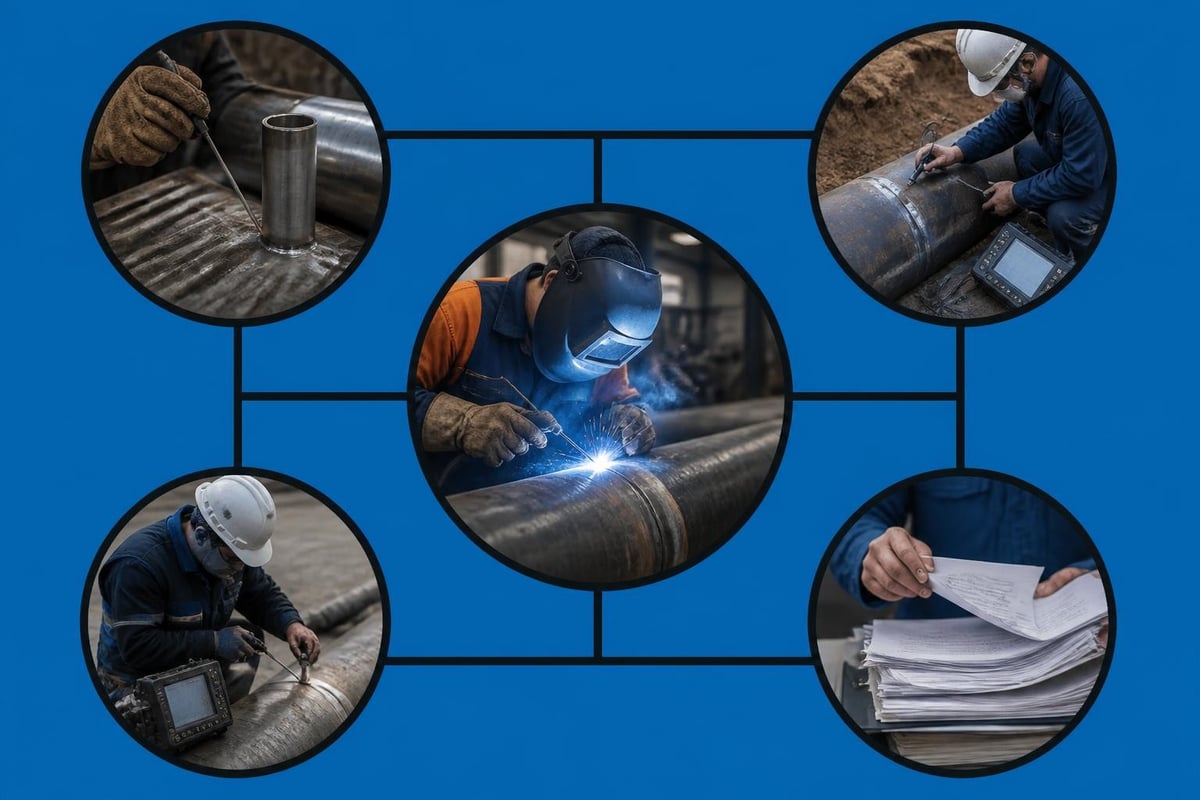
Certified API 1104 pipeline welding contractors maintain comprehensive Welding Procedure Specifications (WPS) that have been qualified through Procedure Qualification Records (PQR). These documents prove that specific welding parameters, filler metals, preheat requirements, and post-weld heat treatment protocols produce acceptable mechanical properties and soundness.
Key elements contractors must maintain include:
- Qualified welding procedures for each base metal combination and thickness range
- Documentation of welder performance qualifications per API 1104 Section 6
- Nondestructive examination (NDE) procedures and qualified inspection personnel
- Quality control manuals aligned with API 1104 acceptance criteria
- Records management systems for traceability and auditing
Companies like LTJ Industrial Services provide pipeline welding services throughout the Western United States, maintaining these qualification systems to serve oil and gas sector clients with projects requiring API 1104 compliance.
Welder Qualification and Performance Testing
While contractors establish the systems and procedures, individual welders must demonstrate their ability to execute those procedures through performance qualification tests. API 1104 Section 6 outlines specific requirements that distinguish pipeline welder testing from general structural welding qualifications.
Performance Test Requirements
Pipeline welder qualification involves welding test coupons under conditions that simulate actual production welding. The test parameters must match or be more restrictive than the production welding conditions.
| Qualification Variable | Production Limit | Test Requirement |
|---|---|---|
| Pipe diameter | Down to 2 inches | Qualifies on smaller sizes |
| Wall thickness | ±50% of test | Must test at expected thickness range |
| Welding position | Specific positions | 5G or 6G qualifies multiple positions |
| Filler metal classification | Specific to test | Cannot substitute without requalification |
Qualified welders working for certified API 1104 pipeline welding contractors receive identification numbers and maintain records showing their test results, radiographic or other NDE examination results, and the essential variables their qualification covers. The American Welding Society provides training resources specifically designed to help welders and contractors understand API 1104 requirements.
Production Welding Monitoring
Qualification represents only the baseline. Contractors must implement monitoring systems to ensure production weld quality remains consistent. This includes periodic testing of radiographic film interpretation, visual inspection consistency, and statistical tracking of repair rates and defect types.
When contractors demonstrate excessive repair rates or patterns indicating systemic issues, requalification of welders or revision of welding procedures may become necessary. Professional welding businesses recognize that ongoing monitoring protects both project quality and their reputation.
Inspection and Acceptance Criteria for Pipeline Welds
API 1104 establishes specific acceptance standards for weld imperfections based on the service severity and inspection method employed. Understanding these criteria separates qualified contractors from those attempting pipeline work without proper expertise.
Nondestructive Examination Methods
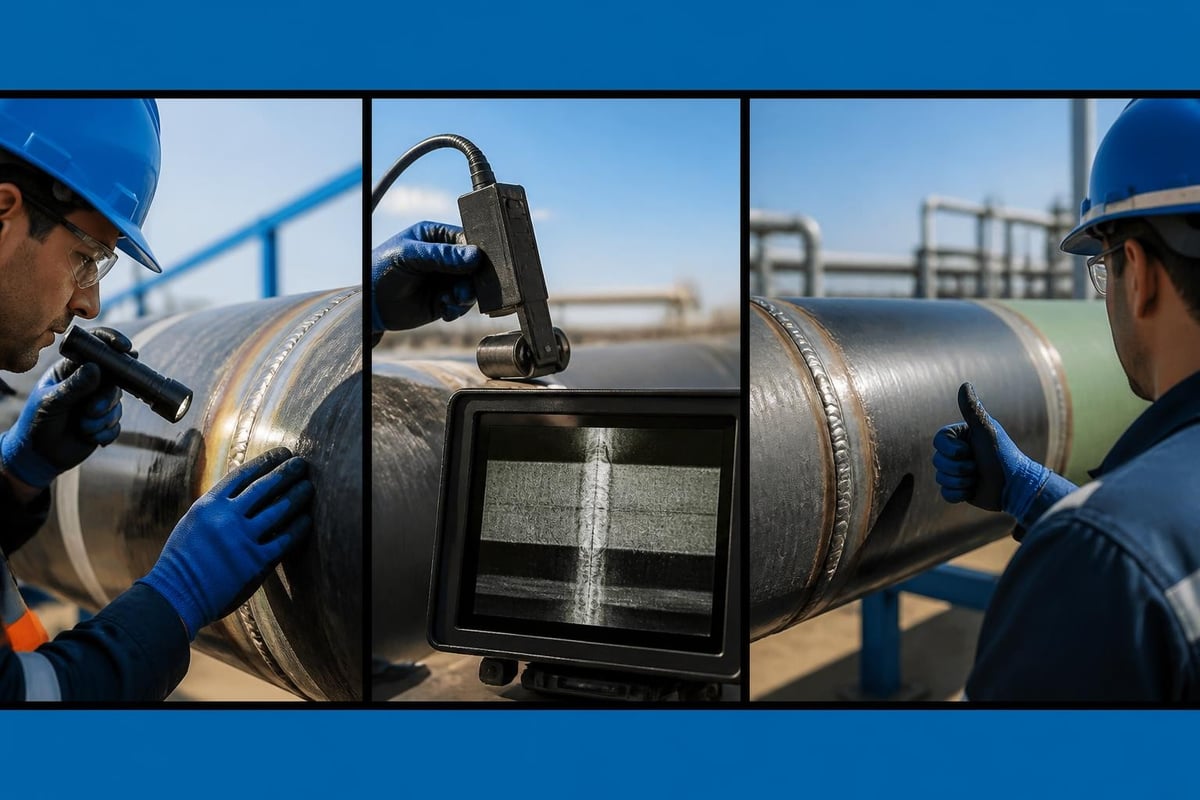
The standard recognizes multiple NDE methods with specific acceptance criteria for each:
- Radiographic examination (RT): Most common for critical pipeline welds, with detailed acceptance limits for porosity, slag inclusions, incomplete fusion, and crack-like indications
- Ultrasonic examination (UT): Increasingly used for real-time inspection, particularly on larger diameter or thicker wall pipe
- Visual examination (VT): Required for all welds as a first-line quality control measure
- Magnetic particle (MT) or liquid penetrant (PT): Surface examination methods for specific applications
Certified API 1104 pipeline welding contractors employ inspectors who hold appropriate certifications and, in many cases, AWS endorsements for API 1104 inspection, which demonstrates specialized knowledge of pipeline weld acceptance criteria.
Imperfection Acceptance Limits
The standard categorizes imperfections and establishes dimensional limits based on wall thickness and imperfection type. For example, isolated porosity receives different treatment than clustered porosity, and elongated slag inclusions face stricter limits than rounded inclusions.
Common acceptance considerations include:
- Linear indications (cracks, incomplete fusion, inadequate penetration) are generally unacceptable
- Rounded indications have size limits based on wall thickness
- Multiple indications must meet minimum spacing requirements
- Surface irregularities must not exceed specified contour limits
Projects involving ASME code welding services for pressure piping often require contractors familiar with both API 1104 and ASME Section IX, as these standards sometimes apply to different portions of the same facility.
Recent Updates and Industry Evolution
The API 1104 standard undergoes periodic revision to incorporate new welding processes, base materials, and inspection technologies. The 22nd edition, released in recent years, introduced several significant changes that certified API 1104 pipeline welding contractors must understand and implement.
Major Technical Changes in Recent Editions
Industry organizations like the Pipeline Research Council International have documented the substantive changes between the 21st and 22nd editions, helping contractors update their quality systems and procedures accordingly.
Key updates include:
- Expanded coverage of automated and mechanized welding systems
- Updated acceptance criteria for ultrasonic examination
- Clarifications on hot tap welding procedures and qualifications
- Enhanced requirements for welder identification and record keeping
- Modified essential variables for procedure qualification
Contractors must review their existing WPS and PQR documentation to ensure compliance with the current edition required by their contracts. Some project specifications reference specific editions, while others require the latest published version.
Practical Implementation Challenges
Industry webinars and training resources, such as those provided by regulatory compliance partners summarizing the 22nd edition updates, help contractors understand how these changes affect daily operations. The transition between editions can create documentation burdens, particularly for contractors maintaining multiple procedure books for different clients or jurisdictions.
Selecting the Right Pipeline Welding Contractor
Procurement teams and project managers evaluating potential contractors should look beyond simple claims of API 1104 capability. Thorough vetting ensures the selected contractor can deliver compliant, high-quality work on schedule.
Qualification Documentation Review
Request and verify the following documentation before contract award:
| Document Type | Verification Points | Red Flags |
|---|---|---|
| Welding Procedure Specifications | Current edition, signed by qualified personnel | Outdated references, missing essential variables |
| Procedure Qualification Records | Complete mechanical testing, matching WPS | Incomplete data, test results near minimum acceptance |
| Welder Qualification Records | Within qualification expiration, covers required positions | Expired qualifications, limited position coverage |
| NDE Procedures | Written practices, qualified personnel | Generic procedures, unqualified inspectors |
| Quality Control Manual | API 1104 specific sections, audit history | Generic welding QC, no API 1104 references |
Experience and Track Record
Beyond documentation, contractors should demonstrate relevant project experience. Case studies from similar projects provide insight into a contractor's ability to manage scope, schedule, and quality simultaneously. Experience with the specific pipe materials, diameters, and service conditions relevant to your project proves particularly valuable.
Ask potential contractors about:
- Similar diameter and wall thickness combinations
- Experience with the specified base metal grades
- Familiarity with any special processes (hot taps, tie-ins, repair procedures)
- Geographic experience in your project location
- References from recent pipeline projects
Safety Program Integration
Pipeline welding often occurs in challenging environments where safety represents a paramount concern. Proper safety signage from suppliers like SafetySignsForSale helps maintain awareness of hazards, but comprehensive safety programs require systematic approaches to hazard identification, training, and incident prevention. Certified API 1104 pipeline welding contractors should maintain robust safety programs that integrate with their quality management systems.
Quality Control Systems and Project Management
Successful pipeline projects require more than qualified welding procedures and skilled welders. Contractors must implement comprehensive quality control systems that ensure consistent compliance throughout project execution.
Production Monitoring and Documentation
Daily quality control activities for certified API 1104 pipeline welding contractors include:
- Pre-welding inspection of joint preparation and fit-up
- In-process monitoring of welding parameters and techniques
- Visual examination of completed welds
- NDE scheduling and results documentation
- Defect tracking and repair procedure implementation
- Weather monitoring and environmental controls
Contractors should use digital documentation systems that provide real-time visibility into production status, inspection results, and compliance metrics. These systems support both internal quality assurance and external auditing by owner representatives or regulatory inspectors.
Defect Management and Repair Procedures
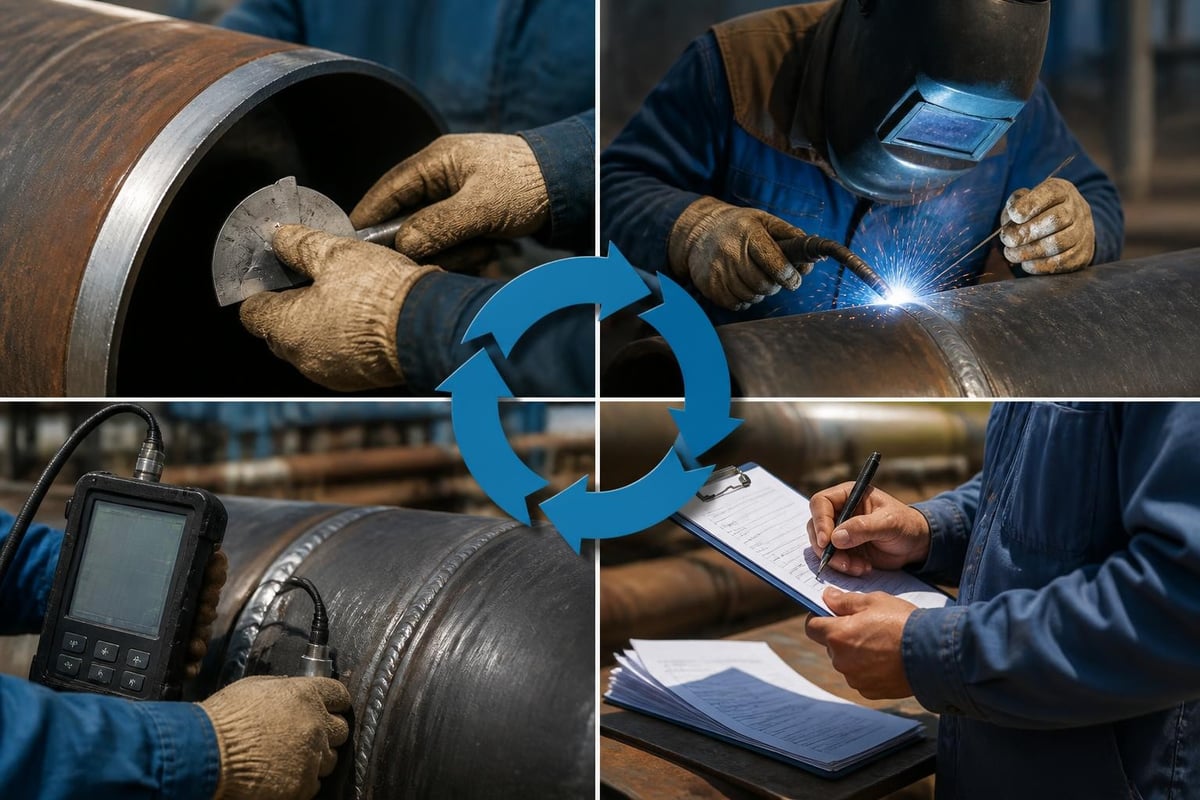
Even with qualified procedures and welders, some production welds will require repair. API 1104 provides specific requirements for repair procedures, including:
- Complete removal of defective weld metal
- Re-examination of the repair cavity to ensure complete removal
- Welding using qualified repair procedures
- Re-examination of the completed repair using the original NDE method
Contractors should track repair rates by welder, joint type, and defect category. Statistical analysis of this data identifies training opportunities, procedure refinements, or systemic issues requiring corrective action.
Integration with Related Standards and Regulations
Pipeline projects rarely operate under API 1104 alone. Certified API 1104 pipeline welding contractors must understand how this standard integrates with regulatory requirements, other industry codes, and project-specific quality programs.
Relationship to ASME B31 Piping Codes
The ASME B31 series of piping codes govern pipeline design, construction, and operation. While ASME B31.4 (liquid petroleum pipelines) and B31.8 (gas transmission pipelines) establish overall requirements, they generally reference API 1104 for welding provisions. Understanding these relationships becomes critical when projects involve metal fabrication services that include both pipeline and facility piping components.
The ASME guidance on pipeline personnel qualification helps contractors understand how API 1104 welder qualification relates to ASME Section IX requirements and operator qualification programs under B31Q.
Federal and State Regulatory Requirements
In the United States, the Pipeline and Hazardous Materials Safety Administration (PHMSA) establishes minimum safety standards for pipeline construction and operation. While PHMSA regulations reference industry standards like API 1104, they also impose additional requirements for:
- Operator qualification programs
- Construction inspection and testing
- Record retention and documentation
- Incident reporting and investigation
State regulations may impose requirements beyond federal minimums. Contractors working across multiple states must maintain awareness of jurisdiction-specific requirements and integrate them into project quality plans.
Technology and Innovation in Pipeline Welding
The pipeline welding industry continues to evolve with new technologies that improve productivity, quality, and safety. Certified API 1104 pipeline welding contractors who adopt these innovations while maintaining compliance gain competitive advantages.
Automated and Mechanized Welding Systems
Modern pipeline projects increasingly employ automated welding systems that offer:
- Consistent heat input and travel speed
- Reduced weather sensitivity through controlled environments
- Enhanced productivity on long pipeline runs
- Improved weld quality through precise parameter control
- Comprehensive data logging for quality documentation
These systems require specialized procedure qualification and operator training beyond traditional manual welding. The API 1104 standard has expanded to address automated welding, but contractors must develop internal expertise to implement these technologies successfully.
Advanced NDE Technologies
Traditional radiographic examination remains common, but alternative NDE methods offer advantages in specific applications:
Phased array ultrasonic testing (PAUT) provides:
- Real-time inspection results
- No radiation safety concerns
- Detailed flaw characterization
- Permanent digital record capabilities
Time of flight diffraction (TOFD) ultrasonic testing excels at:
- Height sizing of planar defects
- Inspection of thick-walled pipe
- High probability of detection for critical flaws
Contractors investing in these technologies must qualify inspection procedures, train and certify technicians, and ensure project specifications allow alternative NDE methods.
Training and Workforce Development
The pipeline welding industry faces ongoing challenges in maintaining a qualified workforce as experienced welders retire and projects demand increasing technical sophistication. Certified API 1104 pipeline welding contractors must invest in training programs that develop both welding skills and code knowledge.
Structured Training Programs
Effective training programs combine:
- Classroom instruction on API 1104 requirements and metallurgy fundamentals
- Hands-on welding practice with immediate feedback
- Mock qualification tests simulating actual performance testing
- Continuing education on standard updates and new technologies
- Cross-training on inspection and quality control functions
Organizations providing comprehensive shop and field services often develop internal training capabilities that reduce reliance on external labor markets and ensure workforce alignment with company quality standards.
Certification Pathways for Inspection Personnel
Quality pipeline projects require qualified inspectors who understand API 1104 acceptance criteria and can consistently evaluate weld quality. Inspector training should address:
- Visual inspection techniques for weld surface and profile
- Radiographic film interpretation
- Ultrasonic examination fundamentals and advanced techniques
- Welder performance test witnessing
- Documentation requirements and record keeping
The API inspection certification programs provide frameworks for inspector qualification that many pipeline owners require or prefer.
Regional Considerations for Western United States Projects
Pipeline projects in the Western United States present unique challenges related to terrain, weather, regulatory environment, and logistics. Contractors familiar with these regional factors deliver more reliable results than those primarily experienced in other geographic areas.
Environmental and Permitting Factors
Western states maintain strict environmental regulations affecting pipeline construction:
- Cultural resource surveys and archaeological monitoring requirements
- Endangered species protections and seasonal work restrictions
- Water quality permits for stream crossings and wetland impacts
- Air quality considerations in non-attainment areas
- Visual impact mitigation in scenic or recreational areas
Contractors must integrate environmental compliance with welding quality management, ensuring that schedule pressures or mitigation measures don't compromise weld integrity.
Altitude and Weather Challenges
High-altitude welding presents technical challenges that affect procedure qualification:
- Modified shielding gas requirements due to reduced atmospheric pressure
- Enhanced wind protection needs for gas-shielded processes
- Cold weather requiring additional preheat and interpass temperature control
- Rapid temperature changes affecting heat input consistency
Companies with extensive experience across Colorado industries and similar Western states understand these factors and incorporate them into welding procedures and quality control practices.
Selecting certified API 1104 pipeline welding contractors requires careful evaluation of qualifications, experience, quality systems, and regional expertise to ensure project success. When your pipeline or facility projects demand the highest standards of welding quality and regulatory compliance, LTJ Industrial Services brings comprehensive capabilities in pipeline welding, fabrication, and field services throughout the Western United States, backed by qualified procedures, skilled craftspeople, and proven project delivery.