When selecting a protective finish for metal fabrication projects, the powder coating vs paint durability debate often takes center stage. For manufacturers in the aggregate, oil and gas, and recycling industries, choosing the right coating system directly impacts equipment lifespan, maintenance costs, and operational reliability. Both powder coating and conventional liquid paint offer distinct advantages, but understanding their durability characteristics helps you make informed decisions that protect your investment and reduce downtime across demanding Western United States industrial environments.
Understanding Powder Coating and Liquid Paint Fundamentals
Powder coating applies dry pigment particles electrostatically to metal surfaces before curing in an oven at temperatures between 350°F and 400°F. This process creates a chemical bond that produces a uniform, thick film without solvents or volatile organic compounds.
Liquid paint, by contrast, relies on solvents to keep pigments and resins in suspension during application. The coating dries through solvent evaporation and chemical curing, building protection through multiple thin layers.
Key application differences include:
- Powder coating requires specialized electrostatic equipment and curing ovens
- Liquid paint offers more flexibility in field application and touch-up
- Powder systems generate minimal hazardous waste
- Liquid coatings accommodate more complex geometries and thin-wall components
The application method fundamentally affects the final coating structure, which directly influences long-term durability performance in industrial settings.
Chemical Composition and Film Formation
Powder coating formulations typically use either thermoplastic or thermoset resins. Thermoplastic powders melt and flow during curing but remain reversible with heat. Thermoset powders undergo irreversible chemical crosslinking, creating a more durable molecular structure resistant to heat, chemicals, and mechanical stress.
Liquid paints employ alkyd, epoxy, polyurethane, or acrylic resins suspended in organic solvents or water. The U.S. EPA recognizes powder coating as offering environmental advantages while delivering comparable or superior performance to liquid alternatives in many applications.
Corrosion Resistance Performance Comparison
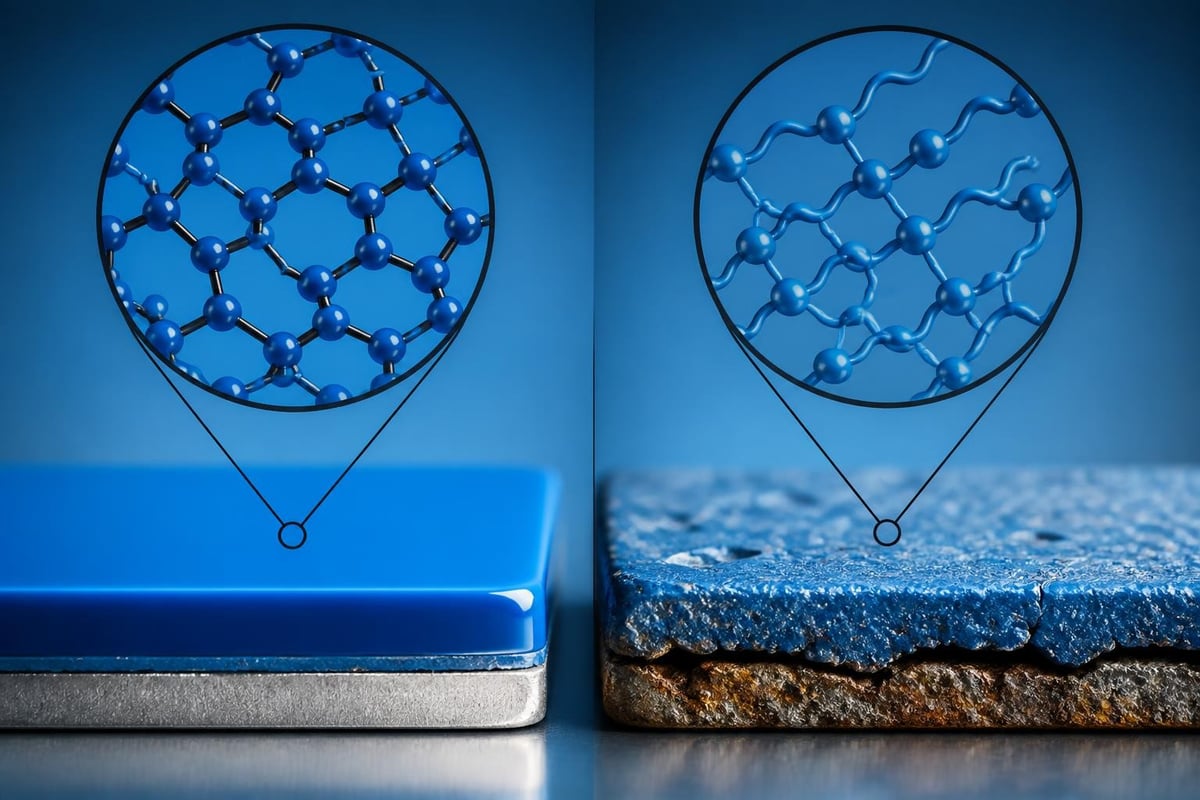
Corrosion resistance represents the most critical durability factor for equipment exposed to moisture, chemicals, and industrial atmospheres. The powder coating vs paint durability question often centers on how each system protects against rust and oxidation.
Powder coating typically provides superior corrosion resistance due to its thicker, more uniform film build. A single powder coat application commonly achieves 2-4 mils of thickness, whereas liquid paint requires multiple coats to reach equivalent protection levels.
| Performance Factor | Powder Coating | Liquid Paint |
|---|---|---|
| Typical Film Thickness | 2-4 mils (single coat) | 0.8-1.5 mils (per coat) |
| Salt Spray Resistance (ASTM B117) | 1,000-3,000+ hours | 500-1,500 hours |
| Edge Coverage | Excellent (electrostatic wrap) | Variable (application-dependent) |
| Pinhole Resistance | Superior (thicker film) | Requires multiple coats |
The ASTM B117 salt spray test provides standardized corrosion resistance measurement, with powder coatings regularly outperforming single-coat liquid systems. For aggregate processing equipment or oil field components exposed to moisture and contaminants, this advantage translates directly into extended service life.
Environmental Exposure Factors
Western United States industrial operations face diverse environmental challenges including intense UV radiation at high elevations, temperature extremes from sub-zero winters to summer heat, and chemical exposure from process materials.
Powder coating advantages in harsh environments:
- Superior UV stability with minimal chalking or color fade
- Excellent temperature cycling resistance without cracking
- Chemical resistance to petroleum products, acids, and alkalis
- Reduced moisture permeation through continuous film structure
High-performance powder formulations meeting AAMA 2605 specifications demonstrate exceptional weathering resistance with minimal color change or gloss loss after 10+ years of outdoor exposure. This makes powder coating particularly valuable for outdoor processing equipment, structural components, and material handling systems.
Mechanical Durability and Abrasion Resistance
Industrial equipment endures constant mechanical stress from material contact, vibration, impact, and friction. The powder coating vs paint durability comparison must account for how each finish withstands these physical challenges.
Powder coating's thicker film and crosslinked structure provide excellent impact resistance and abrasion protection. The cured finish maintains flexibility that absorbs impact energy without chipping or cracking, even in cold temperatures where some liquid coatings become brittle.
Abrasion and Wear Testing
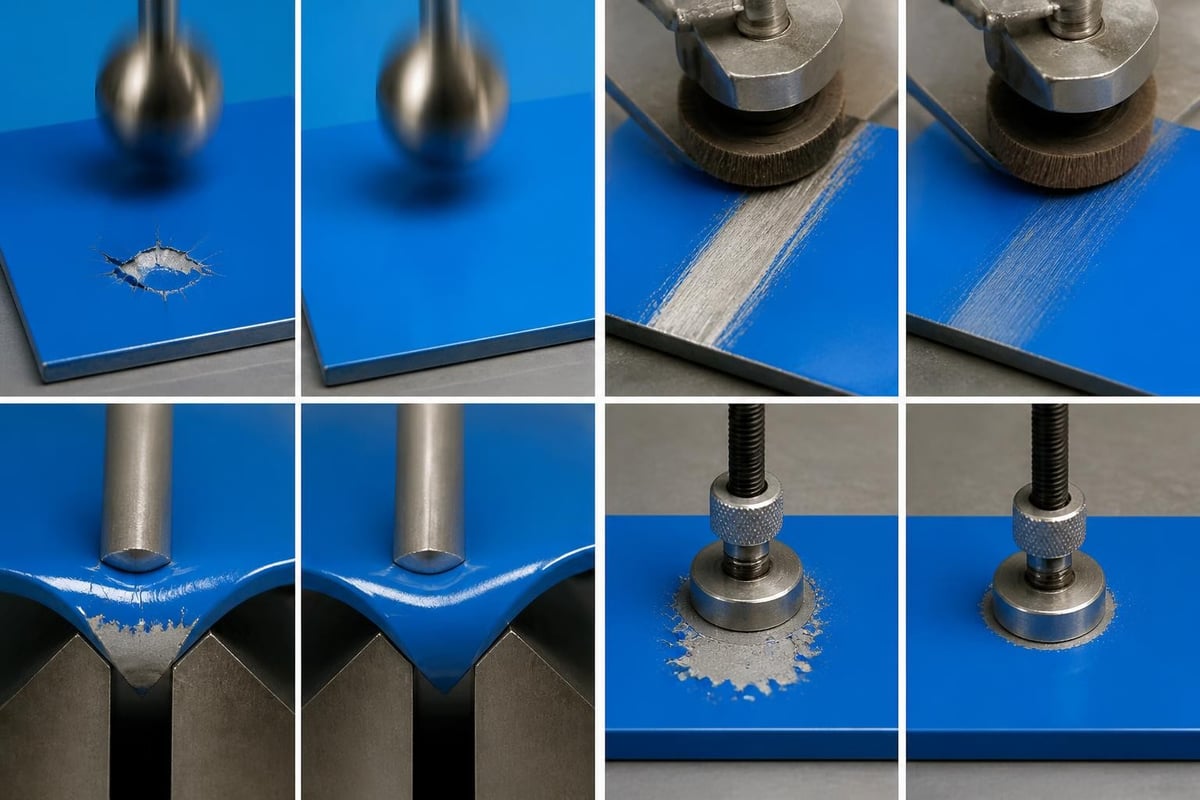
Standard abrasion tests measure coating resistance to surface wear under controlled conditions. Powder coatings consistently demonstrate superior performance in Taber abraser testing, requiring more cycles to reach equivalent wear depth compared to conventional liquid paints.
Testing methodologies include:
- Taber Abrasion Test (ASTM D4060) – rotating abrasive wheels measure wear resistance
- Falling Sand Test (ASTM D968) – evaluates coating resistance to particle impact
- Cross-Hatch Adhesion Test (ASTM D3359) – measures coating bond strength
- Impact Resistance Test (ASTM D2794) – quantifies resistance to sudden impact
For recycling facility equipment processing abrasive materials or aggregate handling systems, superior abrasion resistance directly reduces maintenance frequency and extends component lifespan.
Thickness and Coverage Considerations
Film thickness profoundly influences protective performance. The powder coating vs paint durability equation changes significantly when comparing equivalent thickness levels versus typical application practices.
Powder coating naturally builds thicker films in a single application cycle. Electrostatic attraction pulls powder particles around edges and into recesses, creating relatively uniform coverage on complex geometries. This "wraparound" effect provides better edge protection than liquid paint, where surface tension can cause edge thinning.
| Coverage Aspect | Powder Coating | Conventional Paint |
|---|---|---|
| Single-Pass Thickness | 2-4 mils typical | 0.8-1.5 mils typical |
| Edge Coverage | Excellent (electrostatic wrap) | Poor to fair (requires special technique) |
| Inside Corners | Very good | Excellent |
| Faraday Cage Areas | Challenging (requires technique) | Good (atomization reaches recesses) |
| Coating Uniformity | Very consistent | Operator-dependent |
For custom fabrication projects requiring consistent protection across varying geometries, powder coating delivers more predictable results. However, deep recesses, threaded holes, and complex internal passages may benefit from liquid coating's superior penetration characteristics.
Multi-Layer Systems
Some high-durability applications combine both technologies. A powder coating primer provides excellent corrosion resistance and film build, while a liquid topcoat offers specific performance characteristics like extreme chemical resistance or color-matching requirements.
These hybrid systems leverage each technology's strengths, though they increase complexity and cost. The Journal of Coatings Technology & Research explores emerging advanced coating approaches that may further enhance durability performance for demanding industrial applications.
Cost Analysis and Long-Term Value
Initial application costs represent only part of the economic equation when evaluating powder coating vs paint durability. Total cost of ownership includes material expenses, application labor, curing energy, waste disposal, maintenance frequency, and expected service life.
Powder coating cost factors:
- Higher equipment investment for spray booth and curing oven
- Lower material waste (overspray reclaimed and reused)
- Minimal solvent disposal costs
- Single-coat application reduces labor
- Extended durability reduces recoating frequency
Liquid paint cost factors:
- Lower equipment investment (spray guns, compressors)
- Higher material waste from overspray and cleanup
- Solvent disposal and regulatory compliance costs
- Multiple coats increase labor time
- More frequent maintenance and recoating
For established fabrication shops with consistent coating volumes, powder systems typically deliver lower per-part costs and superior long-term value. Field applications and low-volume custom work often favor liquid paint's flexibility despite higher material costs.
Maintenance and Recoating Requirements
Durability directly impacts maintenance schedules and lifecycle costs. Powder-coated components in typical industrial service often require first recoating after 15-20 years of outdoor exposure, while conventional liquid paint systems may need refinishing every 5-10 years depending on environmental conditions and coating quality.
Touch-up and repair present different challenges for each system. Liquid paint allows straightforward field touch-up with matching material. Powder coating touch-up requires portable curing equipment or liquid touch-up paint that may not perfectly match the original finish appearance, though protection remains effective.
Application-Specific Durability Requirements
Different industrial applications demand varying durability characteristics. The powder coating vs paint durability decision should align with specific operational requirements, environmental exposures, and performance priorities.
Oil and Gas Industry Applications
Equipment serving oil field operations faces petroleum product exposure, outdoor weathering, and mechanical abuse. Powder coating excels in these conditions, providing:
- Excellent resistance to crude oil, diesel fuel, and hydraulic fluids
- Superior impact resistance from tools and equipment contact
- UV stability for outdoor installations
- Reduced maintenance in remote locations
Valves, wellhead components, storage tanks, and structural steel benefit from powder coating's robust protection. Specialty liquid coatings may be specified for extreme chemical exposure or ultra-high-temperature applications exceeding powder coating's thermal limits.
Aggregate and Mining Equipment
Crushing equipment, conveyor systems, and material handling components endure severe abrasion from rock, sand, and processed aggregates. High-build powder coatings with enhanced abrasion resistance formulations provide optimal protection for:
- Crusher housings and wear plates
- Screen decks and support structures
- Conveyor frames and idler assemblies
- Material chutes and transfer points
While no coating eliminates wear in direct material contact zones, powder coating protects structural areas from corrosion while providing reasonable abrasion resistance in moderate-wear applications.
Recycling Industry Components
Recycling operations process diverse materials creating complex chemical exposures, abrasion, and contamination. Equipment coating must resist acids from batteries, alkalis from cleaning processes, petroleum residues, and mechanical damage from material handling.
Epoxy-based powder coatings offer excellent chemical resistance and mechanical durability for recycling equipment including:
- Material sorting equipment and conveyors
- Baler frames and hydraulic components
- Storage containers and processing vessels
- Structural supports and platforms
The continuous film structure and superior adhesion of powder coating prevent underfilm corrosion that commonly degrades liquid-painted equipment in contaminated recycling environments.
Temperature Performance and Thermal Cycling
Temperature extremes affect coating durability through direct thermal stress and expansion/contraction cycling. Powder coating vs paint durability performance varies significantly across temperature ranges.
Standard powder coatings maintain integrity from approximately -40°F to 250°F, covering most industrial equipment operating ranges. Specialized high-temperature powder formulations withstand continuous exposure up to 400°F for applications like exhaust components or industrial ovens.
| Temperature Factor | Powder Coating | Liquid Paint |
|---|---|---|
| Standard Upper Limit | 250°F continuous | 180-250°F (formulation-dependent) |
| High-Temp Formulations | 400-600°F | 500-1,200°F (specialty systems) |
| Cold Temperature Flexibility | Excellent (-40°F+) | Variable (some become brittle) |
| Thermal Cycling Resistance | Superior (crosslinked structure) | Good to excellent (formulation-dependent) |
Equipment experiencing significant temperature cycling-such as outdoor components in Western mountain climates or process equipment with heating/cooling cycles-benefits from powder coating's dimensional stability and crack resistance.
Performance Standards and Industry Specifications
Specifying coating systems according to recognized industry standards ensures consistent powder coating vs paint durability performance. Multiple organizations publish specifications defining minimum performance requirements for various applications.
The American Architectural Manufacturers Association (AAMA) publishes several specifications for organic coatings, with AAMA 2605 representing the highest performance tier. This specification requires accelerated weathering resistance equivalent to 10+ years Florida outdoor exposure with minimal color change or gloss loss.
Key performance specifications include:
- AAMA 2603 – Base-level architectural coating performance
- AAMA 2604 – Enhanced performance for commercial applications
- AAMA 2605 – Superior performance for demanding environments
- ASTM D3363 – Film hardness measurement (pencil hardness test)
- ASTM D522 – Flexibility testing (mandrel bend)
Industrial fabricators should specify appropriate performance levels matching application requirements. PCI Magazine discusses how proper specification and system design achieve optimal durability through powder coating.
Quality Control and Inspection
Consistent durability requires proper quality control during application. Critical process variables include surface preparation, coating thickness, curing temperature and time, and environmental conditions.
Surface preparation fundamentals:
- Remove all contamination (oils, mill scale, rust)
- Create appropriate surface profile (50-100 microinches for powder coating)
- Apply conversion coating or pretreatment for maximum adhesion
- Verify cleanliness before coating application
Inadequate surface preparation remains the leading cause of premature coating failure regardless of coating type. Proper preparation provides greater durability impact than coating selection alone.
Field Versus Shop Application Considerations
Application location significantly influences powder coating vs paint durability decisions. Powder coating requires controlled shop conditions with specialized curing equipment, while liquid paint accommodates both shop and field application.
Shop fabrication advantages:
- Optimal surface preparation equipment and processes
- Controlled temperature and humidity during application and curing
- Complete coating before assembly and installation
- Quality inspection and testing capabilities
Field application requirements:
- Component size or installation prevents shop coating
- Repair and touch-up of installed equipment
- Environmental conditions (temperature, humidity, wind)
- Limited equipment and process control
Large fabricated assemblies destined for Western United States industrial sites often receive shop powder coating before shipment, maximizing durability through optimal application conditions. Field touch-up uses compatible liquid coatings for repairs and missed areas.
Making the Right Choice for Your Application
Evaluating powder coating vs paint durability for specific projects requires balancing multiple factors including performance requirements, application constraints, cost considerations, and long-term value expectations.
Decision framework questions:
- What environmental exposures will the coating face (UV, moisture, chemicals, temperature)?
- What mechanical stresses occur (abrasion, impact, flexing)?
- Is shop application feasible or field coating required?
- What are acceptable maintenance intervals and lifecycle costs?
- Do specifications mandate particular coating systems or performance levels?
- Are there regulatory requirements (VOC limits, environmental compliance)?
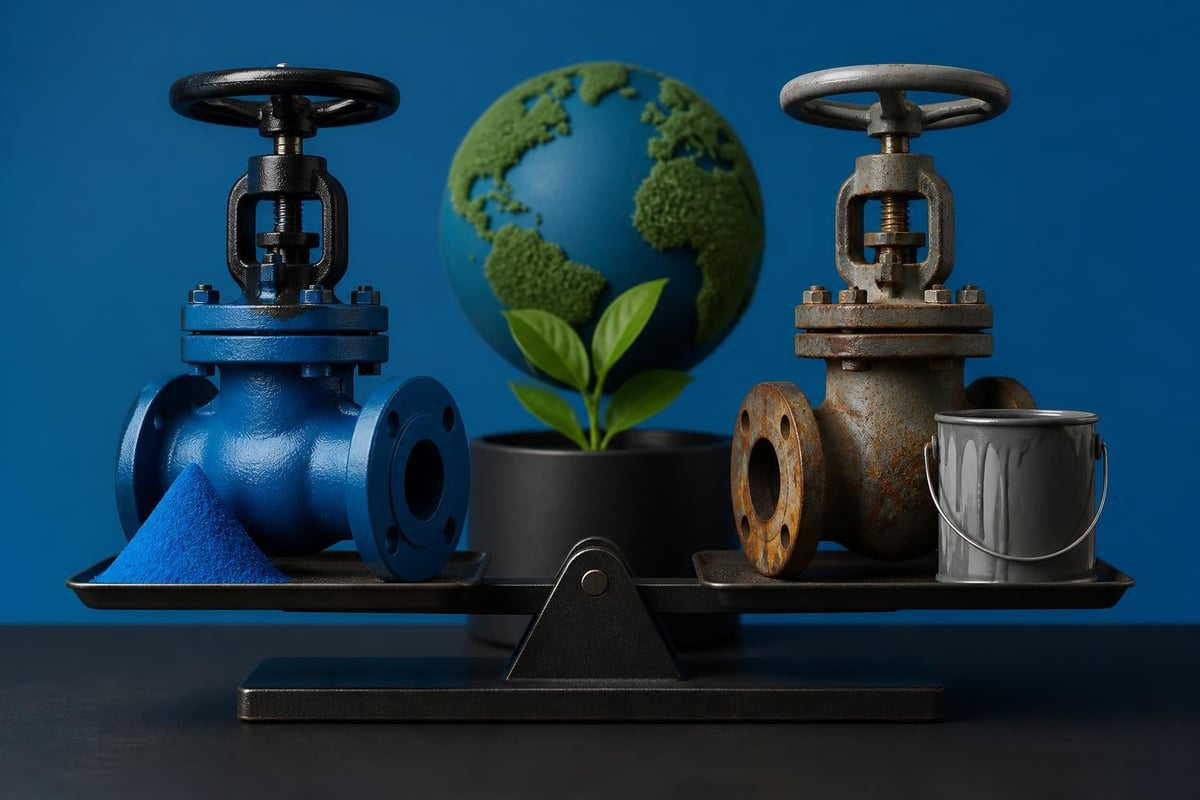
For most industrial fabrication serving aggregate, oil and gas, and recycling applications throughout the Western United States, powder coating delivers superior durability, lower environmental impact, and better long-term value compared to conventional liquid paint systems. The technology's robust performance under harsh operating conditions justifies initial equipment investment for shops with consistent coating volumes.
Custom fabrication, field repairs, and specialized applications may benefit from liquid paint's application flexibility or specific performance characteristics. Some projects optimally employ both technologies, leveraging each system's strengths within a comprehensive coating program.
The powder coating vs paint durability debate continues evolving as coating technologies advance, but current powder coating formulations consistently outperform conventional liquid paints across most industrial durability metrics relevant to manufacturing, processing, and production equipment applications.
Selecting the right coating system based on durability requirements, application constraints, and lifecycle costs ensures your fabricated components deliver reliable long-term performance. Whether you need custom metal fabrication, precision machining, or specialized welding services throughout Colorado and the Western United States, LTJ Industrial Services combines technical expertise with quality craftsmanship to deliver solutions that meet your exact specifications. Contact our team to discuss how our comprehensive fabrication and finishing capabilities can support your next project.