When excavators experience worn bushings, misaligned pivot points, or damaged boom connections, traditional repair approaches often require complete equipment disassembly and costly transport to a machine shop. On site line boring services for excavators eliminate these inefficiencies by bringing precision machining directly to your location, restoring critical tolerances without moving the equipment. This field machining approach has become essential for operators throughout the Western United States who need to minimize downtime while maintaining OEM specifications.
Understanding Line Boring Technology for Heavy Equipment
Line boring represents a specialized machining process that restores cylindrical holes to precise dimensions and alignment. For excavators, this technology addresses the inevitable wear that occurs at pivot points, pin connections, and bushing interfaces where thousands of operational cycles create ovalization and dimensional loss.
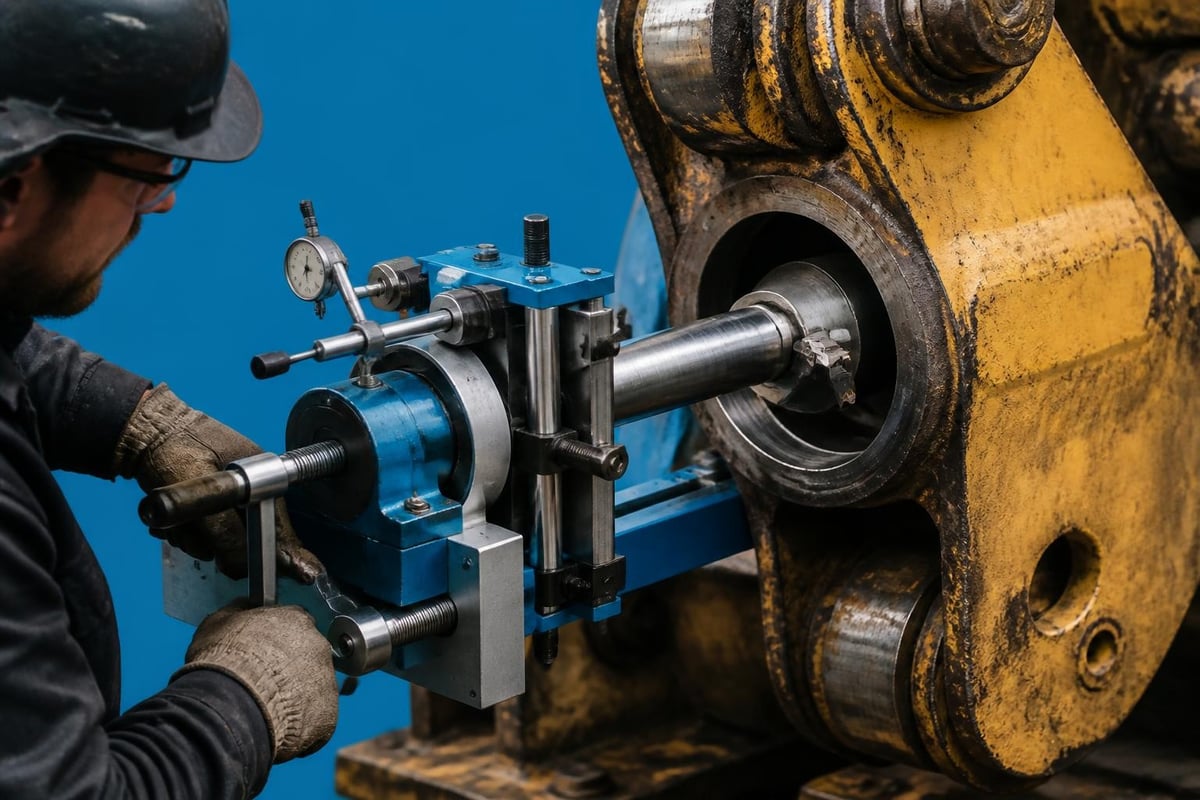
The fundamental principle involves mounting a boring bar through the worn bore, then using cutting tools to remove material in controlled passes until the hole returns to round and within tolerance. What distinguishes on site line boring services for excavators from shop-based work is the portable equipment designed specifically for field conditions.
Portable Line Boring Equipment Components
Modern field line boring systems consist of several integrated components that enable precision work in challenging environments:
- Boring bars: Rigid shafts sized for specific bore diameters, providing the foundation for cutting operations
- Feed mechanisms: Hydraulic or mechanical systems that advance cutting tools at controlled rates
- Alignment fixtures: Custom brackets and support structures ensuring the boring bar maintains perfect alignment
- Cutting tools: Carbide-tipped inserts designed for specific materials and finish requirements
- Measurement instruments: Digital micrometers and bore gauges verifying dimensions throughout the process
The portable machining approach allows technicians to establish a stable machining platform directly on the equipment frame, transforming the excavator itself into a temporary machine tool.
Common Excavator Applications Requiring Line Boring
Excavators contain dozens of pin-and-bushing connections that experience extreme loading cycles. Over time, even properly maintained equipment develops wear patterns that compromise performance and accelerate secondary damage.
Boom and Stick Pivot Points
The main boom pivot carries the entire weight of the boom assembly plus bucket loads, creating tremendous bearing pressures. Worn pivot bushings allow excessive play, which translates to imprecise bucket positioning and accelerated wear on hydraulic cylinders. On site line boring services for excavators restore these critical mounting points without removing the boom from the mainframe.
Stick pivot connections face similar challenges with the added complexity of constantly changing angles during digging operations. When these bushings wear beyond acceptable limits, operators notice increased cycle times and difficulty maintaining grade.
Bucket Link Connections
Bucket linkages represent some of the highest-wear areas on excavators due to continuous articulation under load. The combination of rotational movement and impact forces creates both radial and axial wear patterns. Addressing these worn connections through field line boring prevents the need for complete linkage replacement, which often costs three to five times more than precision machining repairs.
| Wear Location | Typical Wear Rate | Repair Frequency | Downtime (Shop) | Downtime (On-Site) |
|---|---|---|---|---|
| Main boom pivot | 0.003-0.008" annually | Every 3-5 years | 5-7 days | 8-16 hours |
| Stick pivot | 0.004-0.010" annually | Every 2-4 years | 4-6 days | 6-12 hours |
| Bucket pins | 0.006-0.015" annually | Every 1-3 years | 3-5 days | 4-8 hours |
Undercarriage and Track Frame Connections
Track roller frames and idler mounts experience constant vibration and loading that gradually elongates mounting bores. These applications require precise alignment across multiple bores to ensure proper track tensioning and component lifespan.
The On-Site Line Boring Process From Setup to Completion
Executing on site line boring services for excavators demands methodical preparation and strict adherence to safety protocols. The process typically follows a structured sequence that ensures both worker safety and machining accuracy.
Pre-Machining Assessment and Preparation
Before any cutting begins, experienced technicians perform detailed measurements of existing bore conditions. This assessment identifies the extent of wear, ovalization patterns, and final machining dimensions required. Digital bore gauges capture readings at multiple points along the bore length and at various rotational positions.
Proper lockout-tagout procedures are absolutely critical when working on heavy equipment. All hydraulic pressure must be relieved, electrical systems de-energized, and mechanical components secured against unexpected movement. Documentation of energy isolation protects both technicians and ensures compliance with safety regulations.
The work area receives thorough cleaning to remove contaminants that could interfere with machining or damage cutting tools. Grease, dirt, and rust are eliminated from bore surfaces and surrounding structures where alignment fixtures will mount.
Alignment and Fixturing
Establishing perfect alignment represents the most critical phase of field line boring. Even minor misalignment produces tapered or skewed bores that accelerate future wear and may prevent proper bushing installation.
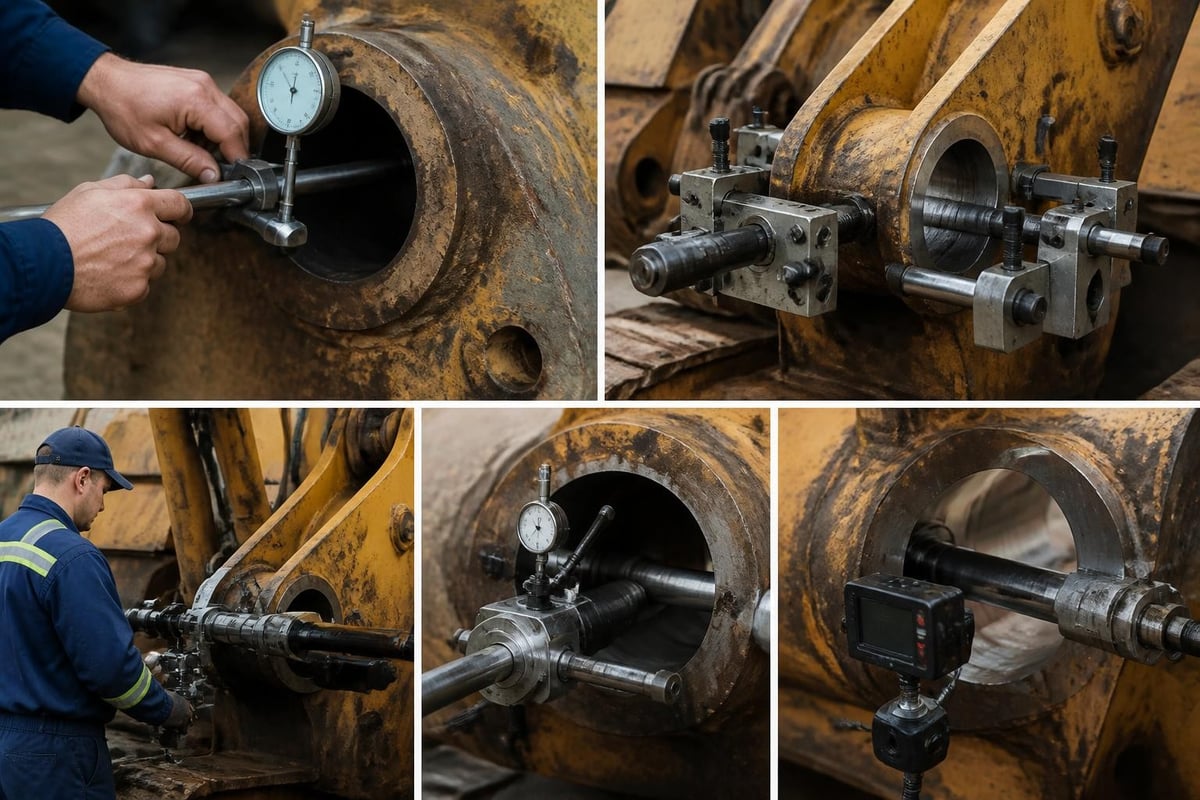
Technicians use precision levels, dial indicators, and laser alignment tools to position the boring bar exactly parallel to the required bore centerline. Custom fixtures fabricated for specific excavator models provide rigid support while accommodating the unique geometry of each application.
Key alignment verification steps include:
- Measuring and recording the existing bore centerline position
- Installing alignment fixtures with verified mounting surface contact
- Positioning the boring bar and confirming parallel alignment in two planes
- Conducting trial measurements before committing to cutting operations
- Maintaining alignment verification throughout the machining process
Machining Operations and Quality Control
Once alignment is verified, cutting operations proceed in controlled passes that gradually remove material. Feed rates, spindle speeds, and depth of cut are calculated based on bore diameter, material hardness, and desired surface finish.
Technicians at LTJ Industrial Services monitor cutting forces and vibration throughout machining, making real-time adjustments to maintain optimal conditions. Excessive vibration indicates tool wear or alignment issues requiring immediate correction.
Dimensional verification occurs after each roughing pass and continuously during finishing operations. The goal is achieving tolerances typically within 0.001-0.002 inches while maintaining surface finishes suitable for press-fit bushings or bearing installation.
Bore Welding Integration for Severely Worn Components
When wear exceeds the maximum oversized bushing available, or when material removal would compromise structural integrity, bore welding provides the solution. This process deposits weld material to the bore interior, building up worn surfaces before machining back to standard dimensions.
The combination of automated bore welding and machining creates a complete restoration cycle. Robotic welding equipment maintains consistent heat input and deposition rates, minimizing distortion while building adequate material for subsequent machining.
Welding Material Selection and Procedures
Proper filler metal selection ensures the deposited material matches or exceeds the base metal's mechanical properties. For typical excavator frames constructed from high-strength structural steel, low-hydrogen electrodes rated for similar tensile strength provide optimal results.
Preheat and interpass temperature control prevents cracking and reduces residual stresses. Excavator components often require 200-400°F preheat depending on material thickness and carbon content. These thermal management requirements make bore welding a specialized skill requiring certified welders familiar with heavy equipment metallurgy.
After welding, the bore receives stress relief through controlled cooling before machining operations begin. This waiting period, typically 2-4 hours depending on component mass, allows thermal gradients to equalize and material properties to stabilize.
Precision Standards and Tolerance Requirements
On site line boring services for excavators must achieve the same precision standards as factory manufacturing. OEM specifications typically call for bore diameter tolerances of ±0.001-0.002 inches with roundness within 0.001 inches total indicator reading.
Surface finish requirements usually fall between 125-250 microinches Ra, providing adequate support for press-fit bushings while allowing proper lubrication retention. Achieving these finishes in field conditions demands sharp cutting tools, rigid setup, and experienced operators who understand how environmental factors affect machining.
Verification and Documentation
Professional service providers document all dimensions before and after machining, creating permanent records of work performed. This documentation proves valuable for maintenance planning and warranty purposes.
Inspection techniques borrowed from infrastructure applications provide additional verification of bore quality. Ultrasonic testing can detect subsurface defects, while magnetic particle inspection reveals surface cracks that might compromise component integrity.
Quality control extends beyond dimensional accuracy to include visual inspection of machined surfaces, verification of alignment between multiple bores, and confirmation that all safety features and guards are properly reinstalled.
Cost-Benefit Analysis of Field vs. Shop Repairs
The decision between on site line boring services for excavators and traditional shop repairs involves multiple financial and operational considerations. While hourly rates for field service may appear higher than shop labor, the total cost equation often favors on-site work.
Primary cost factors include:
- Transportation expenses for moving heavy equipment to and from repair facilities
- Disassembly and reassembly labor required for component removal
- Extended downtime waiting for shop scheduling and work completion
- Rental equipment costs to maintain productivity during repair periods
- Risk of additional damage during transport and handling
For excavators operating in remote locations or on time-critical projects, the ability to complete repairs without moving equipment provides enormous value. A boom pivot repair completed on-site in 12 hours versus 7 days of shop downtime can easily justify 2-3 times higher labor rates.
| Repair Scenario | Shop Total Cost | On-Site Total Cost | Shop Downtime | On-Site Downtime |
|---|---|---|---|---|
| Main boom pivot | $8,500-12,000 | $6,500-9,000 | 5-7 days | 10-14 hours |
| Bucket link set | $6,000-8,500 | $4,500-6,500 | 3-5 days | 6-10 hours |
| Stick pivot | $7,500-10,500 | $5,800-8,200 | 4-6 days | 8-12 hours |
Scheduling Considerations and Maintenance Planning
Proactive maintenance planning allows operators to schedule on site line boring services for excavators during planned downtime, avoiding emergency repairs during critical project phases. Regular inspection intervals should include bore measurements at high-wear locations, tracking dimensional changes over time.
Many operators throughout the oil and gas, aggregate, and recycling industries served by industrial manufacturing specialists implement condition-based maintenance programs. These programs trigger service when measurements approach tolerance limits rather than waiting for catastrophic failure.
Seasonal Timing Strategies
Weather conditions significantly impact field machining operations. Cold temperatures affect hydraulic fluid viscosity in portable equipment, while extreme heat can cause thermal expansion that complicates precision work. Planning major bore repairs during moderate weather windows improves efficiency and quality.
For operations in the Western United States, spring and fall often provide ideal conditions. Winter field service remains possible with proper equipment preparation and environmental controls, though productivity may decrease 15-25% in extreme cold.
Material and Bushing Selection After Bore Restoration
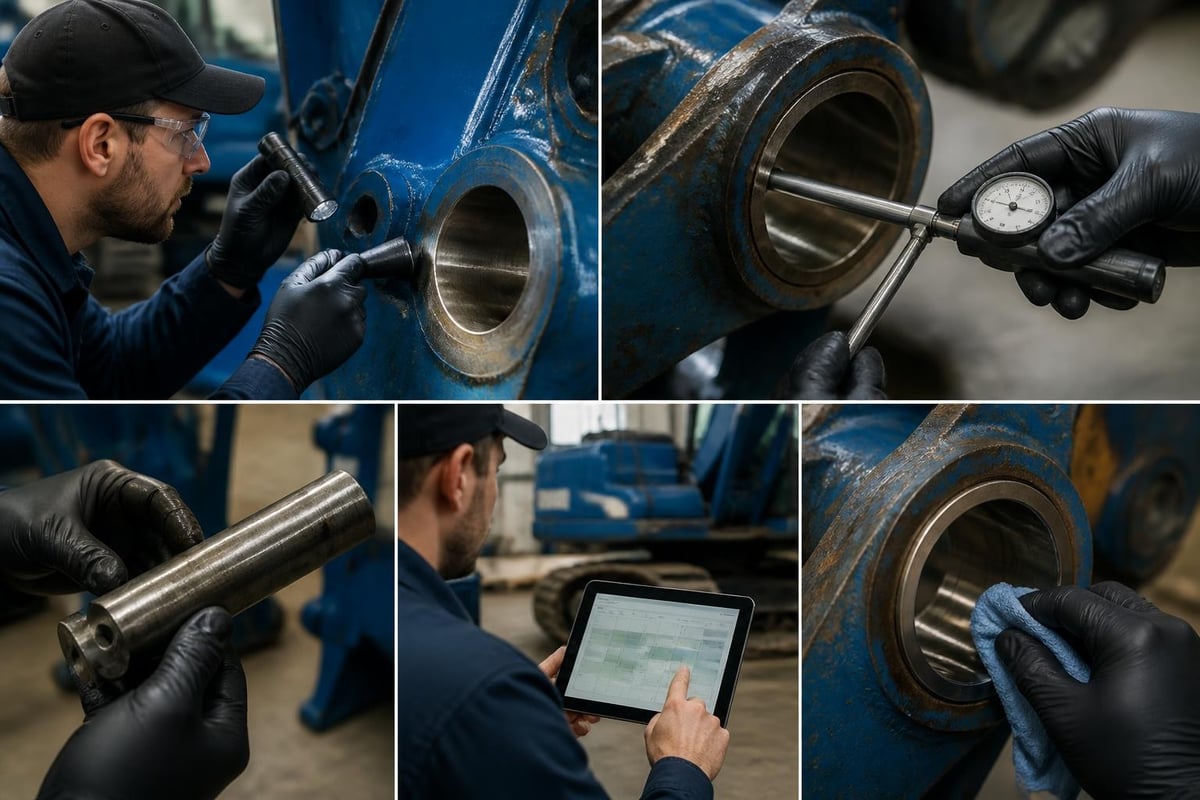
Restoring bores to precise dimensions creates the opportunity to select optimal bushing materials for specific applications. Bronze, polymer, and steel-backed composite bushings each offer distinct advantages depending on loading conditions and maintenance preferences.
High-capacity excavators often benefit from composite bushings that combine steel backing with polymer bearing surfaces. These designs provide exceptional load capacity while reducing maintenance requirements compared to bronze bushings requiring regular greasing.
Press Fit Specifications and Installation
Proper interference fits ensure bushings remain securely positioned under operating loads. Typical specifications call for 0.001-0.003 inches of interference per inch of bore diameter. Achieving these fits requires the dimensional accuracy that professional line boring techniques deliver.
Installation procedures must control pressing forces to avoid bushing damage while ensuring complete seating. Hydraulic presses with calibrated force measurement prevent excessive loads that could crack brittle materials or distort thin-walled components.
Safety Protocols for Field Machining Operations
Performing on site line boring services for excavators involves inherent hazards that require comprehensive safety management. Beyond standard machine safeguarding and lockout procedures, field operations introduce environmental variables absent in controlled shop settings.
Working beneath elevated boom sections demands redundant support systems preventing collapse if primary supports fail. Hydraulic cylinder failure, pin breakage, or fixture movement could release tremendous energy with catastrophic consequences.
Personal protective equipment requirements exceed basic safety glasses and steel-toed boots. Face shields protect against metal chips traveling at high velocity, while hearing protection addresses noise from both machining operations and ambient site activities. Specialized cut-resistant clothing protects against sharp edges common on excavator structures.
Selecting Qualified Service Providers
Not all machining companies possess the specialized equipment, expertise, and safety culture necessary for successful field line boring. Evaluating potential service providers should examine multiple qualification factors beyond simple price comparison.
Critical provider qualifications include:
- Demonstrated experience with excavator models matching your fleet
- Ownership of appropriate portable boring equipment sized for your applications
- Certified welders when bore welding integration is required
- Documented safety training and incident-free performance records
- Quality control procedures ensuring dimensional accuracy verification
- Insurance coverage adequate for the equipment values and liability exposures involved
References from similar operations provide valuable insight into provider performance under actual working conditions. Speaking directly with maintenance managers who have used a provider's services reveals important details about communication, flexibility, and problem-solving capabilities.
Regional Considerations for Western United States Operations
Excavator operations throughout Colorado, Wyoming, Utah, and surrounding states face unique challenges that influence line boring service requirements. High altitude affects engine performance and hydraulic system behavior, while extreme temperature swings accelerate wear at pivot points experiencing thermal cycling.
Remote job sites common in mining, pipeline, and oil field operations make on site line boring services for excavators particularly valuable. The alternative of transporting equipment hundreds of miles for shop repairs becomes economically prohibitive and operationally disruptive.
Companies like LTJ Industrial Services based in Rifle, Colorado, understand these regional factors and maintain mobile capabilities reaching across the Western United States. This geographic positioning enables rapid response when equipment failures threaten project timelines.
Technology Advances Improving Field Machining Capabilities
Portable machining technology continues evolving with innovations that expand capabilities and improve precision. Laser alignment systems now provide micron-level accuracy in setup procedures that previously relied on dial indicators and manual calculations.
Digital measurement integration allows real-time monitoring of bore dimensions during cutting operations. Operators receive immediate feedback if dimensional trends indicate tool wear or alignment drift, enabling corrections before parts move outside tolerances.
Automated control systems manage feed rates and spindle speeds based on material conditions and cutting parameters. These systems optimize productivity while reducing the skill level required for routine operations, though experienced technicians remain essential for complex setups and troubleshooting.
On site line boring services for excavators deliver precision restoration without the costs and delays associated with equipment transport and shop repairs. Understanding the processes, standards, and strategic considerations enables informed decisions that maximize equipment availability while controlling maintenance expenses. LTJ Industrial Services brings comprehensive field machining, welding, and fabrication capabilities directly to your location throughout the Western United States, combining portable precision equipment with decades of heavy equipment repair experience to keep your operations running efficiently.