Finding reliable mobile welding services near me has become essential for industrial operations throughout the Western United States. Whether you're managing an aggregate facility, overseeing recycling operations, or maintaining oil and gas infrastructure, on-site welding capabilities can mean the difference between hours of downtime and immediate solutions. Mobile welding brings professional fabrication, repair, and custom metalwork directly to your location, eliminating transportation costs and minimizing operational disruptions. For commercial and industrial manufacturers, understanding what separates exceptional mobile welding providers from average contractors is crucial for maintaining productivity and ensuring safety compliance.
Understanding Mobile Welding Services
Mobile welding services deliver professional welding capabilities directly to industrial job sites, manufacturing facilities, and commercial operations. Unlike traditional shop-based welding, mobile services bring fully equipped welders and specialized equipment to wherever repairs or fabrication are needed.
This flexibility proves invaluable for industries operating large equipment, fixed infrastructure, or projects requiring on-site customization. Industrial sectors including recycling, aggregate processing, and energy production frequently need immediate welding solutions that cannot wait for equipment transportation or shop scheduling.
Key Service Capabilities
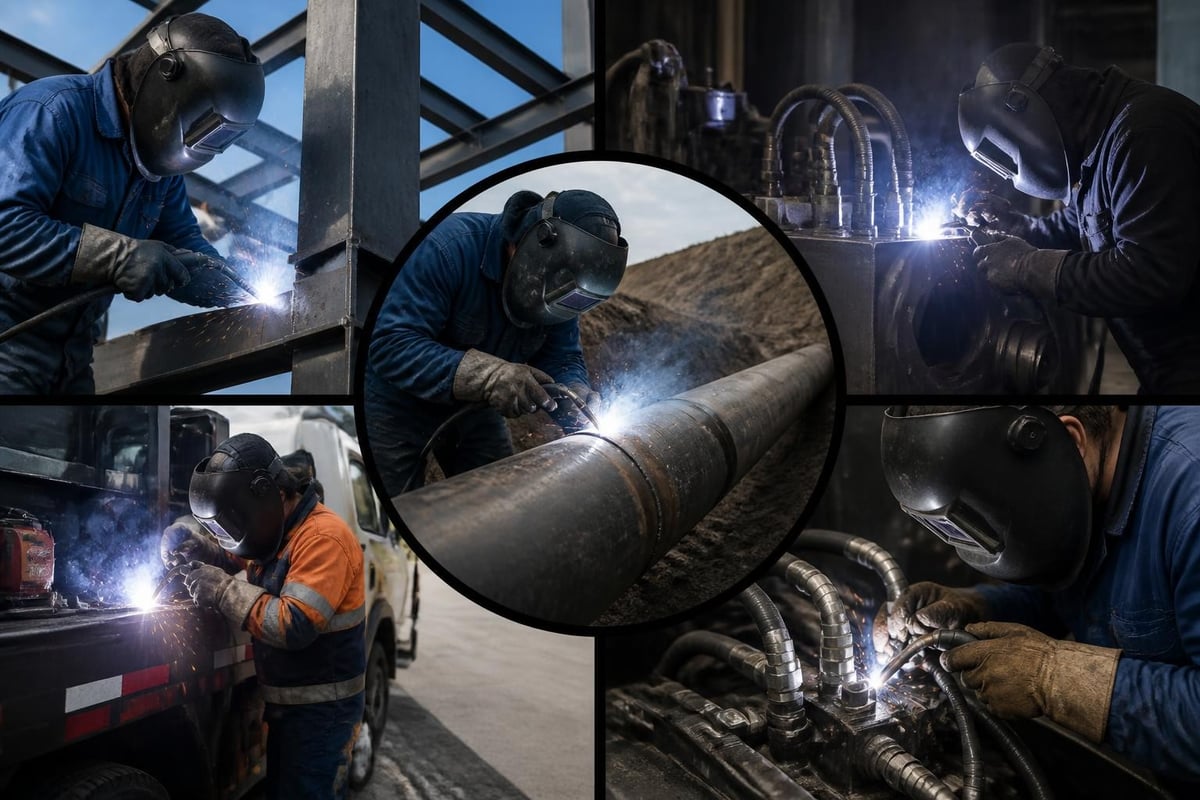
Mobile welding professionals provide comprehensive metalworking solutions beyond basic repairs:
- Structural welding for building frames, supports, and load-bearing components
- Pipeline welding for oil and gas operations requiring field repairs
- Equipment repair welding to fix broken machinery, conveyors, and processing equipment
- Custom fabrication creating specialized parts and modifications on-site
- Emergency welding services available 24/7 for critical breakdowns
- Hydraulic system repairs addressing leaks, cracks, and component failures
The scope of mobile welding extends to virtually any metal joining or fabrication need that occurs outside a traditional shop environment. Professional mobile welders maintain certifications across multiple processes including MIG, TIG, stick welding, and specialty techniques for aluminum, stainless steel, and exotic alloys.
Advantages of On-Site Welding Solutions
Choosing mobile welding services near me offers distinct operational and financial benefits for industrial operations. Transportation logistics alone can create significant challenges when heavy equipment requires shop-based welding.
Time savings represent the most immediate advantage. Mobile welders eliminate equipment disassembly, transportation, shop queue times, and reassembly. A conveyor system repair that might require three days through traditional shop services can often be completed in hours with mobile welding.
Cost efficiency extends beyond obvious transportation savings. Consider the revenue impact of production downtime. An aggregate processing plant losing eight hours of operation while equipment travels to a welding shop may forfeit tens of thousands in production value. Mobile welding addresses these issues immediately, preserving operational continuity.
Operational Benefits Comparison
| Aspect | Mobile Welding | Shop-Based Welding |
|---|---|---|
| Equipment downtime | 2-8 hours typical | 2-5 days typical |
| Transportation costs | None | $500-$3,000+ |
| Production impact | Minimal interruption | Extended shutdown |
| Custom fitting | Perfect on-site match | May require adjustments |
| Emergency availability | 24/7 response possible | Limited to business hours |
Mobile services also provide superior accuracy for custom fabrication. When welders work directly with installed equipment, they ensure perfect measurements and fit. This precision eliminates the common problem of shop-fabricated components requiring field modifications during installation.
For projects involving metal fabrication company services, the ability to assess, fabricate, and install on-site creates seamless integration between design and implementation.
Safety Standards and Compliance
Safety protocols for mobile welding extend beyond standard shop practices due to variable site conditions and unique environmental hazards. Professional providers follow strict guidelines to protect workers, facilities, and surrounding operations.
OSHA welding safety protocols specifically address mobile welding through OSHA 1926.350, covering cylinder safety, fire prevention, and compliance measures essential for field work. These regulations recognize that mobile welding occurs in less controlled environments than fixed shop locations.
Critical Safety Considerations
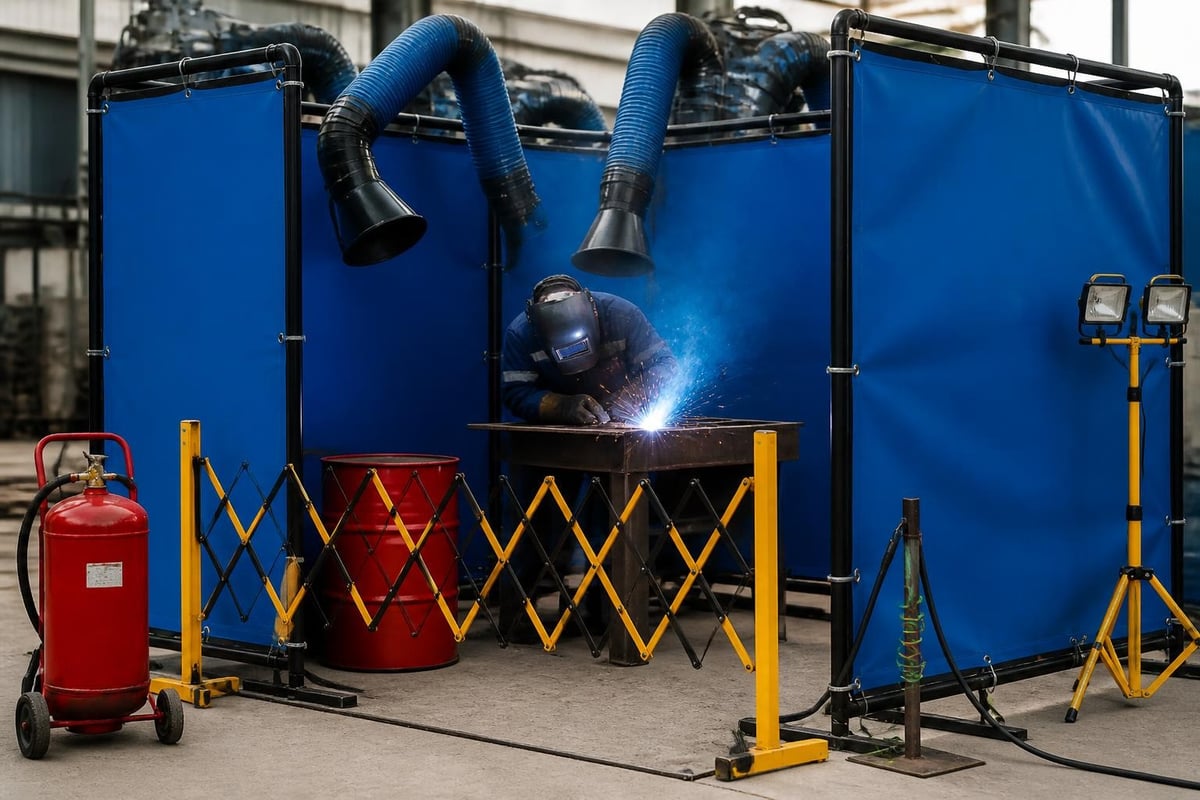
Mobile welding operations must address multiple hazard categories simultaneously:
- Fire prevention through spark containment, fire watch personnel, and extinguisher placement
- Ventilation management ensuring adequate airflow in enclosed or semi-enclosed spaces
- Electrical safety with proper grounding, cable management, and power source verification
- Compressed gas handling following strict cylinder storage and transportation protocols
- Personal protective equipment appropriate to specific welding processes and materials
The American Welding Society standards provide comprehensive frameworks for quality and safety across welding operations. Professional mobile welding services maintain certifications demonstrating compliance with AWS D1.1 Structural Welding Code and relevant industry-specific standards.
According to comprehensive welding safety guidelines, common mobile welding hazards include electric shock, toxic fumes, fire risks, and eye injuries. Qualified mobile welders implement multiple protective measures including insulated equipment, fume extraction systems, fire-resistant barriers, and appropriate PPE for each specific job.
Selecting Quality Mobile Welding Providers
Finding dependable mobile welding services near me requires evaluation beyond simple internet searches. Industrial operations need partners who understand sector-specific requirements, maintain proper certifications, and deliver consistent quality under field conditions.
Qualification Assessment Checklist
- Certifications: AWS certifications, state licensing, and industry-specific qualifications
- Insurance coverage: Comprehensive liability and workers compensation protection
- Equipment quality: Modern, well-maintained welding machines and safety gear
- Process expertise: Proficiency across MIG, TIG, stick, and specialty welding methods
- Material knowledge: Experience with carbon steel, stainless, aluminum, and exotic alloys
- Industry experience: Proven track record in your specific sector (aggregate, recycling, oil & gas)
Response time capabilities separate excellent mobile welding providers from average contractors. Industrial operations cannot afford to wait days for critical repairs. Quality providers maintain emergency response systems, backup equipment, and sufficient personnel to address urgent needs.
Reference verification provides crucial insights into provider reliability. Request specific examples of similar projects, particularly those in comparable industrial environments. Ask about challenges encountered and solutions implemented, revealing problem-solving capabilities and technical depth.
Typical Applications Across Industries
Mobile welding services near me serve diverse industrial applications throughout the commercial manufacturing sector. Understanding common use cases helps businesses recognize when on-site welding provides optimal solutions.
Recycling facilities frequently require mobile welding for conveyor repairs, sorting equipment modifications, and structural reinforcements. The constant material flow creates wear patterns demanding immediate attention without extended shutdowns.
Aggregate operations depend on mobile welding for crusher repairs, screen deck modifications, and heavy equipment maintenance. These facilities process abrasive materials that rapidly wear equipment components, creating ongoing repair needs.
Oil and gas infrastructure requires specialized mobile welding for pipeline repairs, wellhead modifications, and processing equipment maintenance. These applications often demand specific certifications and proven experience with high-pressure systems.
Industry-Specific Requirements
| Industry | Common Applications | Critical Factors |
|---|---|---|
| Recycling | Conveyor systems, sorting equipment | Minimal downtime requirements |
| Aggregate | Crushers, screens, hoppers | Wear-resistant materials |
| Oil & Gas | Pipelines, tanks, processing units | Pressure certifications |
| Manufacturing | Production equipment, custom tooling | Precision fabrication |
| Construction | Structural steel, beam modifications | Code compliance verification |
The hydraulics sector represents another significant mobile welding application. Hydraulic cylinder repairs, fitting replacements, and system modifications often cannot be completed without mobile capabilities. Equipment disassembly and transportation would exceed repair costs in many scenarios.
Cost Factors and Pricing Models
Understanding mobile welding service pricing helps industrial operations budget appropriately and evaluate proposals effectively. Multiple factors influence final costs beyond simple hourly rates.
Travel distance affects pricing significantly. Providers typically charge trip fees or minimum service hours to cover transportation time and equipment mobilization. Local services within 50 miles may charge nominal trip fees, while projects 200+ miles away might require full-day minimums.
Project complexity determines labor time and skill level requirements. Simple repairs might complete in hours at standard rates, while intricate fabrication or specialized alloy welding commands premium pricing reflecting advanced expertise.
Material requirements add direct costs for welding consumables, filler materials, and any fabricated components. Exotic materials like stainless steel or specialized alloys increase consumable costs substantially over standard carbon steel.
Pricing Structure Breakdown
Mobile welding services typically employ several pricing models:
- Hourly rates ($75-$150/hour) for straightforward repairs with variable completion times
- Project-based pricing for defined scopes with predictable requirements
- Emergency service rates (1.5x-2x standard) for after-hours or urgent response
- Retainer agreements providing priority service and potentially reduced rates for high-volume clients
Smart procurement involves obtaining detailed written estimates specifying all cost components. Quality providers itemize labor hours, materials, consumables, travel charges, and any special equipment fees. This transparency allows accurate comparisons between competing proposals.
Consider total cost of ownership when evaluating options. The lowest hourly rate may not represent the best value if that provider requires longer completion times, produces lower-quality work requiring future repairs, or lacks proper insurance coverage creating liability exposure.
Quality Assurance and Workmanship
Verifying mobile welding quality proves more challenging than shop-based work due to field conditions and limited inspection access. Professional providers implement systematic quality control measures ensuring work meets specifications regardless of location.
Pre-weld preparation significantly impacts final quality. Proper cleaning, joint preparation, and material preheating (when required) establish foundations for strong, durable welds. Quality mobile welders invest time in preparation rather than rushing to arc initiation.
Process control maintains consistency throughout welding operations. This includes monitoring amperage, voltage, travel speed, and environmental conditions. Advanced mobile welders use calibrated equipment and document parameters for critical applications.
Post-weld inspection verifies work meets applicable codes and specifications. Visual inspection identifies surface defects, while NDT (non-destructive testing) methods like ultrasonic or radiographic testing verify internal quality for critical applications.
The research on welding quality monitoring demonstrates how statistical methods can model quality inconsistencies, highlighting the importance of systematic approaches to maintaining weld integrity across variable field conditions.
Equipment and Technology Capabilities
Modern mobile welding services leverage advanced equipment extending capabilities far beyond simple stick welding setups. Understanding provider technology reveals their ability to handle diverse project requirements.
Power sources range from diesel-powered engine-driven welders providing independence from electrical infrastructure to sophisticated inverter-based machines offering precise process control. Multi-process machines enable switching between MIG, TIG, and stick welding without equipment changes.
Specialty equipment addresses specific industry needs:
- Orbital welding systems for precise pipe welding in oil and gas applications
- Stud welding equipment for structural attachments
- Plasma cutting systems for precise material removal and preparation
- Hydraulic torque wrenches for proper bolt tensioning adjacent to welded joints
Advanced mobile welding providers invest in condition monitoring technology ensuring equipment reliability and consistent quality output. Modern systems track machine performance, predict maintenance needs, and verify proper operation before critical projects.
Emergency Response and Availability
Industrial breakdowns respect no schedule. Equipment failures occur during nights, weekends, and holidays when production demands remain constant. Emergency mobile welding services near me provide crucial support during these critical situations.
Response time commitments separate true emergency services from standard providers offering nominal after-hours availability. Quality emergency welding services maintain dedicated response personnel, backup equipment, and commitment to specific arrival timeframes (typically 2-4 hours for genuine emergencies).
24/7 availability requires substantial organizational infrastructure. Providers offering round-the-clock service maintain on-call rotations, stocked service vehicles, and established protocols for rapid mobilization. This capability commands premium pricing but delivers invaluable support when production stoppage costs exceed service fees.
Planning ahead mitigates emergency service needs. Establishing relationships with qualified mobile welding providers before emergencies occur ensures faster response and potentially preferential treatment during critical situations. Many industrial operations maintain preferred vendor agreements guaranteeing priority service and predetermined pricing.
Regional Considerations for Western Operations
Selecting mobile welding services near me in the Western United States involves unique considerations beyond standard provider evaluation. Geographic realities significantly impact service delivery and project success.
Travel distances between population centers and industrial sites can be substantial. A recycling facility in rural Colorado may be 150+ miles from the nearest metropolitan area where most welding services concentrate. Understanding provider service radius and willingness to travel to remote locations becomes essential.
Altitude effects influence welding parameters and techniques. High-altitude locations throughout Colorado, Wyoming, and other Western states require welding procedure adjustments accounting for reduced atmospheric pressure and different cooling rates.
Weather extremes present additional challenges. Winter temperatures dropping below zero require special procedures for cold weather welding, while summer heat affects material properties and welder endurance. Experienced regional providers understand these variables and adapt accordingly.
Environmental regulations vary significantly across Western states. Providers serving multiple jurisdictions must maintain current knowledge of local permitting requirements, emission standards, and environmental protection protocols.
Documentation and Compliance Records
Professional mobile welding services maintain comprehensive documentation supporting quality assurance, code compliance, and future maintenance planning. These records provide value beyond immediate project completion.
Welding procedure specifications (WPS) document exactly how welding was performed, including materials, processes, parameters, and techniques. These specifications enable consistent repairs and modifications throughout equipment life.
Welder qualification records verify personnel certifications and demonstrate compliance with applicable codes. AWS certifications should be current and relevant to specific welding processes and materials used in your projects.
Inspection reports capture quality verification results, identifying any defects addressed and confirming final acceptance. These reports become part of permanent maintenance records, supporting warranty claims and future service planning.
Retention of proper documentation satisfies insurance requirements, supports warranty claims, and provides valuable information for future maintenance planning. Quality providers deliver complete documentation packages upon project completion rather than requiring special requests.
Long-Term Partnership Benefits
Establishing ongoing relationships with dependable mobile welding services near me creates compounding value beyond individual project savings. Strategic partnerships deliver benefits unavailable through transactional service relationships.
Familiarity with your equipment allows partnered providers to develop deep understanding of specific machinery, common failure points, and optimal repair techniques. This knowledge reduces diagnostic time and improves solution effectiveness with each successive service call.
Priority scheduling ensures faster response when needs arise. Providers serving valued long-term clients typically prioritize their requests over new or occasional customers, particularly during peak demand periods.
Negotiated pricing structures often provide cost savings for regular customers through retainer agreements, volume discounts, or preferred pricing arrangements. These agreements can reduce overall maintenance costs 15-25% compared to spot market pricing.
Preventive maintenance partnerships prove particularly valuable. Regular inspection visits identify developing problems before failures occur, enabling planned repairs during scheduled downtime rather than emergency response during production hours. This proactive approach minimizes total downtime and extends equipment life.
Selecting the right mobile welding services near me directly impacts operational efficiency, safety compliance, and long-term maintenance costs for industrial operations throughout the Western United States. By evaluating provider qualifications, understanding pricing structures, and establishing strategic partnerships, businesses in recycling, aggregate, oil and gas, and manufacturing sectors can ensure reliable access to expert welding capabilities exactly when and where needed. When your operation requires professional mobile welding, fabrication, or machining services backed by decades of industrial experience, LTJ Industrial Services delivers comprehensive solutions throughout Colorado and the Western region, combining technical expertise with responsive service to keep your operations running smoothly.