
When critical equipment breaks down in industrial operations, downtime costs escalate rapidly. Manufacturing replacement parts machining has become an essential capability for businesses across the aggregate, oil and gas, and recycling industries throughout the Western United States. The ability to produce precise, durable replacement components on demand reduces dependency on OEM supply chains, minimizes production interruptions, and extends the operational life of expensive machinery. For companies operating in remote locations or maintaining legacy equipment, in-house or regional machining capabilities represent the difference between hours of downtime and weeks of waiting for parts.
Understanding the Replacement Parts Machining Process
Manufacturing replacement parts machining encompasses the complete workflow from component analysis through final installation. The process begins with careful examination of the failed or worn part, followed by reverse engineering, material selection, precision machining, and quality verification.
Reverse Engineering and Documentation
The foundation of successful replacement part manufacturing lies in accurate reverse engineering. Technicians measure existing components using calipers, micrometers, and coordinate measuring machines (CMM) to capture precise dimensions. When original specifications are unavailable, precision machining services teams create detailed technical drawings that document every critical dimension, tolerance, and surface finish requirement.
Key reverse engineering steps include:
- Physical measurement of all dimensions and geometric features
- Material analysis through visual inspection and testing
- Documentation of tolerances and fit requirements
- Creation of CAD models for CNC programming
- Verification of critical wear surfaces and contact points
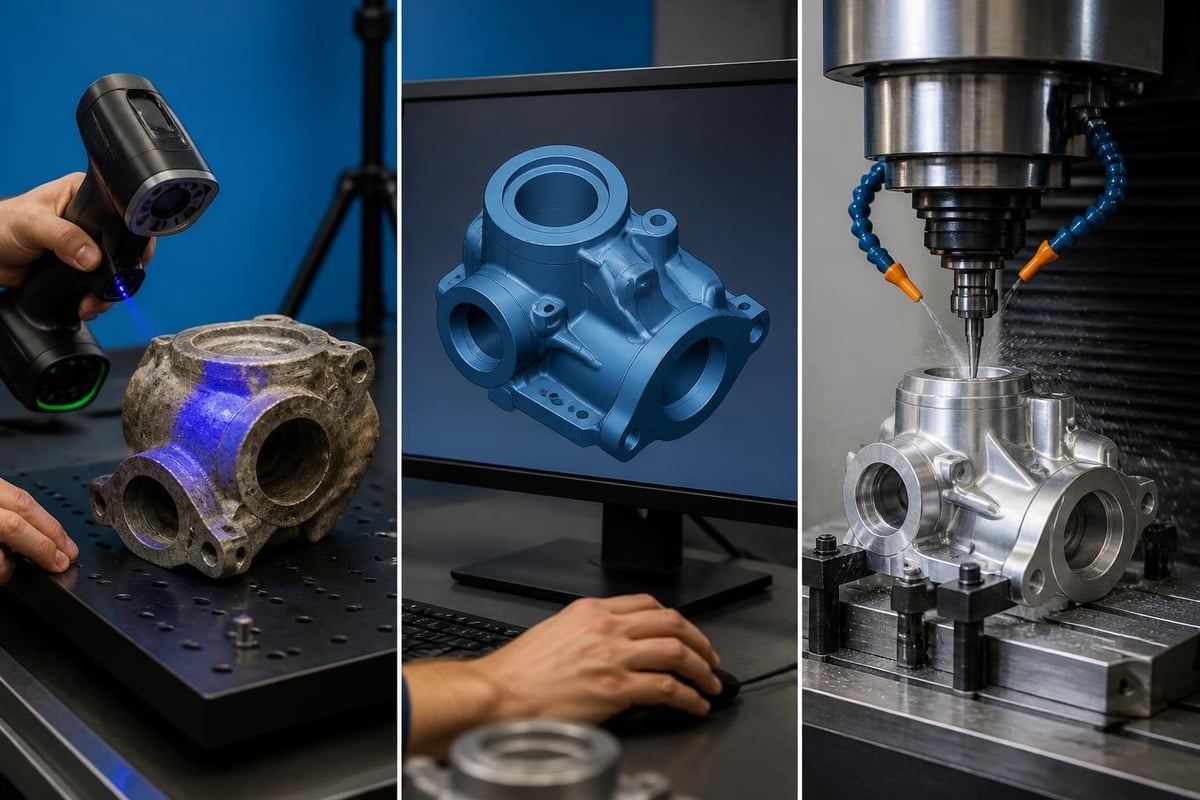
Modern facilities increasingly leverage digital twin technology to improve accuracy. Research shows that digital twins in additive manufacturing systems provide model-based process control and in-line metrology, techniques equally valuable when machining conventional replacement parts to exacting specifications.
Material Selection and Sourcing
Choosing the correct material for replacement parts directly impacts component longevity and performance. Manufacturing replacement parts machining requires matching or improving upon the original material's mechanical properties, corrosion resistance, and wear characteristics.
| Material Category | Common Applications | Key Advantages |
|---|---|---|
| Carbon Steel | Structural components, shafts | High strength, cost-effective, readily available |
| Stainless Steel | Corrosive environments, food processing | Excellent corrosion resistance, hygienic |
| Tool Steel | Wear surfaces, cutting edges | Superior hardness, wear resistance |
| Bronze/Brass | Bushings, bearings | Self-lubricating, corrosion resistant |
| Aluminum Alloys | Weight-critical applications | Lightweight, good machinability |
For specialized applications in the aggregate and mining industries, mining equipment fabrication often requires high-manganese steel or chromium-carbide overlays to withstand extreme abrasion. Material selection must account for operating temperatures, load cycles, environmental exposure, and compatibility with mating components.
Precision Machining Techniques for Replacement Parts
The actual machining phase demands technical expertise and appropriate equipment. Manufacturing replacement parts machining utilizes various processes depending on component geometry, material properties, and required tolerances.
CNC Milling and Turning Operations
Computer numerical control (CNC) machines form the backbone of modern replacement part production. Multi-axis mills handle complex geometries, while CNC lathes excel at cylindrical components like shafts, bushings, and sleeves. Precision CNC machining capabilities enable tight tolerances often measured in thousandths of an inch.
Critical CNC considerations include:
- Toolpath optimization to minimize cycle time while maintaining surface finish
- Fixturing design ensuring repeatable positioning and minimizing distortion
- Cutting parameter selection balancing speed, feed, and tool life
- In-process measurement verifying dimensions before removing parts from machines
- Tool wear monitoring preventing dimensional drift across production runs
The National Center for Manufacturing Sciences provides guidance on parts obsolescence and reverse engineering strategies, highlighting the importance of documented processes when OEM support ceases. This documentation proves invaluable when manufacturing replacement parts for legacy equipment.
Specialized Machining Processes
Beyond conventional milling and turning, certain replacement parts require specialized techniques. Electrical discharge machining (EDM) creates complex internal features or works with hardened materials. Wire EDM cuts intricate profiles in thick stock. Broaching produces precise internal keyways and splines that would be difficult or impossible to mill.
For large components that cannot be transported to a shop, on-site line boring services bring precision machining directly to the equipment. Mobile line boring machines restore bearing bores, pin holes, and mounting surfaces without disassembling entire machines.
Quality Control and Verification Standards
Manufacturing replacement parts machining demands rigorous quality control to ensure components meet or exceed original specifications. A systematic inspection process catches errors before installation and validates that parts will perform reliably in service.
Dimensional Inspection Protocols
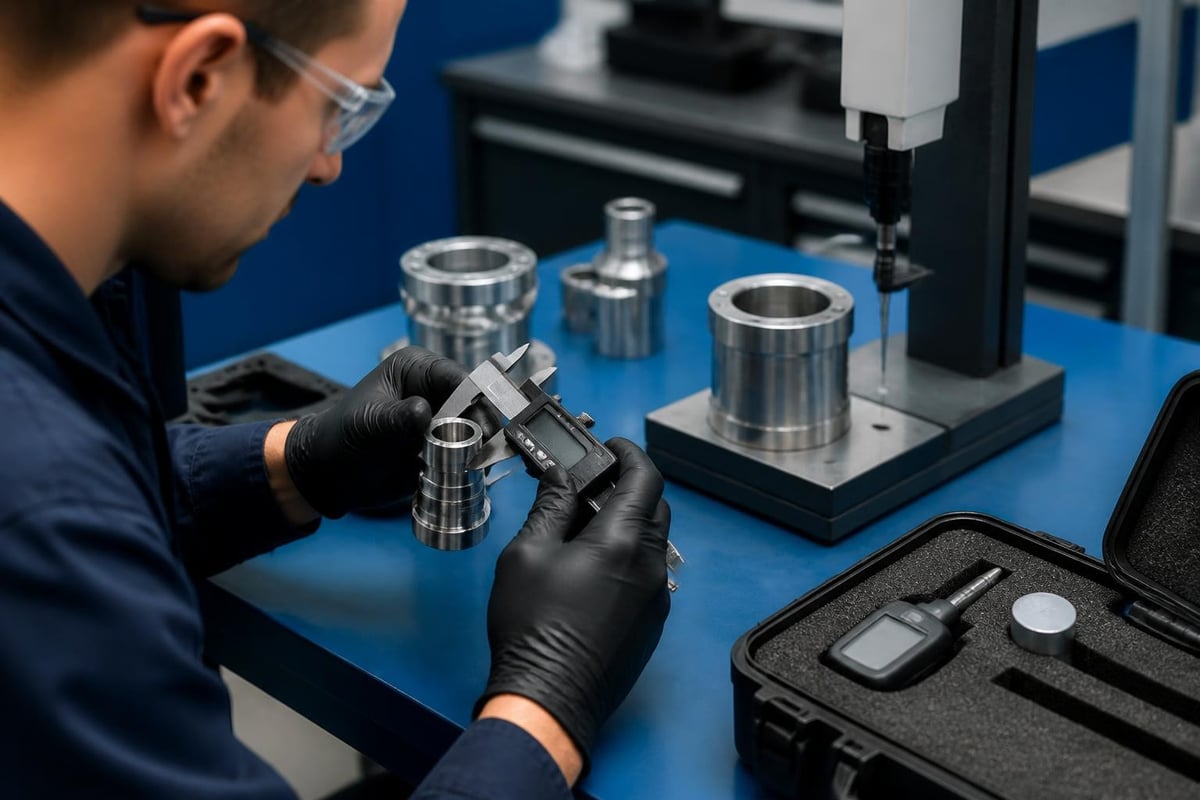
Every critical dimension requires verification against engineering drawings. Inspection methods range from simple hand tools to sophisticated coordinate measuring machines depending on tolerance requirements and part complexity.
Inspection hierarchy by tolerance level:
- ±0.010" tolerances: Dial calipers, micrometers, height gauges
- ±0.002" tolerances: Digital indicators, bore gauges, pin gauges
- ±0.0005" tolerances: CMM, optical comparators, laser scanners
- Geometric tolerancing: CMM with GD&T software, surface plates
Surface finish measurements verify that wear surfaces, sealing surfaces, and bearing journals meet specifications. Portable profilometers measure roughness (Ra) values, while visual comparison to reference standards provides quick verification for less critical surfaces.
Material Property Verification
Beyond dimensional accuracy, replacement parts must possess appropriate material properties. Hardness testing confirms that heat treatment achieved desired results. Rockwell, Brinell, or Vickers hardness tests take seconds but provide critical validation that parts will resist wear and deformation.
For structural components, non-destructive testing (NDT) methods detect internal defects:
- Magnetic particle inspection reveals surface and near-surface cracks in ferromagnetic materials
- Dye penetrant testing identifies surface-breaking defects in any non-porous material
- Ultrasonic testing locates internal voids, inclusions, or delamination
- Radiographic inspection provides permanent records of internal structure
Integration with Welding and Fabrication Services
Manufacturing replacement parts machining often integrates closely with welding and fabrication capabilities. Complex assemblies may combine machined components with welded structures, while worn parts frequently benefit from weld repair followed by precision machining.
Weld Repair and Machining Workflows
Worn shafts, housings, and structural members can often be restored through weld buildup followed by remachining. This approach proves particularly cost-effective for large, expensive components where replacement would be prohibitively expensive. Recycling equipment repair and welding frequently employs this technique to extend equipment life in demanding applications.
The typical repair sequence follows this pattern:
- Clean and prepare the worn surface
- Apply appropriate weld metal using MIG, TIG, or hardfacing processes
- Allow proper cooling to prevent cracking and distortion
- Machine the welded surface to final dimensions
- Inspect and verify dimensional accuracy
Hybrid approaches combining additive and subtractive processes show promise. Oak Ridge National Laboratory research on toolpath considerations explores how CAM strategies optimize machining-in-loop repair and remanufacturing workflows, techniques applicable to conventional weld-and-machine repairs.
Custom Fabrication and Assembly
Many replacement "parts" are actually assemblies requiring both fabrication and machining expertise. A replacement conveyor roller might need a machined shaft, fabricated end plates, welded structural supports, and machined bearing journals. Custom machining services coordinate these operations to deliver complete, ready-to-install assemblies.
| Operation Type | Typical Applications | Equipment Required |
|---|---|---|
| Machining | Precision fits, bearing surfaces, threads | CNC mills, lathes, grinders |
| Welding | Structural assembly, repair buildup | MIG, TIG, stick welders |
| Fabrication | Brackets, frames, housings | Press brakes, shears, rollers |
| Finishing | Corrosion protection, appearance | Sandblasting, painting, coating |
This integrated approach reduces lead times and coordination challenges. When welding, machining, and fabrication occur under one roof, quality control improves and scheduling becomes more predictable.
Supply Chain and Lead Time Considerations
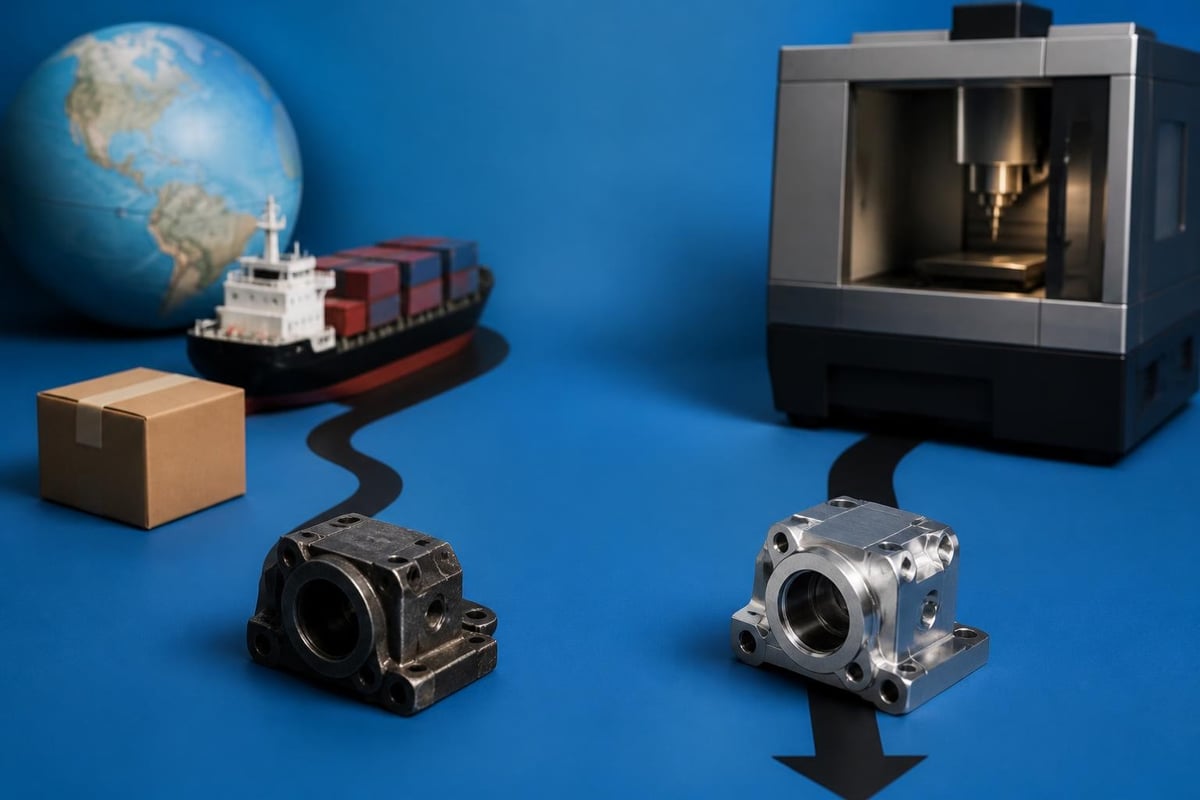
Manufacturing replacement parts machining locally offers significant supply chain advantages over relying exclusively on OEM sources. When equipment fails, waiting weeks or months for parts shipped from distant manufacturers translates directly into lost production revenue.
OEM Availability Challenges
Original equipment manufacturers face their own supply chain pressures. Parts for older equipment may be discontinued entirely, forcing operators to source alternatives or manufacture replacements. Even current-production parts may have extended lead times due to manufacturing backlogs, shipping delays, or minimum order quantities that don't align with actual needs.
Academic research on replacement-part supply chains and intellectual property examines how digital manufacturing technologies affect spare parts logistics, highlighting both opportunities and legal considerations when producing replacement components.
Common OEM sourcing problems include:
- Discontinued parts for legacy equipment still in service
- Minimum order quantities exceeding actual requirements
- Extended lead times during supply chain disruptions
- Premium pricing for low-volume specialty components
- Shipping costs and delays for international suppliers
Regional Manufacturing Advantages
Partnering with regional providers for manufacturing replacement parts machining offers operational flexibility. Located in Rifle, Colorado, facilities serving the Western United States reduce shipping times from weeks to days while enabling face-to-face collaboration on complex requirements.
Regional manufacturers can inspect failed parts, discuss application requirements, and recommend improvements all while maintaining communication throughout the production process. This proximity proves invaluable when urgent breakdowns threaten production schedules.
Cost Analysis and Decision Framework
Deciding whether to manufacture replacement parts versus purchasing from OEM sources requires careful cost-benefit analysis. The optimal approach varies based on part complexity, required quantities, urgency, and long-term fleet considerations.
Break-Even Calculations
For high-value components or recurring replacements, manufacturing replacement parts machining often proves more economical than OEM purchases. The analysis must account for both direct costs and indirect factors.
Direct cost components:
- Material costs (raw stock, consumables, coatings)
- Machine time (setup, programming, actual cutting)
- Labor hours (engineering, machining, inspection)
- Tooling and fixturing (amortized across expected production)
- Quality verification and documentation
Indirect cost factors:
- Downtime costs during lead time periods
- Inventory carrying costs for spare parts
- Risk mitigation value of local supply redundancy
- Engineering knowledge captured for future needs
- Opportunity cost of delayed repairs
A simple break-even formula compares total manufacturing costs against OEM pricing plus downtime costs. When OEM lead times extend weeks but local manufacturing delivers in days, the downtime differential often justifies higher per-unit manufacturing costs.
Prototype and Small-Batch Considerations
Manufacturing replacement parts machining proves particularly valuable for prototype development and small production runs. Prototype machining and fabrication services enable iterative development, testing modifications before committing to larger orders.
For equipment modifications or improvements, producing small batches locally allows field testing under actual operating conditions. Feedback from operators can inform design refinements before scaling production, reducing the risk of expensive mistakes.
Complementary Services and Capabilities
Comprehensive manufacturing facilities offer services beyond basic machining that enhance replacement part solutions. Integration with finishing, assembly, and field installation services provides turnkey solutions.
Surface Treatment and Finishing
Machined components often require protective coatings or surface treatments to achieve desired service life. Corrosion protection, wear resistance, and aesthetic requirements all influence finishing choices.
Industrial powder coating provides durable, corrosion-resistant finishes for many applications. For components operating in high-temperature or chemical environments, specialized coatings may be necessary. Industrial sandblasting prepares surfaces for optimal coating adhesion.
Field Installation and Commissioning
Manufacturing replacement parts represents only part of the solution. Field installation services complete the workflow, ensuring components install correctly and perform as designed. For hydraulic systems, hydraulic system repair expertise ensures proper integration with existing equipment.
Field mechanics verify that replacement parts fit properly, function as intended, and that surrounding components haven't sustained damage. This comprehensive approach reduces the risk of repeat failures and validates that the manufactured replacement truly solves the original problem.
Documentation and Continuous Improvement
Professional manufacturing replacement parts machining operations maintain detailed records that prove invaluable for future needs. Documentation serves multiple purposes from quality assurance to supply chain optimization.
Engineering Records and Revision Control
Every manufactured replacement part should generate documentation including:
- Detailed dimensional drawings with tolerances
- Material specifications and certifications
- Machining process sheets with parameters
- Inspection reports and measurement data
- Installation instructions and torque specifications
This documentation enables rapid reorders when additional parts are needed. More importantly, it captures engineering knowledge that might otherwise exist only in the experience of individual technicians. When similar failures occur on related equipment, this database accelerates problem-solving.
Failure Analysis and Root Cause Investigation
Manufacturing replacement parts provides opportunity to examine why original components failed. Was the part underspecified for actual loads? Did contamination cause premature wear? Did installation errors create stress concentrations? Understanding root causes enables improved designs that address underlying issues rather than simply replicating failed components.
Common improvement opportunities include:
- Upgrading materials for better wear or corrosion resistance
- Modifying geometries to reduce stress concentrations
- Adding lubrication ports or access for maintenance
- Improving surface finishes on wear surfaces
- Incorporating inspection access for condition monitoring
This continuous improvement mindset transforms breakdown maintenance into opportunities for equipment optimization. Over time, well-documented manufacturing replacement parts machining operations build institutional knowledge that drives reliability improvements across entire fleets.
Manufacturing replacement parts machining delivers critical capabilities for industrial operations facing equipment downtime, supply chain challenges, or obsolete component issues. From reverse engineering through precision machining, quality verification, and field installation, integrated capabilities reduce lead times while improving reliability. LTJ Industrial Services combines comprehensive machining, welding, and fabrication expertise to deliver custom replacement parts throughout the Western United States, helping businesses minimize downtime and maximize equipment longevity. Whether you need a single prototype or ongoing production support, experienced teams bring the precision and responsiveness your operations demand.