Manufacturing operations across the Western United States rely on specialized industrial welding services to maintain equipment, fabricate custom components, and ensure continuous production. From oil and gas facilities to aggregate processing plants, the demand for precision welding has grown significantly as industries push for higher quality standards and operational efficiency. Understanding the scope, techniques, and applications of professional welding services helps business owners make informed decisions about their maintenance and fabrication needs.
Understanding Industrial Welding Services in Modern Manufacturing
Industrial welding services encompass a comprehensive range of metal joining processes designed to meet the rigorous demands of commercial and manufacturing sectors. These services extend far beyond basic welding to include custom fabrication, structural repairs, pipe systems, and specialized applications that keep industrial operations running smoothly.
The fundamentals of industrial welding involve multiple techniques, each suited to specific materials, thicknesses, and operational requirements. Professional welding providers must maintain expertise across various methods while adhering to strict industry standards and safety protocols.
Core Welding Techniques Used in Industrial Applications
Modern industrial facilities require different welding approaches depending on the project specifications and material properties. The most commonly employed techniques include:
- MIG (Metal Inert Gas) Welding: Ideal for high-speed production and thicker materials
- TIG (Tungsten Inert Gas) Welding: Provides precision for thin materials and critical joints
- Stick Welding: Versatile for outdoor and field applications
- Flux-Cored Arc Welding: Effective for heavy fabrication and structural work
- Resistance Welding: Suited for automotive and sheet metal applications
Each method offers distinct advantages. TIG welding delivers exceptional precision for stainless steel and aluminum, making it essential for food processing equipment and pharmaceutical manufacturing. MIG welding provides speed and efficiency for structural steel fabrication, while stick welding remains the go-to choice for field repairs in challenging environmental conditions.
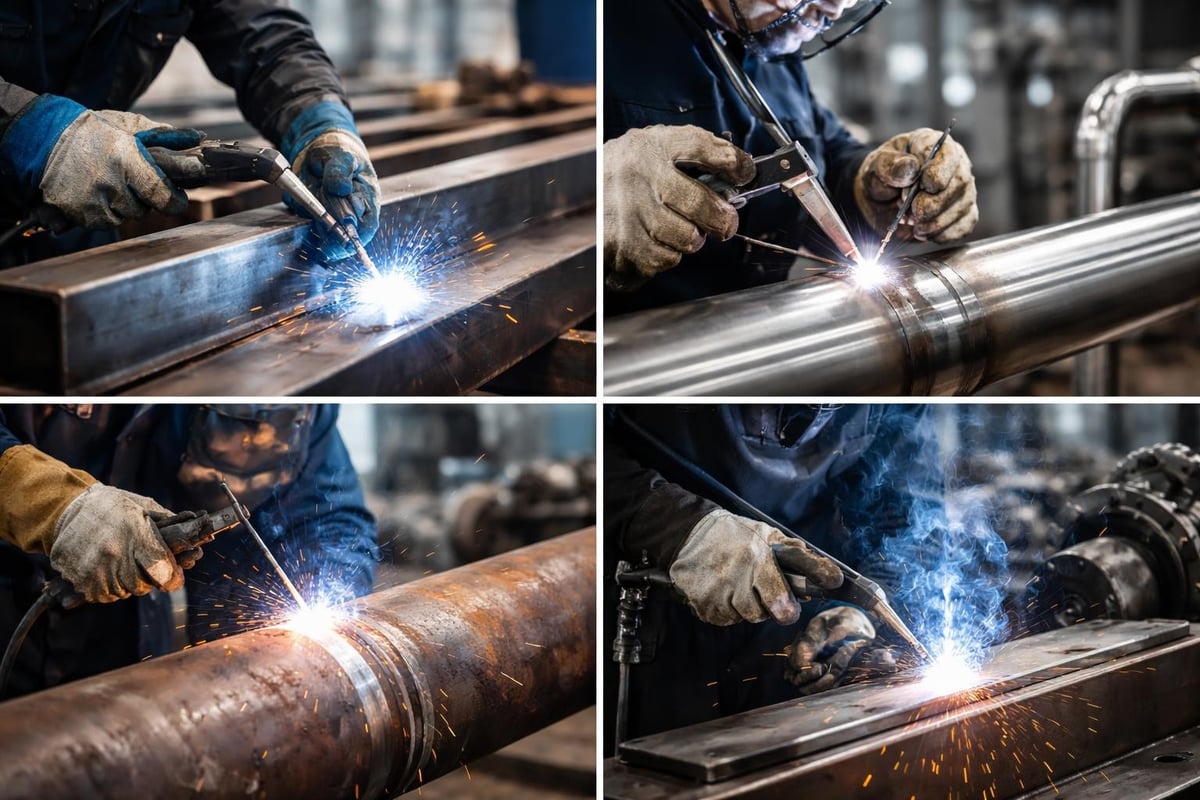
The selection of welding technique depends on multiple factors including base material composition, joint design, position accessibility, and required finish quality. Professional welders assess these variables to determine the optimal approach for each project.
Critical Applications Across Industrial Sectors
Industrial welding services support diverse manufacturing and processing operations throughout the commercial landscape. These applications demand specialized knowledge of industry-specific requirements and regulatory compliance.
Oil and Gas Industry Requirements
The oil and gas sector presents unique welding challenges due to high-pressure systems, corrosive environments, and stringent safety standards. Welding applications in this industry include pipeline construction, tank fabrication, platform structures, and pressure vessel repairs.
Welders serving this sector must obtain specialized certifications and follow protocols established by organizations like the American Petroleum Institute. The work often involves exotic materials such as duplex stainless steel and high-strength low-alloy steels that require precise heat control and post-weld treatments.
Aggregate and Recycling Operations
Processing facilities for aggregate materials and recycling operations experience constant wear on conveyor systems, chutes, screens, and crushing equipment. Industrial welding services keep these operations productive through:
- Wear plate application and hardfacing
- Structural repairs to screening equipment
- Conveyor component fabrication
- Chute and hopper restoration
- Custom fabrication for material handling systems
These environments demand durable welding solutions that withstand abrasive materials and repetitive impact. Hard-facing techniques and wear-resistant alloys extend equipment life significantly compared to standard steel fabrication.
Equipment and Technology in Professional Welding
The quality of industrial welding services directly correlates with the equipment, technology, and facilities available to the welding provider. Modern welding operations employ sophisticated machinery and quality control systems to ensure consistent results.
| Equipment Category | Purpose | Key Features |
|---|---|---|
| Power Sources | Provide welding current | Multi-process capability, digital controls, remote adjustability |
| Positioning Equipment | Manipulate workpieces | Rotators, positioners, gantry systems |
| Cutting Systems | Prepare materials | Plasma, oxy-fuel, water jet cutting |
| Inspection Tools | Verify weld quality | Ultrasonic, radiographic, magnetic particle testing |
Advanced welding facilities incorporate computer-controlled welding systems for repetitive production work, ensuring consistency across large fabrication runs. Robotic welding cells have become increasingly common for high-volume manufacturing, though skilled manual welders remain essential for custom work and field services.
The industrial welding services industry continues to adopt new technologies including laser welding systems, friction stir welding, and hybrid processes that combine multiple techniques for optimal results.
Quality Control and Testing Methods
Professional welding providers implement rigorous quality control protocols to verify weld integrity. Non-destructive testing methods allow inspection without damaging the finished product:
- Visual inspection for surface defects and dimensional accuracy
- Dye penetrant testing to reveal surface-breaking cracks
- Magnetic particle inspection for ferromagnetic materials
- Ultrasonic testing to detect internal discontinuities
- Radiographic examination for critical pressure-containing components
These testing methods ensure welds meet or exceed specifications established by governing codes and customer requirements. Documentation of test results provides traceability and supports quality assurance programs.
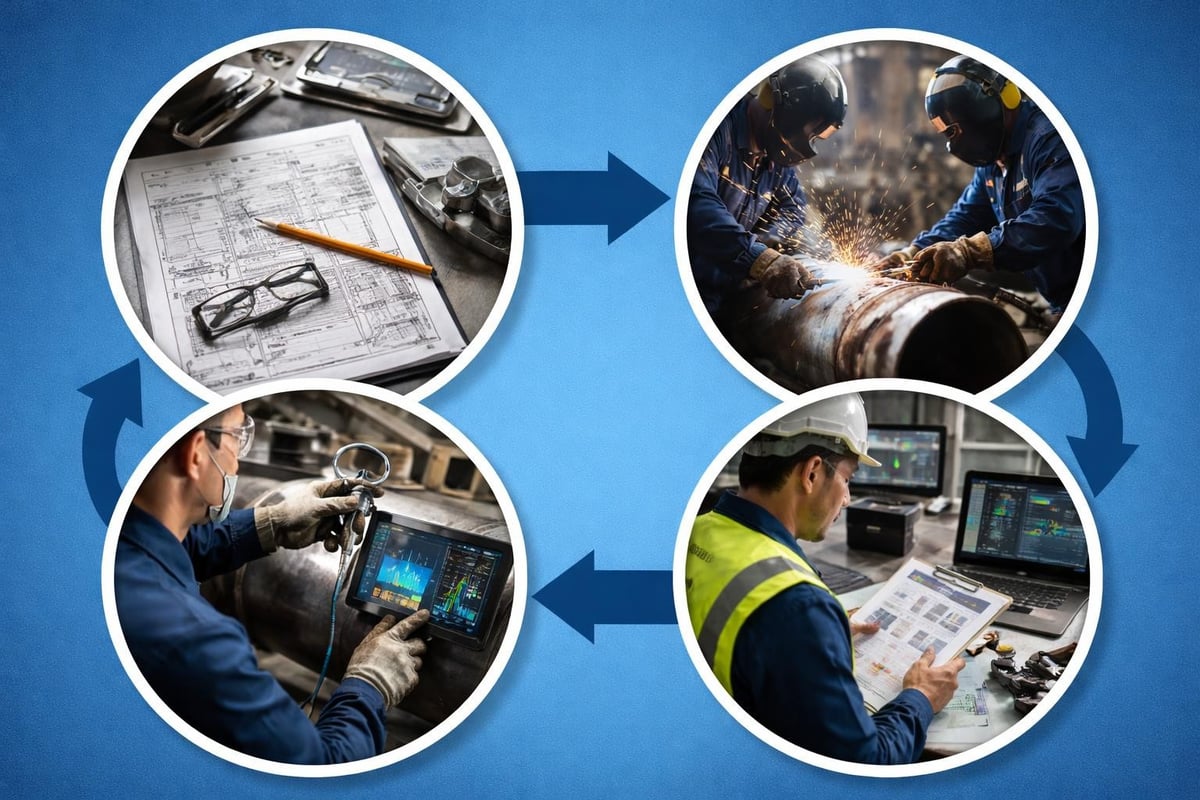
Certifications and Industry Standards Compliance
The welding industry operates under strict regulatory frameworks designed to ensure safety, reliability, and consistency. Professional industrial welding services maintain certifications from recognized authorities that govern welding procedures and welder qualifications.
Essential Welding Certifications
The American Welding Society (AWS) establishes widely recognized standards for welder certification and procedure qualification. AWS certifications verify that welders possess the skills necessary to produce quality welds in specific positions and with particular processes.
Similarly, the American Society of Mechanical Engineers (ASME) governs welding for pressure vessels and boilers through strict codes and certification requirements. Organizations like FAB Source emphasize their ASME and AWS certified welders as proof of their capability to handle complex industrial projects.
Additional certifications may be required for specialized work:
- API certifications for petroleum industry applications
- NADCAP approval for aerospace and defense projects
- CWI (Certified Welding Inspector) credentials for quality oversight
- Structural welding certifications for building construction
These credentials provide assurance that welding personnel follow established best practices and can produce work that meets code requirements consistently.
Procedure Qualification and Documentation
Beyond individual welder certification, industrial welding services must qualify welding procedures through formal testing. Welding Procedure Specifications (WPS) document the specific parameters, techniques, and variables used for each application.
Procedure Qualification Records (PQR) provide evidence that the WPS produces acceptable results through destructive testing of sample welds. This documentation system ensures repeatability and compliance with engineering specifications.
Field Welding Services for Remote Operations
Many industrial facilities require welding services performed on-site rather than in a controlled shop environment. Field welding presents unique challenges including weather exposure, limited access, and variable working positions.
Mobile welding units equipped with generators, welding machines, and support equipment bring fabrication capabilities directly to the job site. This approach minimizes downtime for operations that cannot transport large components or shut down equipment for extended periods.
Advantages of On-Site Industrial Welding
Field services offer several operational benefits for manufacturing and processing facilities:
- Reduced equipment downtime by performing repairs in place
- Elimination of transportation costs for large assemblies
- Immediate response to emergency repair situations
- Flexibility to work around production schedules
- Customization to existing structures and systems
Experienced field welders adapt to challenging conditions while maintaining quality standards. They work from lifts, scaffolding, and confined spaces to access equipment that cannot be moved to a shop environment.
The ability to provide both shop and field services distinguishes comprehensive metal fabrication industries providers from limited-scope welding contractors. This versatility ensures clients receive complete solutions regardless of project location or scope.
Preventive Maintenance Through Welding Services
Strategic use of industrial welding services extends equipment life and prevents costly failures. Proactive maintenance programs incorporate welding repairs before minor issues escalate into major breakdowns.
| Maintenance Application | Welding Solution | Benefit |
|---|---|---|
| Wear on conveyor components | Hard-facing with wear-resistant alloys | 3-5x extended service life |
| Cracked structural members | Crack repair and reinforcement | Restored load capacity |
| Corroded tanks and vessels | Patch welding and overlay | Continued service without replacement |
| Damaged machinery bases | Build-up and re-machining | Precise dimensional restoration |
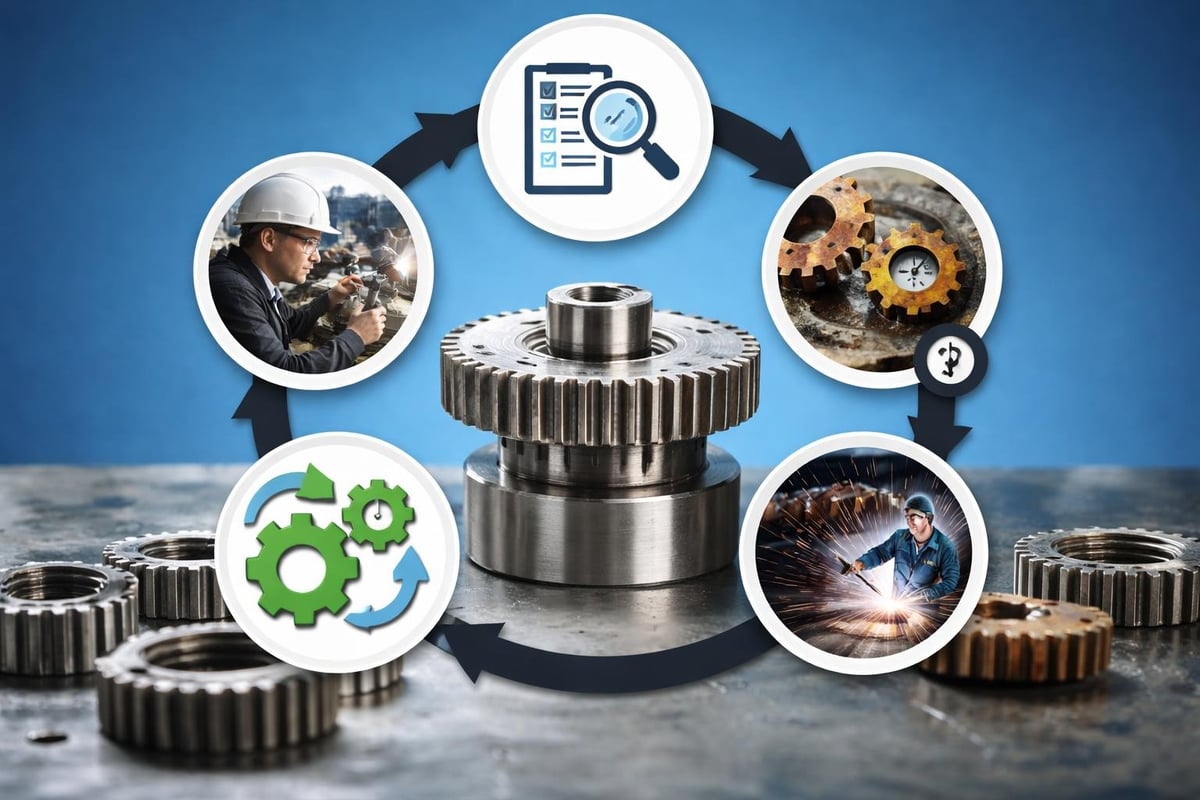
Regular inspection identifies areas experiencing accelerated wear or developing stress cracks. Addressing these conditions through welding repairs costs significantly less than emergency failures that halt production.
Hardfacing and Wear Protection
Industrial environments with abrasive materials benefit tremendously from hardfacing applications. This specialized welding technique deposits wear-resistant alloys onto surfaces exposed to friction, impact, or erosion.
Common hardfacing applications include crusher jaws, excavator buckets, chute liners, and mixer paddles. The process can increase component life by 300-500% compared to unprotected carbon steel surfaces.
Professional welding services select hardfacing materials based on specific wear mechanisms. Different alloys resist abrasion, impact, or heat more effectively depending on their composition and microstructure.
Custom Fabrication Capabilities
Beyond repairs and maintenance, industrial welding services enable custom fabrication projects that address unique operational challenges. Manufacturing facilities often require specialized equipment, fixtures, or structural components not available as standard products.
Custom fabrication begins with engineering consultation to understand requirements, followed by detailed design work that considers material selection, fabrication methods, and installation constraints. Skilled welders then transform raw materials into finished assemblies through cutting, forming, and joining operations.
Examples of Custom Welded Products
Industrial fabrication projects span a wide range of applications:
- Structural steel platforms and walkways for facility access
- Custom tanks and hoppers for material processing
- Conveyor supports and transfer chutes
- Machine guards and safety enclosures
- Specialized tooling and fixtures
These projects require coordination between engineering, fabrication, and installation teams. The ability to provide turnkey solutions from concept through commissioning adds significant value for clients managing complex industrial operations.
The Gases and Welding Distributors Association promotes industry standards that support safe and economical welding practices across commercial and industrial applications. Their guidelines help ensure custom fabrications meet both functional requirements and safety expectations.
Material Considerations in Industrial Welding
Different base materials require specific welding approaches to achieve proper fusion, mechanical properties, and corrosion resistance. Professional industrial welding services maintain expertise across a broad spectrum of metals and alloys.
Common Industrial Materials
Carbon steel remains the most prevalent material in industrial fabrication due to its strength, availability, and weldability. However, many applications demand specialized materials:
- Stainless steel for corrosion resistance and sanitary requirements
- Aluminum for weight reduction and corrosion protection
- High-strength low-alloy steels for structural applications
- Tool steels for wear resistance and hardness
- Exotic alloys (Inconel, Hastelloy) for extreme environments
Each material category presents distinct challenges. Aluminum requires careful heat control to prevent distortion and oxide formation. Stainless steel demands cleanliness to avoid contamination that compromises corrosion resistance. High-carbon steels need preheat and post-weld heat treatment to prevent cracking.
Experienced welders understand these material-specific requirements and adjust their techniques accordingly. This knowledge prevents failures and ensures welds perform as intended throughout their service life.
Safety Protocols in Industrial Welding Operations
Welding operations generate multiple hazards including extreme heat, ultraviolet radiation, toxic fumes, and fire risks. Professional industrial welding services implement comprehensive safety programs that protect workers and client facilities.
Essential Safety Measures
Welding safety begins with proper personal protective equipment:
- Welding helmets with auto-darkening filters for eye and face protection
- Flame-resistant clothing to prevent burns
- Respiratory protection for fume exposure control
- Welding gloves rated for heat and arc protection
- Steel-toed boots for foot protection
Beyond personal protection, area safeguards include fire watches, ventilation systems, and barriers to protect nearby personnel from arc flash and splatter. Hot work permits formalize the authorization process and ensure appropriate precautions are in place before welding begins.
Safety training programs keep welding personnel current on hazard recognition and control measures. Regular safety meetings reinforce proper practices and address emerging concerns specific to each work environment.
Selecting Industrial Welding Service Providers
Choosing the right welding contractor impacts project outcomes, costs, and schedule adherence. Several factors distinguish professional operations from basic welding services.
Key evaluation criteria include:
- Relevant certifications (AWS, ASME) and welder qualifications
- Equipment capabilities and shop facilities
- Experience in your specific industry sector
- Quality control processes and testing capabilities
- Field service availability and response times
- Insurance coverage and safety record
References from similar clients provide insight into reliability, workmanship quality, and problem-solving capabilities. Site visits to fabrication facilities reveal equipment condition, organization, and overall operational professionalism.
The comprehensive welding services offered by qualified providers ensure clients receive expert guidance from project conception through final delivery. This end-to-end support minimizes complications and maximizes value.
Integration with Complementary Services
Industrial facilities benefit most when welding services integrate seamlessly with related capabilities such as machining, fabrication, and mechanical services. This comprehensive approach streamlines projects and reduces coordination challenges.
| Service Integration | Application | Advantage |
|---|---|---|
| Welding + Machining | Repair worn shafts and rebuild dimensions | Single-source accountability |
| Welding + Hydraulics | Cylinder repair and system installation | Coordinated installation |
| Welding + Fabrication | Complete assembly manufacturing | Efficient project management |
| Welding + Water Jetting | Surface preparation before welding | Optimal bond quality |
Operations that combine these services eliminate handoffs between multiple contractors. This integration reduces project duration, minimizes communication errors, and provides unified responsibility for final results.
For example, rebuilding worn machinery components often requires both welding to restore material and precision machining to achieve final dimensions. Having both capabilities under one roof ensures proper coordination and eliminates transportation between facilities.
Economic Considerations and Value Optimization
Industrial welding services represent significant operational investments, making cost-effectiveness an important consideration. However, focusing solely on initial costs often leads to poor long-term outcomes.
Total Cost of Ownership Perspective
Evaluating welding services requires looking beyond hourly rates to consider factors affecting overall project value:
- Rework costs from poor-quality initial work
- Equipment downtime during repairs or installations
- Service life of repaired or fabricated components
- Emergency call-out charges for preventable failures
- Transportation expenses for off-site work
Quality welding completed correctly the first time typically costs less than bargain services that require correction. Professional providers invest in proper equipment, training, and processes that deliver reliable results consistently.
Planned maintenance programs incorporating regular inspections and preventive welding repairs cost significantly less than emergency responses to unexpected failures. This proactive approach also minimizes production interruptions that affect revenue generation.
Regional Considerations for Western United States Operations
Industrial facilities throughout the Western United States face unique operational conditions that impact welding requirements. Remote locations, elevation variations, temperature extremes, and extended distances between service providers all influence service delivery.
Regional factors affecting industrial welding services:
- Extended travel requirements for field service in rural areas
- High-altitude welding considerations affecting arc characteristics
- Temperature extremes from desert heat to mountain cold
- Limited local infrastructure in some industrial corridors
- Seasonal access challenges in certain locations
Welding contractors serving this region must maintain mobile capabilities and stock appropriate equipment for diverse conditions. The ability to respond quickly across large geographic areas becomes a critical selection factor for facilities far from urban centers.
Companies operating recycling plants, aggregate facilities, and oil and gas operations in Colorado, Utah, Wyoming, and surrounding states particularly value service providers with regional presence and field service capabilities. This proximity enables faster response times and better understanding of local industry conditions.
Successful industrial operations depend on reliable, high-quality welding services that keep equipment running and support custom fabrication needs. From routine maintenance to complex field repairs, professional welding expertise directly impacts productivity and operational costs. LTJ Industrial Services brings comprehensive shop and field capabilities to commercial and industrial clients throughout the Western United States, combining certified welders, modern equipment, and responsive service to support your manufacturing, aggregate, recycling, and oil and gas operations.