
Understanding how much does metal fabrication cost is essential for industrial manufacturers, facility managers, and business owners planning capital projects or routine maintenance. Fabrication pricing varies dramatically based on material selection, complexity, labor requirements, and shop capabilities. In 2026, rising material costs, skilled labor shortages, and evolving technology continue to reshape the pricing landscape across the Western United States and beyond.
Core Components of Metal Fabrication Pricing
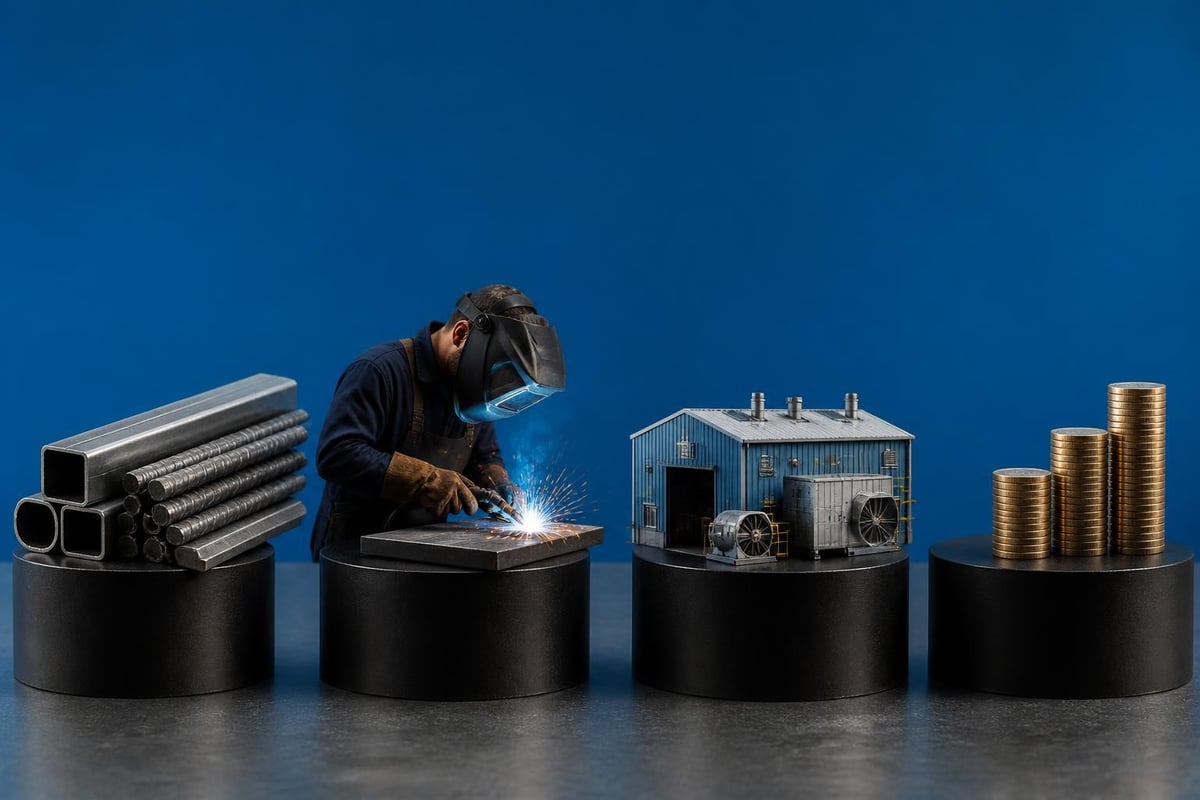
Metal fabrication costs break down into four primary categories that every project manager should understand before requesting quotes. Material costs typically represent 40-50% of the total project expense, while labor accounts for another 30-40%. The remaining 10-30% covers overhead (facility, utilities, insurance) and profit margins.
Material selection drives the foundational cost structure. Steel remains the most economical choice, with hot-rolled carbon steel costing approximately $0.60-$0.85 per pound in 2026. Stainless steel ranges from $1.50-$3.00 per pound depending on grade (304 vs. 316), while aluminum averages $1.20-$2.00 per pound. Specialty alloys like Inconel or titanium can exceed $15-$30 per pound. SteelBenchmarker tracks pricing indices that help fabricators and clients monitor raw material cost movements.
Labor rates vary significantly by region and specialization. General fabricators typically charge $45-$75 per hour, while certified welders command $65-$95 per hour. CNC machinists fall into the $55-$85 range, and field service technicians often charge $85-$125 per hour plus travel expenses. Shops in metropolitan areas or regions with higher living costs naturally operate at the upper end of these ranges.
Machine Hour Rates and Equipment Costs
Understanding machine hour rates is crucial when estimating how much does metal fabrication cost for complex projects. CNC plasma cutting tables typically run $75-$125 per hour, while waterjet cutting systems charge $85-$150 per hour due to higher consumable costs and maintenance requirements. As discussed in waterjet cutting vs plasma cutting comparisons, each technology offers distinct advantages that affect overall project economics.
CNC machining centers represent the highest hourly rates. Three-axis mills range from $85-$140 per hour, while multi-axis equipment can reach $150-$250 per hour. These rates reflect significant capital investment, tooling costs, and specialized programming expertise. A detailed cost structure breakdown helps explain how shops allocate these expenses across different operations.
Press brake operations fall into a more moderate range at $60-$95 per hour, depending on tonnage capacity and complexity. Manual welding stations typically bill at the welder's labor rate plus 15-25% for equipment and consumables. Robotic welding cells command premium rates of $125-$200 per hour but deliver exceptional consistency and speed for high-volume production.
| Equipment Type | Hourly Rate Range | Primary Cost Drivers |
|---|---|---|
| CNC Plasma Table | $75-$125 | Electricity, consumables, maintenance |
| Waterjet System | $85-$150 | Abrasive, nozzles, high-pressure pumps |
| 3-Axis CNC Mill | $85-$140 | Tooling, programming, machine depreciation |
| Press Brake | $60-$95 | Tonnage capacity, setup complexity |
| Robotic Welding | $125-$200 | Capital investment, programming expertise |
Project Complexity and Design Factors
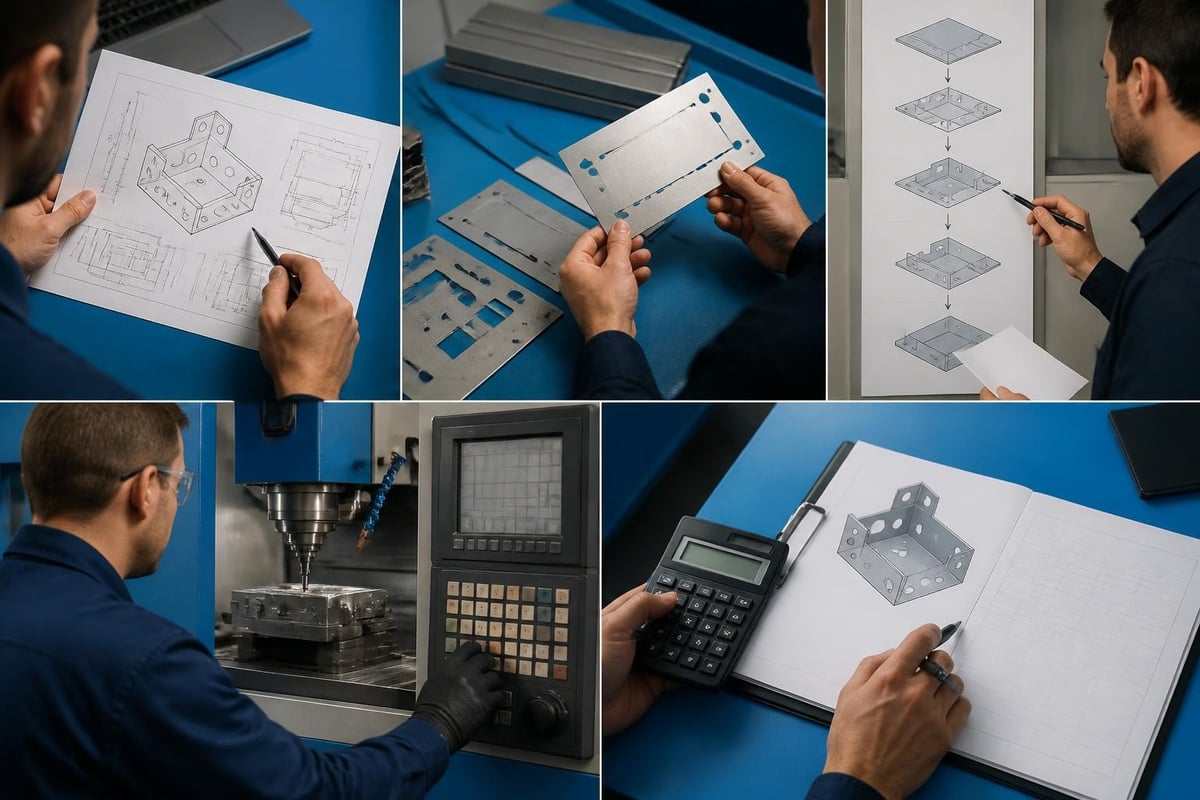
Complexity multiplies fabrication costs exponentially rather than linearly. A simple steel bracket requiring one bend and two welds might cost $25-$50, while a multi-component assembly with tight tolerances can easily reach $500-$2,000 for the same material volume. Tolerance requirements significantly impact pricing-standard commercial tolerances (±0.030") cost substantially less than precision work requiring ±0.005" or tighter.
The number of unique components affects setup time and programming costs. Projects requiring extensive fixturing, jigs, or specialized tooling add 15-40% to baseline costs. Prototype work typically runs 2-3 times the cost of production runs because setup expenses distribute across fewer units. For runs of 100+ identical parts, per-unit costs can drop by 40-60% compared to single-piece fabrication.
Surface finishing requirements add considerable expense:
- As-fabricated (no finishing): baseline cost
- Deburring and edge rounding: add 5-10%
- Sandblasting/media blasting: add 10-20%
- Powder coating: add $2-$5 per square foot
- Wet painting: add $3-$7 per square foot
- Electropolishing (stainless): add 25-40%
- Anodizing (aluminum): add $1.50-$3.50 per square foot
Welding Cost Calculation Methods
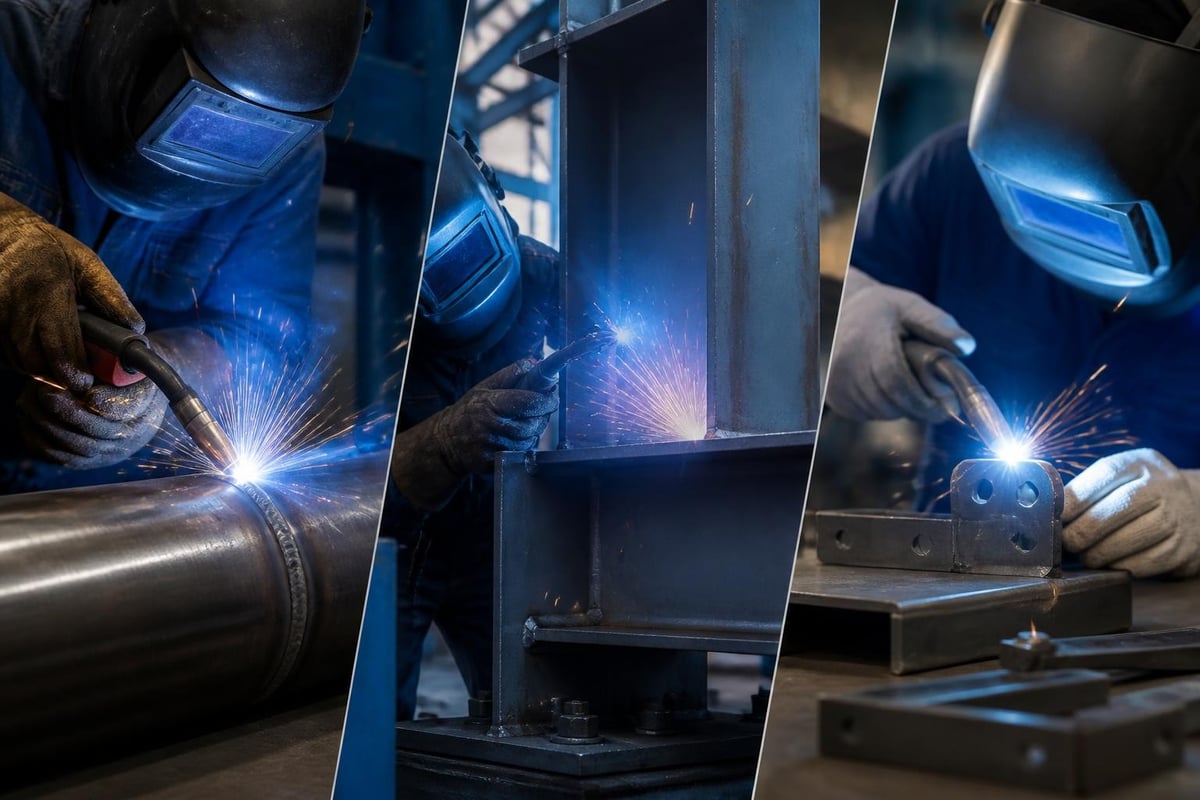
The American Welding Society outlines several approaches for calculating welding expenses accurately. The cost-per-length method works well for fillet welds, typically ranging from $5-$15 per linear foot depending on weld size and material. A 1/4" fillet weld in carbon steel averages $6-$9 per foot, while the same weld in stainless steel costs $10-$14 per foot.
The cost-per-weight approach suits larger structural applications. Deposited weld metal costs approximately $3-$7 per pound for carbon steel and $8-$16 per pound for stainless alloys. This method accounts for material consumption, gas usage, and the labor required to complete specific weld volumes.
Cost-per-joint pricing works best for repetitive assemblies. Simple tack-welded connections might cost $8-$15 each, while full-penetration welded joints requiring multiple passes range from $35-$85 per joint. Shops serving the oil and gas industry often encounter specifications requiring radiographic testing, which adds $75-$200 per weld inspection point.
Material Quantity and Procurement Impact
Understanding how much does metal fabrication cost requires analyzing material procurement strategies. Shops purchasing full sheets or standard lengths achieve better pricing than projects requiring specific cut-to-size materials. A full 4'x8' sheet of 1/4" carbon steel costs approximately $180-$250, yielding a per-square-foot cost of $5.60-$7.80. Purchasing the same material in custom-cut pieces adds 25-40% for cutting and handling.
Minimum buy quantities affect small projects significantly. Many suppliers impose minimum orders of $150-$300, which can inflate costs for simple repairs or single-component jobs. Projects requiring exotic materials face even higher minimums-specialty alloys often require $500-$1,000 minimum purchases.
Material utilization efficiency impacts overall costs substantially:
- Excellent nesting (85-90% utilization): near-baseline material cost
- Average planning (70-80% utilization): 10-15% material waste cost
- Poor optimization (50-65% utilization): 30-50% material waste cost
Experienced fabricators use nesting software to maximize material yield, reducing scrap and lowering per-part costs. This efficiency becomes particularly critical when working with expensive materials like stainless steel or aluminum.
Regional and Industry-Specific Pricing Variations
Geographic location influences how much does metal fabrication cost through labor rates, overhead expenses, and market competition. Fabrication shops in Colorado's Western Slope region typically charge 10-20% less than Front Range metropolitan shops due to lower facility costs and living expenses. However, rural locations may add travel charges for field services, offsetting initial savings.
Industry specialization creates pricing variations based on quality standards and certification requirements:
Oil and gas fabrication commands premium rates (15-30% above general work) due to stringent welding certifications, material traceability requirements, and pressure vessel codes. Projects requiring ASME Section VIII compliance or API certifications naturally cost more than commercial-grade work.
Aggregate and recycling equipment fabrication balances durability with cost-effectiveness. These projects often specify abrasion-resistant steels like AR400 or AR500, which cost $1.20-$1.80 per pound-roughly double standard carbon steel-but deliver extended service life in demanding applications.
Food-grade and pharmaceutical fabrication requires 316L stainless steel, full surface passivation, and extensive documentation. These projects typically run 40-60% above comparable carbon steel fabrication due to material costs and specialized finishing requirements.
| Industry Sector | Typical Price Premium | Primary Cost Drivers |
|---|---|---|
| Oil & Gas | +15% to +30% | Certifications, testing, traceability |
| Food/Pharma | +40% to +60% | Stainless materials, sanitary finishes |
| Aggregate/Mining | +10% to +25% | Wear-resistant materials, heavy construction |
| General Commercial | Baseline | Standard materials, commercial tolerances |
Estimation Methods and Quote Accuracy
Professional fabricators use several approaches to estimate costs accurately. Parametric estimating applies historical cost-per-pound or cost-per-square-foot data to similar projects. Simple structural steel fabrication averages $4-$8 per pound of finished product, including materials, labor, and basic finishing. More complex assemblies run $8-$16 per pound.
Bottom-up estimating calculates each operation individually. This detailed approach provides greater accuracy for custom projects. An OSTI manufacturing cost model publication describes frameworks for decomposing product costs across materials, labor, energy, tooling, and overhead-particularly valuable for complex fabrication projects.
Asking the right questions improves quote accuracy. The article on questions to ask a machine shop covers essential topics like tolerance capabilities, material certifications, and timeline expectations. Clear communication about specifications, quantities, and delivery requirements eliminates costly revisions and change orders.
Shop minimums typically range from $250-$750 depending on facility size and specialization. Projects falling below these thresholds still incur the minimum charge, making small jobs appear disproportionately expensive on a per-part basis. Batching multiple small items into single orders improves cost-effectiveness.
Volume Discounts and Production Economies
Understanding how quantity affects how much does metal fabrication cost helps project planners optimize budgets. Production economics create dramatic per-unit cost reductions as quantities increase:
Prototype/single units: Full setup costs applied to one piece
- 1 piece: $500 per unit
- 10 pieces: $180 per unit (64% reduction)
- 50 pieces: $95 per unit (81% reduction)
- 250 pieces: $52 per unit (90% reduction)
These reductions reflect setup time, programming, fixturing, and tooling costs distributed across more units. Break-even analysis helps determine optimal order quantities. Many fabricators offer price breaks at 10, 25, 50, 100, and 250+ units.
Long-term partnership agreements provide additional savings. Shops often discount repeat customers by 5-15% and prioritize their scheduling. Annual agreements specifying minimum volumes can secure preferential pricing and guaranteed capacity during peak demand periods.
Hidden Costs and Budget Considerations
Several factors affect how much does metal fabrication cost beyond obvious material and labor expenses. Engineering and design support ranges from $75-$150 per hour when shops provide drawing development, design optimization, or manufacturability analysis. While not always itemized separately, these costs embed in project quotes.
Shipping and logistics add 5-15% to project costs depending on size and weight. A 500-pound assembly might cost $150-$300 to ship regionally, while oversized or over-weight items requiring specialized carriers can exceed $1,000. Field installation services add travel time, per diem expenses, and equipment mobilization costs.
Material price volatility creates budget challenges. Steel prices fluctuated by 15-25% throughout 2025, and IndustryWeek regularly covers how supply chain pressures and global demand affect manufacturing costs. Many shops include price protection clauses for projects exceeding 60-90 days, allowing material cost adjustments if market prices move significantly.
Quality control and testing expenses vary by industry:
- Basic dimensional inspection: included in base pricing
- Dye penetrant testing: $50-$150 per inspection
- Radiographic weld testing: $75-$200 per weld
- Ultrasonic testing: $100-$250 per area
- Full material certifications: $75-$200 per heat lot
- Third-party inspection services: $500-$2,000+ per day
Rush charges apply when projects require expedited turnaround. Standard lead times for custom fabrication run 2-4 weeks; reducing this to 1 week typically adds 25-40%, while 3-5 day turnaround can double baseline costs.
Technology and Automation Effects
Advanced fabrication technologies are reshaping how much does metal fabrication cost in 2026. Fiber laser cutting systems offer superior speed and precision compared to plasma, with operating costs of $90-$160 per hour. While higher than plasma, fiber lasers reduce secondary operations and improve edge quality, potentially lowering overall project costs.
Robotic welding delivers consistency and speed advantages for production runs. Initial programming requires 4-8 hours at $85-$120 per hour, but the investment pays off quickly on runs exceeding 25-50 units. Robotic cells maintain tighter quality control, reduce rework, and enable lights-out manufacturing that maximizes equipment utilization.
Additive manufacturing integration affects traditional fabrication economics. While metal 3D printing costs $300-$800 per kilogram of finished material-substantially higher than conventional methods-it eliminates tooling costs and enables complex geometries impossible with traditional processes. Hybrid approaches combining printed components with fabricated structures optimize both cost and performance.
Software investments improve estimation accuracy and production efficiency. Modern ERP systems with integrated quoting modules reduce estimating time by 40-60% while improving accuracy. CAD/CAM integration streamlines programming, and nesting software maximizes material utilization-all contributing to more competitive pricing.
Cost Control Strategies for Buyers
Clients can influence how much does metal fabrication cost through strategic specification and planning decisions. Design for manufacturability reduces unnecessary complexity. Specifying standard material sizes, avoiding excessively tight tolerances where unnecessary, and designing for efficient welding access all lower production costs.
Flexibility on delivery schedules enables shops to batch jobs efficiently. Projects with firm deadlines require dedicated resources and potentially overtime labor. Allowing 4-6 week lead times instead of 2 weeks can reduce costs by 15-25% as shops optimize production scheduling.
Material selection offers significant cost control opportunities:
- Consider A36 carbon steel before specifying higher-grade alloys
- Evaluate whether 304 stainless suffices instead of 316
- Assess if standard plate thicknesses work vs. special-order gauges
- Determine if commercial-grade aluminum serves the application vs. aerospace alloys
Providing complete, accurate drawings upfront prevents costly revisions. Change orders during fabrication typically cost 2-3 times what the same changes would have cost if specified initially. Clear welding symbols, complete dimensions, and specified tolerances eliminate guesswork and prevent misunderstandings.
Long-term relationships with fabricators yield benefits beyond pricing. Preferred customers receive better communication, priority scheduling, and technical support. Shops familiar with a client's standards and expectations work more efficiently, reducing costs through improved processes and reduced supervision requirements.
Understanding metal fabrication costs requires analyzing materials, labor, equipment, complexity, and industry-specific requirements that influence final pricing. Whether planning a single prototype or large production run, careful specification and clear communication with fabricators ensure accurate quotes and successful project outcomes. LTJ Industrial Services brings decades of expertise in metal fabrication, machining, and welding services to commercial and industrial clients throughout the Western United States. Our team provides transparent pricing, engineering support, and comprehensive capabilities from shop fabrication to field installation-contact us to discuss your next project and receive a detailed, competitive quote.