Earthmoving equipment operates under some of the harshest conditions in industrial environments, from mining sites to aggregate operations. Excavators, loaders, dozers, and scrapers face constant stress from heavy loads, abrasive materials, and continuous operation cycles that push mechanical components to their limits. When these machines fail due to cracked frames, worn buckets, or fractured structural members, downtime becomes extraordinarily expensive. Heavy duty welding services for earthmoving equipment provide the specialized expertise needed to restore these critical assets quickly and reliably, minimizing operational disruptions while ensuring safety and structural integrity across the Western United States.
Understanding the Unique Demands of Earthmoving Equipment Repairs
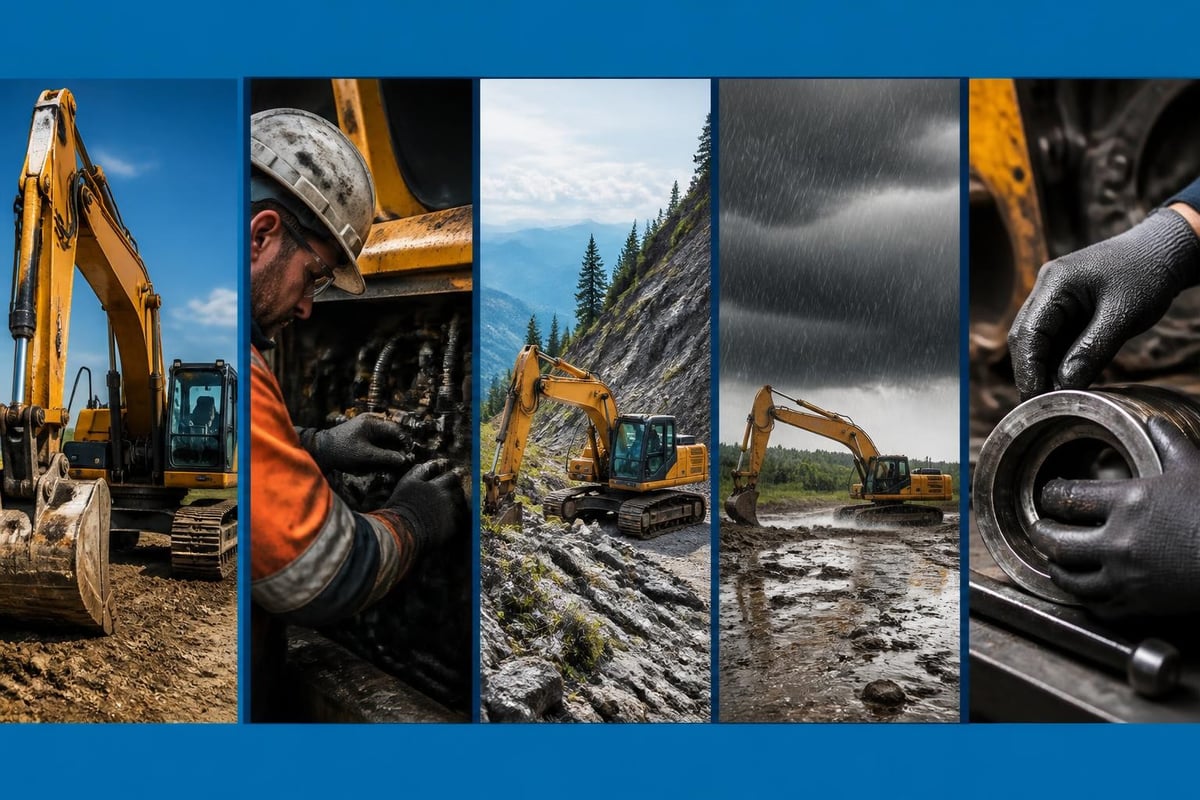
Earthmoving machinery presents distinct challenges that separate routine welding from true heavy duty applications. These machines typically use high-strength, low-alloy steels that require specific preheat and post-weld treatment protocols to prevent cracking and maintain material properties.
The scale alone sets these repairs apart. A single excavator boom may weigh several tons, requiring specialized lifting equipment and positioning strategies. The thickness of structural members often exceeds one inch, demanding multi-pass welding techniques and careful heat management to avoid distortion.
Material Considerations and Metallurgical Challenges
Most modern earthmoving equipment employs advanced high-strength steels with yield strengths ranging from 80,000 to 130,000 psi. These materials offer excellent strength-to-weight ratios but create complexity during repair welding.
Key metallurgical challenges include:
- Heat-affected zone (HAZ) embrittlement that reduces toughness adjacent to welds
- Hydrogen-induced cracking in high-strength base metals
- Residual stress accumulation from constrained joints and thick sections
- Temper embrittlement in previously heat-treated components
Proper hardfacing and weld overlay practices become essential when repairing wear surfaces on buckets, teeth, and cutting edges. These techniques extend component life while maintaining the underlying structural integrity that heavy duty welding services for earthmoving equipment must preserve.
Critical Repair Applications in Earthmoving Operations
Different earthmoving machines experience distinct failure patterns based on their operational profiles. Understanding these patterns helps welding professionals develop targeted repair strategies.
Excavator Structural Repairs
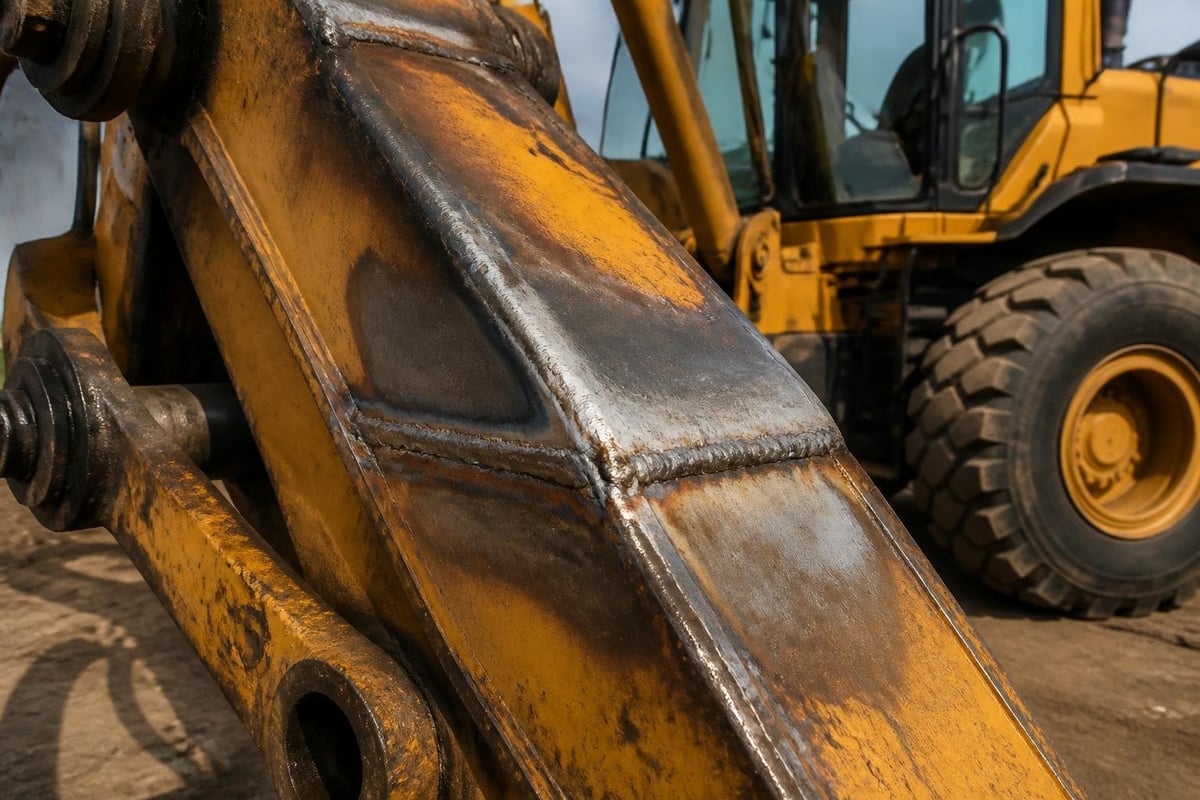
Excavators develop cracks in booms, sticks, and frames due to cyclic loading and shock impacts. The undercarriage components-including track frames and rollers-suffer from abrasive wear and fatigue.
| Component | Common Failure Mode | Repair Complexity | Typical Downtime |
|---|---|---|---|
| Boom structures | Fatigue cracks at gussets | High | 3-5 days |
| Stick assemblies | Crack propagation from pin bosses | Very High | 4-7 days |
| Counterweight frames | Structural fractures | Medium | 2-3 days |
| Track frames | Wear and cracking | High | 5-8 days |
Boom repairs often require complete disassembly and positioning in a controlled shop environment. Heavy duty welding services for earthmoving equipment must account for load path restoration, ensuring repaired sections can handle original design stresses.
Loader and Dozer Component Restoration
Wheel loaders and track dozers experience concentrated stress in bucket linkages, cutting edges, and push arms. The repetitive nature of loading cycles creates predictable crack initiation points.
Bucket repairs represent perhaps the most frequent welding need. Constant ground engagement wears lips and corners while impact loading cracks side panels and reinforcement ribs. Skilled welders must balance wear resistance through hardfacing with structural strength in parent materials.
Dozer blade assemblies require specialized attention. The C-frame and push arms transfer enormous forces, and cracks in these components compromise machine stability. Repairs must restore full load-bearing capacity through proper joint preparation, filler metal selection, and welding sequence planning.
Field Welding Versus Shop-Based Repairs
The decision between on-site field welding and transporting equipment to a fabrication shop significantly impacts repair quality, cost, and timeline. Each approach offers distinct advantages for heavy duty welding services for earthmoving equipment.
When Field Welding Makes Sense
Remote job sites, particularly in mining and aggregate operations, often make equipment transport impractical. Field welding allows repairs to proceed with minimal mobilization delay.
Field welding advantages:
- Reduced transportation costs and logistics complexity
- Immediate response to critical failures
- Ability to repair multiple machines sequentially
- Minimal impact on site operations
However, field conditions introduce complications. Weather exposure, limited power availability, and restricted positioning access all challenge welding quality. Following OSHA welding and hot work requirements becomes particularly important when working in active industrial environments where fire hazards and confined spaces present additional risks.
Shop-Based Repair Capabilities
Controlled shop environments enable precision work impossible in field settings. Climate control, overhead cranes, positioning equipment, and comprehensive tooling support complex structural repairs.
Temperature control proves especially critical when welding high-strength steels. Preheating thick sections to 200-400°F prevents hydrogen cracking, while controlled cooling rates minimize residual stresses. Shop facilities maintain these parameters consistently throughout multi-day repairs.
Quality assurance procedures also benefit from shop infrastructure. Radiographic testing and phased array ultrasonic testing equipment verifies weld integrity before returning equipment to service, reducing the risk of premature re-failure.
Welding Process Selection for Heavy Equipment
Different welding processes offer unique benefits when repairing earthmoving equipment. Process selection depends on material thickness, position, accessibility, and required mechanical properties.
Shielded Metal Arc Welding (SMAW)
Stick welding remains highly relevant for heavy duty welding services for earthmoving equipment despite technological advances. Its simplicity and minimal equipment requirements make SMAW ideal for field repairs.
Low-hydrogen electrodes (E7018, E8018, E9018) prevent cracking in high-strength steels. The process handles thick sections effectively through multiple passes, though productivity lags behind more modern alternatives.
Flux-Cored Arc Welding (FCAW)
FCAW dominates production welding and structural repairs in shop environments. Self-shielded variants work outdoors despite wind, while gas-shielded wires achieve superior mechanical properties.
Deposition rates exceed SMAW by 200-300%, dramatically reducing repair times. For bucket rebuilding and frame reinforcement, FCAW provides an optimal balance of speed, quality, and mechanical performance.
Gas Metal Arc Welding (GMAW)
MIG welding serves specific applications where spatter control and aesthetics matter. Pulsed GMAW modes enable all-position welding with minimal heat input, beneficial for thin-walled components.
| Process | Deposition Rate | Field Suitability | Typical Applications |
|---|---|---|---|
| SMAW | 2-5 lb/hr | Excellent | Emergency repairs, remote sites |
| FCAW | 8-15 lb/hr | Good (self-shielded) | Production repairs, frame work |
| GMAW | 5-12 lb/hr | Fair | Precision work, aluminum repairs |
| GTAW | 1-3 lb/hr | Poor | Root passes, critical joints |
Weld Quality and Inspection Protocols
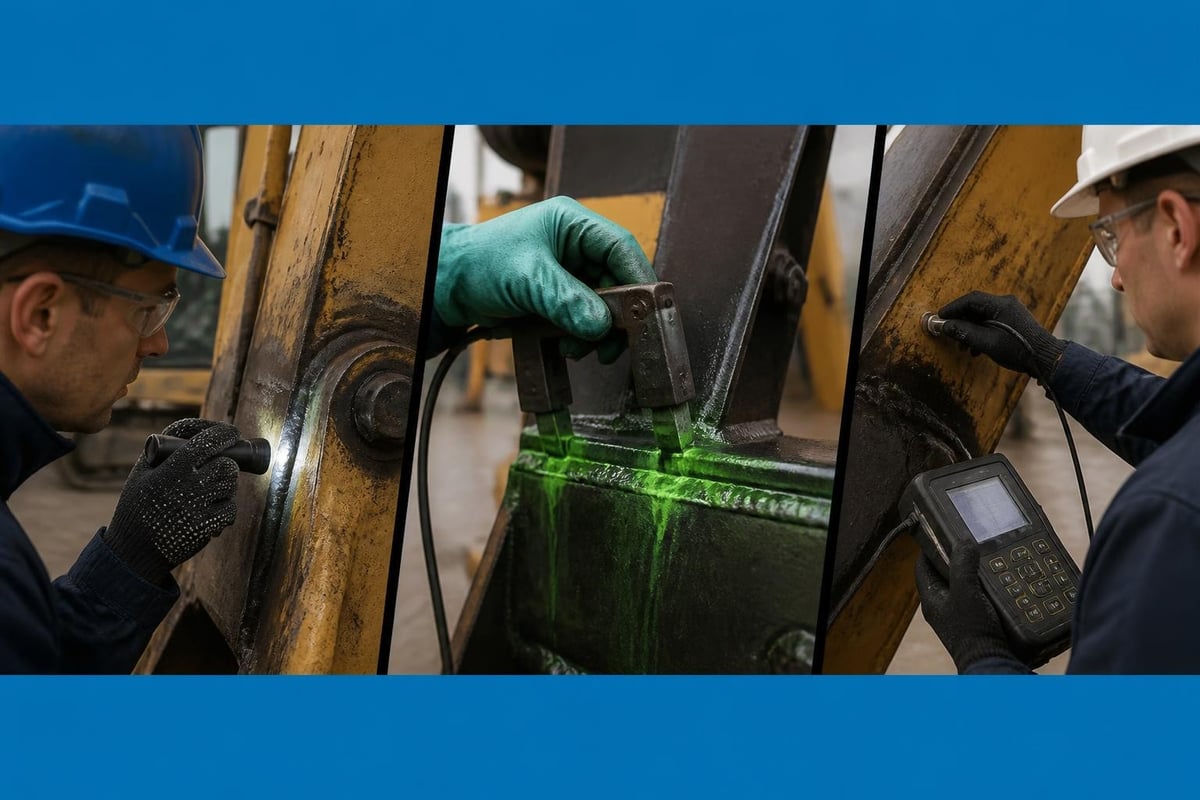
Ensuring weld integrity requires systematic inspection approaches tailored to equipment criticality and operating conditions. Visual inspection forms the foundation, but advanced nondestructive testing (NDT) methods verify internal soundness.
Visual and Dimensional Inspection
Every repair begins with thorough visual assessment of crack extent, material condition, and fit-up quality. Dimensional verification ensures replaced components match original specifications.
Post-weld visual inspection identifies surface defects including undercut, overlap, excessive reinforcement, and crater cracks. These indicators often reveal subsurface discontinuities requiring further investigation.
Nondestructive Testing Applications
Critical structural repairs-booms, sticks, and main frames-warrant NDT verification. Magnetic particle testing (MT) detects surface and near-surface cracks in ferromagnetic steels. Ultrasonic testing (UT) examines full weld cross-sections for internal porosity, lack of fusion, and cracking.
Advanced techniques like phased array ultrasonic testing provide detailed imaging of weld quality. These methods become particularly valuable when heavy duty welding services for earthmoving equipment must certify repairs meet or exceed original equipment manufacturer (OEM) specifications.
Radiographic inspection offers permanent records of weld quality but requires careful safety protocols. The technique excels at detecting volumetric defects in thick-section welds where access limitations prevent ultrasonic examination.
Preventive Maintenance Through Welding Services
Beyond emergency repairs, proactive welding interventions extend equipment life and reduce catastrophic failures. Scheduled inspections identify developing cracks before they propagate to critical lengths.
Crack Arrest and Reinforcement Strategies
Small cracks detected during routine inspections can be arrested through drilling stop-holes and applying localized reinforcement. These preventive measures cost a fraction of emergency structural repairs.
Gusset reinforcement at high-stress joints preemptively strengthens known weak points. Many operators implement reinforcement programs based on fleet experience, addressing common failure locations before cracks initiate.
Wear Surface Management
Bucket edges, teeth, and wear plates require periodic replacement or hardfacing restoration. Scheduled welding of hardfacing alloys maintains production efficiency while preventing underlying structural damage.
Hardfacing application strategies:
- Chromium carbide overlays for extreme abrasion resistance in rock and ore handling
- Tungsten carbide particles for impact and abrasion in aggregate operations
- Manganese steel buildup for impact-dominated applications like rippers and scarifiers
- Martensitic overlays balancing wear resistance with impact toughness
Proper preheat and interpass temperature control prevent cracking in hardfacing applications. These specialized techniques require expertise beyond standard structural welding, highlighting the value of comprehensive heavy duty welding services for earthmoving equipment.
Material Selection and Filler Metal Matching
Selecting appropriate filler metals directly impacts repair longevity and performance. Undermatching creates weak joints; overmatching can increase HAZ cracking susceptibility.
Base Metal Identification
Accurate base metal identification guides every subsequent repair decision. Spark testing, chemical analysis, and hardness testing help identify steel grades when documentation isn't available.
Modern earthmoving equipment increasingly uses proprietary high-strength steels. Consultation with OEM specifications or metallurgical testing determines proper welding procedures and filler metal requirements.
Filler Metal Selection Criteria
Matching tensile strength represents the starting point, but toughness, ductility, and crack resistance matter equally. Low-hydrogen wires and electrodes prevent hydrogen-induced cracking in high-strength applications.
| Base Metal Strength | Recommended Filler | Preheat Temperature | Post-Weld Treatment |
|---|---|---|---|
| 70-80 ksi | E8018-C1 / E81T1-Ni1 | 150-200°F | Optional stress relief |
| 90-100 ksi | E9018-M / E91T1-GM | 200-300°F | Recommended stress relief |
| 110-130 ksi | E11018-M / E111T1-K3 | 300-400°F | Mandatory stress relief |
Nickel-bearing filler metals improve HAZ toughness in thick sections and restrained joints. These premium consumables increase material costs but significantly reduce failure risk in critical applications.
Safety and Regulatory Compliance
Heavy duty welding services for earthmoving equipment must prioritize worker safety and environmental compliance. Welding operations generate numerous hazards requiring systematic controls.
Fume Extraction and Ventilation
Welding fumes contain metallic oxides and potentially toxic compounds depending on base metals and coatings. Proper fume control and worker protection measures reduce exposure through local exhaust ventilation and respiratory protection.
Shop environments benefit from source-capture fume extraction systems that remove contaminants at the arc. Field operations require portable ventilation equipment and appropriate respirators based on exposure assessments.
Hot Work Permits and Fire Prevention
Field welding near flammable materials demands comprehensive hot work permitting. Fire watches, combustible material removal, and emergency response planning prevent workplace fires.
Confined space entry procedures apply when repairing fuel tanks, hydraulic reservoirs, and enclosed structural members. Atmospheric testing, ventilation, and standby personnel ensure worker safety during these high-risk operations.
Managing Distortion in Large-Scale Repairs
Thermal expansion and contraction during welding create distortion that compromises fit, function, and aesthetics. Controlling distortion requires careful planning, particularly in precision-critical applications.
Pre-Weld Distortion Mitigation
Strategic tack welding sequences and strongback application restrain movement during welding. Preheating reduces thermal gradients that drive distortion, while proper fit-up minimizes gap bridging that increases heat input.
Distortion control techniques:
- Balanced welding sequences that distribute shrinkage forces symmetrically
- Backstep welding to counteract longitudinal shrinkage
- Peening of hot weld metal to induce compressive stress
- Thermal tensioning using localized heating ahead of the weld
Post-Weld Correction Methods
Despite preventive measures, some distortion proves unavoidable in heavy repairs. Flame straightening applies controlled heating to induce plastic deformation that counteracts weld-induced distortion.
Mechanical straightening using hydraulic presses works for moderate distortion in accessible areas. Careful force application prevents overstressing repaired sections while achieving dimensional accuracy.
Economics of Professional Welding Services
Equipment owners often evaluate repair economics against replacement costs. Heavy duty welding services for earthmoving equipment typically deliver superior value through extended asset life and reduced capital expenditure.
Cost-Benefit Analysis Framework
A comprehensive repair analysis considers direct welding costs, transportation, downtime, and opportunity costs from lost production. Many repairs cost 15-30% of replacement value while delivering 60-80% of remaining service life.
Critical factors include equipment age, overall condition, and parts availability. Machines with recent major component replacements (engines, transmissions) justify more extensive structural repairs than units approaching retirement.
Value Engineering in Repair Planning
Strategic repair planning optimizes outcomes. Combining multiple repairs during scheduled downtime spreads mobilization costs across several work scopes.
Upgrading worn components during structural repairs adds minimal incremental cost. Installing heavier wear plates or reinforcing known weak points during boom repairs prevents future failures at modest additional expense.
Training and Certification Requirements
Quality welding depends fundamentally on welder skill and knowledge. Heavy duty welding services for earthmoving equipment require specialized training beyond basic welding certification.
Industry Certifications and Standards
AWS (American Welding Society) certifications verify welder proficiency in specific processes and positions. D1.1 Structural Steel certification demonstrates capability for critical load-bearing repairs.
Employer-specific qualifications supplement industry certifications. Many welding service providers implement internal testing programs that verify proficiency on actual equipment repairs under realistic conditions.
Continuing Education and Skill Development
Materials and processes continue evolving. Ongoing training in advanced high-strength steels, new welding consumables, and updated procedures maintains workforce competency.
Manufacturer-specific training programs provide detailed knowledge of proprietary materials and recommended repair procedures. These programs prove particularly valuable when working on newer equipment models with specialized alloys.
Emerging Technologies in Heavy Equipment Welding
Technological advancement continues transforming heavy duty welding services for earthmoving equipment. Automation, advanced materials, and digital quality systems enhance capabilities while addressing skilled labor shortages.
Robotic and Automated Welding
Programmable welding systems achieve consistent quality in repetitive repairs. Bucket reinforcement, wear plate installation, and standardized bracket fabrication benefit from automation that maintains precise parameters throughout long weld sequences.
Collaborative robots (cobots) assist human welders by holding torches in difficult positions or automating routine portions of complex repairs. These systems augment rather than replace skilled craftspeople.
Digital Documentation and Traceability
Advanced welding power sources record detailed parameters for every weld. This data enables quality audits, process optimization, and troubleshooting when issues arise.
3D scanning and digital modeling help plan complex repairs. Scanning damaged components enables precise replacement part fabrication and fit verification before final welding begins.
Professional heavy duty welding services transform equipment failures from catastrophic losses into manageable maintenance events. The combination of metallurgical knowledge, process expertise, and quality assurance protocols ensures earthmoving equipment returns to service with confidence.
Whether you need emergency field repairs on remote job sites or comprehensive structural restoration in a controlled shop environment, LTJ Industrial Services delivers the specialized capabilities your operation demands. Our team brings decades of experience serving the aggregate, mining, and construction industries throughout the Western United States, combining advanced welding technology with practical field expertise to minimize your downtime and maximize equipment reliability.