
The oil and gas industry demands welding services that meet the highest standards of quality, safety, and durability. From pipeline construction to facility maintenance and pressure vessel fabrication, specialized welding expertise is essential to keep energy infrastructure operational in demanding environments. Companies serving this sector must navigate complex codes, maintain rigorous certifications, and deliver reliable field and shop services that minimize downtime while ensuring the structural integrity of critical assets.
The Unique Demands of Oil and Gas Welding
Oil and gas welding services differ significantly from general industrial welding due to the extreme operating conditions and regulatory requirements of energy infrastructure. Pipelines carrying hydrocarbons operate under high pressure and often traverse harsh terrain, while processing facilities must handle corrosive materials, temperature extremes, and explosive atmospheres.
Welders working in this sector face unique challenges including limited access in field locations, weather exposure during construction and maintenance, and the critical nature of every joint. A single defective weld in a transmission pipeline or pressure vessel can result in catastrophic failure, environmental damage, and significant financial losses. This reality drives the industry's commitment to stringent qualification programs and inspection protocols.
Industry Standards and Code Compliance
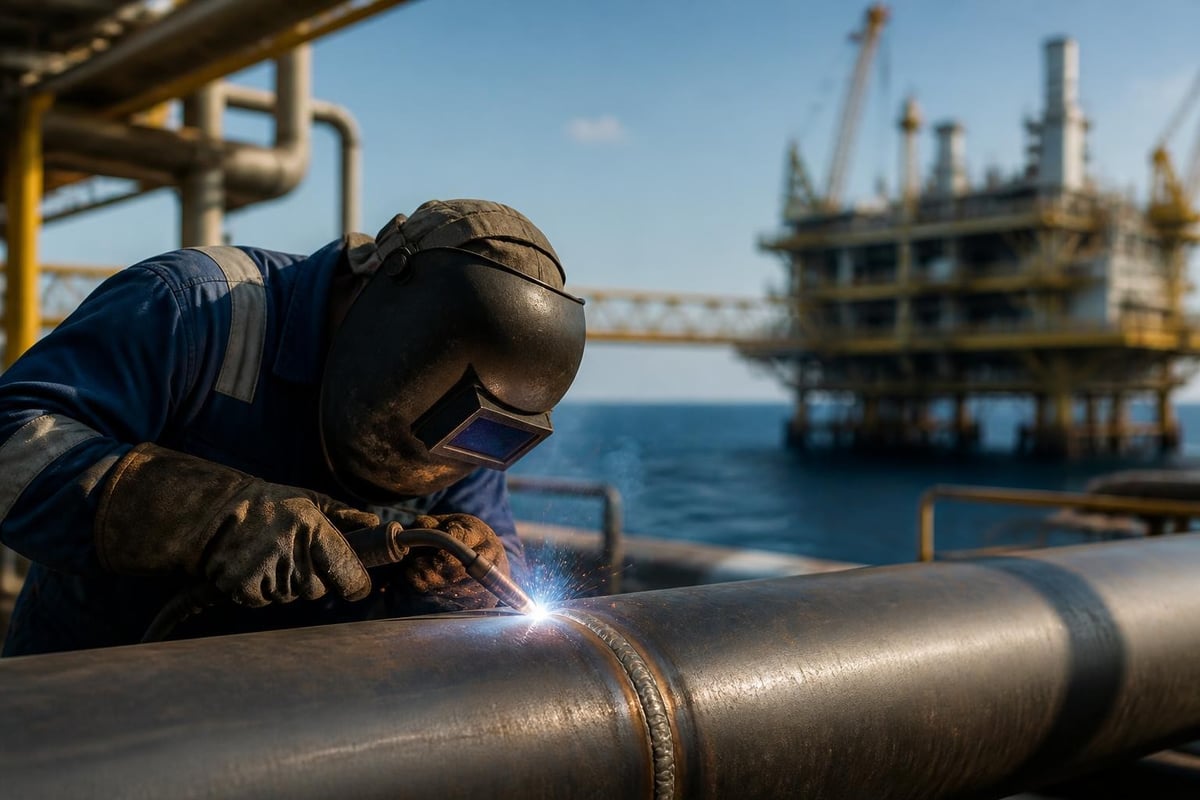
The foundation of reliable oil and gas welding services rests on adherence to industry-recognized codes and standards. API Std 1104, the standard for welding of pipelines and related facilities, establishes the requirements for qualification procedures, welder performance testing, and inspection criteria specific to pipeline work. This standard addresses everything from joint preparation and welding parameters to radiographic examination and repair procedures.
Beyond pipeline-specific codes, ASME BPVC Section IX governs welder and procedure qualification for pressure equipment commonly found in oil and gas facilities. Understanding the differences between these standards is crucial for contractors serving multiple aspects of the industry, and those evaluating providers should understand AWS D1.1 vs API 1104 code applications.
| Standard | Primary Application | Key Requirements |
|---|---|---|
| API Std 1104 | Pipeline welding and related facilities | Welder qualification, procedure testing, radiographic inspection |
| ASME Section IX | Pressure vessels, process piping, boilers | Procedure qualification record (PQR), welder performance qualification |
| API RP 582 | Chemical, oil, and gas industry repairs | Guidelines for welding procedures and inspection specific to refining |
| B31.3 | Process piping | Design, materials, fabrication, and testing requirements |
Essential Services for Energy Infrastructure
Oil and gas welding services encompass a broad range of capabilities tailored to the sector's diverse needs. Field welding represents perhaps the most visible aspect, with crews mobilizing to pipeline rights-of-way, wellheads, compressor stations, and processing facilities to perform construction, maintenance, and emergency repairs.
Shop fabrication services complement field work by producing custom components, structural assemblies, and pressure vessels in controlled environments where quality can be maximized. Many projects benefit from a combination of both approaches, with major assemblies prefabricated in the shop and final connections completed on-site.
Pipeline Construction and Maintenance
Pipeline welding remains the backbone of oil and gas transmission infrastructure. Construction crews execute thousands of welds during new pipeline installation, joining sections of pipe that may span hundreds of miles. Each weld must withstand decades of service while resisting internal pressure, soil stress, and environmental exposure.
Maintenance welding addresses the ongoing needs of existing pipeline networks through tie-in connections for new spurs, hot tap installations on operating lines, and repair of damaged or corroded sections. These projects often carry higher risk due to proximity to pressurized hydrocarbons and require specialized procedures and safety protocols.
Critical pipeline welding capabilities include:
- GTAW (TIG) root pass welding for critical quality applications
- SMAW (stick) welding for fill and cap passes in field conditions
- FCAW (flux-core) welding for increased productivity on larger diameter pipe
- Automated orbital welding for consistent quality on high-value projects
- Hot tap welding on pressurized systems with appropriate safety measures
Facility Welding and Fabrication
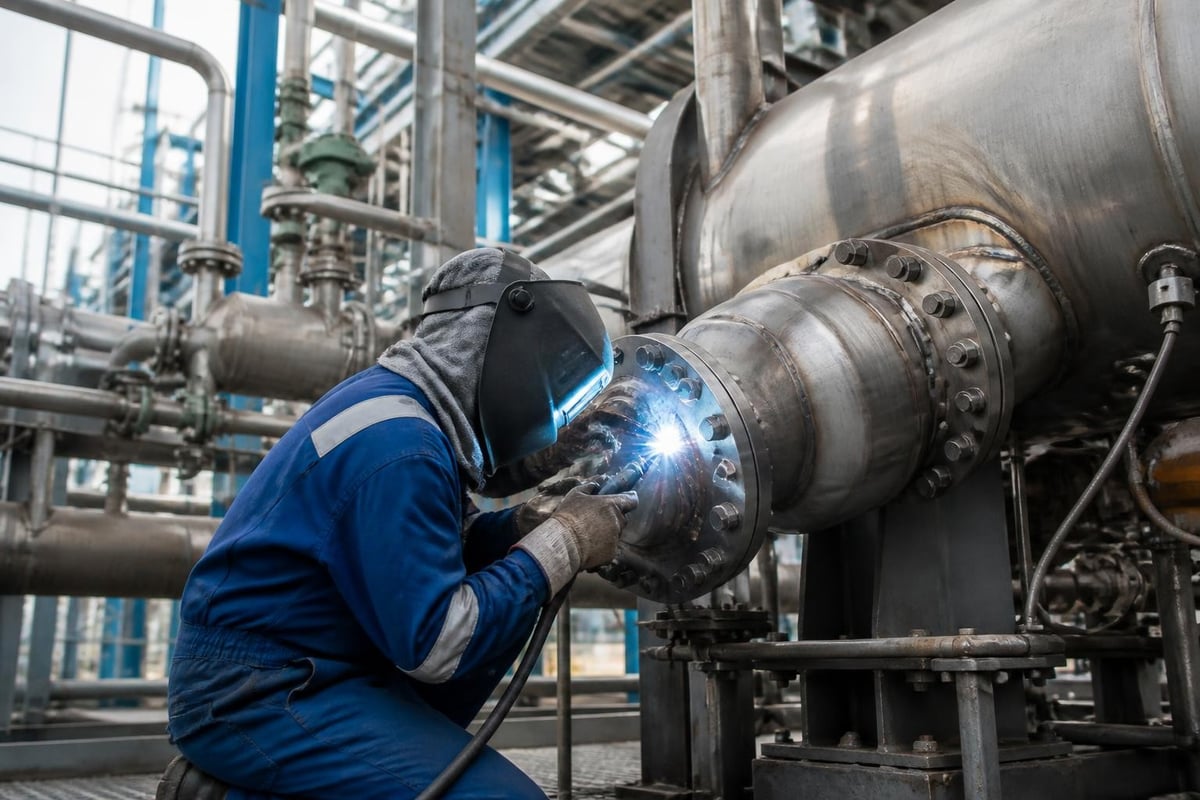
Processing facilities, refineries, and production sites require extensive welding services for both new construction and ongoing maintenance. Pressure vessels, heat exchangers, storage tanks, and process piping systems all demand fabrication and installation expertise that meets applicable codes while considering operational requirements.
Industrial welding contractors serving this market must maintain diverse process capabilities and material expertise. Stainless steel, chrome-moly alloys, duplex materials, and exotic metals are common in processing applications where corrosion resistance and high-temperature performance are essential.
Quality Assurance and Inspection Protocols
The reliability of oil and gas welding services depends on comprehensive quality assurance programs that verify every weld meets specification requirements. Inspection begins before the arc is struck with procedure review and welder qualification verification, continues during welding with real-time monitoring, and concludes with non-destructive examination of completed joints.
Visual inspection serves as the first line of quality control, identifying obvious defects like undercut, porosity, and profile irregularities. However, the critical nature of oil and gas applications demands volumetric examination to detect internal discontinuities that could compromise joint integrity.
Advanced Non-Destructive Testing Methods
Radiographic testing has long been the standard for pipeline and pressure vessel weld examination, but phased array ultrasonic testing (PAUT) offers significant advantages in many applications. PAUT provides real-time imaging of weld cross-sections, eliminates radiation safety concerns, and can be performed more rapidly than conventional radiography.
The choice of inspection method depends on project specifications, accessibility, material thickness, and joint configuration. Many modern oil and gas welding services employ multiple NDE techniques to provide comprehensive quality verification:
- Visual Testing (VT): Initial assessment of surface condition and weld profile
- Liquid Penetrant Testing (PT): Detection of surface-breaking defects in non-magnetic materials
- Magnetic Particle Testing (MT): Surface and near-surface defect detection in ferromagnetic materials
- Radiographic Testing (RT): Traditional volumetric examination with permanent film record
- Ultrasonic Testing (UT/PAUT): Advanced volumetric examination with real-time imaging capability
- Positive Material Identification (PMI): Verification of material chemistry and alloy grades
Welder Qualification and Certification
The competence of individual welders directly impacts the quality and reliability of oil and gas welding services. Industry standards require formal qualification testing that demonstrates a welder's ability to produce sound joints in specific positions, processes, and material combinations. These qualifications are not one-time achievements but must be maintained through ongoing performance and periodic requalification.
The AWS Certified Welder program provides industry-recognized credentials that demonstrate proven competency. Many oil and gas operators and contractors require AWS certification in addition to procedure-specific qualifications as a baseline for employment.
Maintaining Qualified Personnel
Recruiting and retaining qualified welders represents an ongoing challenge for service providers in this sector. The specialized skills required for oil and gas work, combined with the often remote locations and demanding schedules, create workforce pressures that impact service availability and costs.
Leading companies address this challenge through comprehensive training programs, competitive compensation, career development opportunities, and investment in technologies that enhance both productivity and working conditions. Automated and semi-automated welding systems can improve quality consistency while reducing the physical demands on welders, though skilled operators remain essential for setup, monitoring, and quality control.
Field Service Capabilities and Mobilization
The distributed nature of oil and gas infrastructure places a premium on responsive field service capabilities. When a pipeline requires emergency repair or a production facility needs maintenance welding during a turnaround, contractors must mobilize qualified personnel, equipment, and consumables quickly while maintaining full compliance with safety and quality requirements.
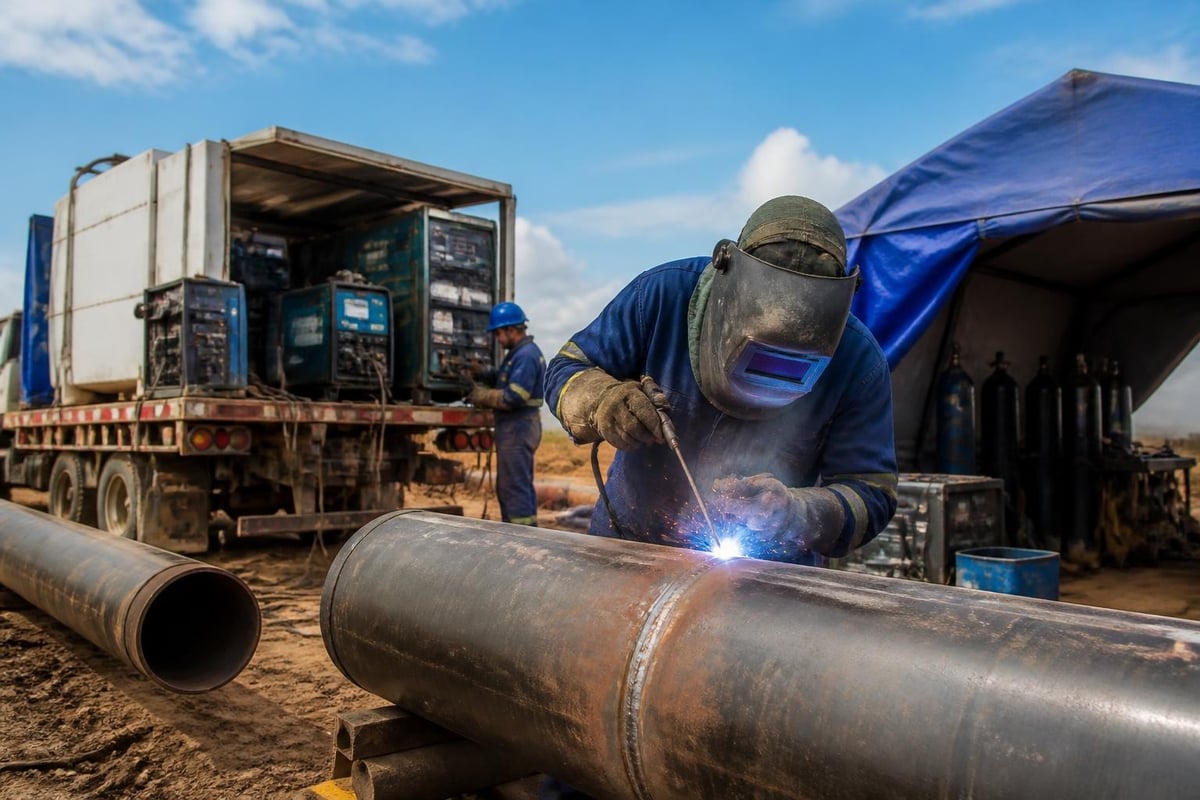
Effective field welding services require more than welding expertise. Logistics coordination, site safety management, environmental compliance, and client communication all contribute to successful project execution. Companies serving the Western United States must be prepared to deploy across vast distances, often to locations with limited infrastructure and harsh environmental conditions.
Equipment and Resource Management
Modern oil and gas welding services rely on significant equipment investments to support both quality and productivity objectives. Mobile welding machines with multi-process capability, portable power generation, advanced fume extraction systems, and climate-controlled welding enclosures enable high-quality work in challenging field environments.
Essential field service resources include:
- Truck-mounted welding systems with integrated power generation
- Positive pressure welding habitats for critical procedure requirements
- Portable radiographic and ultrasonic inspection equipment
- Hydraulic alignment and fit-up tools for large diameter pipe
- Gas supply systems for GTAW and GMAW processes
- Environmental containment and spill prevention equipment
Specialized Applications and Advanced Processes
Beyond conventional pipe and vessel welding, the oil and gas sector requires specialized capabilities for unique applications. Overlay welding applies corrosion-resistant or wear-resistant materials to base metal substrates, extending equipment life in harsh service environments. Hard-banding of drill pipe connections, valve seat refurbishment, and pump component repair all demand specific process expertise and metallurgical knowledge.
Automation and robotics are increasingly integrated into oil and gas welding services. Active visual sensing methods for robotic welding enable automated systems to adapt to joint variations and maintain optimal parameters, improving both quality and productivity. While fully automated pipeline welding remains limited to specific applications, semi-automated processes like mechanized GMAW and orbital TIG welding are widely employed.
Integration with Complementary Services
Oil and gas projects rarely require welding services in isolation. The most effective contractors provide integrated capabilities that address the full scope of maintenance and fabrication needs. Hydraulic cylinder repair, precision machining, and waterjet cutting services complement welding capabilities, enabling single-source solutions that reduce coordination complexity and improve schedule efficiency.
When evaluating oil and gas welding services, consider the provider's full range of capabilities and their ability to coordinate multiple disciplines. A contractor who can fabricate, machine, and install a replacement component while managing lifting, rigging, and alignment needs offers significant advantages over coordinating multiple specialty vendors.
| Service Integration | Project Benefits | Typical Applications |
|---|---|---|
| Welding + Machining | Precision fit-up, post-weld machining | Pressure vessel nozzles, flange facing, shaft repair |
| Welding + Hydraulics | Complete actuator service | Valve operators, gate actuators, BOP equipment |
| Welding + Waterjet | Precise preparation without heat | Weld removal, material separation, corrosion removal |
Material Expertise and Procedure Development
The diversity of materials encountered in oil and gas applications demands extensive metallurgical knowledge and procedure development capability. Carbon steel piping represents the most common application, but stainless steels, chrome-moly alloys, duplex materials, and nickel alloys are widely used where corrosion resistance, high temperature service, or sour gas environments demand enhanced properties.
Successful oil and gas welding services require documented welding procedures (WPS) that specify every critical variable affecting weld quality. Procedure qualification testing validates these specifications through mechanical testing and non-destructive examination of representative welds. API RP 582, which provides welding guidelines for the chemical, oil, and gas industries, offers comprehensive guidance for procedure development and qualification in refining and processing applications.
Dissimilar Metal Welding Challenges
Many oil and gas applications involve joining dissimilar materials, such as connecting stainless steel piping to carbon steel equipment or attaching high-alloy overlays to base metal substrates. These joints require careful filler metal selection, preheat and interpass temperature control, and often post-weld heat treatment to achieve satisfactory properties.
Thermal expansion mismatch, hydrogen cracking susceptibility, and carbon migration are among the challenges that must be addressed through proper procedure development. Experienced providers maintain qualified procedures for common dissimilar metal combinations and can develop and qualify new procedures when unique applications arise.
Safety Management in Hazardous Environments
Oil and gas welding services operate in environments where hydrocarbons, hydrogen sulfide, and other hazardous materials create significant risks. Hot work in these settings demands rigorous safety protocols including atmospheric monitoring, fire watch personnel, spark containment, and emergency response planning. Contractors must maintain comprehensive safety management systems that protect personnel while ensuring regulatory compliance.
Beyond general industrial safety requirements, oil and gas sites often impose additional training and certification requirements. OSHA certification, H2S awareness, confined space entry qualification, and client-specific safety orientations may all be required before work authorization is granted.
Critical safety program elements include:
- Comprehensive job hazard analysis for each project
- Hot work permit systems with multi-level authorization
- Continuous atmospheric monitoring during welding operations
- Dedicated fire watch personnel and suppression equipment
- Emergency evacuation procedures and communication protocols
- Regular safety training and incident investigation processes
Geographic Considerations for Western Operations
Companies providing oil and gas welding services across the Western United States face unique logistical and environmental challenges. The region's vast distances, variable terrain, and extreme weather conditions impact both project planning and execution. From the Rockies to the Permian Basin, service providers must be prepared to work in high-altitude environments, desert heat, winter cold, and everything in between.
Proximity to service centers affects response time for emergency calls and the economics of routine maintenance work. Contractors based in strategic locations like Western Colorado can efficiently serve multi-state regions while maintaining the responsiveness that time-sensitive projects demand. For heavy-duty welding services and other industrial applications, regional expertise and established relationships prove invaluable.
Environmental and Regulatory Compliance
Oil and gas welding services must navigate an increasingly complex regulatory environment encompassing air quality, stormwater management, waste disposal, and environmental protection. Welding operations generate fumes, consumable waste, and potential spill risks that require proper management and documentation.
Leading contractors maintain environmental management systems that identify regulatory requirements, implement appropriate controls, and provide verification of compliance. This proactive approach protects both the contractor and the client from regulatory exposure while demonstrating corporate responsibility.
Technology Integration and Future Developments
The oil and gas welding services sector continues to evolve through technology adoption and process innovation. Digital documentation systems replace paper records with cloud-based platforms that provide real-time access to procedures, qualifications, and inspection results. Weld management software tracks every joint from fit-up through final inspection, creating comprehensive quality records that satisfy regulatory and client requirements.
Advanced sensors and data acquisition systems monitor welding parameters in real time, flagging deviations before they result in defective welds. This predictive quality approach reduces rework costs while improving overall reliability. When combined with automated inspection technologies, these systems create unprecedented levels of quality assurance and documentation.
Additive manufacturing techniques are beginning to influence repair welding practices, particularly for complex geometries and high-value components. While traditional welding processes will remain dominant for the foreseeable future, directed energy deposition and other metal additive processes offer new solutions for specialized applications.
Selecting the Right Service Provider
Choosing an oil and gas welding services contractor requires careful evaluation of multiple factors beyond basic pricing considerations. Code compliance, qualified personnel, inspection capabilities, safety performance, and financial stability all impact project success and long-term partnership value.
Request documentation of procedure qualifications, welder certifications, and recent project experience in similar applications. Verify insurance coverage, safety statistics, and client references. The lowest bid often reflects compromises in capability, quality, or service that prove expensive when projects encounter challenges.
Key evaluation criteria include:
- Code compliance and procedure libraries covering relevant standards and materials
- Qualified welder availability with demonstrated performance history
- Inspection and quality assurance capabilities including in-house NDE services
- Safety performance metrics and comprehensive management systems
- Equipment and technology investments supporting quality and productivity
- Geographic coverage and response capability for field service needs
- Financial stability and insurance coverage protecting project interests
- Client references and project portfolio demonstrating relevant experience
The most effective partnerships develop when contractors and clients align on quality expectations, communication protocols, and continuous improvement objectives. Collaborative relationships enable proactive problem-solving, schedule optimization, and value engineering that benefit both parties.
Oil and gas welding services represent a critical capability for maintaining and expanding energy infrastructure across the Western United States. Success in this demanding sector requires specialized expertise, rigorous quality systems, and the flexibility to address diverse project needs from remote field locations to controlled shop environments. Whether your operation needs pipeline construction support, facility maintenance welding, or emergency repair services, partnering with a qualified contractor ensures projects meet the stringent standards this industry demands. LTJ Industrial Services delivers comprehensive welding, fabrication, and machining solutions backed by extensive oil and gas sector experience throughout the Western United States, combining field service responsiveness with shop fabrication capabilities to keep your operations running safely and efficiently.