
Understanding and implementing proper welding specifications is fundamental to delivering safe, reliable fabrication work in today's industrial environment. These technical documents serve as the blueprint for every welding operation, ensuring consistency, quality, and compliance across projects ranging from structural steel fabrication to pressure vessel construction. For manufacturers and fabricators serving the oil and gas, aggregate, and recycling industries throughout the Western United States, mastering welding specifications isn't optional-it's essential to maintaining competitive advantage and protecting project integrity.
What Are Welding Specifications and Why They Matter
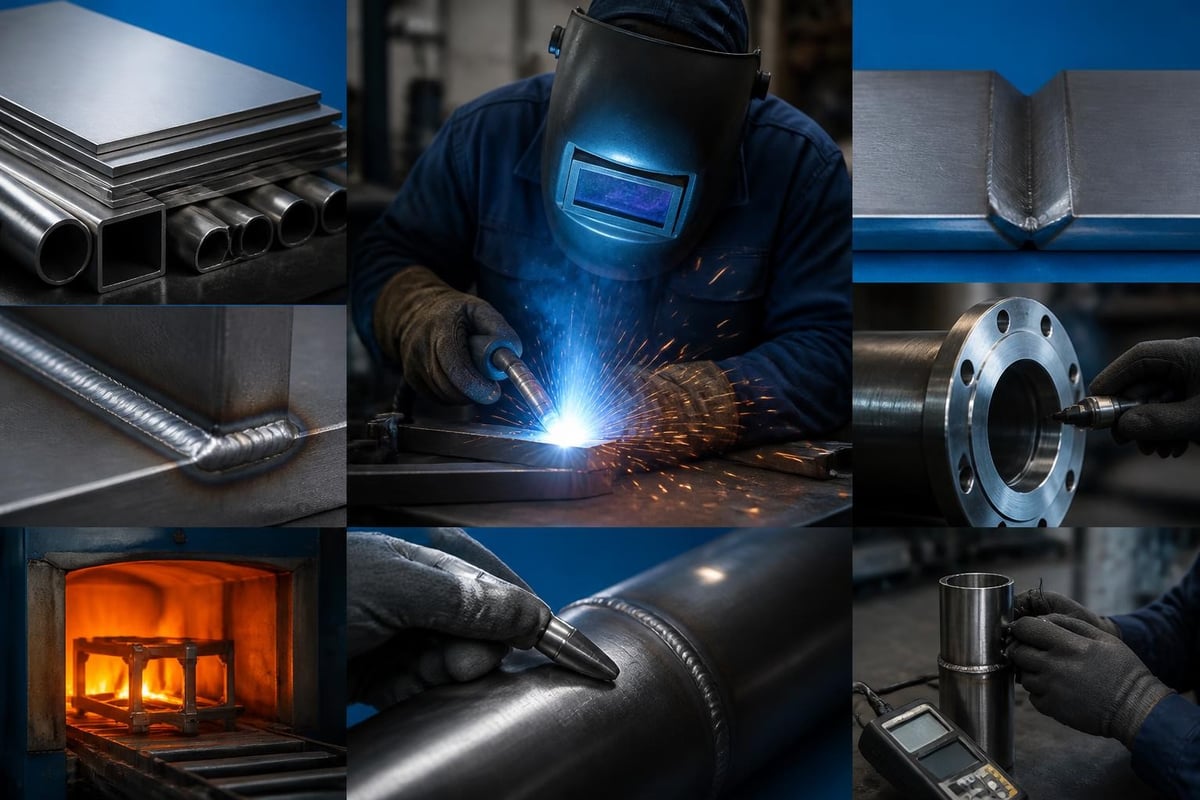
Welding specifications are comprehensive technical documents that define the requirements, procedures, and acceptance criteria for welding operations on a specific project or fabrication. These specifications establish everything from base material selection and filler metal requirements to preheat temperatures, welding processes, and post-weld heat treatment protocols.
The primary purpose of these documents is to ensure that welded joints meet the structural, mechanical, and performance requirements necessary for their intended service. When properly developed and followed, welding specifications eliminate guesswork, reduce costly rework, and provide a defensible quality assurance framework.
Core Components of Effective Specifications
Every comprehensive welding specification contains several critical elements that work together to define acceptable welding practices:
- Base material specifications including grade, type, and thickness ranges
- Welding process parameters such as amperage, voltage, and travel speed
- Filler metal requirements with specific AWS classifications
- Joint design and preparation standards including edge preparation and fit-up tolerances
- Preheat and interpass temperature requirements
- Post-weld heat treatment protocols when applicable
- Inspection and testing criteria including NDT methods and acceptance standards
- Welder qualification requirements tied to specific procedure specifications
The American Welding Society publishes numerous standards that form the foundation for most industrial welding specifications in North America.
Understanding Welding Procedure Specifications (WPS)
A Welding Procedure Specification, commonly abbreviated as WPS, represents the heart of any welding quality system. This document provides specific instructions to welders and welding operators, ensuring they produce welds that meet predetermined quality standards.
Essential Variables in WPS Development
The WPS must address both essential and nonessential variables according to the governing code. Essential variables are parameters that, when changed beyond specified limits, require re-qualification of the procedure.
Essential Variables Typically Include:
- Base metal specification and thickness range
- Filler metal classification and size
- Welding process (SMAW, GMAW, FCAW, GTAW, SAW)
- Joint design configuration
- Welding position (flat, horizontal, vertical, overhead)
- Preheat and interpass temperature minimums
- Post-weld heat treatment requirements
- Shielding gas composition and flow rate
- Current type and polarity
| Variable Category | Impact on Qualification | Common Examples |
|---|---|---|
| Essential | Requires requalification if changed | Base metal P-Number change, process change, deleted PWHT |
| Supplementary Essential | Requires requalification for impact testing | Preheat temperature decrease, heat input increase |
| Nonessential | Does not require requalification | Electrode brand change (same classification), joint detail changes |
Developing welding specifications that account for all essential variables ensures procedures remain valid across the full range of anticipated fabrication scenarios. TWI Global’s technical guidance provides excellent resources for understanding these distinctions across different welding codes.
Major Welding Codes and Standards
Different industries and applications require compliance with specific welding codes. Understanding which codes govern your work is the first step in developing appropriate welding specifications.
AWS D1.1 Structural Welding Code – Steel
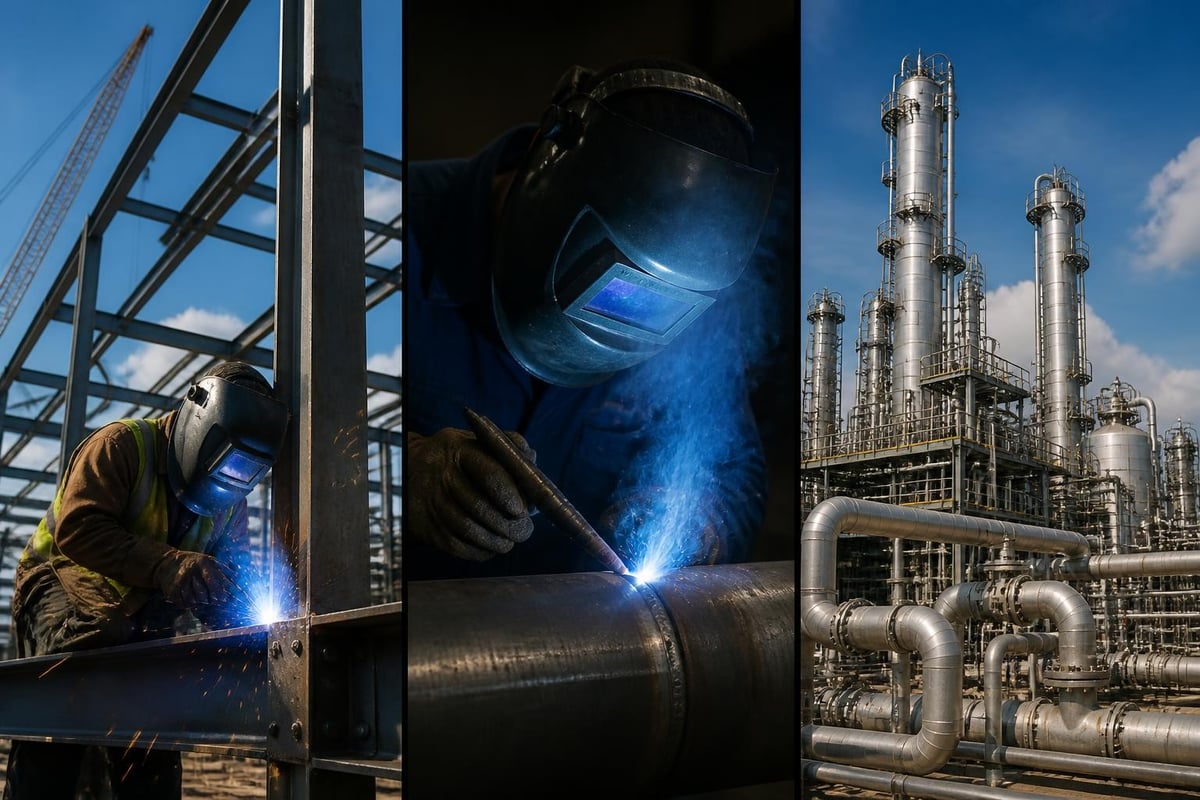
The AWS D1 Committee on Structural Welding maintains this widely-used code for structural steel fabrication. D1.1 governs welding specifications for buildings, bridges, and other structural applications where load-bearing capacity is critical.
This code provides detailed requirements for:
- Prequalified joint details and WPS requirements
- Qualification testing procedures for welders and procedures
- Workmanship and visual acceptance criteria
- NDT requirements based on loading and criticality
- Tubular connection design and fabrication
ASME Boiler and Pressure Vessel Code Section IX
For pressure vessels, piping systems, and boilers, ASME Section IX provides the qualification framework for welding and brazing procedures. This code is particularly relevant for oil and gas applications, process equipment, and any application involving pressure containment.
ASME Section IX uses a variable-based system organized around:
P-Numbers: Grouping of base metals with similar characteristics
F-Numbers: Grouping of filler metals with similar usability characteristics
A-Numbers: Grouping of weld metal analysis requirements
The ASME WPS and PQR forms provide standardized templates that ensure all required information is documented during procedure qualification.
API Standards for Petroleum and Natural Gas
API 1104 specifically addresses welding of pipelines and related facilities in the petroleum and natural gas industries. This standard is essential for companies working in the oil and gas sector across the Western United States.
Procedure Qualification Records (PQR)
While the WPS tells welders how to make a weld, the Procedure Qualification Record documents that the WPS actually produces acceptable welds. The PQR provides objective evidence through testing that a welding procedure meets the required mechanical and metallurgical properties.
PQR Development and Testing Requirements
Creating a valid PQR requires welding test coupons using the exact parameters and conditions specified in the preliminary WPS. These test coupons then undergo destructive testing to verify mechanical properties.
Standard PQR Testing Methods:
- Visual examination for surface discontinuities
- Tensile testing to verify strength requirements
- Bend testing (root, face, or side bends) to assess ductility
- Impact testing when specified for low-temperature service
- Macro-etching to evaluate fusion, penetration, and porosity
- Hardness testing for specific applications
| Test Type | Purpose | Typical Acceptance Criteria |
|---|---|---|
| Tensile | Verify joint strength | Equal to or greater than base metal minimum |
| Guided Bend | Assess weld ductility | No discontinuities >1/8 inch after bending |
| Charpy Impact | Low-temp toughness | Minimum absorbed energy per code requirements |
| Macro-Etch | Evaluate weld quality | Complete fusion, adequate penetration, minimal porosity |
The investment in proper procedure qualification pays dividends through reduced field failures, improved weld quality, and demonstrated compliance with contract specifications.
Developing Project-Specific Welding Specifications
Generic welding specifications rarely address all the unique requirements of specialized industrial projects. Custom specifications must account for material grades, service conditions, environmental factors, and client-specific quality requirements.
Material Considerations
Base metal selection drives many aspects of welding specifications. Carbon steel fabrication for aggregate processing equipment requires different approaches than stainless steel piping for corrosive service or high-strength alloys for pressure vessels.
Consider these material-specific factors:
- Carbon equivalent and susceptibility to hydrogen cracking
- Maximum hardness requirements in heat-affected zones
- Corrosion resistance needs based on service environment
- Impact toughness for low-temperature applications
- Material thickness and its effect on heat input and cooling rates
When working with materials prone to corrosion, AMPP standards provide essential guidance on coating compatibility, surface preparation, and post-weld treatment requirements.
Environmental and Service Conditions
The operating environment significantly influences welding specification requirements. Equipment operating in sub-zero temperatures requires impact testing and controlled heat input. Structures exposed to cyclic loading need fatigue considerations. Corrosive environments demand specific filler metal chemistry and post-weld treatments.
Key Environmental Factors:
- Operating temperature range (ambient to service extremes)
- Corrosive media exposure (chemicals, saltwater, acids)
- Loading conditions (static, cyclic, impact)
- Accessibility for inspection and maintenance
- Regulatory requirements specific to industry or location
Welder Qualification and Performance Testing
Even the most thoroughly developed welding specifications fail without qualified welders executing the work. Welder qualification demonstrates that individual welders can produce sound welds following specific procedures.
Welder Performance Qualification (WPQ)
Most codes require welders to pass performance tests that simulate actual production conditions. These tests verify the welder's ability to deposit sound weld metal in specific positions, using designated processes, within acceptable quality standards.
Qualification variables typically include:
- Welding process used
- Base metal type and thickness
- Filler metal diameter
- Welding position (flat, horizontal, vertical, overhead)
- Joint type (groove vs. fillet)
- Backing condition (with or without backing)
A welder qualified in the 6G position (pipe inclined 45 degrees, fixed) gains qualification for all positions. This approach provides maximum flexibility for shop and field work.
Inspection and Quality Control Requirements
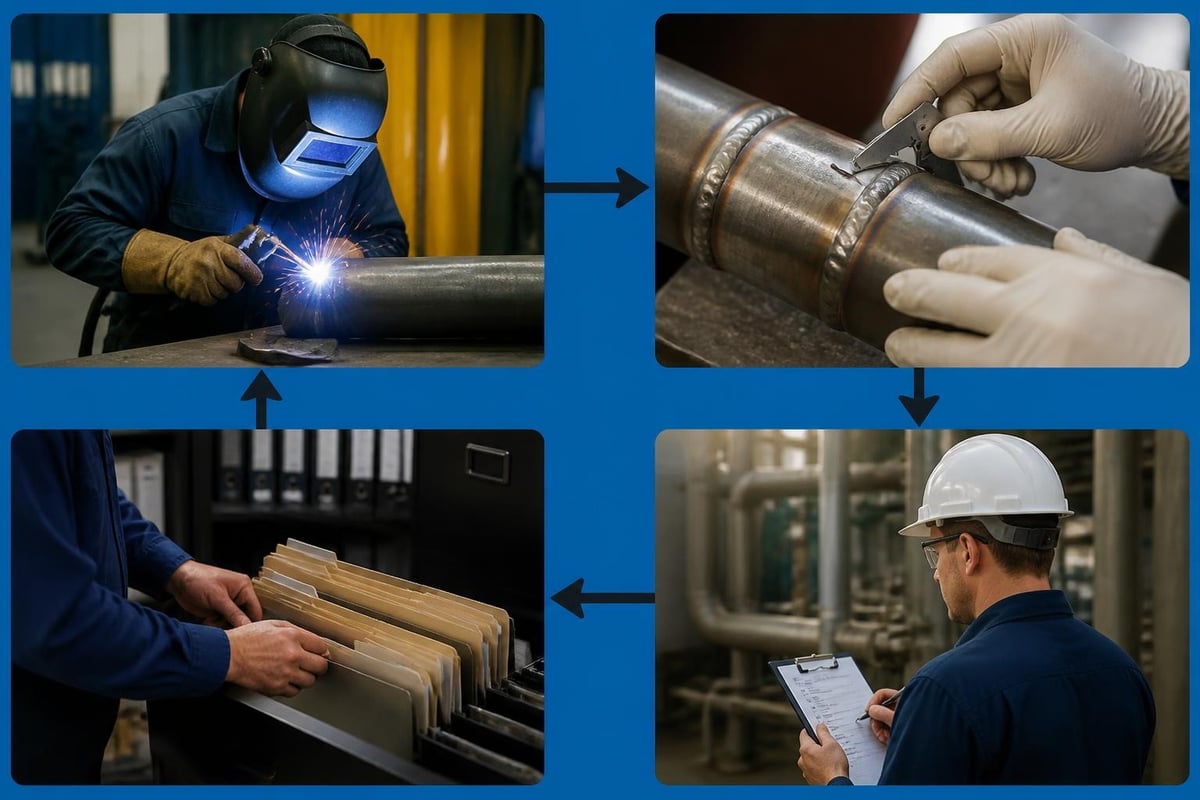
Welding specifications must clearly define inspection methods, frequency, and acceptance criteria. Quality control programs verify that completed welds meet specification requirements before equipment enters service.
Non-Destructive Testing Methods
Different NDT methods suit different applications and defect types. Selecting appropriate inspection methods requires understanding each method's capabilities and limitations.
| NDT Method | Best For Detecting | Typical Applications | Limitations |
|---|---|---|---|
| Visual (VT) | Surface discontinuities, dimensions | All welds, first-line inspection | Surface defects only |
| Radiographic (RT) | Internal volumetric defects | Critical joints, pressure vessels | Expensive, radiation safety concerns |
| Ultrasonic (UT) | Internal discontinuities, lack of fusion | Thick sections, structural welds | Operator skill-dependent |
| Magnetic Particle (MT) | Surface and near-surface defects in ferromagnetic materials | Carbon steel welds | Ferromagnetic materials only |
| Liquid Penetrant (PT) | Surface-breaking defects in any material | Stainless, aluminum, non-magnetic | Surface defects only |
Inspection frequency varies by code and application criticality. Production welding may require 10-100% inspection depending on service classification and loading conditions.
Acceptance Criteria and Defect Evaluation
Welding specifications must establish clear, measurable acceptance criteria aligned with applicable codes. Not all discontinuities are defects-acceptability depends on type, size, location, and orientation relative to service stresses.
Common acceptance considerations include:
- Crack indications: Typically unacceptable in any amount
- Porosity: Limited by size, distribution, and total percentage
- Incomplete fusion: Generally unacceptable, especially in critical applications
- Undercut: Acceptable within depth and length limits
- Reinforcement: Controlled by maximum height requirements
Documentation and Record Keeping
Comprehensive documentation proves compliance and provides traceability throughout a fabrication's service life. Proper records protect both fabricators and clients by demonstrating adherence to welding specifications.
Essential Documentation Elements
A complete welding quality package typically includes:
- Approved WPS documents for all welding performed
- Supporting PQRs demonstrating procedure qualification
- Welder qualification records (WPQ) for all welders
- Material test reports verifying base and filler metal compliance
- Inspection and test records documenting all quality verification activities
- Non-conformance reports and corrective action documentation
- Final weld maps showing weld locations and identification
Digital documentation systems improve accessibility and reduce loss risk. Many fabricators now maintain electronic quality management systems that integrate welding specifications, procedures, qualifications, and inspection records in searchable databases.
Pre-Weld and Post-Weld Heat Treatment
Heat treatment requirements represent critical elements of many welding specifications, particularly for thick sections, high-strength materials, and sour service applications.
Preheat Requirements
Preheat slows cooling rates, reduces hydrogen cracking risk, and decreases residual stresses. Minimum preheat temperatures depend on base metal type, thickness, carbon equivalent, and hydrogen content of the welding process.
Typical Preheat Considerations:
- Material composition and carbon equivalent
- Section thickness and heat sink effects
- Ambient temperature and wind conditions
- Restraint level and joint configuration
- Welding process and hydrogen level
Temperature measurement and verification require proper instrumentation. Temperature-indicating crayons, contact pyrometers, or infrared thermometers document compliance with specification requirements.
Post-Weld Heat Treatment (PWHT)
PWHT serves multiple purposes including stress relief, hydrogen removal, and tempering of hard microstructures. ASME and API codes specify PWHT requirements based on material type, thickness, and service conditions.
Effective PWHT requires:
- Controlled heating rates to avoid thermal shock
- Uniform temperature distribution across the entire weld zone
- Sufficient hold time at temperature for stress relief
- Controlled cooling rates to prevent new stresses
- Proper temperature monitoring and documentation
Field Welding Specifications vs. Shop Welding
Welding specifications must account for differences between controlled shop environments and variable field conditions. Field welding presents unique challenges that require specific procedural considerations.
Shop Welding Advantages
Fabrication shops provide environmental control, positioning equipment, and comprehensive quality resources. Shop welding specifications can incorporate:
- Positioning for downhand welding whenever possible
- Automated or semi-automated welding processes
- Extensive preheat capability and controlled cooling
- Immediate access to inspection and testing resources
- Climate-controlled environments protecting from weather
Field Welding Challenges
Field specifications must address limitations including:
- Fixed workpiece positions requiring all-position qualifications
- Environmental protection from wind, rain, and temperature extremes
- Limited positioning and handling equipment
- Restricted access for inspection activities
- Power source availability and consistency
Successful field welding programs develop procedures specifically qualified for actual field conditions. Testing performed in controlled shops may not predict field performance where welders work overhead in 20 mph winds at 15°F.
At LTJ Industrial Services, extensive experience with both shop and field welding across the Western United States informs practical specification development that addresses real-world fabrication challenges.
Common Welding Specification Mistakes
Understanding frequent specification errors helps avoid costly problems during fabrication and inspection.
Inadequate Variable Definition
Specifications that fail to address all essential variables create qualification gaps. A WPS qualified only for 1/4-inch material cannot support production welding on 1-inch plate without additional qualification testing.
Common Oversights Include:
- Incomplete thickness range coverage
- Missing position qualifications for actual production needs
- Inadequate filler metal size ranges
- Undefined preheat or interpass temperature requirements
- Omitted post-weld heat treatment specifications
Contradictory Requirements
Specifications incorporating requirements from multiple codes sometimes create conflicts. ASME and AWS codes have different qualification rules, acceptance criteria, and procedure variables.
Ensure specifications clearly identify the governing code and resolve any contradictions before welding begins. Contract documents should establish precedence when multiple standards apply.
Unrealistic Quality Requirements
Overly restrictive acceptance criteria increase costs without improving functional performance. Specifying 100% radiography for non-critical fabrications wastes resources. Requiring impact testing for room-temperature service adds expense without benefit.
Welding specifications should match quality requirements to actual service demands. Work with engineering and quality personnel to establish appropriate, cost-effective requirements.
Updating and Revising Welding Specifications
Welding specifications require periodic review and updating to incorporate new technologies, address field experience, and maintain code compliance.
Triggers for Specification Revision
Several factors may necessitate updating existing welding specifications:
- Publication of new code editions or amendments
- Introduction of new base materials or filler metals
- Process improvements or new welding technologies
- Non-conformance trends indicating procedural issues
- Changes in service conditions or design requirements
- Client-specific requirement modifications
Version Control and Change Management
Maintain strict version control to prevent use of superseded specifications. Each revision should include:
- Revision number and date prominently displayed
- Summary of changes from previous version
- Authorization signatures from qualified personnel
- Distribution record ensuring all users receive updates
- Withdrawal of obsolete versions from circulation
Effective change management prevents costly errors from outdated procedures remaining in circulation. Many fabricators now use digital systems with automatic update distribution and acknowledgment tracking.
Integration with Fabrication Quality Systems
Welding specifications don't exist in isolation-they integrate with broader quality management systems covering all aspects of fabrication operations.
ISO 3834 and Welding Quality Requirements
ISO 3834 provides a comprehensive framework for quality requirements in fusion welding of metallic materials. This standard addresses organization, personnel qualification, production planning, welding procedures, inspection, testing, and non-conformance management.
Companies pursuing ISO 3834 certification demonstrate systematic control over all welding quality factors. This certification increasingly appears in contract requirements for critical fabrication work.
Continuous Improvement Through Data Analysis
Modern fabrication operations collect extensive data from welding operations, inspection results, and field performance. Analyzing this information identifies improvement opportunities:
- Non-conformance trending revealing procedural weaknesses
- Welder performance patterns indicating training needs
- Process parameter optimization reducing costs and improving quality
- Material performance data supporting specification refinement
Mastering welding specifications requires understanding applicable codes, developing comprehensive procedures, qualifying processes and personnel, and maintaining rigorous documentation systems. These specifications form the foundation of quality fabrication, ensuring safety, reliability, and compliance across diverse industrial applications. Whether you need structural steel fabrication, pressure vessel construction, or custom welding for specialized equipment, LTJ Industrial Services brings extensive expertise in developing and executing welding specifications that meet the demanding requirements of the commercial and industrial manufacturing sectors throughout the Western United States.
{
“@context”: “https://schema.org”,
“@type”: “FAQPage”,
“mainEntity”: [
{
“@type”: “Question”,
“name”: “What is a Welding Procedure Specification (WPS)?”,
“acceptedAnswer”: {
“@type”: “Answer”,
“text”: “A Welding Procedure Specification (WPS) is a detailed document that provides specific instructions for welders to produce welds meeting predetermined quality standards. It includes essential variables such as base metal specifications, filler metal requirements, welding process parameters, joint design, preheat and interpass temperatures, post-weld heat treatment protocols, and inspection criteria. The WPS ensures consistency and quality across all welding operations on a project.”
}
},
{
“@type”: “Question”,
“name”: “What is the difference between a WPS and a PQR?”,
“acceptedAnswer”: {
“@type”: “Answer”,
“text”: “A Welding Procedure Specification (WPS) tells welders how to make a weld, while a Procedure Qualification Record (PQR) documents that the WPS actually produces acceptable welds. The PQR provides objective evidence through destructive testing-including tensile tests, bend tests, and impact tests-that a welding procedure meets required mechanical and metallurgical properties. The WPS is the instruction manual; the PQR is the proof that following those instructions produces quality results.”
}
},
{
“@type”: “Question”,
“name”: “Which welding codes apply to structural steel fabrication?”,
“acceptedAnswer”: {
“@type”: “Answer”,
“text”: “AWS D1.1 Structural Welding Code – Steel is the primary standard governing structural steel fabrication in North America. This code provides detailed requirements for prequalified joint details, WPS development, welder and procedure qualification, workmanship standards, visual acceptance criteria, and NDT requirements based on loading and criticality. For buildings, bridges, and other load-bearing structures, AWS D1.1 establishes the welding specification framework.”
}
},
{
“@type”: “Question”,
“name”: “How often do welder qualifications need to be renewed?”,
“acceptedAnswer”: {
“@type”: “Answer”,
“text”: “Most welding codes require welder qualifications to remain current through continuous welding activity. Typically, if a welder has not welded with a specific process for six months or more, requalification is required. Additionally, qualifications expire if the welder produces unacceptable work, demonstrating loss of skill. Some companies implement periodic testing programs beyond code minimums to ensure ongoing welder competency and maintain quality standards.”
}
},
{
“@type”: “Question”,
“name”: “What NDT methods are most commonly specified for welding inspection?”,
“acceptedAnswer”: {
“@type”: “Answer”,
“text”: “Visual testing (VT) is required for all welds as the first line of inspection. Beyond visual examination, the most common NDT methods include radiographic testing (RT) for detecting internal volumetric defects in critical joints and pressure vessels, ultrasonic testing (UT) for thick sections and structural welds, magnetic particle testing (MT) for surface and near-surface defects in ferromagnetic materials, and liquid penetrant testing (PT) for surface-breaking defects in any material. Method selection depends on material type, weld criticality, and defect detection requirements.”
}
},
{
“@type”: “Question”,
“name”: “When is preheat required for welding?”,
“acceptedAnswer”: {
“@type”: “Answer”,
“text”: “Preheat requirements depend on base metal type, thickness, carbon equivalent, ambient temperature, and welding process hydrogen level. Preheat is typically required for carbon steels exceeding certain thickness thresholds, high-strength materials, materials with high carbon equivalents, low ambient temperatures, or highly restrained joints. Preheat slows cooling rates, reduces hydrogen cracking risk, and decreases residual stresses. Specific minimum preheat temperatures are established by welding codes based on these factors and must be verified before welding begins.”
}
},
{
“@type”: “Question”,
“name”: “What documentation is required for welding quality assurance?”,
“acceptedAnswer”: {
“@type”: “Answer”,
“text”: “A complete welding quality package includes approved WPS documents for all welding performed, supporting PQRs demonstrating procedure qualification, welder qualification records (WPQ) for all welders, material test reports verifying base and filler metal compliance, inspection and test records documenting all quality verification activities, non-conformance reports with corrective actions, and final weld maps showing weld locations and identification. This documentation proves compliance and provides traceability throughout the fabrication’s service life.”
}
},
{
“@type”: “Question”,
“name”: “How do field welding specifications differ from shop welding specifications?”,
“acceptedAnswer”: {
“@type”: “Answer”,
“text”: “Field welding specifications must account for environmental variables, fixed workpiece positions requiring all-position qualifications, weather protection needs, limited access for inspection, and restricted equipment availability. Shop specifications can incorporate positioning for downhand welding, automated processes, extensive preheat capability, immediate inspection access, and climate-controlled environments. Successful field programs develop procedures specifically qualified for actual field conditions, as testing performed in controlled shops may not predict performance in variable outdoor environments.”
}
},
{
“@type”: “Question”,
“name”: “Why should I choose LTJ Industrial Services for welding fabrication projects?”,
“acceptedAnswer”: {
“@type”: “Answer”,
“text”: “LTJ Industrial Services provides comprehensive welding, fabrication, and machining services throughout the Western United States with expertise in developing and executing welding specifications for the oil and gas, aggregate, recycling, and industrial manufacturing sectors. Based in Rifle, CO, the company offers both shop and field services, ensuring welding specifications are properly developed, qualified, and implemented whether work is performed in controlled facilities or challenging field environments. Contact LTJ Industrial Services for high-quality welding solutions that meet demanding specification requirements.”
}
},
{
“@type”: “Question”,
“name”: “What services does LTJ Industrial Services offer beyond welding?”,
“acceptedAnswer”: {
“@type”: “Answer”,
“text”: “LTJ Industrial Services offers comprehensive shop and field services including metal fabrication, precision machining, hydraulics repair and maintenance, water jetting for surface preparation and cutting, custom welding for specialized applications, and mechanical services for commercial and industrial equipment. Serving industries including recycling, aggregate, oil and gas, and general manufacturing throughout the Western United States, LTJ Industrial Services delivers integrated solutions that allow businesses to focus on their operational goals while ensuring quality fabrication and maintenance work.”
}
}
]
}
{
“@context”: “https://schema.org”,
“@type”: “Article”,
“headline”: “Welding Specifications: Standards & Best Practices 2026”,
“description”: “Complete guide to welding specifications for industrial projects. Learn WPS requirements, code compliance, and quality control standards.”,
“image”: “https://ltjindustrial.com/welding-specifications-featured-image.jpg”,
“author”: {
“@type”: “Organization”,
“name”: “LTJ Industrial Services”,
“url”: “https://ltjindustrial.com”
},
“publisher”: {
“@type”: “Organization”,
“name”: “LTJ Industrial Services”,
“logo”: {
“@type”: “ImageObject”,
“url”: “https://ltjindustrial.com/logo.jpg”
}
},
“datePublished”: “2026-11-02”,
“dateModified”: “2026-11-02”,
“mainEntityOfPage”: {
“@type”: “WebPage”,
“@id”: “https://ltjindustrial.com/welding-specifications”
},
“keywords”: “welding specifications, WPS, PQR, welding codes, AWS D1.1, ASME Section IX, welder qualification, welding inspection, NDT testing, fabrication quality”,
“articleSection”: “Welding and Fabrication”,
“wordCount”: 2000,
“inLanguage”: “en-US”
}