
Recycling facilities across North America face a constant challenge: keeping heavy-duty processing equipment operational despite the punishing wear imposed by abrasive materials. From shredders and trommels to screens and conveyors, these critical machines endure impacts, friction, and corrosion daily. When components fail or wear beyond tolerance, skilled recycling equipment repair welding becomes the most economical path to restoring functionality and extending service life. Unlike simple replacement, professional welding repair addresses root causes, builds up worn surfaces, and reinforces vulnerable areas to prevent future failures.
Understanding Recycling Equipment Wear Patterns
Recycling facilities process diverse material streams-municipal solid waste, scrap metal, electronic waste, plastics, and construction debris. Each material type creates unique wear mechanisms that challenge equipment durability.
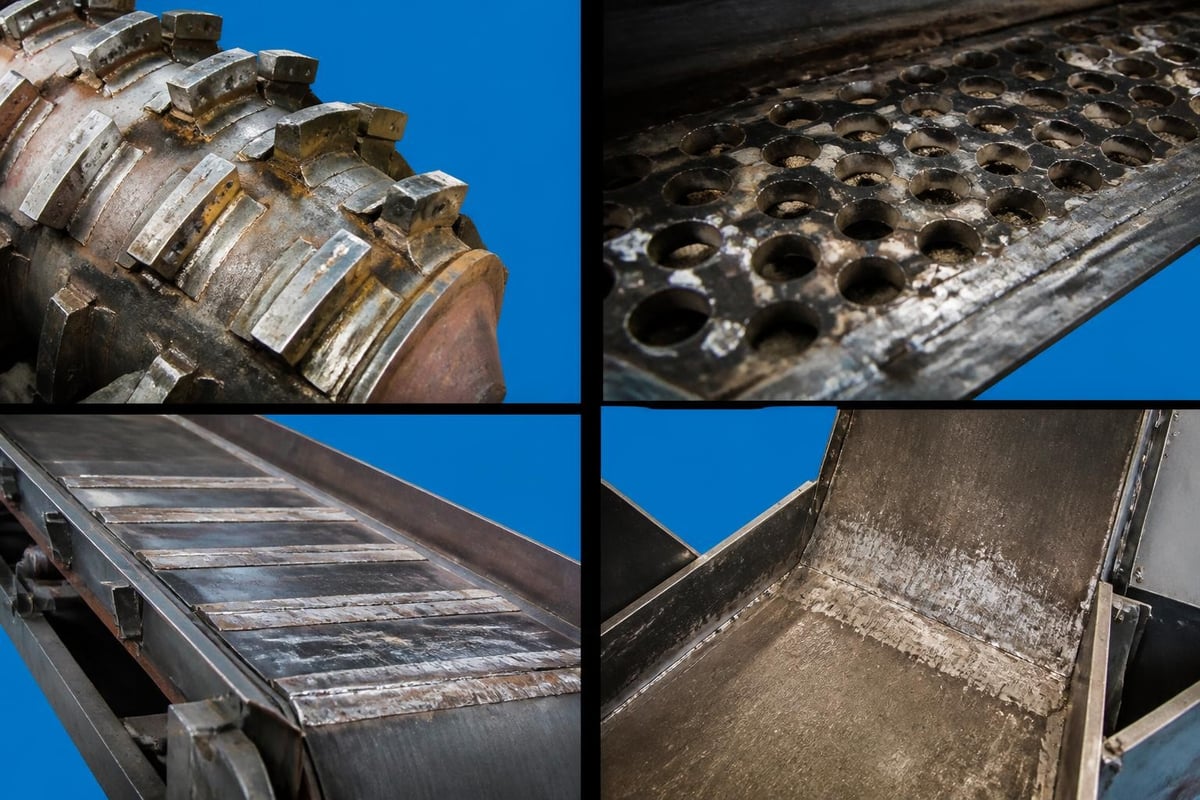
Abrasive wear dominates in facilities handling sand-contaminated materials, glass, or aggregate. Screen decks, chute liners, and discharge points experience continuous material flow that gradually erodes metal surfaces. Impact wear occurs in shredders and hammer mills where rotating components strike incoming materials at high velocity. Research documented in the EPA’s field evaluation of shredders demonstrates that hammer life varies dramatically based on material composition and operational parameters.
Material-Specific Challenges
Different recycling streams impose distinct demands:
- Metal recycling: High-impact loads, sharp edges cutting softer components, heavy shock forces
- E-waste processing: Copper contamination in welds, fine particulate abrasion, mixed-metal wear
- C&D recycling: Concrete and masonry dust erosion, rebar impact damage, irregular feed patterns
- Plastics sorting: Chemical exposure combined with mechanical wear, thermal cycling effects
The specific wear pattern dictates which recycling equipment repair welding technique delivers optimal results. Facilities that understand their predominant failure modes can implement targeted repair strategies.
Essential Welding Processes for Equipment Restoration
Professional recycling equipment repair welding employs multiple processes, each suited to specific repair scenarios and material requirements.
Shielded Metal Arc Welding (SMAW)
SMAW remains the workhorse process for field repairs and structural restoration. Its portability and tolerance for less-than-ideal conditions make it invaluable when equipment cannot be moved to a shop environment. Operators use cellulosic or low-hydrogen electrodes depending on base metal composition and service requirements.
For recycling equipment, E7018 electrodes provide excellent mechanical properties and crack resistance when repairing mild steel frames and supports. When rebuilding high-wear surfaces, hardfacing electrodes in the E6 series deliver superior abrasion resistance.
Gas Metal Arc Welding (GMAW)
GMAW offers higher deposition rates than SMAW, making it efficient for building up worn shafts, rebuilding bearing journals, and restoring dimensional tolerances. The continuous wire feed enables consistent bead geometry-critical when machining is planned post-weld.
Advantages for recycling equipment repair:
- Faster deposition speeds reduce downtime
- Lower heat input minimizes distortion on thin-walled components
- Better visibility of the weld pool improves accuracy
- Suitable for both shop and field applications with proper shielding
Flux-Cored Arc Welding (FCAW)
FCAW combines high deposition rates with excellent mechanical properties, particularly valuable when applying hardfacing overlays to large surface areas. Self-shielded flux-cored wires eliminate external gas requirements, simplifying field repairs in windy conditions common at outdoor recycling facilities.
| Process | Best Applications | Deposition Rate | Field Suitability |
|---|---|---|---|
| SMAW | Structural repairs, crack repair, root passes | Moderate | Excellent |
| GMAW | Buildup, precision restoration, thin materials | High | Good (with wind protection) |
| FCAW | Hardfacing, large area overlay, thick sections | Very High | Excellent (self-shielded) |
| GTAW | Critical repairs, dissimilar metals, root passes | Low | Moderate |
Hardfacing Techniques for Extended Component Life
Hardfacing represents the most cost-effective strategy for combating wear in recycling equipment. By depositing wear-resistant alloys onto surfaces that experience abrasion or impact, facilities dramatically extend component life compared to base metal alone.
The American Welding Society’s hardfacing guidance provides comprehensive technical information on consumable selection, application techniques, and quality verification. Understanding metallurgical principles ensures successful recycling equipment repair welding outcomes.
Consumable Selection Criteria
Chrome carbide alloys excel in abrasive environments with minimal impact. These deposits contain hard chromium carbide particles distributed throughout a tough matrix, providing exceptional resistance to gouging abrasion. Typical hardness ranges from 58-65 HRC.
Tungsten carbide composite overlays deliver maximum abrasion resistance where impact loads remain moderate. The extremely hard tungsten carbide particles (approaching 70 HRC) resist even the most aggressive abrasive wear, though brittleness limits applications involving heavy shock.
Austenitic manganese steel deposits work-harden under impact, making them ideal for shredder hammers and impact bars. Initial hardness of 200 BHN increases to 500+ BHN through service work-hardening, combining toughness with developing wear resistance.
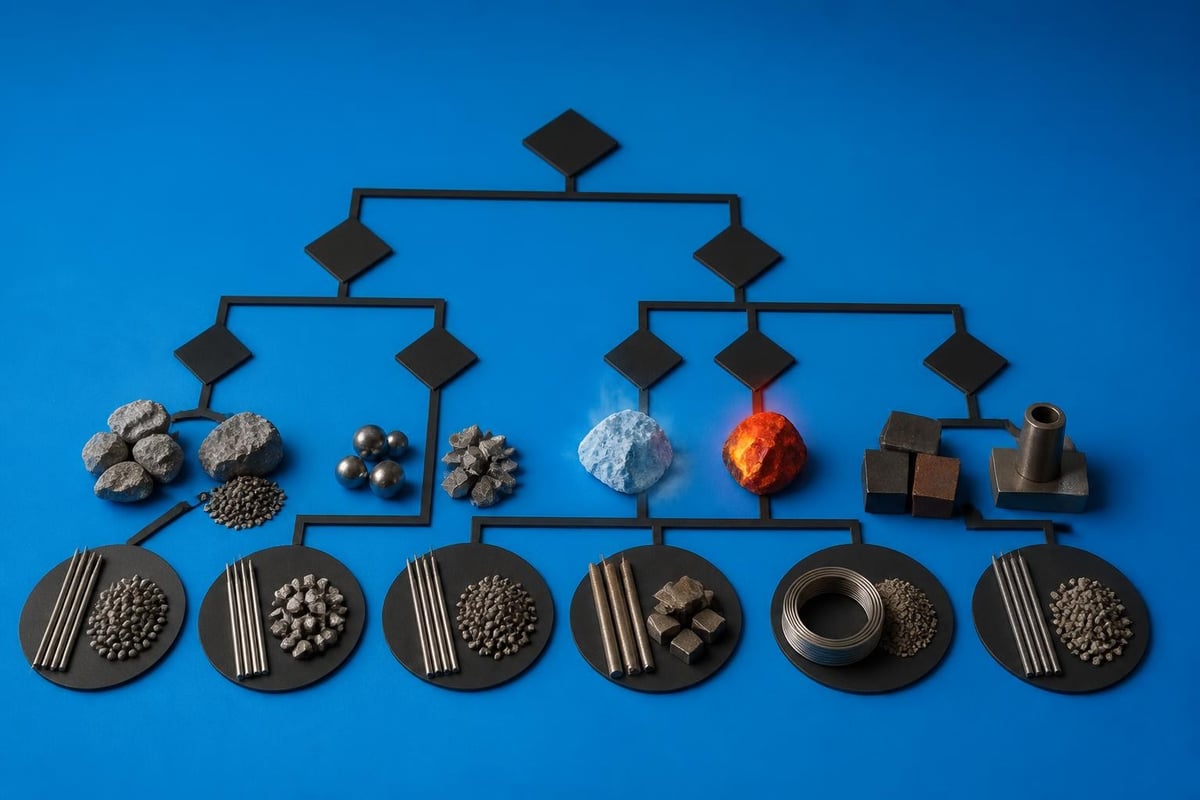
Recent research on microstructure and wear behavior of electric-arc hardfacing demonstrates how process parameters influence final properties. Facilities partnering with experienced welding businesses benefit from this metallurgical knowledge when specifying repairs.
Application Best Practices
Successful hardfacing requires attention to detail throughout the process:
- Surface preparation: Remove all contamination, rust, and existing wear patterns through grinding or machining
- Preheat: Calculate and apply appropriate preheat based on base metal carbon equivalent and section thickness
- Buffer layer: Deposit a tough, crack-resistant buffer layer before applying hard overlays to dissimilar base metals
- Controlled heat input: Maintain interpass temperature within specified ranges to prevent cracking and achieve target microstructure
- Cooling protocol: Implement slow cooling or post-heat to minimize residual stresses
Field Versus Shop Repair Decision Factors
Determining whether to perform recycling equipment repair welding in-situ or transport components to a fabrication shop involves multiple considerations beyond simple convenience.
Shop environment advantages include controlled temperature, proper fixturing, access to precision machining, and complete shielding from weather. Complex repairs requiring multi-axis positioning or post-weld heat treatment generally demand shop capabilities. Facilities near comprehensive manufacturing centers in Colorado and throughout the Western United States can leverage regional expertise.
When Field Repair Makes Sense
Field welding becomes the logical choice when:
- Equipment size or configuration prevents practical removal
- Transportation costs exceed field mobilization expenses
- Downtime penalties make rapid response critical
- Repairs address localized damage rather than complete component replacement
- Access to the damaged area is adequate for safe welding operations
Field repair challenges include weather exposure, limited positioning options, power availability constraints, and reduced access to supplementary equipment. Experienced technicians mitigate these factors through proper planning and specialized equipment.
Hybrid Approaches
Many facilities optimize outcomes by removing severely damaged components for shop restoration while addressing minor wear through field welding during scheduled maintenance windows. This balanced strategy minimizes both downtime and total repair costs.
Preventive Maintenance Through Strategic Welding
Beyond corrective repairs, recycling equipment repair welding plays a crucial preventive role. Proactive hardfacing of new or lightly worn components extends service intervals and reduces catastrophic failures.
Wear mapping programs identify failure patterns across equipment fleets. By tracking which components wear fastest and where damage concentrates, maintenance teams target preventive hardfacing to high-risk zones before operational failures occur.
Component-Specific Strategies
Shredder rotor assemblies benefit from preventive hardfacing on hammer tips, rotor disc edges, and shaft bearing surfaces. Applying wear-resistant overlays during planned maintenance extends hammer life by 200-400% compared to unprotected steel.
Screen deck frames experience concentrated wear at aperture edges where material particles create cutting and gouging action. Selective hardfacing around aperture perimeters maintains screening efficiency longer and reduces deck replacement frequency.
Conveyor systems require attention at transfer points, impact zones, and slider bed contact surfaces. Strategic overlay placement protects against wear without adding excessive weight that increases power consumption.
| Component | Primary Wear Mode | Recommended Overlay | Typical Life Extension |
|---|---|---|---|
| Shredder hammers | Impact + abrasion | Austenitic Mn or Cr-carbide | 3-4x baseline |
| Screen decks | Particle abrasion | Chrome carbide alloy | 2-3x baseline |
| Chute liners | Sliding abrasion | Tungsten carbide composite | 4-6x baseline |
| Rotor discs | Impact + gouging | Multi-layer Cr-carbide | 2.5-3x baseline |
Quality Assurance and Inspection Protocols
Professional recycling equipment repair welding demands rigorous quality verification to ensure repairs meet performance expectations and safety standards.
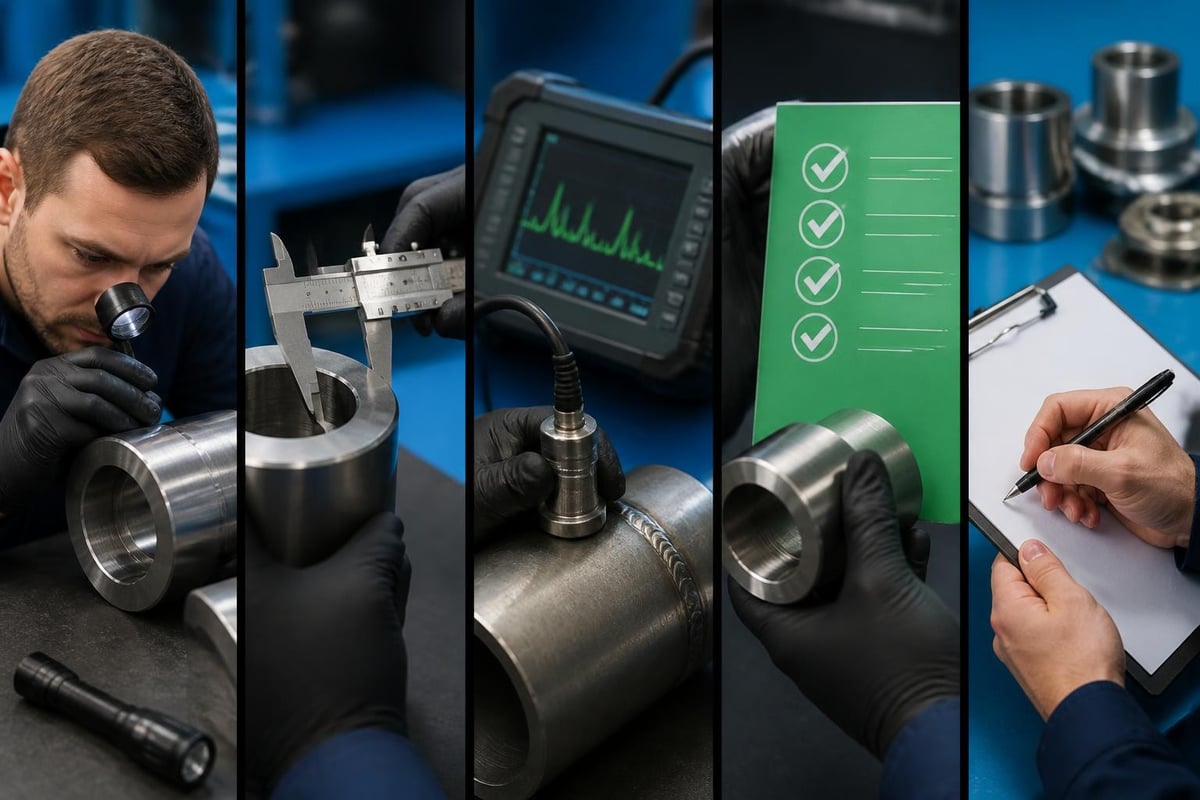
Visual inspection identifies surface irregularities, crack indications, incomplete fusion, and porosity. Trained inspectors evaluate bead geometry, tie-in quality, and overall workmanship against applicable codes and standards.
Non-Destructive Testing Methods
Magnetic particle testing (MT) reveals surface and near-surface discontinuities in ferromagnetic materials. This method excels at detecting fatigue cracks that may have initiated before repair or stress cracks from welding thermal cycles.
Liquid penetrant testing (PT) works on any non-porous material, making it suitable for stainless steel and non-magnetic components where MT cannot be applied. The contrast between penetrant and developer clearly highlights crack openings and porosity.
Ultrasonic testing (UT) evaluates internal soundness without destructive sectioning. Particularly valuable for thick-section buildup and structural repairs, UT confirms fusion quality and detects subsurface defects.
Hardness Testing Verification
Overlay hardness directly correlates with wear performance. Portable hardness testers enable field verification that hardfacing deposits achieve specified values. Testing multiple locations across repaired surfaces confirms uniform properties and proper dilution control.
Facilities should establish acceptance criteria before repairs begin, specifying minimum hardness values, maximum crack indications per linear inch, and dimensional tolerance requirements. Clear standards eliminate disputes and ensure consistent quality.
Operator Safety and Environmental Considerations
Recycling equipment repair welding operations present distinct safety challenges beyond conventional fabrication work. Residual materials, confined spaces, and diverse chemical exposures require comprehensive safety protocols.
Contamination hazards arise from recycling equipment history. Components may retain oils, refrigerants, heavy metals, or other substances that create toxic fumes when heated. Thorough cleaning and air monitoring protect welders from exposure.
Ventilation Requirements
Adequate ventilation removes welding fumes, ozone, and nitrogen oxides from the breathing zone. Field repairs often occur in partially enclosed areas where natural air movement is insufficient. Portable exhaust systems and supplied-air respirators provide necessary protection.
Hexavalent chromium generation during stainless steel and chrome-alloy hardfacing welding requires particular attention. Engineering controls and respiratory protection must meet OSHA standards for this known carcinogen.
Fire Prevention in Recycling Environments
Recycling facilities contain combustible materials-paper, plastics, wood, textiles-creating elevated fire risk during hot work. Comprehensive fire watch procedures include:
- Clearing 35-foot radius around welding operations
- Continuous monitoring during welding and for 60 minutes post-work
- Readily accessible fire extinguishers rated for Class A, B, and C fires
- Hot work permits documenting precautions and approval
Cost-Benefit Analysis of Repair Versus Replacement
Financial decision-making around recycling equipment repair welding requires comprehensive analysis beyond simple part price comparison. Total cost of ownership includes acquisition, installation, downtime, disposal, and opportunity costs.
Repair advantages include lower direct costs, faster turnaround, retention of fitted components, and reduced inventory requirements. A $15,000 shredder rotor repair typically costs 60-75% less than a $60,000+ replacement rotor, with completion in days rather than weeks.
Replacement benefits emerge when components have been repeatedly repaired, dimensional restoration exceeds practical limits, or base metal has degraded beyond reliable restoration. New components carry warranties and known service life expectations.
Break-Even Calculation Framework
Consider total installed cost including:
- Component price (repair labor/materials or replacement part cost)
- Removal and installation labor
- Equipment rental or mobilization fees
- Production loss during downtime
- Expedited shipping if applicable
- Disposal costs for replaced components
When repair costs exceed 40-50% of replacement installed cost AND expected service life drops below 60% of new component life, replacement generally proves more economical. Below these thresholds, recycling equipment repair welding delivers superior value.
Emerging Technologies and Future Trends
The recycling industry continues evolving, driving innovation in repair welding technologies and techniques. Advanced processes promise improved efficiency, quality, and performance.
Laser cladding deposits wear-resistant materials with minimal heat input and exceptional metallurgical bonding. Though equipment costs currently limit widespread adoption, facilities processing high-value materials increasingly employ laser cladding for precision repairs.
Automated welding systems bring consistency and productivity gains to repetitive repairs. Collaborative robots equipped with welding torches can overlay hardfacing on multiple identical components with uniform quality, freeing skilled welders for complex custom work.
Weld Procedure Development Through Modeling
Computational welding mechanics enables virtual testing of repair procedures before striking an arc. Thermal modeling predicts distortion, residual stress distribution, and optimal preheat/interpass temperature ranges. This science-based approach reduces trial-and-error while improving first-time success rates.
Consumable innovations continue expanding options for challenging applications. Nanostructured hardfacing alloys, metal-cored wires with refined microstructures, and specialty flux formulations enhance properties while simplifying application.
Training and Certification Requirements
Effective recycling equipment repair welding demands skilled practitioners with both fundamental welding knowledge and specialized experience in maintenance applications. Investment in workforce development pays dividends through reduced failures and extended equipment life.
Welder Qualification Standards
While certified pipeline welding contractors follow API 1104 standards for energy infrastructure, recycling equipment repairs typically reference AWS D1.1 (Structural Welding Code-Steel) or AWS D14.4 (Industrial and Mill Crane Specification). Facilities should establish qualification requirements appropriate to equipment criticality and applicable regulatory frameworks.
Key competencies include:
- Multiple process proficiency (SMAW, GMAW, FCAW minimum)
- Hardfacing consumable selection and application
- Preheat and interpass temperature control
- Distortion prediction and mitigation techniques
- Basic metallurgy understanding for dissimilar metal joining
Ongoing education keeps welders current with evolving consumables, processes, and best practices. Partnerships with industry organizations, equipment manufacturers, and specialized service providers provide valuable knowledge transfer.
Cross-Functional Knowledge Integration
Optimal repair outcomes require collaboration between welders, machinists, engineers, and operations personnel. Welders benefit from understanding equipment function and failure modes. Operations staff gain perspective on repair limitations and realistic performance expectations. This integrated approach drives continuous improvement in repair effectiveness.
Mastering recycling equipment repair welding techniques extends equipment life, reduces operational costs, and maintains processing capacity in demanding industrial environments. When your recycling, aggregate, or manufacturing operation requires expert welding, fabrication, or machining services throughout the Western United States, LTJ Industrial Services delivers comprehensive shop and field solutions tailored to your unique challenges. Our experienced team combines metallurgical knowledge, advanced processes, and proven repair strategies to keep your critical equipment operating reliably.