The American Welding Society's D1.1 Structural Welding Code stands as the most widely recognized standard for steel structural welding across North America. For fabricators, contractors, and industrial service providers operating in sectors like aggregate processing, oil and gas infrastructure, and heavy manufacturing, understanding aws d1 1 requirements isn't just about compliance-it's about delivering safe, reliable structures that meet exacting engineering specifications. This comprehensive code governs everything from welder qualification and inspection procedures to base material requirements and prequalified joint designs, making it essential knowledge for anyone involved in structural steel fabrication.
Understanding the Scope and Purpose of AWS D1.1
AWS D1.1 establishes minimum requirements for the fabrication and erection of structural steel components through welding. The code applies to both statically and cyclically loaded structures, covering carbon and low-alloy steels used in building construction, bridges, machinery supports, and industrial facilities.
The primary objective of aws d1 1 is to ensure structural integrity through prescribed welding procedures, qualified personnel, and rigorous inspection protocols. Unlike product-specific codes such as ASME Section IX, this standard focuses exclusively on structural applications where load-bearing capacity and long-term durability are paramount concerns.
Key Applications Across Industries
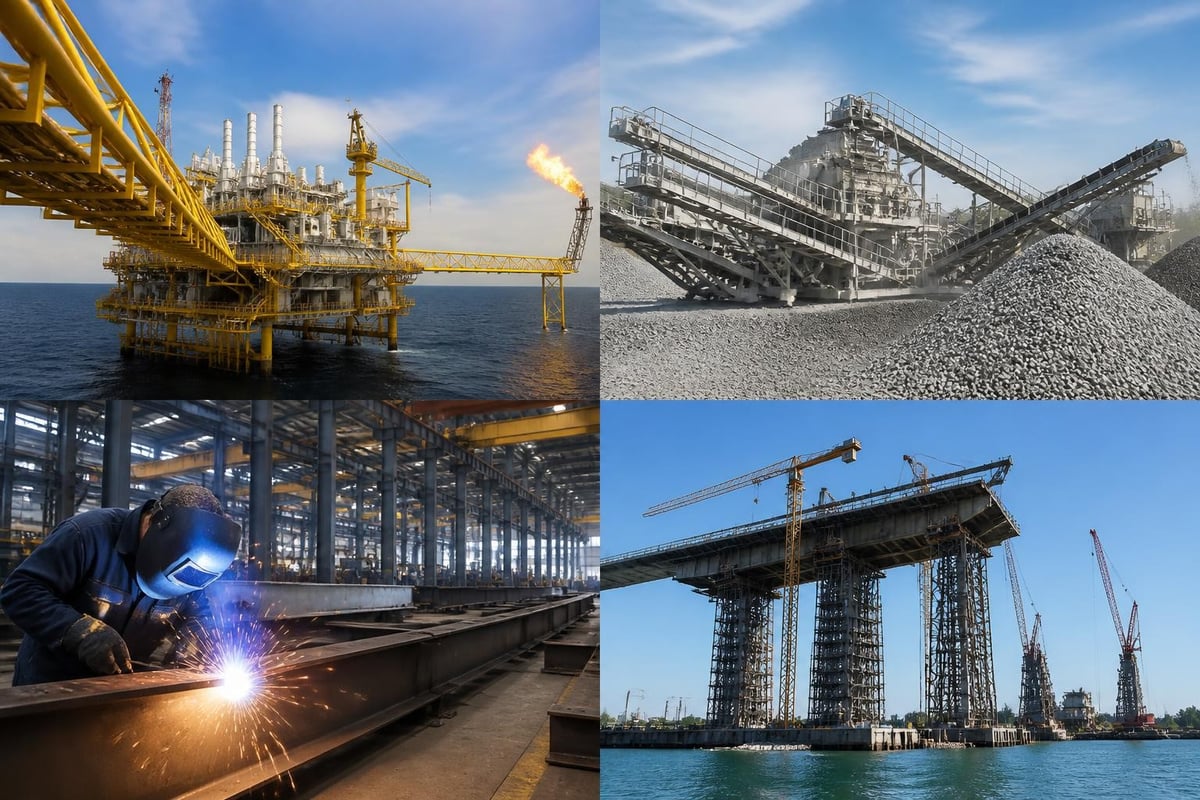
The code's versatility makes it applicable across numerous industrial sectors:
- Oil and gas facilities: Process piping supports, platform structures, storage tank foundations
- Aggregate and mining operations: Conveyor system frameworks, crusher support structures, material handling equipment
- Manufacturing plants: Structural building frames, equipment mounting platforms, crane runway beams
- Transportation infrastructure: Highway bridges, pedestrian walkways, sign structures
Many federal and state agencies have incorporated aws d1 1 by reference into their regulations, making compliance mandatory for public works projects. The Federal Highway Administration approves AWS D1.1 for use in bridge construction, while various other agencies reference it for structural fabrication requirements.
Prequalified Welding Procedures and Joint Designs
One of the most valuable aspects of aws d1 1 is its comprehensive library of prequalified welding procedure specifications (WPS) and joint configurations. These prequalified procedures allow fabricators to begin production without conducting formal procedure qualification tests, provided they strictly adhere to the specified parameters.
Base Metal Requirements
The code categorizes steels into groups based on chemical composition and weldability characteristics:
| Group | Steel Type | Typical Applications |
|---|---|---|
| I | Carbon steels (A36, A572 Gr. 50) | General structural fabrication |
| II | High-strength low-alloy steels | Heavy equipment, high-load structures |
| III | Quenched and tempered steels | Specialized applications requiring enhanced properties |
For projects involving structural steel fabrication, understanding these groupings ensures proper filler metal selection and prevents incompatible material combinations.
Prequalified Joint Configurations
AWS D1.1 provides detailed joint designs for various connection types:
- Complete joint penetration (CJP) groove welds: Full-thickness welds requiring back gouging or backing
- Partial joint penetration (PJP) groove welds: Limited penetration designs for specific loading conditions
- Fillet welds: The most common structural weld type, with size limitations based on base metal thickness
- Plug and slot welds: Specialized connections for overlapping members
The authoritative AWS D1.1 publication contains extensive tables detailing these configurations with specific dimensional requirements, joint preparation angles, and root opening specifications.
Welder and Welding Operator Qualification
AWS D1.1 establishes stringent qualification requirements to ensure personnel competency before production welding begins. These qualifications differ significantly from certifications under other codes and must be maintained according to specific criteria.
Qualification Testing Variables
Performance qualification tests must demonstrate proficiency across essential variables:
- Base metal thickness range: Qualification on a specific thickness qualifies the welder for a defined range
- Welding process: SMAW, GMAW, FCAW, and SAW each require separate qualification
- Position: 1G, 2G, 3G, 4G (groove) and 1F, 2F, 3F, 4F (fillet) designations
- Weld type: Groove welds versus fillet welds require distinct qualifications
A welder qualified in the 3G position (vertical) with SMAW on ½-inch plate gains qualification for thicknesses and positions within prescribed ranges, but switching to GMAW would require a new qualification test.
Qualification validity depends on continuity of work. Under aws d1 1, welders must perform work within their qualified processes at least once every six months to maintain qualification status. Companies employing certified welding services must maintain detailed records documenting this continuity.
Visual Inspection and Testing Criteria
Qualification test welds undergo both visual examination and destructive testing. Visual acceptance criteria prohibit cracks, incomplete fusion, and excessive porosity or undercut. Destructive tests vary by weld type but typically include:
- Guided bend tests (root, face, or side bends depending on thickness)
- Fillet weld break tests
- Macroetch examinations to verify fusion and penetration
These rigorous standards ensure that qualified personnel can consistently produce sound welds under production conditions.
Inspection Requirements and Acceptance Criteria
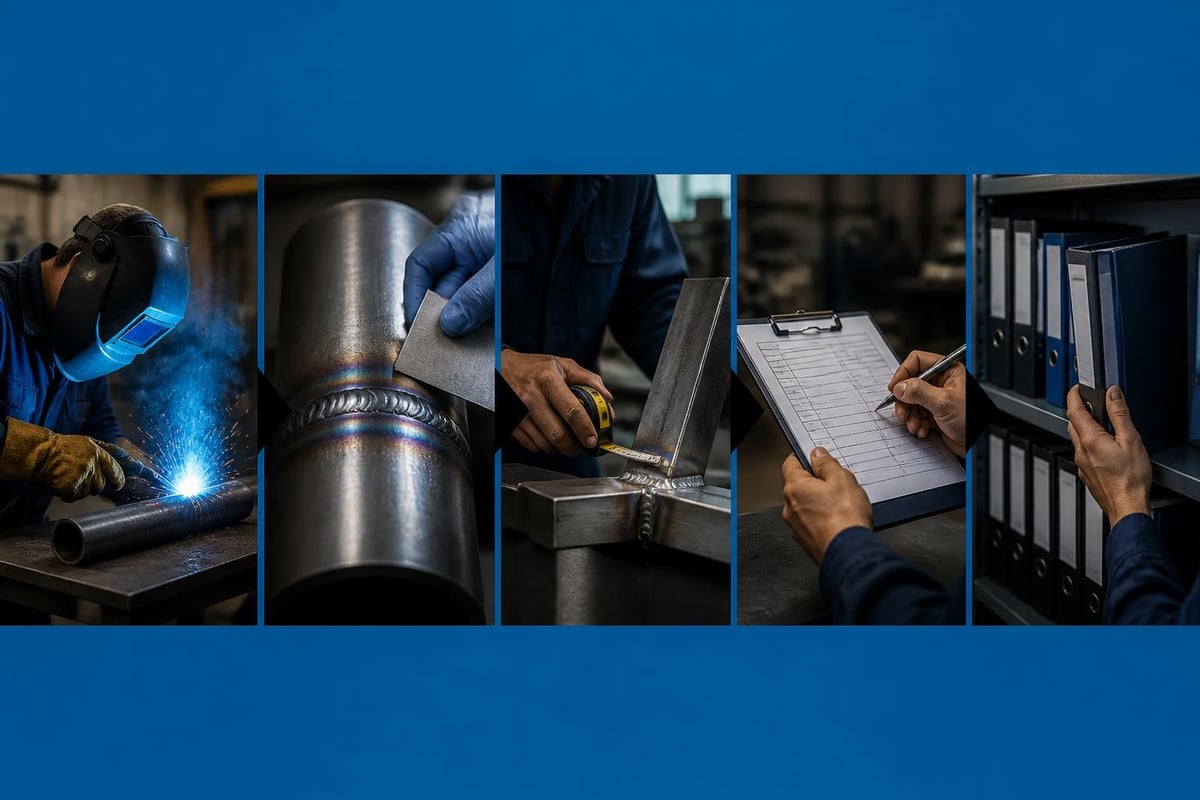
The code mandates comprehensive inspection protocols tailored to the structural criticality and loading conditions of welded assemblies. Understanding these requirements helps fabricators plan quality control programs and allocate resources effectively.
Visual Inspection Fundamentals
All welds receive 100% visual inspection as the primary quality control method. Inspectors evaluate:
- Weld profile and dimensions: Leg size on fillets, reinforcement on groove welds
- Surface discontinuities: Cracks (prohibited), porosity (size and distribution limits), undercut (depth restrictions)
- Weld finish: Overlap, unfilled craters, surface irregularities
For custom fabrication projects, establishing clear acceptance criteria based on aws d1 1 requirements prevents disputes and ensures consistent quality expectations between fabricators and clients.
Nondestructive Testing Methods
Beyond visual inspection, aws d1 1 specifies NDT requirements based on structural category and inspection requirements specified in contract documents:
| NDT Method | Primary Applications | Discontinuities Detected |
|---|---|---|
| Ultrasonic Testing (UT) | CJP groove welds in tension | Internal fusion defects, cracks, inclusions |
| Magnetic Particle Testing (MT) | Surface and near-surface examination of ferromagnetic materials | Surface cracks, shallow subsurface defects |
| Liquid Penetrant Testing (PT) | Non-ferromagnetic materials, surface examinations | Surface-breaking discontinuities, tight cracks |
| Radiographic Testing (RT) | Full-penetration welds, complex joints | Internal porosity, inclusions, incomplete penetration |
The extent of NDT application varies by structural category. Fracture-critical members (those whose failure would result in collapse) receive 100% NDT of CJP groove welds, while non-fracture-critical members may only require spot testing or verification testing at reduced percentages.
International Standards Comparison
For companies working on international projects or with global clients, understanding how aws d1 1 compares to other national codes proves valuable. The Canadian Welding Bureau provides a comparative review between AWS D1.1 and Canadian CSA standards, highlighting key differences in qualification requirements and acceptance criteria. Similarly, TWI's technical guidance explains how AWS codes relate to European EN and international ISO standards, particularly regarding defect classification and quality levels.
Workmanship Requirements and Production Controls
Beyond qualification and testing, aws d1 1 establishes detailed workmanship standards that govern day-to-day fabrication activities. These provisions address material handling, assembly practices, and environmental controls.
Material Preparation and Fit-Up
Proper joint preparation significantly impacts final weld quality:
- Edge preparation: Cutting methods must produce smooth edges free from notches or gouges; thermal cutting requires removal of hardened zones on quenched and tempered steels
- Cleanliness: Rust, mill scale, moisture, and contaminants within one inch of the weld zone must be removed
- Alignment tolerances: The code specifies maximum mismatch between adjacent plate surfaces and angular misalignment limits
These requirements parallel the precision expected in tight tolerance machining operations, where dimensional accuracy directly affects assembly quality and final performance.
Preheat and Interpass Temperature Control
Temperature control represents one of the most critical variables affecting weld metal properties and hydrogen-induced cracking susceptibility. AWS D1.1 provides minimum preheat temperature tables based on:
- Base metal chemistry and thickness
- Welding process
- Hydrogen exposure risk (low-hydrogen electrodes versus standard electrodes)
Typical preheat temperatures for common structural steels:
- A36 material up to ¾ inch thick: No preheat required with low-hydrogen processes
- A572 Grade 50 between 1 and 1½ inches: 150°F minimum preheat
- Quenched and tempered steels over 2½ inches: 225°F or higher depending on specific grade
Maximum interpass temperature limitations prevent excessive grain growth and property degradation in the heat-affected zone. For most structural applications, the code limits interpass temperature to 550°F, though specific project specifications may impose stricter requirements.
Arc Strikes and Temporary Attachments
The code strictly prohibits arc strikes on base metal outside the weld area, as these create localized hardened zones susceptible to cracking under cyclic loading. When temporary attachments (strongbacks, lifting lugs, assembly aids) are removed, resulting surfaces must be ground smooth and inspected to ensure no discontinuities remain that could serve as crack initiation sites.
Documentation and Quality Assurance Programs
Comprehensive documentation forms the backbone of aws d1 1 compliance, providing traceable evidence that all code requirements have been met throughout fabrication.
Required Documentation Elements
Compliant fabrication shops maintain records including:
- Welding procedure specifications (WPS): Prequalified procedures reference the code; qualified procedures include supporting procedure qualification record (PQR) documentation
- Welder qualification records: Test results, qualified ranges, and continuity documentation
- Inspection reports: Visual inspection records, NDT reports with technician certifications
- Material certifications: Mill test reports verifying base metal and filler metal chemistry and mechanical properties
For companies providing ASME certified welding services, maintaining parallel documentation systems for both ASME and AWS requirements requires careful organization and cross-referencing.
Quality Control Personnel Requirements
AWS D1.1 requires that visual weld inspection be performed by qualified personnel designated as Certified Welding Inspectors (CWI), Associate Welding Inspectors (AWI), or individuals who have demonstrated competency through employer-based programs. These inspectors must possess:
- Technical knowledge of welding processes and metallurgy
- Understanding of code acceptance criteria and inspection techniques
- Ability to read and interpret drawings and specifications
- Near visual acuity (corrected or uncorrected) to read 0.030-inch letters at 12 inches minimum
Organizations frequently invest in AWS CWI certification programs to develop internal inspection capability, ensuring personnel can identify non-conformances during production rather than discovering defects during final inspection.

Tubular Structures and Seismic Applications
The code includes specialized provisions addressing unique structural configurations and loading conditions that require enhanced design consideration and workmanship standards.
Tubular Member Connections
Annex sections within aws d1 1 specifically address hollow structural section (HSS) connections, which present unique challenges due to:
- Limited access for welding: Rectangular and circular tubes restrict positioning options
- Load transfer complexity: Concentrated forces at tube-to-tube connections create complex stress patterns
- Crack sensitivity: Connection geometries often create stress concentrations requiring careful detail design
Effective length limits, branch-to-chord width ratios, and connection reinforcement requirements help ensure adequate load transfer capacity and prevent premature failure under service loading.
Seismic Design Provisions
For structures in seismically active regions, aws d1 1 Annex I establishes enhanced requirements including:
- Demand critical welds: Welds expected to undergo inelastic strains during earthquake loading
- Protected zone restrictions: Limits on attachments and penetrations in areas where yielding is anticipated
- Special inspection requirements: Increased NDT coverage and qualification testing
- Toughness requirements: Charpy V-notch impact testing to verify adequate ductility
These provisions recognize that seismic loading creates demand levels far exceeding typical static or even dynamic service conditions, requiring enhanced quality assurance to ensure ductile behavior during major seismic events.
Federal Recognition and Regulatory Incorporation
The widespread adoption of aws d1 1 across federal agencies demonstrates its technical credibility and industry acceptance. Understanding where and how the code has been incorporated helps contractors navigate regulatory requirements on government projects.
The NIST Standards Incorporated by Reference database tracks federal incorporation across various agencies, showing where AWS D1.1 appears in Code of Federal Regulations citations.
Agency-Specific Applications
Different federal agencies apply aws d1 1 in contexts suited to their missions:
- Department of Transportation: Bridge fabrication and repair for federal-aid highway projects
- General Services Administration: Federal building construction and renovation
- Department of Defense: Military facility construction, shipyard structures, and support infrastructure
- Department of Energy: Nuclear facility support structures (in conjunction with other codes)
State departments of transportation similarly reference the code in standard specifications, making it the de facto standard for publicly funded infrastructure projects across most of the United States.
Common Compliance Challenges and Solutions
Even experienced fabricators encounter challenges implementing aws d1 1 requirements, particularly when transitioning from other codes or addressing complex project specifications.
Prequalification Versus Qualification Decisions
Many shops struggle determining when prequalified procedures suffice versus when formal procedure qualification becomes necessary:
Use prequalified procedures when:
- Base metals fall within Groups I, II, or III as defined by the code
- Joint configurations match prequalified designs exactly
- All essential variables remain within prequalified ranges
- No unusual service conditions exist (extreme temperatures, corrosive environments)
Conduct procedure qualification when:
- Base metals outside standard groupings require welding
- Joint configurations deviate from prequalified designs
- Contract specifications impose requirements beyond code minimums
- Mixed thickness combinations fall outside prequalified ranges
For operations providing custom machining services alongside welding, understanding these distinctions helps properly scope projects and allocate engineering resources.
Managing Welder Qualification Continuity
Maintaining welder qualification status presents logistical challenges for shops with variable workload:
- Workload fluctuations: Seasonal industries may experience periods where specific processes aren't utilized
- Process diversity: Shops using multiple welding processes must ensure each welder performs work in all qualified processes regularly
- Documentation burden: Tracking continuity for dozens of welders across multiple qualifications requires robust record systems
Practical solutions include establishing rotation schedules ensuring all qualified welders perform production work in all qualified processes within six-month windows, implementing database systems that flag upcoming continuity expirations, and scheduling requalification tests before expiration rather than waiting for qualifications to lapse.
Balancing Quality and Productivity
Meeting code requirements while maintaining competitive productivity levels requires systematic approaches:
| Challenge | Impact | Solution Strategy |
|---|---|---|
| Excessive repair rates | Schedule delays, cost overruns | Root cause analysis, welder retraining, procedure optimization |
| Inspection bottlenecks | Production delays waiting for inspection | Stagger inspection points, increase qualified inspector availability |
| Material delays | Idle welders, schedule disruption | Procurement planning aligned with production schedule, approved substitute materials identified |
Companies specializing in metal fabrication find that upfront investment in welder training, procedure development, and quality systems reduces long-term costs by minimizing rework and establishing efficient production workflows.
Training and Competency Development
Successful aws d1 1 implementation requires ongoing investment in personnel development, from entry-level welders through senior quality control staff.
Welder Skill Development Programs
Effective welder training extends beyond minimum qualification requirements:
- Process versatility: Cross-training in multiple processes (SMAW, GMAW, FCAW) increases scheduling flexibility
- Position proficiency: Emphasis on overhead and vertical welding for field work applications
- Blueprint reading: Understanding structural drawings, weld symbols, and specification requirements
- Quality consciousness: Teaching welders to self-inspect and identify potential defects during production
Organizations employing skilled welders recognize that investing in comprehensive training programs yields returns through reduced rejection rates, improved first-pass inspection success, and enhanced capability to handle complex projects.
Inspector Certification and Continuing Education
Quality control personnel require different but equally important development:
- Initial certification: AWS Certified Welding Inspector (CWI) credential provides comprehensive code knowledge
- Specialized training: NDT Level II certifications in relevant methods (UT, MT, PT, RT)
- Code updates: Regular training on code revisions and interpretation bulletins
- Practical application: Field experience applying acceptance criteria to actual production conditions
The 2025 edition of aws d1 1 includes numerous revisions from previous versions, making continuing education essential for maintaining current knowledge and proper code application.
Material Considerations and Special Requirements
While aws d1 1 primarily addresses welding procedures and quality requirements, it also establishes important limitations and considerations regarding base materials and consumables.
Filler Metal Selection Criteria
Proper filler metal selection balances mechanical property matching with operational considerations:
- Strength matching: Weld metal must meet or exceed base metal minimum specified tensile strength
- Toughness: Low-temperature service or dynamic loading may require impact-tested filler metals
- Hydrogen control: Low-hydrogen electrodes and proper storage/handling prevent hydrogen-induced cracking
- Position capability: All-position electrodes for field work versus high-deposition flat/horizontal products for shop fabrication
For specialized applications like hardfacing or wear plate installation, understanding how overlay materials interact with structural welds prevents incompatibility issues and ensures code compliance.
Environmental and Service Conditions
The code addresses various environmental factors affecting material selection and welding procedures:
Low-temperature service (below -50°F for ASTM A36, varying by grade for other materials) requires Charpy V-notch impact testing to verify adequate toughness. Base metal specifications must include supplementary requirements ensuring materials retain ductility at service temperatures.
Corrosive environments may necessitate weathering steels, corrosion-resistant cladding, or protective coating systems applied after fabrication. When powder coating or other finishes will be applied, fabricators must ensure weld profiles and surface conditions accommodate coating processes without creating defects or compromising coating adhesion.
Elevated temperature service requires consideration of creep properties and long-term strength degradation, though aws d1 1 generally limits application to normal temperature ranges, deferring to other codes (such as ASME Section I or Section VIII) for pressure vessels and high-temperature piping systems.
Mastering AWS D1.1 requirements enables fabricators to deliver structural steel components that meet rigorous safety and quality standards across diverse industrial applications. Whether your project involves equipment supports, building structures, or specialized fabrication for demanding service conditions, partnering with experienced professionals ensures code compliance and reliable performance. LTJ Industrial Services brings decades of expertise in structural steel fabrication, certified welding, and precision machining to clients throughout the Western United States, delivering quality workmanship backed by comprehensive quality assurance programs aligned with AWS D1.1 and other industry codes.